THE SHORT ANSWER
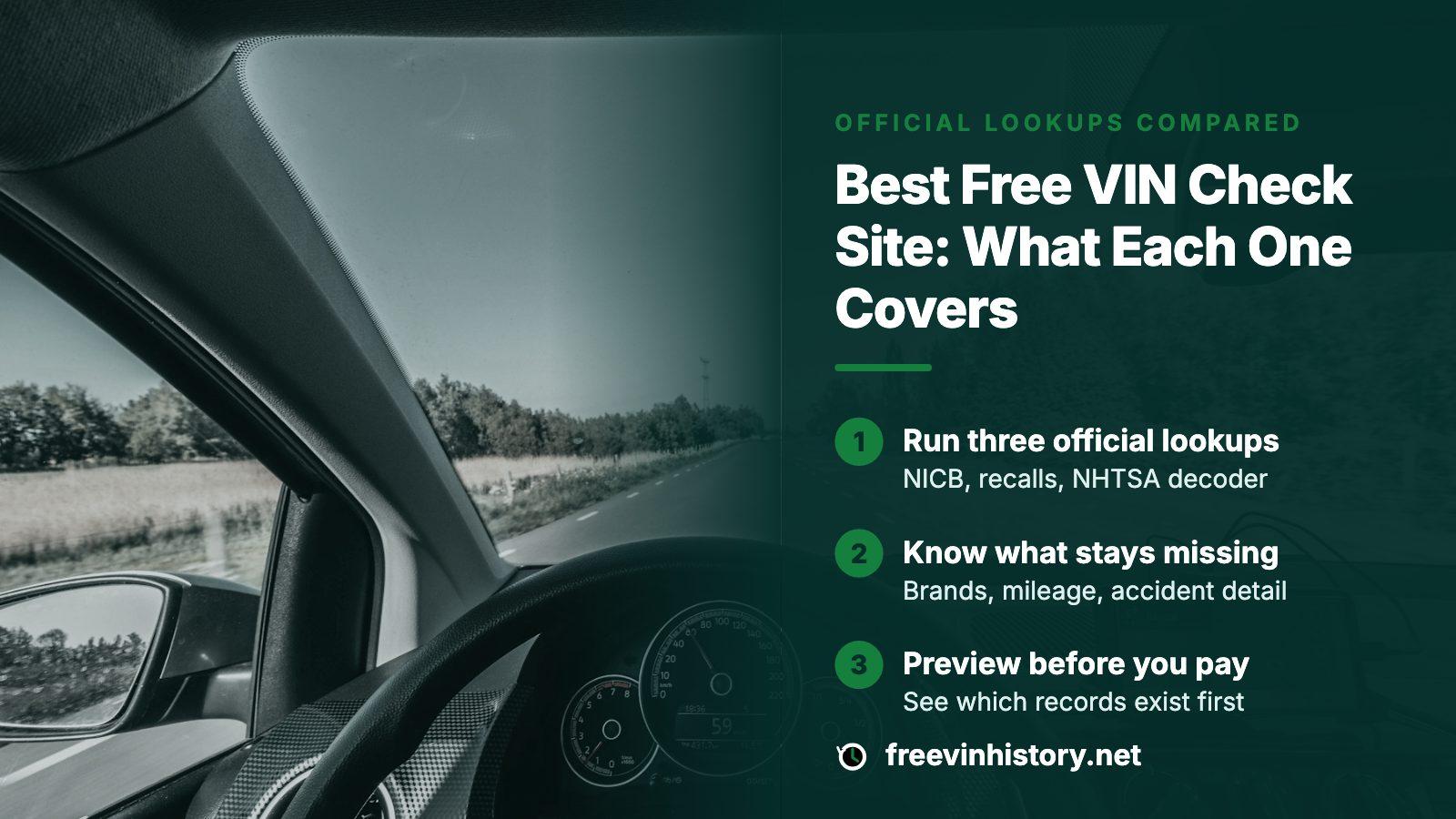
Yes, free VIN checks exist online, and the dependable ones come from NICB and NHTSA rather than from commercial pages. NICB VINCheck flags insurer-reported theft, salvage and flood records, NHTSA lists unrepaired recalls, and NHTSA's decoder returns what the maker built. Between them they miss title brands, mileage history and most accident detail. Run all three, then use a free preview to see what records exist before paying for a full report.
- Free official lookups
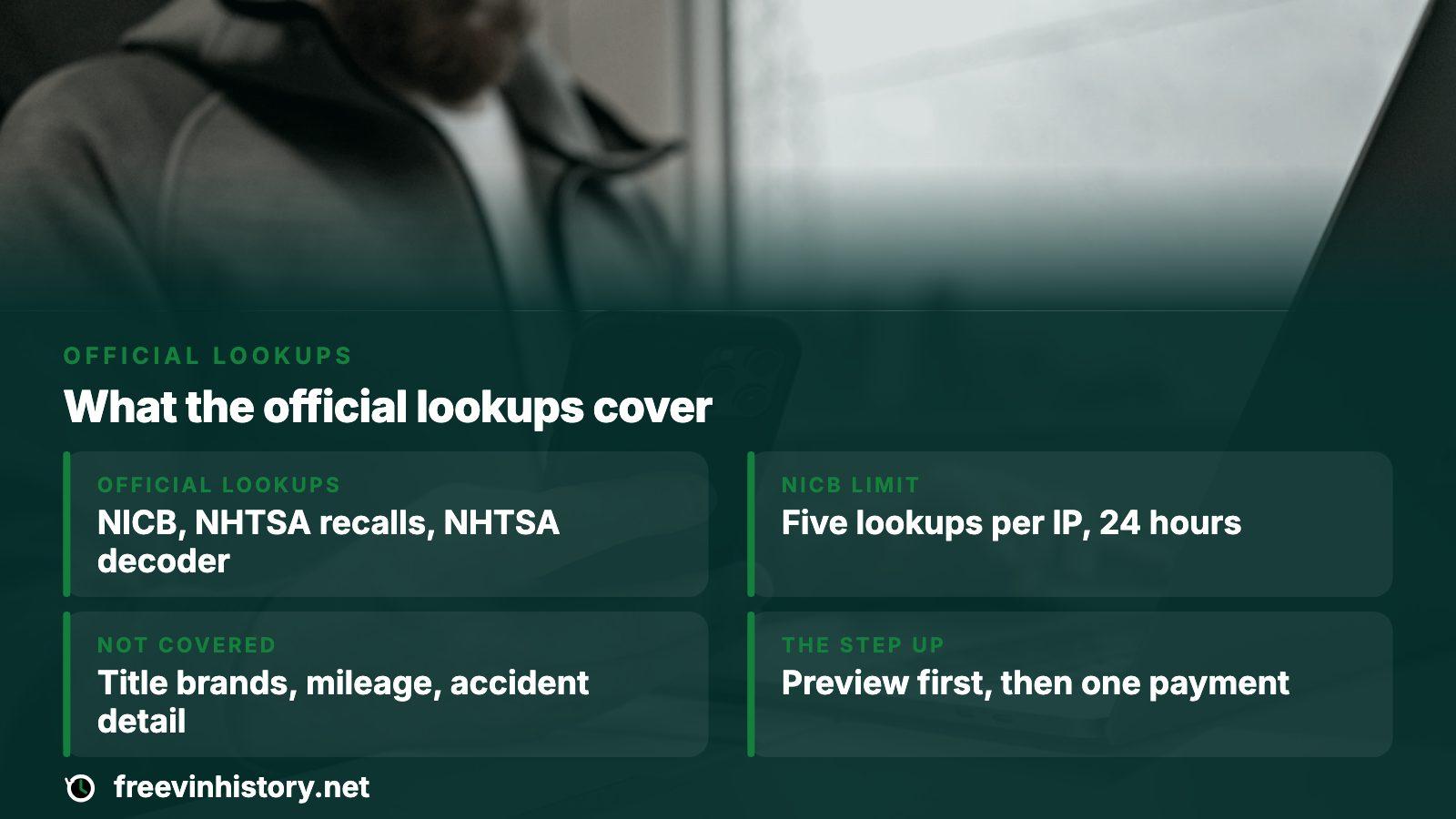
- NICB VINCheck, NHTSA recall search, NHTSA VIN decoder
- NICB limit
- Five lookups per IP address in any 24 hours
- Missing from the free layer
- Title brands, mileage history, accident detail
- The step up
- A free preview first, then one payment for the report
Why no single free site wins
Anyone typing "best free VIN check site" into a search box hopes for one page that returns an entire history. No such page exists, and the cause is the data, not the websites. NHTSA holds recalls and factory build details. NICB holds theft, salvage and flood flags, drawn from records its member insurers submit. Title entries sit in a federal system with its own access route. At best, a site topping the results shows one of those pieces.
So the useful question is which free lookups to run, and in what order. Three official ones belong on every buyer's list.
The three free lookups, side by side
| Lookup | Run by | What it answers | What it cannot tell you |
|---|---|---|---|
| VINCheck | NICB | Stolen-and-unrecovered, salvage or flood flags from member insurers | Anything no insurer submitted, police records, insurers that opted out |
| Recall search | NHTSA | Whether a recall on that VIN is still unrepaired | Recalls already fixed, most recalls over 15 years old, small makers |
| VIN decoder (vPIC) | NHTSA | The model year, body, engine and build plant the manufacturer reported | Condition, owners or history; vehicles from before 1981 |
None of the three charges for a lookup. The catch is scope: each answers one question about one VIN, and a quiet answer from one says nothing about the other two.
What a free VIN check website usually is
Strip away the branding and a free VIN check website is a page with a VIN box that answers without charging. Where the page is commercial, it tends to give a first screen at no charge and sell the detail, which fits NICB's note that most full history reports cost money. That is fair when the page says so before you type anything, and a trap when the price shows up only after you have handed over an email address.
NICB draws the same line on its own lookup page: the tool stops at insurer flags, and outside vendors are listed for full reports that may need a purchase. The Justice Department's list of approved title-record sellers is likewise a list of businesses, with no prices on the page.
Six checks that rank a free VIN site
Hold an unfamiliar site against this list before entering anything.
- It names its sources. Cited agencies or datasets beat talk of records in general.
- It shows what is on file before asking for payment. Counts, or a plain statement of what the paid part adds, beat a teaser that hides everything.
- It displays a result without a card. The FTC notes that a free trial usually takes a card number so the seller can bill you if you miss the cancel date.
- Its terms are easy to find and say whether a charge repeats. The FTC says to skip an offer whose terms you cannot find, and to watch for pre-ticked boxes that permit more charges or data sharing.
- It admits what it cannot see, such as damage nobody reported.
- Its output is more than a decode. Year, make and engine alone mean you ran a decoder, which NHTSA offers directly.
A free-first order for one VIN
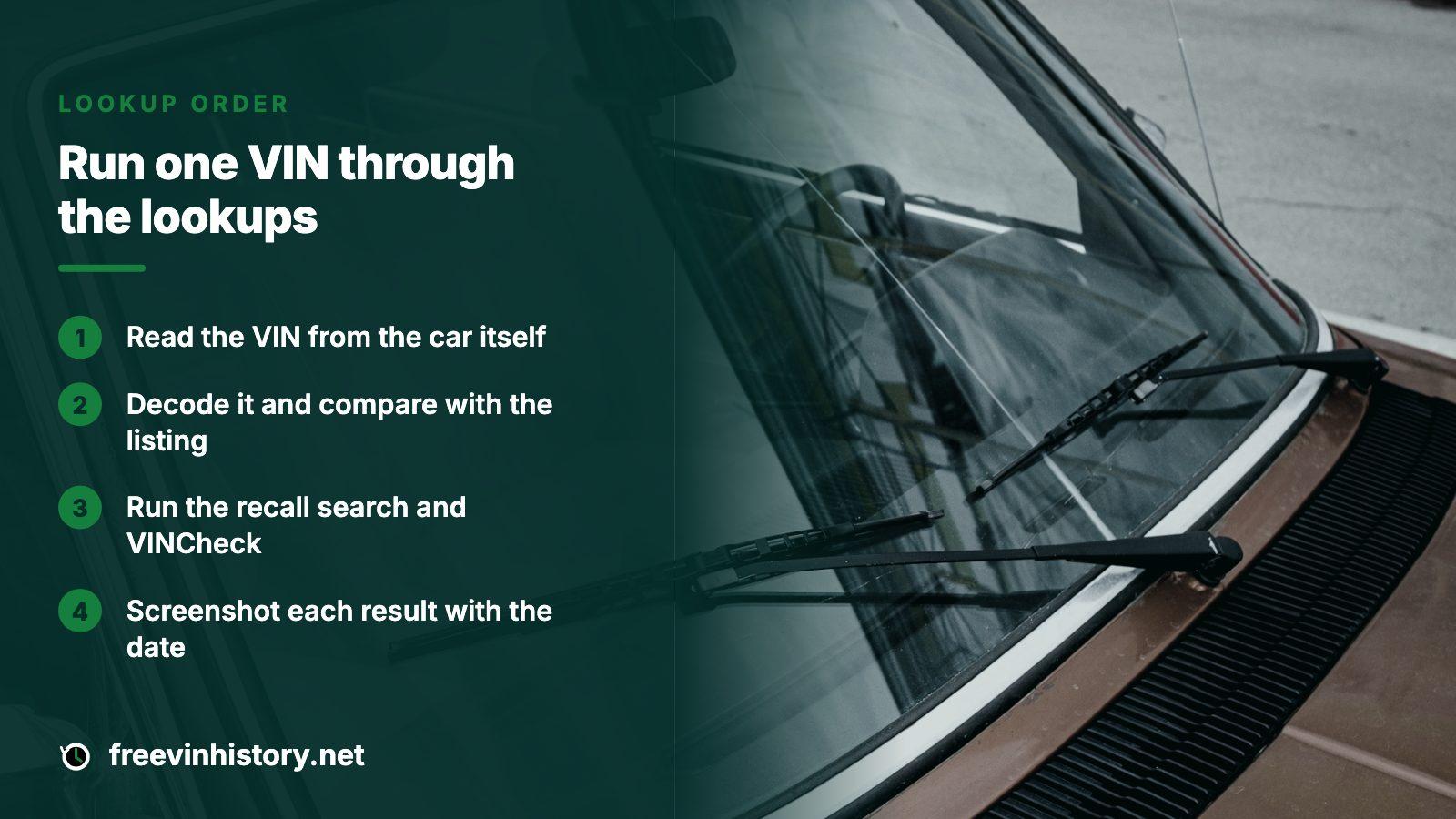
- Take the number from the car itself instead of the advert. NHTSA names the windshield's lower left, and the registration card shows it too. A listing's number is only the seller's word.
- Decode it in vPIC. If the model year, body or build plant disagrees with the listing, settle that first. Coverage starts at 1981. An empty field signals missing data at NHTSA, not a missing feature.
- Run the NHTSA recall search. Dealers fix open recalls without billing the owner, so a hit gives you bargaining room more than a reason to walk.
- Run NICB VINCheck. It needs the exact 17-character VIN, and one IP address gets five lookups a day, which matters when you compare a shortlist from one connection.
- Screenshot each result with the date. Recall lists update continuously, so an old screenshot ages quickly.
Why a clean free result is narrower than it feels
Each lookup states its own edge. NICB's database reflects insurers that write 92.49% of earned U.S. premium, an August 2026 figure, and it holds insurance records only. It does not query law enforcement files or insurers that opted out. NICB itself says a car could be stolen or badly damaged with nothing showing.
Clean does not mean clear
NICB notes that a flood car can keep a clean title when its owner never filed a claim, and that thieves sometimes put a VIN copied from a legitimate car onto a stolen one. A free lookup sees neither. When the price, the paperwork or the seller's story feels off, add a title search and an independent inspection, which NICB lists among its protection steps.
The recall search has gaps too: repairs already done, brand-new recalls not yet attached to every VIN, and makers outside its coverage.
Where the free layer ends
No free lookup shows the state title record: where the car was last titled and when, any brands, an odometer reading, and whether an insurer or salvage yard took it as a total loss. Those entries live in NMVTIS, the federal title system that insurers, salvage yards, recyclers and state titling offices must report to by law. The Justice Department calls a consumer report from it deliberately short, built on five indicators, and says an empty one is good news.
Auction and service records come from private sources, which is why commercial reports exist. The FTC adds a limit that covers every report, free or paid: a history will typically not list mechanical problems, so it cannot replace a mechanic's inspection.
The free preview, and then the report
FreeVINHistory sits after the official lookups, not in place of them. Its preview takes a VIN and returns the car's basic identity, photos where records have them, and counts of what is on file, such as recalls and title or auction entries. It costs nothing and shows whether anything is worth paying to read.
The full report is a single payment, not a plan. Buy one for the car in front of you, or step up to 3, 5 or 10 reports for a longer shortlist. Nothing renews, and current prices live on the pricing page. What it adds is the record the free tools cannot reach: title brands, odometer entries, damage and accident records, and photos from salvage auctions.
When buying the full report makes sense
The free route is enough to eliminate cars and confirm a basic identity. It is not enough to justify a deposit. Run the report when one specific car is left on your shortlist and the free lookups came back quiet, since a quiet result is where gaps hide. Run it sooner when the car comes from another state, the price sits well under similar listings, or a flood or total loss is part of the story.
Do it before the deposit, while a finding can still move the price, and book an inspection either way.
Where this information comes from
- NICB: VINCheck lookup — The insurer-fed theft, salvage and flood lookup, its daily limit and its own stated gaps.
- NICB: Buying a used vehicle — Why flood cars and cloned VINs can slip past a clean-looking record.
- NHTSA: Check for recalls — What the VIN recall search returns and what it leaves out.
- NHTSA: vPIC VIN decoder — The decoder's model year range and its reliance on maker-reported data.
- U.S. Department of Justice: Understanding an NMVTIS report — The five indicators a federal title report covers and who must report into it.
- FTC: Buying a used car from a dealer — Why a history report never replaces an independent inspection.
- FTC: Free trials and auto-renewals — What to read in the terms before accepting any free offer that asks for a card.
Sources and photos: Facts checked against the sources above in November 2026. Photos by Sander Jeurissen, Max Tokarev and Anastasiia Nelen on Unsplash; diagrams by FreeVINHistory.
Keep reading
- Free vehicle history report: what the free sources showA longer walk through the free official sources and what each result means.
- Free stolen car check online: what each lookup coversHow the free theft lookup works and what it leaves out.
- Sample reportA finished report to read before deciding whether to buy one.
- PricingSingle reports and packs of 3, 5 or 10, one payment each, no subscription.
Frequently asked questions
Which free VIN check site is best?
None wins alone. NICB's VINCheck, NHTSA's recall search and NHTSA's decoder each cover a different slice, and running all three beats relying on one commercial page. None shows title brands or mileage history, so add a full report once you are close to buying.
Are there free VIN checks online?
Yes. NICB VINCheck, the NHTSA recall search and the NHTSA VIN decoder all cost nothing. Commercial sites may also show a free first screen, with the detail behind a payment. Read what a page says it returns before entering a card, and skip any that wants one just to display a result.
What is a free VIN check website?
A page with a VIN box that returns something without charging, usually decoded manufacturer data and sometimes a record summary. Agencies such as NHTSA and NICB run some. Commercial pages leading into a paid report run others. Tell them apart by whether the page names its sources and states what the paid part adds.
Can you rely on a free VIN check when buying a used car?
It can rule cars out, not approve one. The free lookups miss unreported damage, title brands, mileage history and anything an insurer did not submit, and NICB says its tool should not be relied on alone. For a car you intend to buy, add a full report and a mechanic's inspection.
Do free VIN checks work for every vehicle?
Not equally. NHTSA's decoder targets 1981 and newer vehicles built for the U.S. market, and its recall search skips most recalls over 15 years old, small makers and foreign-market cars. NICB covers insured U.S. vehicles plus some motorcycles and watercraft. Older, imported or low-volume vehicles return thinner results.
Now check the car itself
The guide explains what to look for. The report shows what this VIN has on record.