THE SHORT ANSWER
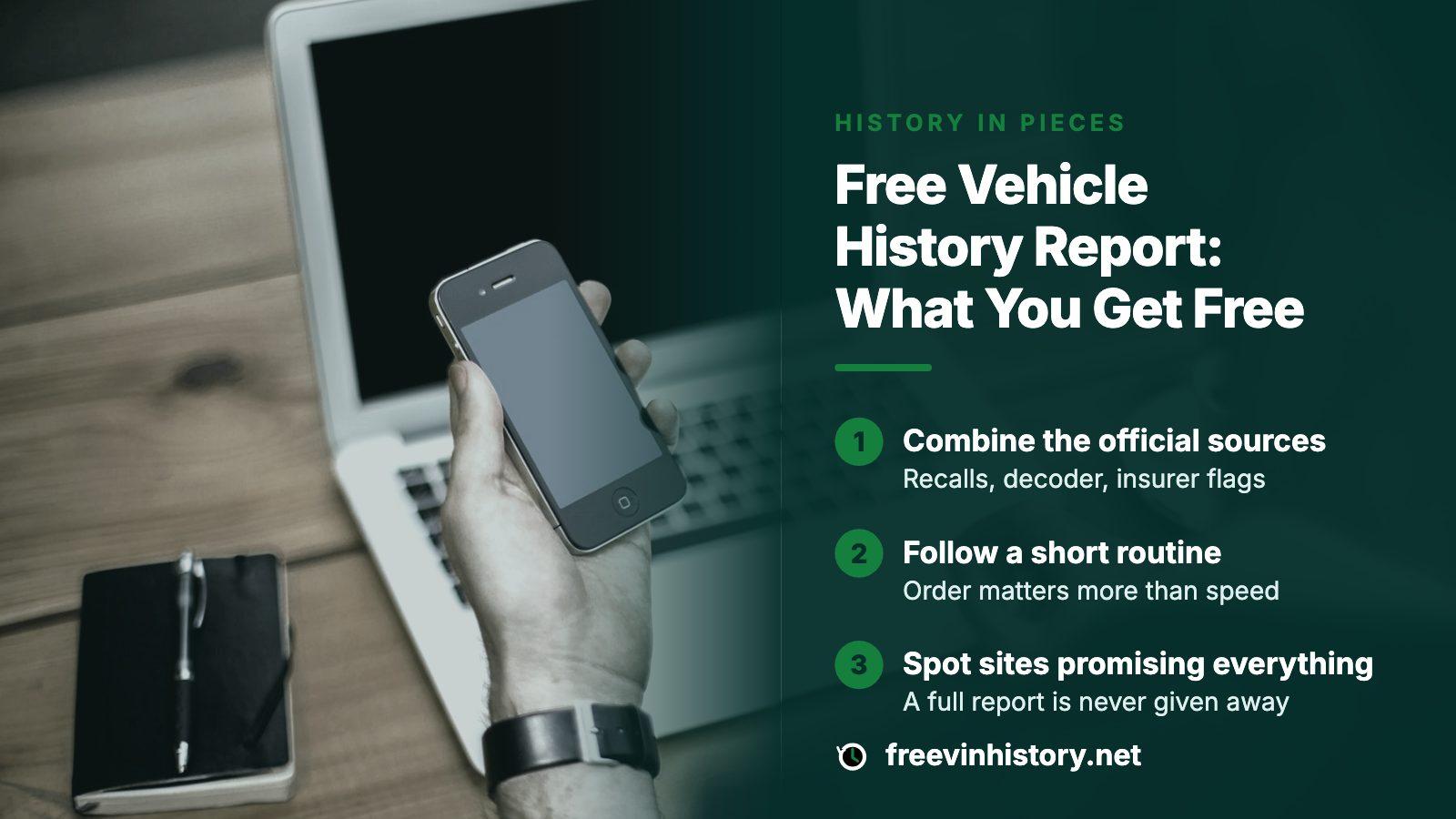
In parts, yes. NHTSA's recall search and VIN decoder need no account, while NICB's VINCheck flags theft and salvage reports, capped at five searches a day per IP address. Together they cover open recalls, factory specs and insurer-reported theft or total loss. They do not show title brands, accident records or mileage history. Run them first, then put the VIN into the preview to see how many records are on file before deciding on the full report.
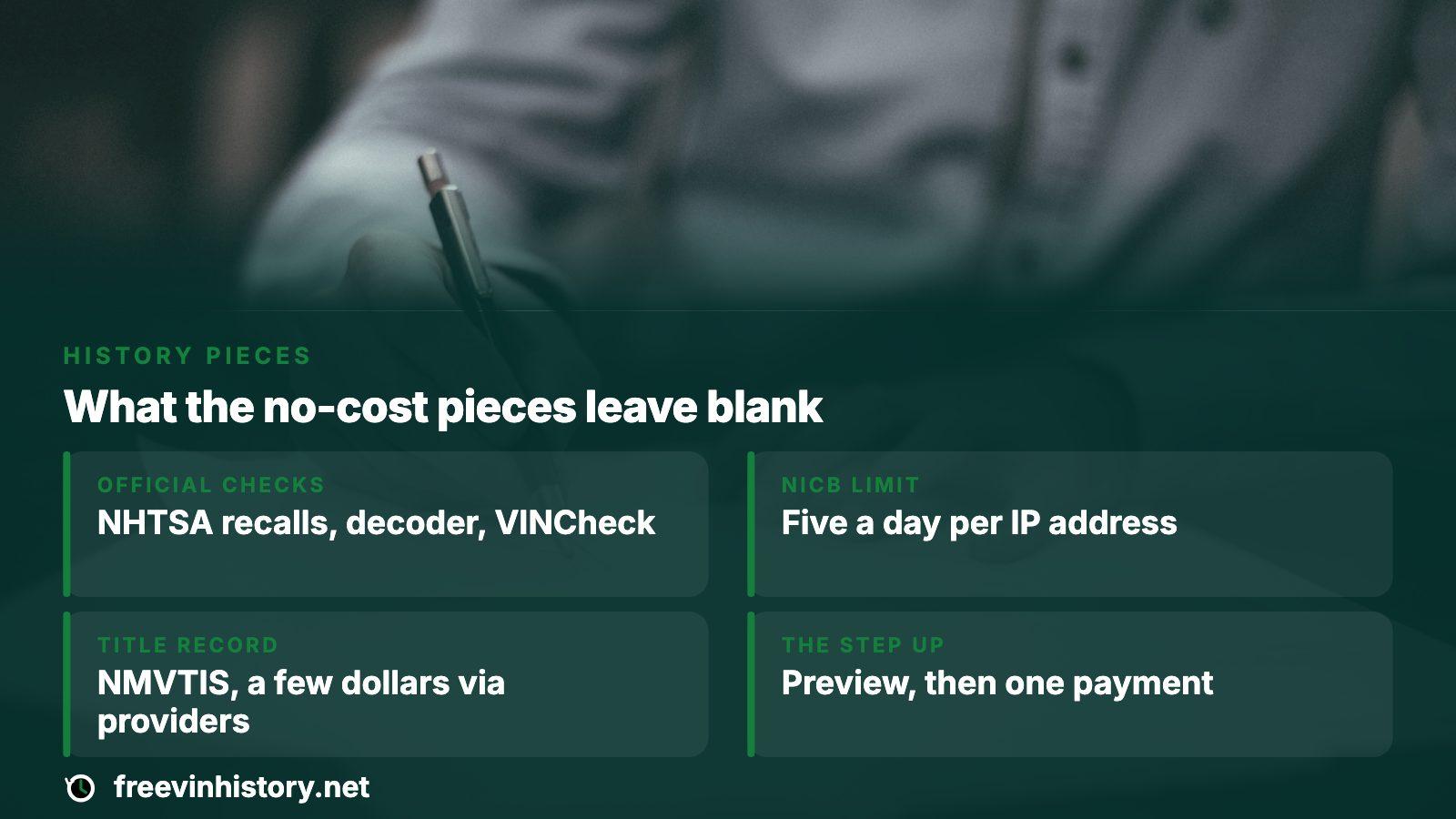
- Free official checks
- NHTSA recalls, NHTSA VIN decoder, NICB VINCheck
- NICB limit
- Five a day per IP address
- Title record
- NMVTIS, a few dollars through approved providers
- The step up
- Free to preview, one purchase for the complete report
Why free vehicle history comes in pieces
A vehicle history is not one database. It is a handful of records held by different bodies, and the ones that publish theirs openly are government agencies and one insurance-funded non-profit. That is why a free vehicle history report in the USA turns out to be a short list of lookups rather than one document.
Each lookup answers one narrow question about the exact VIN: is a safety recall still open, what did the factory build, did a participating insurer report the car stolen or written off. Records collected commercially, such as accident detail and ownership, are sold by whoever assembled them. Knowing where that line sits shows which gaps remain once the free checks are done.
The free sources, side by side
| Source | What it returns | Limits |
|---|---|---|
| NHTSA recall search | Safety recalls on that VIN that are still unrepaired | None on searches, no account |
| NHTSA vPIC decoder | Year, make, model, body, engine, drivetrain, assembly plant | None on searches, no account |
| NICB VINCheck | Theft not recovered, or salvage, as reported by member insurers | Capped at five a day per IP address, members only |
| NHTSA complaint database | Owner complaints by make, model and year, with crash, fire and injury flags | Describes a model year, never one car |
| NMVTIS via approved providers | Brands on the title, plus the mileage written down when ownership changed | Not free: a few dollars per report |
The first four cost nothing. The title record in the last row is the one inexpensive exception, and the providers approved to sell it are listed on the Department of Justice's NMVTIS site.
A five-minute routine, in this order
Order matters because each early step can end the search cheaply, before anyone drives out to see the car.
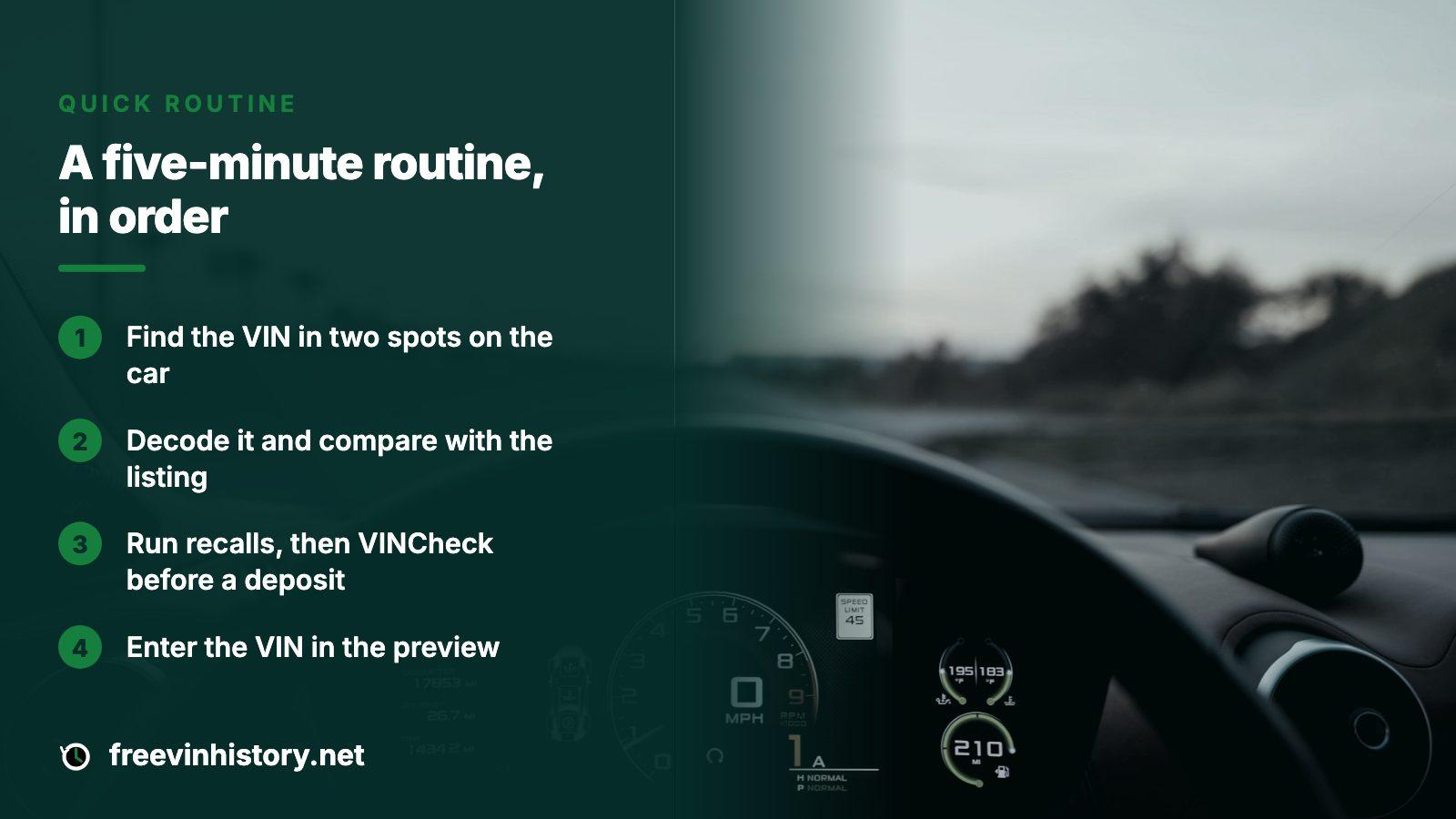
- Find the VIN on the car in two spots, the dash under the glass and the driver's doorframe, and photograph both. The number in an ad is the seller's word; the car's own plate is the evidence.
- Decode it with NHTSA's vPIC. If the engine, body or year differs from the listing, settle that before anything else.
- Run the NHTSA recall search. Open recalls are repaired at no cost to the owner, so a hit is a bargaining point rather than a deal-breaker.
- Enter the VIN in NICB VINCheck before a deposit changes hands on a private sale. Mind the five-a-day cap if you are comparing several cars.
- Enter the VIN in the FreeVINHistory preview to see the photos and record counts on file.
What the free results mean, and the red flags
- Specs that disagree with the ad: either the VIN was copied wrong or the car is not what was described. Stop and sort that out first.
- An open recall: ask for the repair before the sale closes.
- A theft record that is still open: walk away and hand over no deposit.
- A salvage flag: the car was declared a total loss at some stage and may have been repaired and retitled since. Look at the title brands before going further.
- A complaint pattern for that model year in a part you cannot inspect: a reason to consider a different car, not a verdict on this one.
A clean result is narrower than it looks
NICB comes back empty when no participating insurer submitted a record. That differs from nothing having happened to the car. Damage repaired without a claim, or logged by a non-member insurer, can sit behind an empty result.
What the free sources leave blank
After the official checks, these questions are still open. Each has a home in the full report.
| Still unanswered | In the full report |
|---|---|
| Was the title ever branded, and where? | Title brands |
| Was there an accident, and how bad? | Accident and damage records |
| Did the mileage climb consistently? | Odometer readings |
| Did it pass through an auction or salvage sale? | Salvage and auction records with photos |
| Does a lender or impound lot have a claim? | Liens and impounds |
| How was it insured, owned and used? | Insurance records, ownership and use type |
| What is it worth today? | Market value |
Theft records and open recalls appear in the report too, so it repeats what the free checks cover and adds what they cannot.
The free preview: counts before you pay
FreeVINHistory puts a preview between the official checks and the paid report. Put a VIN in and the preview answers with the year, make, model and trim, plus photos if any exist, how many recalls are open, and counts of title and auction entries. No card is requested.
The counts are the useful part. A title or auction count above zero says records exist and deserve a full read before you agree a price. A count of zero narrows the question without closing it, because no check can see damage that nobody reported. The records themselves belong to the full report.
Other ways to see a history without paying
- Ask the dealer. A report is often already on file for a car on the lot, and it costs nothing to ask.
- Ask a private seller whether they already bought one. Match the VIN on the page to the car and check the date it was run.
- Certified pre-owned programs sometimes include a history report with the car.
- Your insurance agent may be able to run a check on a car you are considering.
- Some public libraries give cardholders access to commercial databases.
- A few states publish a registration-status checker. Registration status is not a title record, and title records normally cost money.
A report from a seller is only as good as its VIN and its date.
Warning signs on sites promising a full free report
Accident and ownership data is licensed, so a site advertising a complete history for nothing is usually doing something else. The patterns repeat:
- A summary that hides the detail until you pay. Legitimate, provided the page says so up front.
- A request for card details before it shows what the report covers.
- A trial that turns into a recurring charge under terms placed where few people look.
- Your email address or phone number being the real product.
- A plain decode dressed up as a history.
Check the scope first
A legitimate paid report spells out its contents ahead of payment. If the contents are explained only afterward, stop.
What the full report costs and when to buy it
Nobody pays to view the preview. The full report is its own one-time purchase, available singly or in multi-report packs of 3, 5 and 10 for shoppers sizing up several cars. It never renews and no subscription is attached. Prices are shown only on the pricing page.
Buy when the free checks and the preview have left one specific car on your list, and do it before the deposit, while the findings can still change the price or end the deal. Book an independent inspection either way, since some repairs never reach any record.
Where this information comes from
- NHTSA: Check for recalls by VIN — The federal search for unrepaired safety recalls, with no account needed.
- NHTSA: vPIC VIN decoder — Where the factory build record for a VIN is decoded at no charge.
- U.S. Department of Justice: NMVTIS — The federal title system and the list of providers approved to sell consumer reports.
- NICB: VINCheck — The insurer-fed theft and salvage lookup and its daily search limit.
Sources and photos: Facts checked against the sources above in November 2026. Photos by Alejandro Escamilla, Dennis Eusebio and Scott Graham on Unsplash; diagrams by FreeVINHistory.
Keep reading
- Free Carfax report: what the free checks show and when to step upWhy a free copy of a big-name report usually means someone else already paid.
- NMVTIS report: what the federal title record shows and missesThe federal title record, and what a few dollars buys through approved providers.
- Sample reportA finished report to read through before you decide to buy one.
- PricingSingle reports and packs of 3, 5 or 10, one payment each, no subscription.
Frequently asked questions
Is there a completely free vehicle history report?
Not a complete one. The free sources cover open recalls, factory specifications and insurer-reported theft or salvage, and the FreeVINHistory preview adds record counts at no cost. Title brands, accident detail and odometer readings sit in the full report, a one-time payment. A site claiming a full history for nothing is hiding a paywall or collecting your details.
Can I get a free car history report by VIN with no account?
Three checks need no account: the NHTSA recall search, the NHTSA VIN decoder and NICB VINCheck. NICB caps each IP address at five lookups daily. Together they return open recalls, factory build data and theft or salvage flags, not accident or mileage history. The FreeVINHistory preview asks for no card either.
Does the free preview show accidents?
No. What comes back is the basic vehicle identity, any photos, the open recall number, and counts of title and auction entries. A count above zero tells you records exist. The accident and damage records themselves, along with title brands and odometer readings, are in the full report.
Will a dealer give me a vehicle history report for nothing?
Often, on cars from their own stock, but treat it as a favor rather than a given. Check that the VIN on the printout matches the car and look at the date, because an old report cannot show anything recorded since. A dealer who will not show one has still told you something.
Do the free vehicle history checks cover every state?
The federal ones do: NHTSA recalls and decoding, NICB's insurer database and the NMVTIS title system are national. State tools vary, and a state title record usually costs money. NMVTIS was built so that a brand given in one state follows the car across state lines.
Now check the car itself
The guide explains what to look for. The report shows what this VIN has on record.