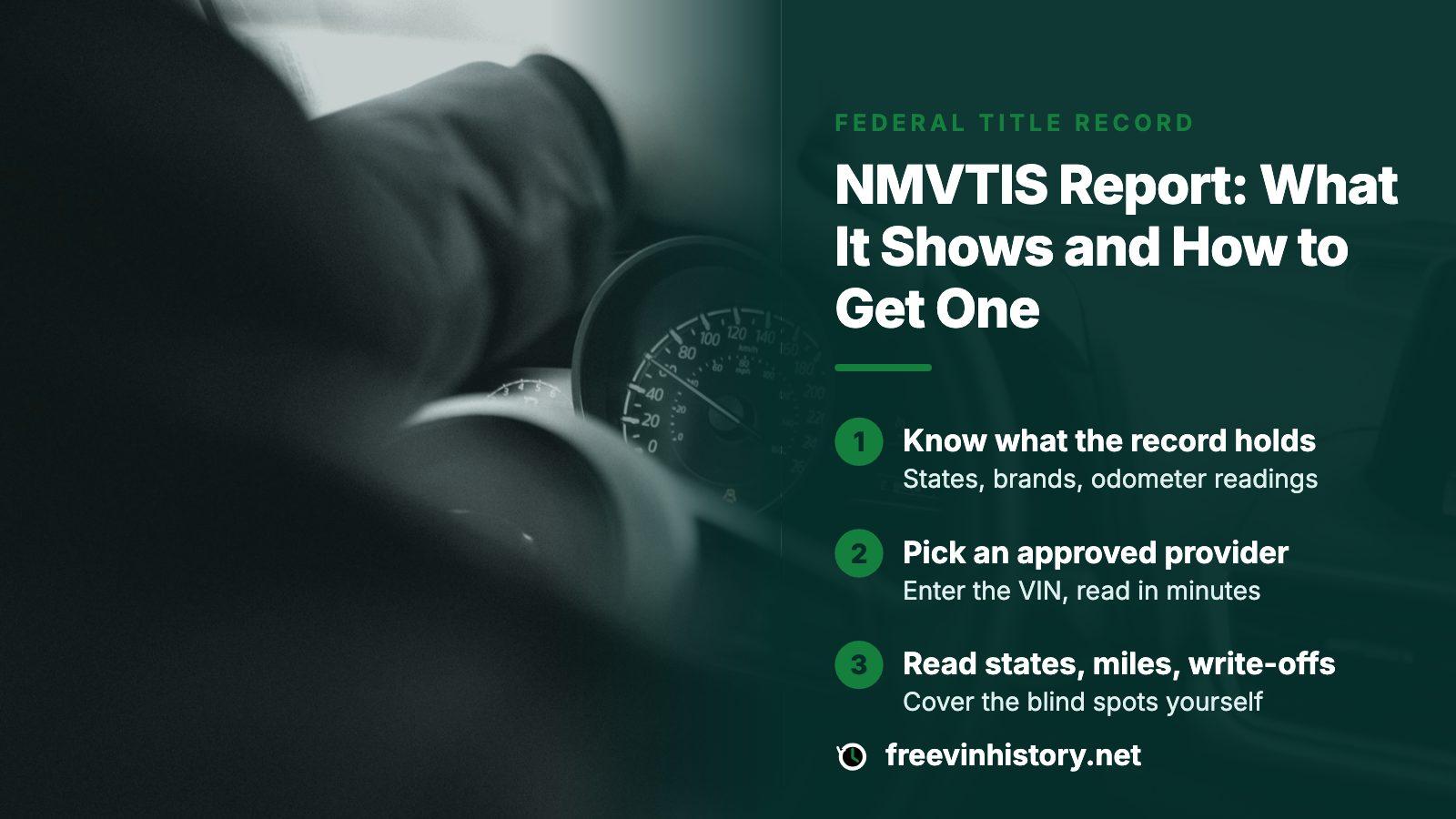
THE SHORT ANSWER
An NMVTIS report is a vehicle's federal title record: the states that titled it, brands, junk and salvage reports and odometer readings from title events. Approved providers sell it, the Justice Department publishes their list, and a report typically costs a few dollars. It will not show repaired damage nobody reported, maintenance, recalls, theft or earlier owners' names, so pair it with the official checks that cost nothing.
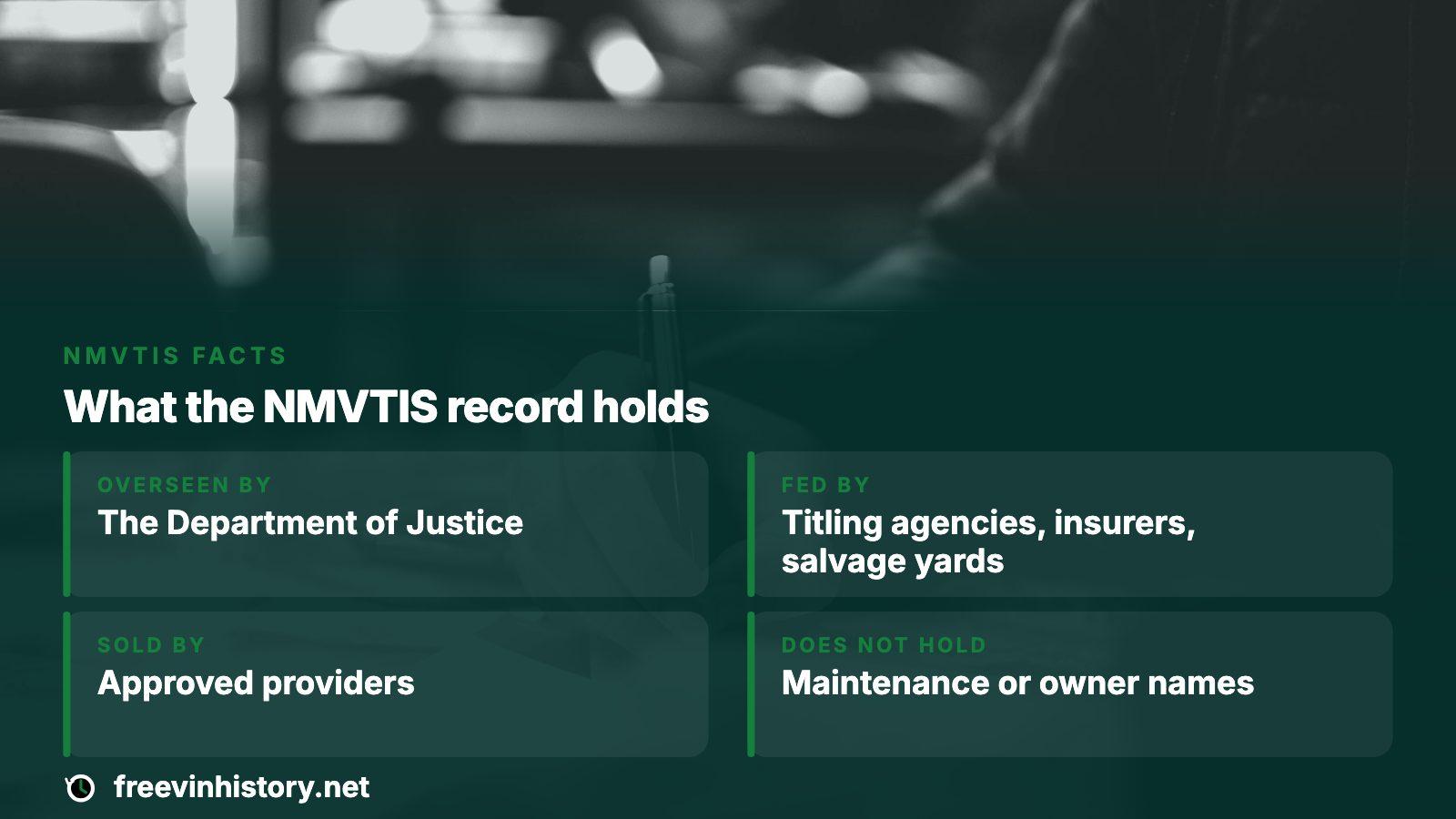
- Overseen by
- The Department of Justice
- Fed by
- State titling agencies, insurers, salvage yards
- Sold by
- Approved providers, for a few dollars
- Does not hold
- Maintenance, unreported damage, owner names
The official lookups to run before you pay anyone
A used-car check has a no-charge tier and a paid tier, and the NMVTIS report belongs to the second. Start with the first.
| Lookup | Run by | What it answers |
|---|---|---|
| Recall search | NHTSA | Whether a safety recall on this VIN is still open |
| VINCheck | NICB, an insurance-industry non-profit | Whether member insurers reported the car stolen and not recovered, or salvage |
| Approved-provider list | Justice Department | Which businesses may sell you the title record |
None of these asks for payment. Between them they can end a purchase early: an open theft record means walk away, and a recall the seller skipped is a talking point.
What the NMVTIS title record adds
None of those lookups says how the car has been titled. NMVTIS does. Its full name is National Motor Vehicle Title Information System, it is overseen by the Department of Justice, and it is fed by state title offices, insurance carriers and salvage operators. A report from it contains:
- The states that have titled the car, in order.
- Brands such as salvage, flood, junk and rebuilt.
- Odometer readings noted at title events.
- Total-loss determinations reported by insurers.
- Junk and salvage reports from yards and recyclers.
Filing is mandatory, and that is the record's strength. A brand issued in one state still reaches the national file even when no commercial report company ever bought that state's data.
Getting the report: provider list, VIN, a few minutes
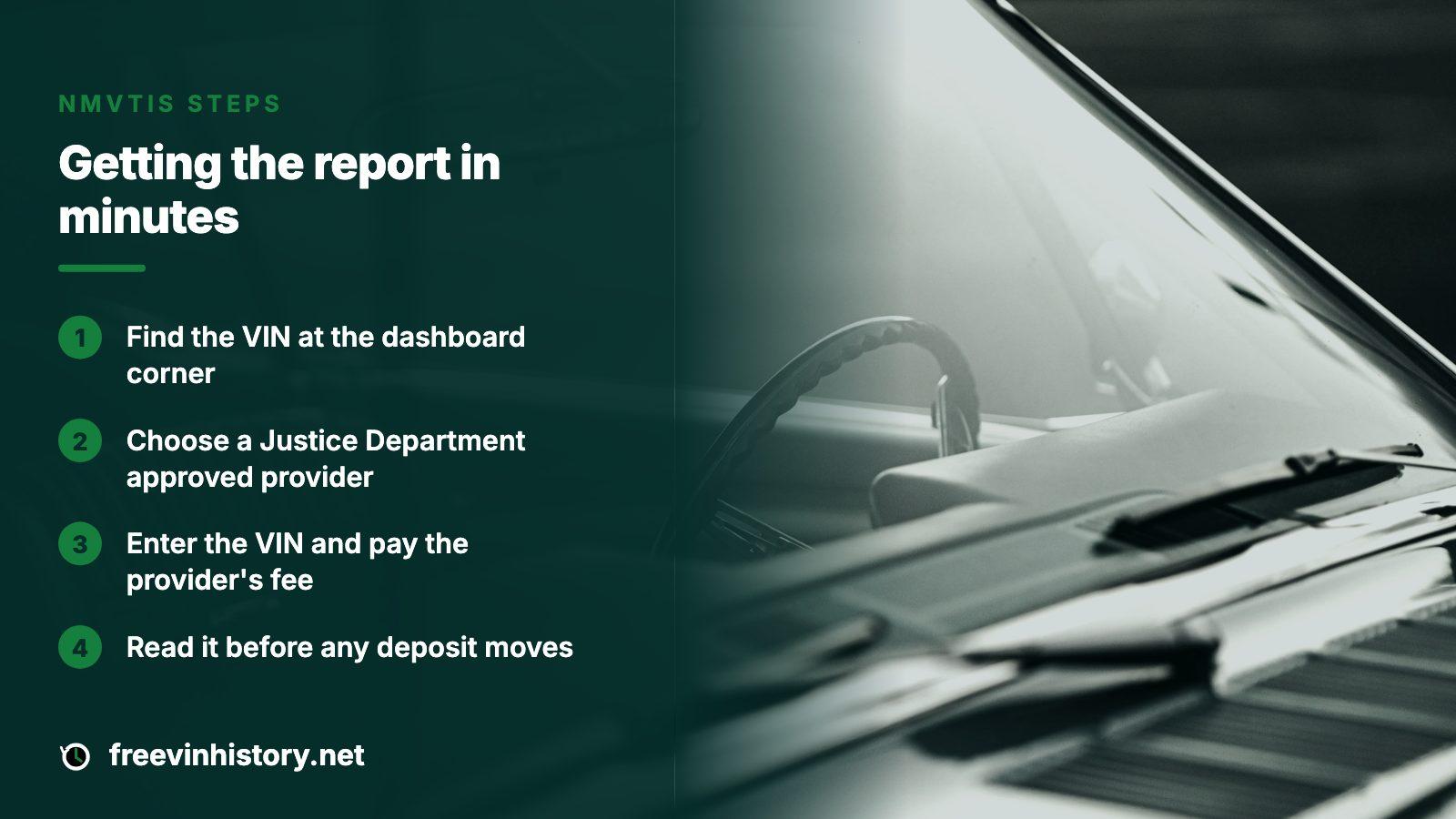
- Find the VIN on the car: at the lower corner of the dashboard, visible through the windshield, and on the label in the driver's doorjamb. Photograph both and compare them with the paper title.
- Choose a business from the Justice Department's approved-provider page. Some providers run affiliated brands, which appear beneath them.
- Enter the 17-character VIN and pay that provider's fee. Reports usually arrive in minutes.
- Read it before any deposit moves.
Skip anything advertised as a free NMVTIS report. The government runs no consumer portal, so the provider's fee is the price of the record. One paid lookup on the car you are about to buy beats ten on listings you are only browsing.
Reading the title chain: states, then miles, then write-offs
- States first. Every move across a state line is a question: why did the car leave, and who took it?
- Miles next. List the title-event readings by date. They should climb. A figure below the previous one is paper evidence of a rollback, so ask for an explanation in writing or pass.
- Then write-offs. An insurer's total-loss entry with no matching brand on the title is the usual shape of a washed title. Value the car as if the brand existed.
Clean is not the same as safe
A quiet report means nothing was filed, not that nothing happened. Repairs paid out of pocket never reach the system.
The write-off that was never paid out
Insurers must report a car they decide is a total loss even if the claim is never settled. The decision triggers the filing. An owner who disputed the valuation, let the policy lapse or withdrew the claim can still have a total-loss entry on record, so a missing payout proves nothing.
Schedules differ by reporter. States send titling data electronically every 24 hours, while insurers and salvage yards send monthly inventories. A salvage yard also files a supplemental report when a car is finally disposed of, or up to 30 days after. A very recent event can therefore lag behind.
Blind spots to cover another way
The federal rule sets out five questions a user must be able to settle through the system, among them whether a title document is valid and current and what odometer figure was disclosed at issue. A provider may present these differently, so read what its sample shows. Anything off that list needs a different source.
| Gap | Cover it with |
|---|---|
| Repaired damage with no claim or title event | An independent inspection, plus accident and damage records in a full report |
| Maintenance | The seller's service receipts |
| Open recalls | NHTSA's search, repeated in a full report |
| Theft | NICB's VINCheck, with theft records in a full report as a cross-check |
| Earlier owners' names | Nothing: the rule keeps owner names and addresses from a private buyer, so doubt any service that claims otherwise |
When a full report is the better buy
A title record is a narrow instrument. The FreeVINHistory report is the wider document. Beyond title brands and odometer readings, it holds crash and damage history, and salvage and auction sales with their photos. It also covers liens, impounds, theft, insurance records and open recalls, the ownership and use type, what the car is worth, and the factory specs.
- To confirm a clean title and steady mileage, the title record does the job.
- To learn whether the car was hit, auctioned or financed, you need accident, auction and lien records.
- To set an offer, market value gives you a baseline to bargain from.
What each step costs
The title record costs a few dollars at an approved provider. The rule behind the system lets its operator recover only what running it costs, which keeps the base record inexpensive.
On FreeVINHistory the preview costs nothing and needs no card. Enter a VIN and you see the car's identity, any photos on file, how many recalls are open, and counts of title and auction records. The full report is a single payment: buy one, or stock up with 3, 5 or 10 for a longer search. Nothing renews. Current prices are on the pricing page.
Work in this order: the official lookups, the preview, then the paid report on the one car you are about to buy, followed by an inspection of the car itself.
Where this information comes from
- Code of Federal Regulations: NMVTIS operator duties — The rule that names buyers as requesters, lists what the system must let a user establish and limits fees to operating cost.
- Justice Department: NMVTIS consumer site — The approved-provider list and the reporting duties behind the database.
- Justice Department: who must report to NMVTIS — Insurer, recycler and salvage-yard filing duties, including the disposition report.
- NICB: VINCheck — The theft and salvage screen that sits alongside the title record.
- NHTSA: Recalls by VIN — Where open safety recalls are looked up at no charge.
Sources and photos: Facts checked against the sources above in November 2026. Photos by Miles Loewen, Dylan Michaud and Owen Michael Grech on Unsplash; diagrams by FreeVINHistory.
Keep reading
- Free vehicle history report: what the free sources showWhat the free official sources show, and what stays blank without a full report.
- Free Carfax report: what the free checks show and when to step upWhy a free copy of a big-name report usually means someone else paid.
- Sample reportA finished report to read through before you decide to buy one.
- PricingSingle reports and bundles, one payment each, no subscription.
Frequently asked questions
Is any NMVTIS report free?
Not through a government portal, because none exists for consumers, and approved providers charge a fee. What costs nothing are the neighboring checks: NHTSA recalls, NICB VINCheck and the preview on FreeVINHistory. Be wary of any ad promising a no-cost NMVTIS report, and check the company against the Justice Department's approved list.
How is an NMVTIS report different from a full vehicle history report?
The NMVTIS record covers titling: states, brands, junk and salvage reports and mileage at title events. A full history report adds accident and damage records, auction photos, liens and impounds, insurance records and market value. The first is harder to dodge because filing is mandatory; the second answers more of what happened to the car.
Does an NMVTIS report show accidents?
Only when an accident led to a title event. A crash that ended in a total-loss determination or a salvage brand appears, because insurers and states file those. A repaired collision with no claim and no brand leaves nothing for the system to hold, which is where accident and damage records in a full report come in.
Which businesses must file records with NMVTIS?
State title offices, insurance carriers and junk or salvage businesses, each on its own schedule: states daily, the others monthly, with a follow-up from salvage yards at final disposition. Because the duty is federal and not a commercial choice, records arrive even when no report company asked for them.
Is a clean NMVTIS report enough to buy the car?
No. Clean means nothing adverse was filed for that VIN. It says nothing about unrepaired faults, unreported damage or service history. Combine it with the recall search, the theft screen, a close look at the paper title and an independent inspection before you pay.
Now check the car itself
The guide explains what to look for. The report shows what this VIN has on record.