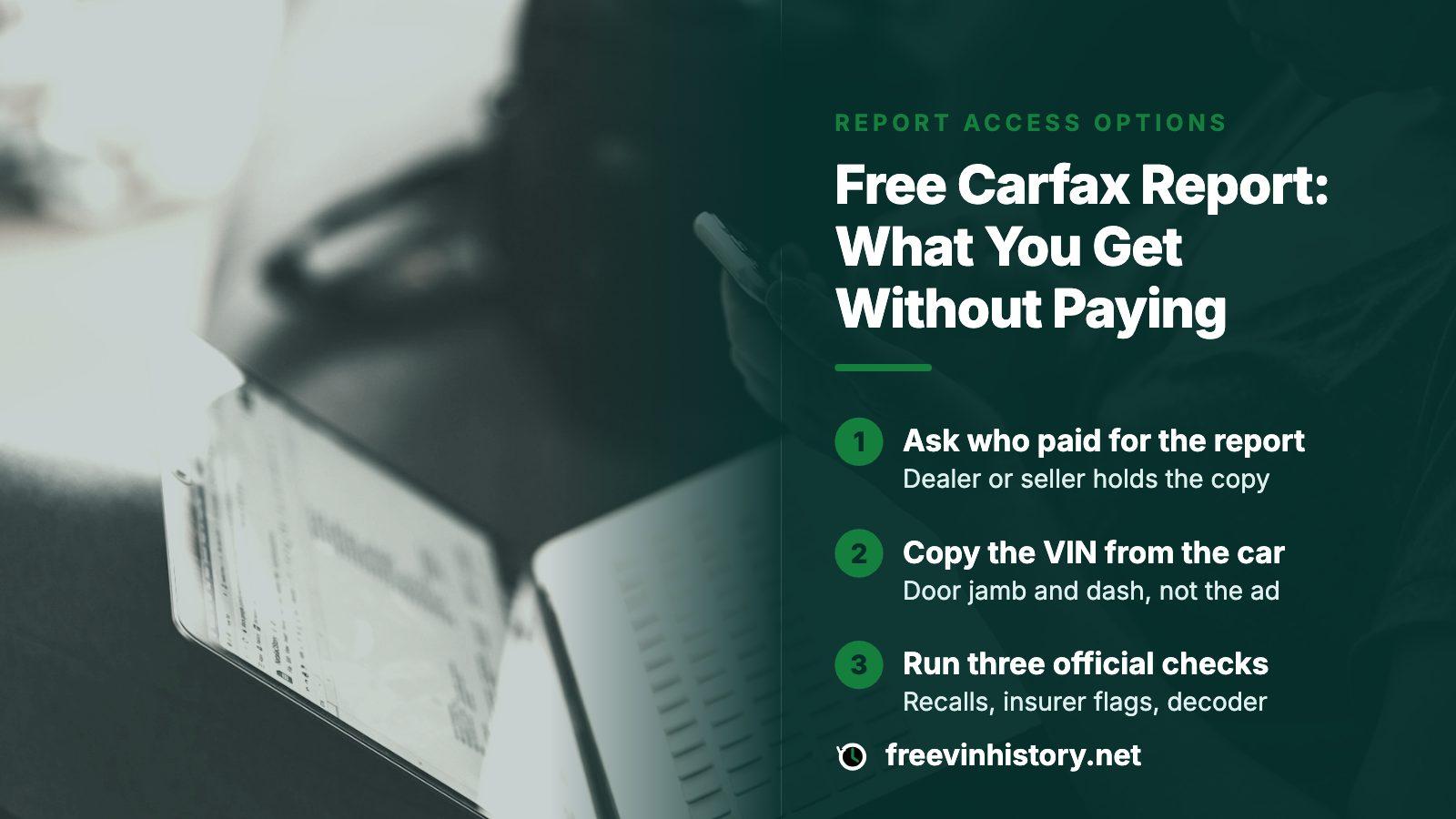
THE SHORT ANSWER
Carfax is a paid product, so a free copy means a dealer, a listing platform or the seller already paid for it. The official checks that cost nothing are NHTSA's recall search, NHTSA's VIN decoder and NICB's VINCheck. They cover open recalls, factory specs and theft or total-loss flags, but not title brands, mileage history or accidents. For those, run the free preview on FreeVINHistory, then decide on the full report as a one-time payment.
- No-cost official checks
- NHTSA recalls, NHTSA VIN decoder, NICB VINCheck
- Dealer test
- 5 or more used cars in 12 months
- Missing from the free checks
- Title brands, mileage history, accident records
- The step up
- A free preview, then one payment for the full report
A free Carfax report means someone else paid
A copy that reaches you at no cost is a copy somebody else bought. Usually that somebody is the dealer, who buys reports in volume and attaches them to listings because a clean history helps a car sell. Some listing platforms bundle reports into seller fees, and now and then a private seller buys one up front. A third-party site offering the branded report for nothing is selling a different product under the familiar name, or fishing for a card number.
FreeVINHistory is independent of Carfax and does not sell or supply its reports. Its role is the official checks first, then a report of its own for the records those checks leave out.
Dealer or private seller: who decides what exists
The Used Car Rule, issued by the FTC, sets a head count for who is a dealer: five used cars sold or put up for sale in a twelve-month stretch, after which the next sale makes the seller one. A dealer has to show a Buyers Guide on the car. The form spells out warranty terms and says nothing about history, and the rule itself never mentions history reports.
| Seller | What to expect | Your move |
|---|---|---|
| Dealer, franchised or independent | A Buyers Guide in the window and probably a report on file | Ask for the report by VIN and read the guide while you wait |
| Private seller with five or more sales behind them | Counts as a dealer, whatever the ad calls them | Read a missing Buyers Guide as a warning |
| Genuine private seller | No Buyers Guide, and usually no report ever bought | Rely on the free checks plus an inspection |
| Auction or salvage yard | Sale terms, not Part 455, decide what you are told | Read the terms before you bid |
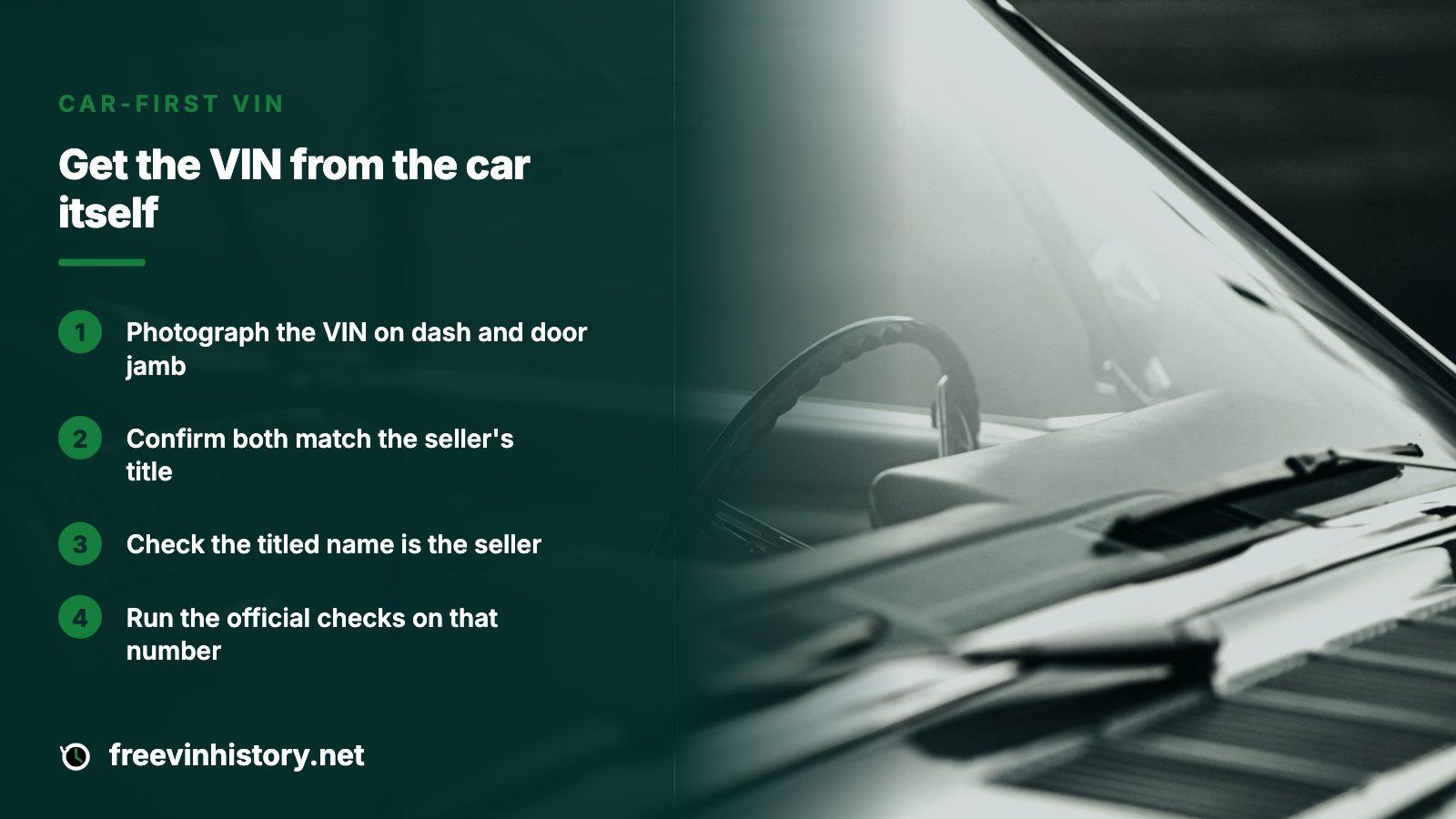
Get the VIN from the car itself
The VIN is 17 characters, and every check below depends on reading it correctly. A number typed into a message is a claim, not a reading.
- Photograph the VIN on the dashboard and on the door jamb yourself.
- Confirm the two match each other and the title in the seller's hand.
- Make sure the seller named on the title is the person in front of you. A different name usually means the transfer will not go cleanly.
- Run the free checks on that number first, before any trip to see the car.
Three official checks that cost nothing
| Check | Run by | What it tells you |
|---|---|---|
| NHTSA recall search | Federal agency | Open safety recalls on that VIN with no repair on record. Recall repairs are done at no charge, so a hit can be worth real money. |
| NHTSA vPIC decoder | Federal agency | Factory specifications filed for the VIN: engine, assembly plant, body style, restraint systems. Compare them with the ad. |
| NICB VINCheck | Industry non-profit | Whether participating insurers have logged the car as stolen and still missing, or as a total loss. |
NHTSA's data is the government's own record. VINCheck reflects what participating insurers choose to report: a large share of the market, not all of it. A clean VINCheck therefore says no participating insurer filed a theft or total-loss claim on that VIN, nothing broader.
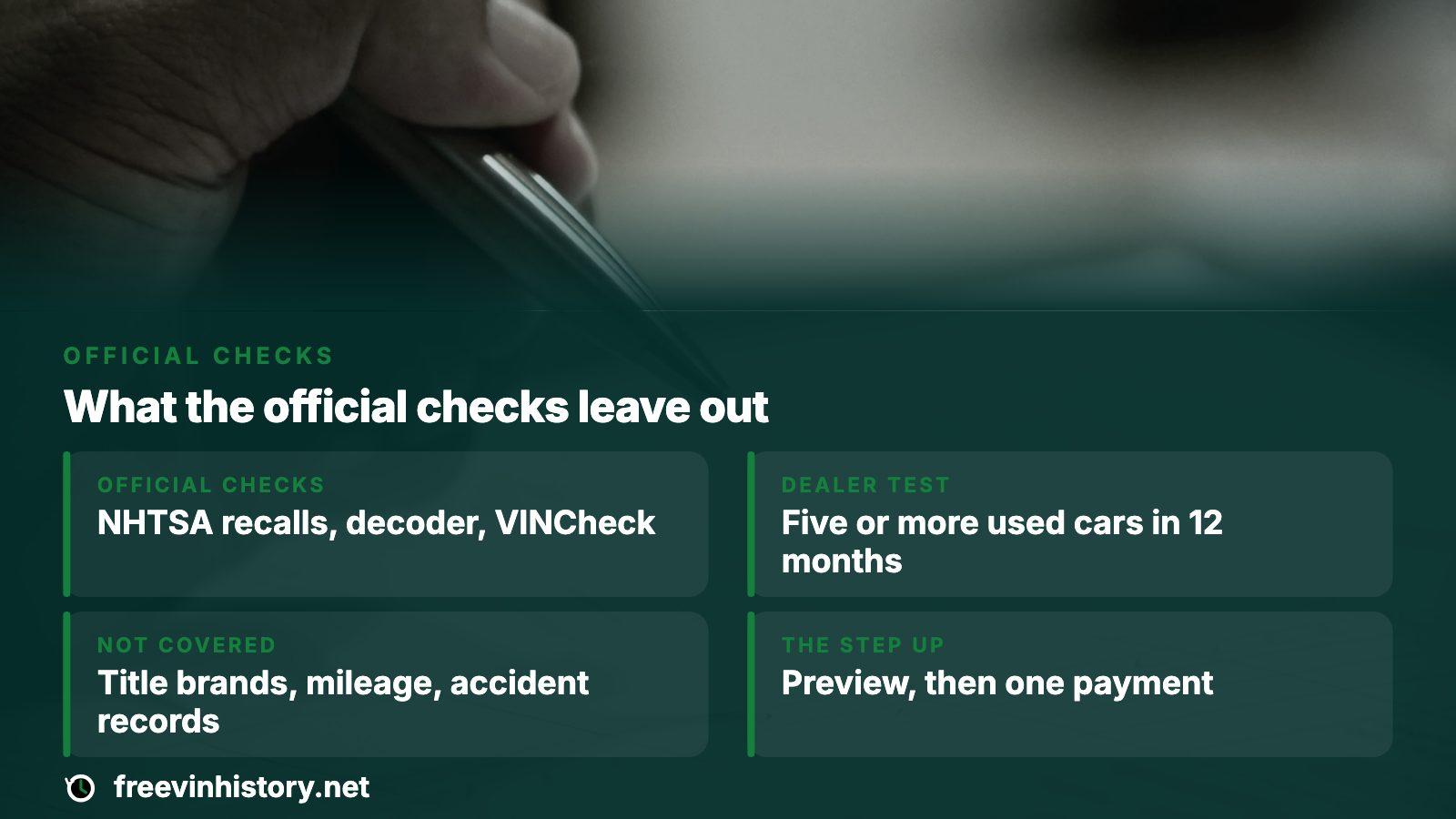
Reading the results and the red flags
- An open recall: a bargaining point rather than a reason to walk. Ask for the repair before the sale closes.
- Specs that disagree with the ad, such as a different engine or body style: either the VIN or the listing is wrong. Settle that first.
- A VINCheck hit for theft or total loss: stop, and do not hand over a deposit.
- A dealer who normally has reports on hand but will not show one for this car: lawful under Part 455, and still information. Spend on an inspection before the deposit.
- A report dated weeks ago: it cannot show anything filed since.
A clean result is not clearance
These checks read filings, not the car. A repair paid for privately, with no claim made, leaves no trace in any record at any price. Treat clean results as encouraging, and keep the inspection.
Where the free checks stop and the report starts
| Question | Official no-cost checks | Full report |
|---|---|---|
| Open safety recalls | NHTSA recall search | Open recalls listed |
| Factory specifications | NHTSA vPIC decoder | Factory specs listed |
| Theft | NICB screen, participating insurers only | Theft records |
| Total loss and insurance | NICB total-loss flag only | Insurance records |
| Title brands | Not covered | Title brands |
| Accidents and damage | Not covered | Accident and damage records |
| Mileage history | Not covered | Odometer readings |
| Liens and impounds | Not covered | Liens and impounds |
| Auction and salvage | Not covered | Auction and salvage records, with photos |
| Owners, use and value | Not covered | Ownership and use type, market value |
NMVTIS, the federal title record, is the dependable place to find a salvage or junk brand that another state applied. It reaches consumers through providers approved by the Department of Justice. Even so, an accident settled in cash and never claimed sits in no record at all.
The free preview: a look before any payment
After the official checks, enter the VIN for the free preview. It shows the open recall count, the year, make, model and trim, any vehicle photos on file, and how many title and auction records exist. No card is needed.
The counts do the work. A title or auction count above zero tells you a record exists and deserves a full read before you agree a price. A count of zero narrows the question without closing it. The records themselves belong to the paid report.
When free is only the headline
This search sends people to some dubious sites. Four patterns turn up again and again.
- Any page that wants card details before it shows a thing. Something free has no need for them.
- A one-dollar trial that quietly becomes a recurring charge, with the terms tucked somewhere easy to miss.
- A summary that holds back the detail until you pay. That makes it a paid report with a taster: a legitimate model, though it is not a free report.
- A promise of an owner's name and address from a VIN. Federal law restricts that data.
FreeVINHistory works on the taster model and says so: a free preview first, then one payment for the full report, with no subscription.
The step up: one payment, then an inspection
If the official checks and the preview leave questions open on a car you are serious about, the full report is the step up. One payment buys one report; a pack of 3, 5 or 10 suits anyone lining up several cars. Nothing renews. Prices sit on the pricing page only, so they are never out of date elsewhere.
Order of play
Run the report before the deposit, while its findings can still change the price or end the deal. Book an independent inspection whatever the report says, since some damage never reaches any record.
Where this information comes from
- eCFR: 16 CFR Part 455, Used Motor Vehicle Trade Regulation Rule — The numeric dealer definition at 455.1(d)(3) and the duty to display a Buyers Guide at 455.2(a).
- NHTSA: Recalls lookup by VIN — Where an open safety recall against a specific VIN is checked at no charge.
- NHTSA: vPIC VIN decoder — The federal decode of the factory specifications filed for a VIN.
- U.S. Department of Justice: NMVTIS — The federal title record and the list of providers approved to sell it to consumers.
- FTC: Buying a used car from a dealer — Consumer guidance on used purchases and how the Buyers Guide fits in.
Sources and photos: Facts checked against the sources above in November 2026. Photos by Michal Biernat, Dylan Michaud and Masjid MABA on Unsplash; diagrams by FreeVINHistory.
Keep reading
- Free vehicle history report: what the free sources showWhat a no-cost history report can hold, from any provider.
- NMVTIS report: what the federal title record shows and missesThe federal title record and where another state's salvage brand turns up.
- Sample reportA finished report to look over before you decide to buy one.
- PricingSingle reports and packs, billed once with no subscription.
Frequently asked questions
How do I get a Carfax report for my car for free?
Only if someone else has paid for it. Look for a report link on the dealer's listing first, then ask the dealer to run the VIN. A private seller rarely has one. Whatever you are handed, read its date, because a copy printed weeks ago cannot show anything filed since.
Does any website give a free Carfax report by VIN?
No website other than Carfax can issue its report, and Carfax charges for it. Sites that promise otherwise are selling a different report under the familiar name or collecting card details for a trial. By VIN, the genuinely no-cost options are NHTSA's recall search, NHTSA's decoder and NICB's VINCheck.
Is a dealer obliged to hand over a vehicle history report?
No. The Used Car Rule obliges dealers to post a Buyers Guide, and that form deals with warranty terms. It says nothing about history reports. You can ask, and a refusal is lawful, but a dealer who normally has reports on hand and will not show one for your car has given you a reason to inspect harder.
What does the FreeVINHistory preview show before I pay?
The open recall count, year, make, model and trim, any vehicle photos on file, and how many title and auction records exist. It stops there. The records themselves sit in the full report, a separate one-time payment with no subscription. The preview needs no card.
If every free check comes back clean, can I skip the full report?
You can, at the risk of missing what those checks never cover: title brands, odometer readings, accident and damage records, liens and impounds. For a car you are close to buying, run the preview, read what it counts, and decide on the report before any deposit. Keep the inspection either way.
Now check the car itself
The guide explains what to look for. The report shows what this VIN has on record.