THE SHORT ANSWER
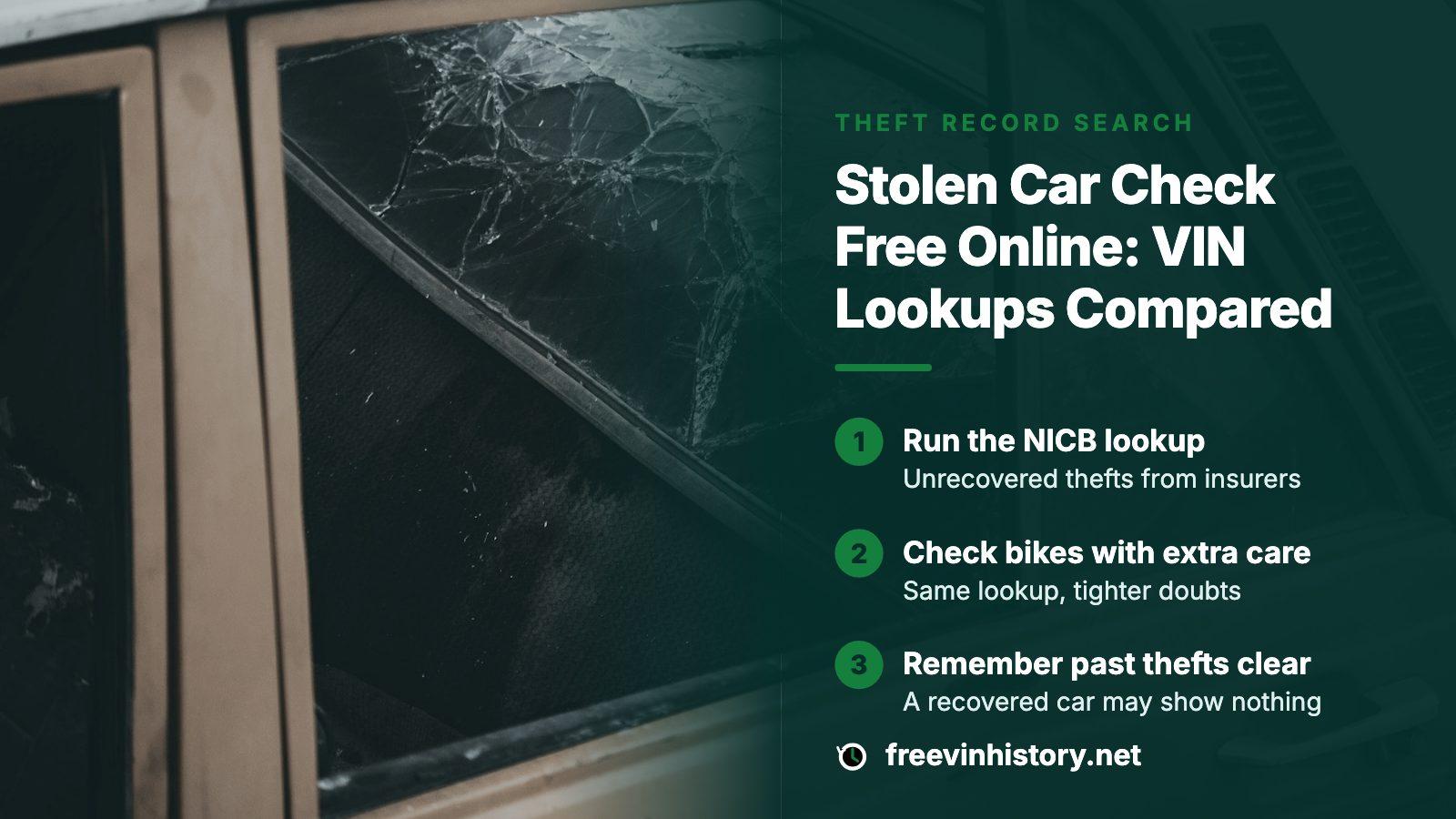
Yes, you can check a VIN for theft at no cost. NICB's VINCheck covers insurer-reported thefts that were never recovered, with a cap of five lookups from one IP address a day. Some states, Arizona among them, publish a lookup fed by police files. None of these shows title brands or mileage history, and a cloned VIN can look perfectly clean. Run the free tools first, then the preview and the full report once one car is serious.
- Free official lookup
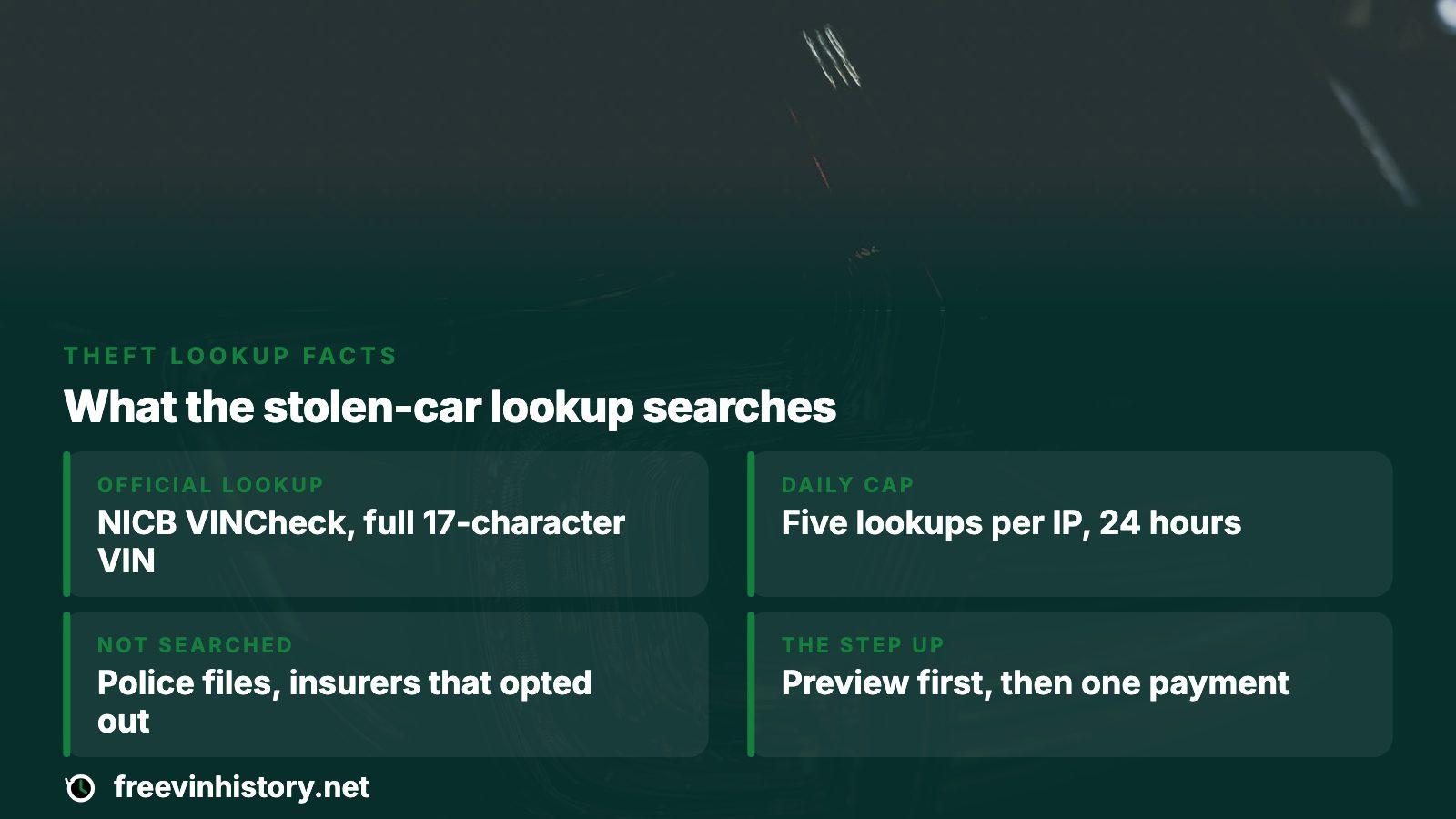
- NICB VINCheck, which needs the full 17-character VIN
- Daily cap
- Five lookups from one IP address per 24 hours
- Not searched
- Police files and insurers that opted out
- The step up
- Preview at no cost, then pay once for the report
What the free stolen-car lookup searches
The lookup most people mean is NICB's VINCheck. NICB is a nonprofit that fights insurance crime, and VINCheck compares one VIN with theft, salvage and flood entries sent in by participating member insurers, which the page says represent 92.49% of U.S. earned premium (as of August 2026). A match means a carrier recorded the vehicle as stolen and still unrecovered. It costs nothing, and lookups are unlimited over time, though one IP address is held to five per 24 hours.
Two limits come straight from NICB. A mistyped character in the VIN may hide a genuine hit, and only insurance records come back, so police files and insurers that opted out sit outside the search. NICB says plainly that a vehicle could be stolen or heavily damaged with nothing showing.
How to run the check
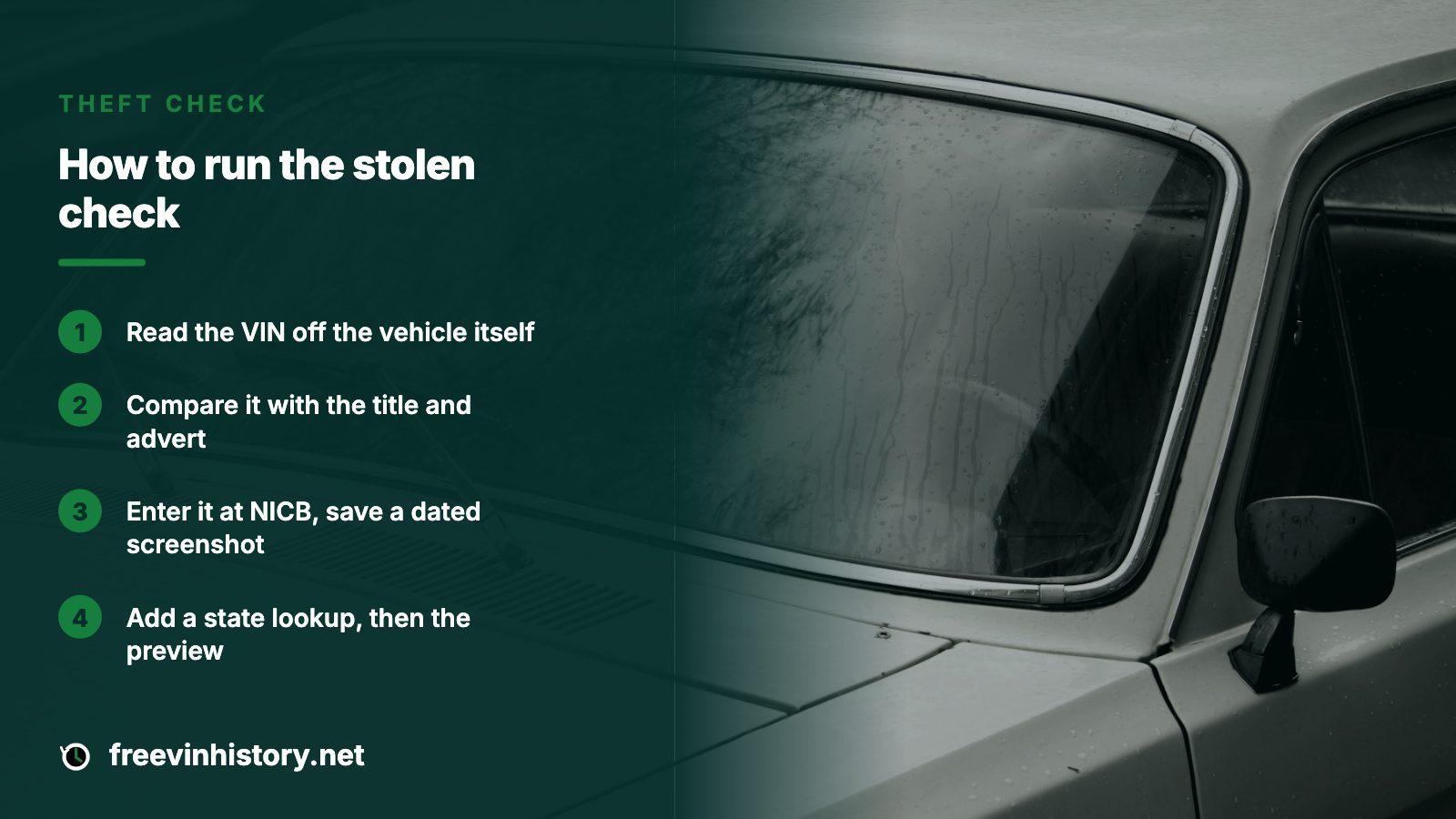
- Pull the VIN from the vehicle in front of you. NHTSA says to look low on the left side of the windshield, and the registration card shows the same 17 characters. A number typed into an advert is only the seller's word.
- Compare it with both the title and the advert. If the windshield number and the paperwork differ by even one character, stop there.
- Enter it at NICB, accept the terms and read the result. Save a dated screenshot, since results can change.
- If a state runs its own lookup, such as Arizona or Colorado, add it. They search state stolen-vehicle data, which NICB's tool does not.
- Finish with this site's preview to see whether title or auction records sit behind the VIN.
Free sources side by side
Each source answers a different slice of the theft question.
| Source | What it searches | What it leaves out |
|---|---|---|
| NICB VINCheck | Insurer-reported thefts still unrecovered, plus salvage and flood entries | Police files and insurers that opted out |
| TheftAZ, Arizona Attorney General | A plate or VIN against the police system used in Arizona; answers give status only | Thefts reported outside Arizona, stolen plates, make and color |
| Colorado Motor Vehicle Verification System | Model year and VIN against the state's stolen vehicle file | Vehicles absent from that state file |
| NHTSA recall search | Whether the VIN has an unrepaired recall | Theft of any kind |
| Approved NMVTIS providers | Title and brand history, odometer, total loss and salvage, and in some cases theft data, for the provider's fee | Records no reporter has submitted yet |
Motorcycle VINs: same lookup, extra caution
VINCheck covers some motorcycles along with insured cars and trucks, and for bikes NICB's page also points riders to CycleVIN. Arizona's TheftAZ accepts motorcycles, ATVs and trailers too. Coverage is patchy by nature: results depend on what member insurers sent in, so a bike that was never insured gives the tool little to find.
NICB warns that sellers build cycle clones from replica aftermarket parts, present them as factory-built bikes and fit a false VIN. Be wary of a bike whose title says assembled vehicle, or whose seller calls it all custom. Ask an insurer for a pre-purchase inspection or get an expert appraisal, and doubt any bike or major part said to come from a swap meet.
What a clean result can still hide
The biggest gap is cloning. A thief copies the VIN of a legally owned car, makes a counterfeit tag and matching papers, steals a look-alike vehicle and fits the fake tag. Type that VIN into any free lookup and the answer describes the innocent car, so it comes back clean. NICB says offices that take in an out-of-state title seldom check for duplicate ownership, which is why thieves are rarely caught.
A buyer left holding a clone has no legal claim to it, whatever was paid. If the switch comes to light, the car is seized and returned either to the person it was taken from or to the insurer that settled the theft claim. NICB's safeguards: have the state motor vehicle agency check the VIN, order a title search, and look closely at any late-model car with no lienholder.
When the theft is already in the car's past
A stolen car does not always stay gone. NMVTIS notes that if a vehicle is not recovered within 30 days, an insurer may declare it a total loss. If it reappears undamaged, the label stays on the record and the car can go back on sale as a working vehicle. So a total-loss or salvage flag on a car with no crash history may trace back to an old theft claim, and its date and cause deserve a look.
From an NHTSA owner complaint
An owner of a 2020 Chevrolet Silverado 1500 filed a complaint under odometer fraud after spotting a mileage gap. The truck showed about 54,753 miles at purchase, yet a history report the owner later found listed it as reported stolen on May 2, 2025, with 102,610 miles on the odometer. The owner suspects the odometer was altered before the sale.
A theft entry and a mileage record should tell one story. When they do not, ask for an explanation in writing before paying.
Where the full report picks up
The free tools answer a narrow question and stop. FreeVINHistory's preview takes the VIN and shows the year, make, model and trim, photos where records exist, how many recalls are still open, and how many title and auction records sit on file. You enter no card for it. When those counts show something, the full report is a one-time buy with no renewal, for one VIN or for three, five or ten if you are comparing several cars. The pricing page lists the rates. The report opens the entries behind the counts: theft records, title brands, odometer readings, auction and salvage photos, and impound or lien entries.
From an NHTSA owner complaint
An owner of a 2018 Honda CR-V told NHTSA that history reports showed a theft record on the VIN from before the purchase, which the seller never mentioned. The owner says they were told the record counted for little because it was absent from the dealership's report and not recognized by California's DMV. The car was later repossessed, and the owner says the record would have changed the decision to buy.
Reports draw on different sources, so one quiet result does not settle a VIN. Where theft is the worry, read more than one record before money changes hands.
What to do with the result
- Flagged: stop negotiating, do not try to reclaim anything yourself, and keep the listing, the messages and a dated screenshot.
- Flagged in Arizona's tool: it returns contact details for the agency holding the report, and the attorney general advises calling that agency rather than acting alone.
- Suspected fraudulent sale: NICB takes reports online or at 800-835-6422.
- Clean: ask the state motor vehicle agency to verify the VIN, order a title search, and book a certified mechanic. NICB lists those steps for private-seller deals, and all of them belong before the deposit.
Where this information comes from
- NICB: VINCheck lookup — What the free lookup searches, its daily limit and the gaps NICB states itself.
- NICB: Buying a used vehicle — How cloned VINs work and what a buyer who ends up with one loses.
- NICB: Motorcycle and boat theft — Cloned and assembled motorcycles, and the checks NICB suggests before buying a bike.
- U.S. Department of Justice: NMVTIS for consumers — What the federal title system holds and how a total-loss label can follow a theft.
- Arizona Attorney General: TheftAZ FAQ — A state lookup fed by police records, with its own coverage limits.
- NHTSA owner complaint 11754960 — owner experience, paraphrased
- NHTSA owner complaint 11722318 — owner experience, paraphrased
Sources and photos: Facts checked against the sources above in November 2026. Photos by Abolfazl Ranjbar, Tigran Shishmanyan and A n v e s h on Unsplash; diagrams by FreeVINHistory.
Keep reading
- Free salvage title check by VIN: what the free lookups showInsurer total-loss and salvage flags, the other half of what NICB's lookup returns.
- NMVTIS report: what the federal title record shows and missesThe federal title record that holds brands, odometer entries and some theft data.
- Sample reportA finished report to read, so you know what the paid step shows before you buy.
- PricingWhat one report costs, and the larger sets of 3, 5 or 10, with nothing recurring.
Frequently asked questions
How many free stolen car checks can I run?
NICB limits each IP address to five lookups within a 24-hour window, though total lookups over time are unlimited, so a long shortlist can be split across days. The cap counts IP addresses rather than people, so searches from one shared connection add up.
Can I check a stolen car by license plate for free?
Arizona's TheftAZ takes a plate or a VIN, though its FAQ calls the VIN the most accurate route since plates are easily switched, and stolen plates are not in its database. NICB's form wants the 17-digit VIN. This site starts from the VIN too, so copy it off the car first.
Will a free check show a car that was stolen and then recovered?
NICB describes its theft flag as stolen and not recovered, so a car that came back is not what that flag is built for. A recovery can still leave traces, such as a salvage entry from an insurer that paid a total-loss claim.
Does a free stolen VIN check cover other states?
NICB's lookup relies on insurers, so it is not tied to one state. The state tools are narrower: Arizona's covers vehicles reported stolen by Arizona agencies, and Colorado's compares against its own stolen vehicle file. For a car from elsewhere, run NICB first.
Does a stolen car check cost anything on this site?
You pay nothing for the preview and give no card; it shows what the car is and how many records exist. Reports are sold singly or in sets of three, five or ten. No subscription. Rates are on the pricing page.
Now check the car itself
The guide explains what to look for. The report shows what this VIN has on record.