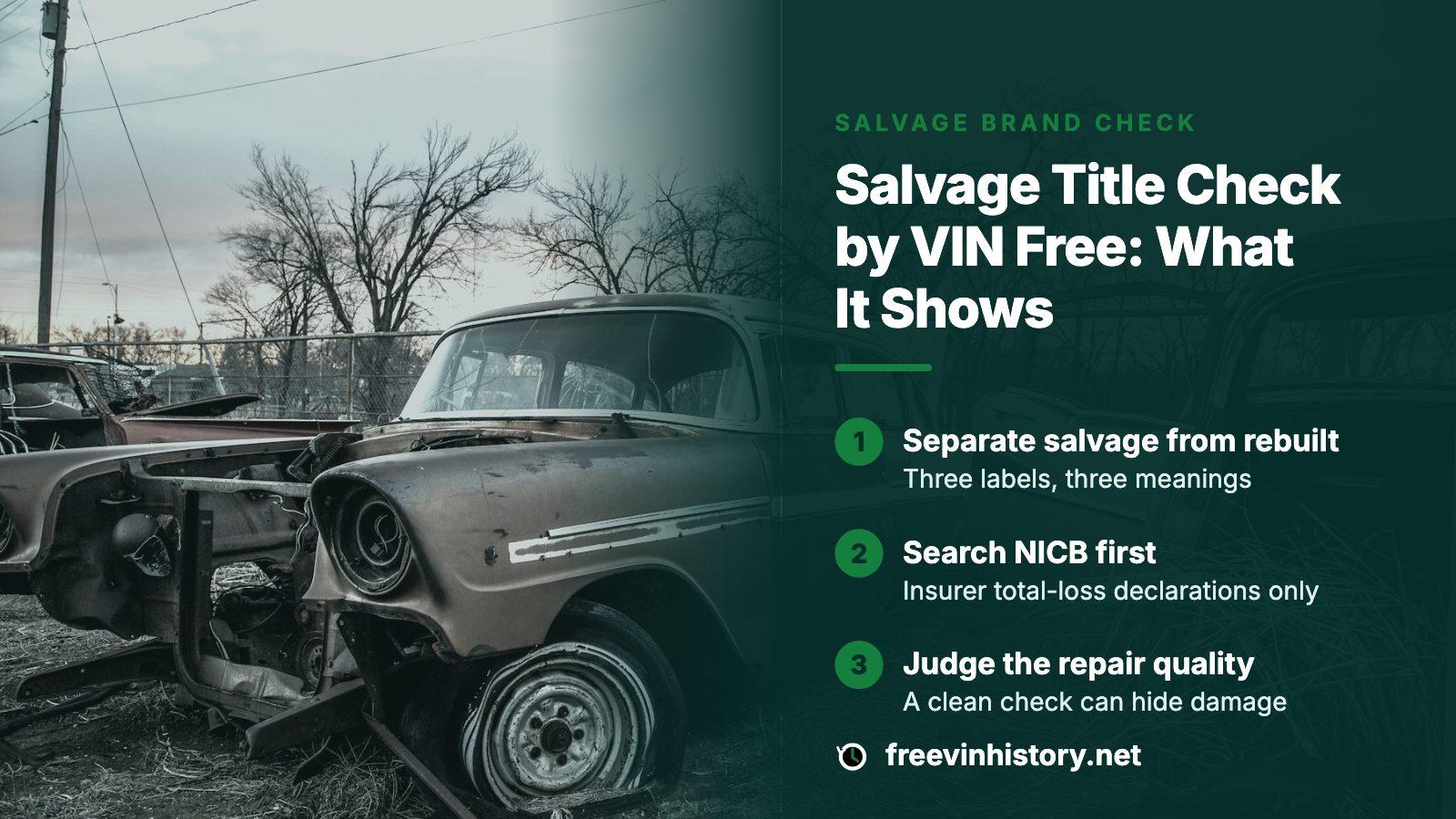
THE SHORT ANSWER
Partly. NICB's VINCheck costs nothing and shows whether a member insurer called the car salvage, flood damaged or stolen and never recovered. It does not read state title brands, and it cannot see a car that never reached an insurer. Run it, add the preview's record counts, and pay for the full report only on the car you mean to pursue.
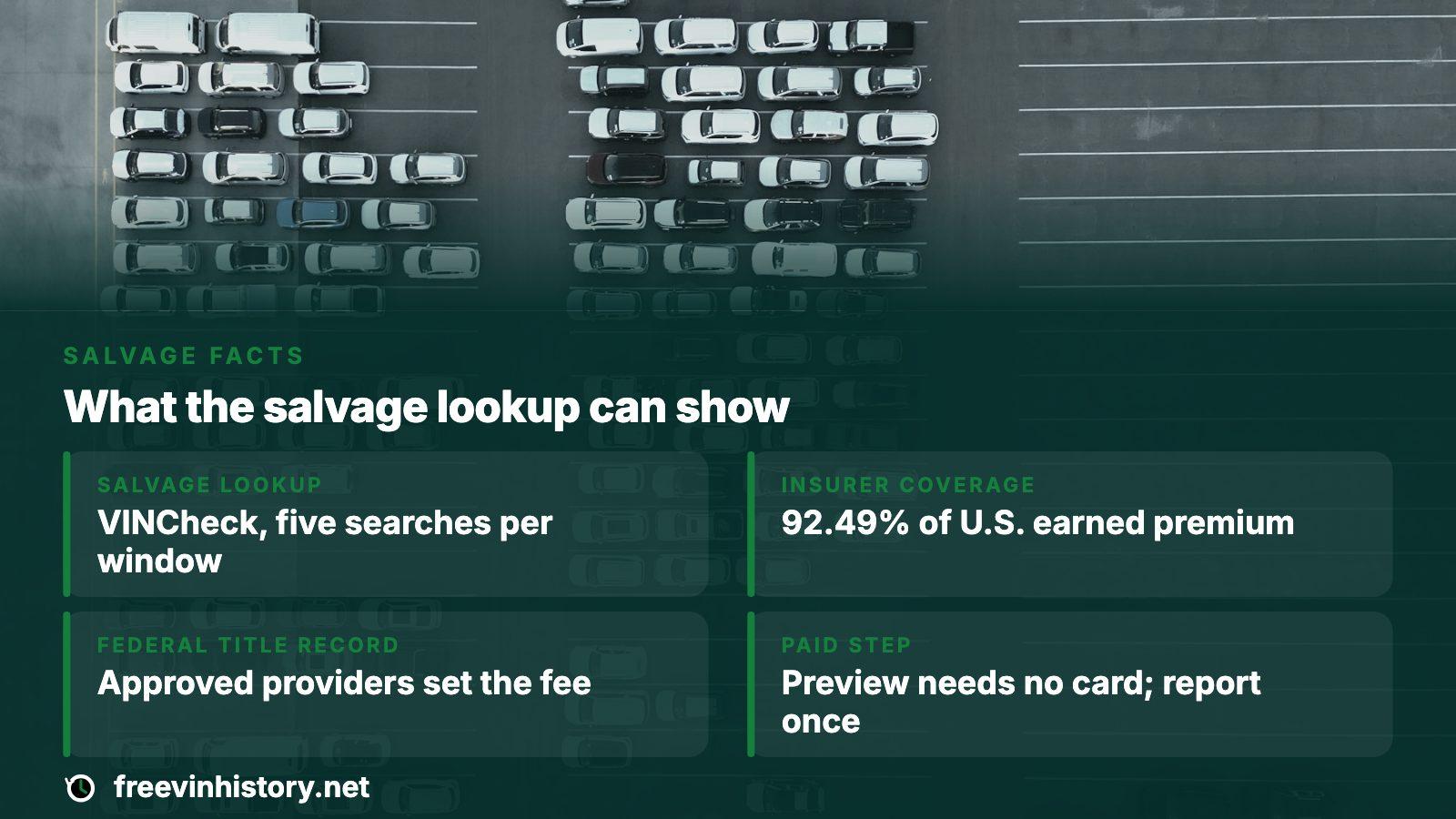
- No-cost salvage lookup
- NICB VINCheck, capped at five searches per 24-hour window
- Insurer coverage
- Members behind 92.49% of U.S. earned premium (August 2026)
- Federal title record
- Sold by approved providers at their own fee
- Paid step
- Preview needs no card; the report is a single payment
Salvage, total loss, rebuilt: three labels that are not the same
A salvage flag is arithmetic, not appearance. NICB says an insurer applies it when repair costs passed a set share of the car's value, so the company paid the claim rather than repairing the car. States set their own thresholds, and the Justice Department notes that one state may brand a damaged car salvage where another will not.
| Label | What the record is saying | A wreck? |
|---|---|---|
| Salvage | An insurer or a state judged repairs too costly for the car's value | Often; the Justice Department links it to significant damage |
| Total loss | An insurer's write-off decision | Not always: a stolen car unfound after 30 days can get it, and keeps it if recovered unharmed |
| Rebuilt | A salvage car that was later fixed and passed inspection | It was damaged once, so repair quality is the open question |
Which no-cost sources speak to salvage, and which stay silent
Among the national lookups that cost nothing, only NICB's carries salvage data, and it speaks for insurers alone.
| Source and cost | What it says about salvage | What it cannot see |
|---|---|---|
| NICB VINCheck: no charge, five searches per IP address per 24 hours | Whether a participating insurer reported salvage, flood damage or an unrecovered theft | Insurers that opt out, police files, damage that never became a claim |
| NHTSA recall search: no charge | Nothing on salvage; it lists unrepaired recalls for the VIN | Repaired recalls, title brands, past damage |
| FreeVINHistory preview: no card | Tallies of title and auction records, plus photos where they exist | The records behind the tallies |
| NMVTIS report from an approved provider: the provider's fee | Brands any state applied, total-loss decisions, salvage-yard entries | Repair history, and anything a reporter has not filed yet |
A quiet answer from the first row opens the search. It does not close it.
A four-step order, then one decision
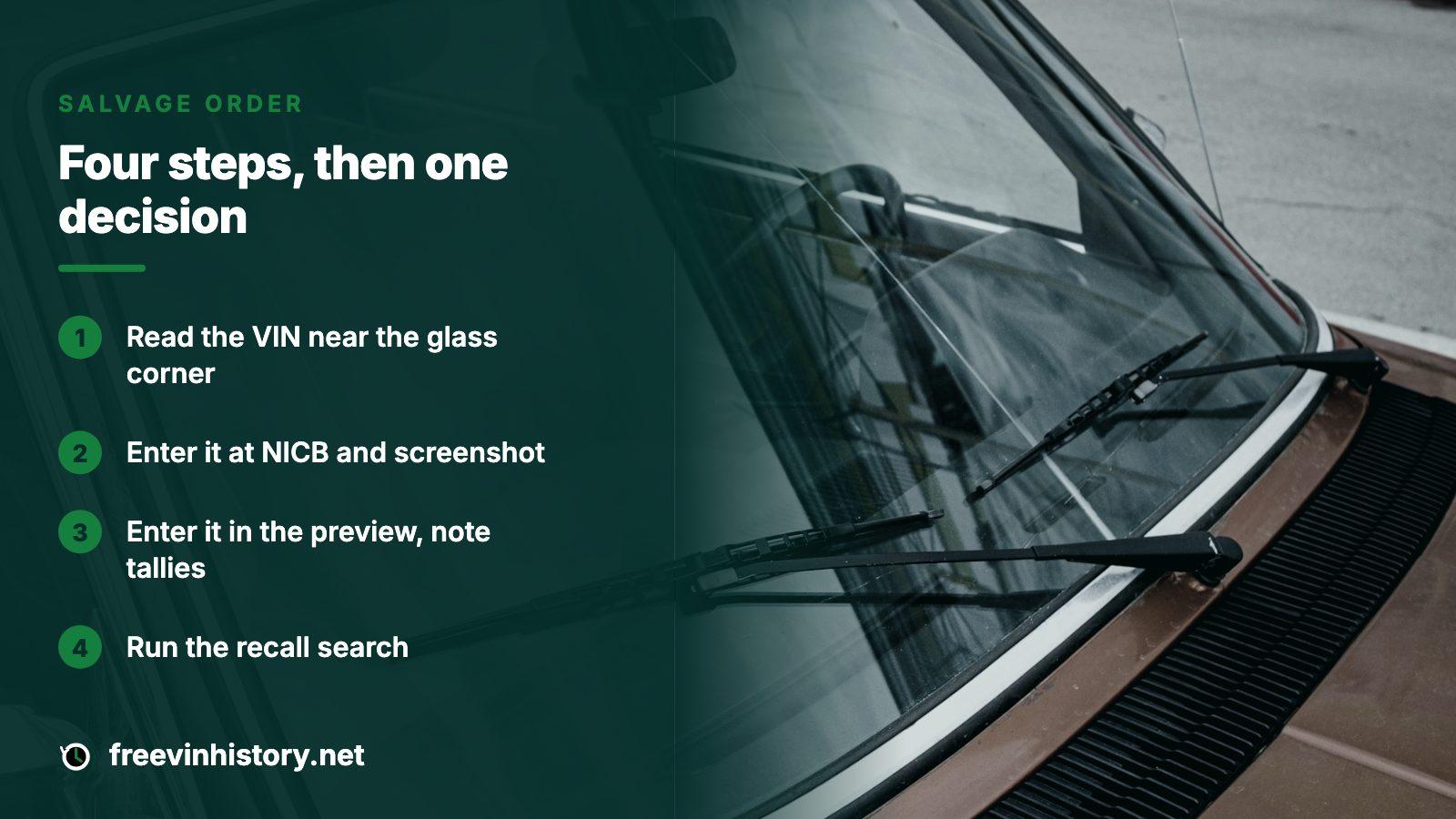
- Read the 17 characters off the car, near the lower left corner of the glass, and check them against the registration card. A VIN typed into an advert is only the seller's word.
- Enter it at NICB's VINCheck, accept the terms, and screenshot the answer with the date, flag or no flag.
- Enter the same VIN in the FreeVINHistory preview and note whether the title and auction tallies are above zero.
- Run NHTSA's recall search. It cannot show a brand, but an open recall is a repair the dealer makes at no charge, so clear it before money moves.
A flag, or a tally above zero, is the cue to weigh the full report while the car is unreserved. If both are quiet, request the title record the state itself holds and book a mechanic. Per the FTC, a history report cannot replace an independent inspection, so have the mechanic put the repair estimate in writing, naming the make, model and VIN.
Reading a flag, a blank and a split verdict
| What comes back | What it means | Next move |
|---|---|---|
| NICB reports salvage | An insurer wrote the car off; it may since have been repaired and retitled | Get the title and repair paperwork, then open the full report |
| NICB is clean, preview counts records | Records exist that the insurer search does not spell out | Read the full report; check dates and brands |
| Both are quiet | Nothing reached these two sources, which differs from nothing happening | Request the state title record; inspect the car |
| A brand appears that the seller never mentioned | A disclosure gap, whatever the reason | Ask in writing, and be ready to walk |
The brand most buyers meet only after paying
NHTSA's public complaint files hold owners who learned of a salvage brand after paying.
From an NHTSA owner complaint
A 2011 Chevrolet Cruze owner reported that the car seemed ready to stall on highways and hills. The owner says the salvage history came to light only once the car went to a dealership for a transmission control module recall. The dealer logged the recall as done, the owner adds, but a second mechanic found otherwise, and the seller, visited three times, said the cash payment left it nothing to do.
From an NHTSA owner complaint
A 2011 Hyundai Sonata owner bought it through Facebook Marketplace after saving up, having first asked their father if it seemed sound. Not long after, the check engine light lit and the engine stalled on starting. The car, it turned out, had a salvage title. The owner says their father had no idea, and the owner had never learned what salvage meant.
Both relied on someone's word or a relative's opinion. Typing the VIN into NICB takes seconds, and that is the cheapest moment in the purchase to learn the truth.
If the title says rebuilt, the question becomes the repair
A rebuilt car passed the state's safety and anti-theft inspections after being a salvage car. In Texas, TxDMV says the title then reads Rebuilt Salvage, and it notes that the wording varies somewhat between states. The brand proves the car cleared inspection, not that the repair was good.
- Find out how severe the damage was and which shop did the repair. TxDMV warns that some repairers make replacement parts from damaged ones or from welded pieces.
- Have an independent mechanic check frame alignment, because a bent frame strains the drivetrain, tires and brakes.
- Ask an insurance agent about cover before buying, since rebuilt cars are often refused.
- Price it as a rebuilt car. TxDMV says they are always worth substantially less.
Why a salvage check can come back clean on a damaged car
Every source here depends on somebody having filed. Insurers report monthly, and the federal rule limits those lists to the latest model year plus the four preceding it. Yards and auctions report cars of any model year, and states send title data on their own timetables.
The Justice Department says its title system reaches 87 percent of U.S. vehicles, while over half of the states feed it, so a search can read no salvage history when the truth is otherwise. Brand washing lives in the gaps between states: the department cites an Experian Automotive count of more than 185,000 titles that carried a brand in one state and came out clean in another during the first six months of 2008.
Where the preview stops and the full report starts
FreeVINHistory's free preview needs no card. Enter a VIN and it returns the year, make, model and trim, photos where records exist, how many recalls are open, and tallies of title and auction records.
The tallies are where a salvage question sharpens: a count above zero means records exist that an insurer lookup would not spell out. The full report opens them, with damage and accident records, mileage readings, insurance records, and salvage or auction entries with their photos, all beside the title brands and their dates.
Buying is one payment. Choose a single report, or a multi-report set (sizes 3, 5 and 10) when several cars are in play. Nothing renews, and current amounts live on the pricing page alone.
Where this information comes from
- NICB: VINCheck lookup — the insurer lookup, its daily cap, coverage share and stated limits
- U.S. Department of Justice: NMVTIS for consumers — brands, total-loss labels, brand washing and false negatives
- U.S. Department of Justice: NMVTIS FAQs — insurer reporting window and where a state title record comes from
- TxDMV: Rebuilt vehicles — what rebuilt means and what to ask before buying one
- FTC: Buying a used car from a dealer — why a report does not replace an inspection
- NHTSA owner complaint 10955446 — owner experience, paraphrased
- NHTSA owner complaint 11655390 — owner experience, paraphrased
Sources and photos: Facts checked against the sources above in November 2026. Photos by Leo_Visions, Max Tokarev and Iain on Unsplash; diagrams by FreeVINHistory.
Keep reading
- NMVTIS report: what the federal title record shows and missesThe federal title record that holds the state brands this lookup cannot show.
- Free VIN check with pictures: what free sources show and where photos beginWhere photos of a damaged car actually come from.
- Free flood check by VIN: what the free tools show and missThe flood version of the same check, with its own blind spots.
- Sample reportWhat the full report looks like before you pay for one.
Frequently asked questions
Can I check a salvage title by VIN for free?
Partly. NICB's VINCheck is the main no-cost route and flags cars a participating insurer reported as salvage, but it cannot show what a state printed on the title. Add the preview and the state's own record, then pay for the full report once one car keeps your interest.
Does a free salvage check show a rebuilt title?
Not through the insurer search, which covers salvage, flood and unrecovered theft records from member insurers. A rebuilt brand is a state title matter, so look for it in title data such as an NMVTIS report, the state's own record, or a full report's title section.
Is a car with a salvage history always unsafe?
No rule says so. NICB says it can be legally rebuilt and retitled, though the history is worth investigating. Treat it as a repair-quality and price question, have a mechanic check the frame, and confirm insurance first, since rebuilt cars are often refused.
Why does the check show nothing on a car I know was wrecked?
The repairs may have been paid for without a claim, the insurer may not take part, the VIN may hold a typo, or a state may not have reported yet. The Justice Department says an empty NMVTIS result probably means no participating state reported anything. That is not proof of a clean car.
What does the report cost after the preview?
Paying happens once and nothing renews. You can buy one report, or sets of 3, 5 or 10, and the pricing page lists current amounts. The preview before it needs no card.
Now check the car itself
The guide explains what to look for. The report shows what this VIN has on record.