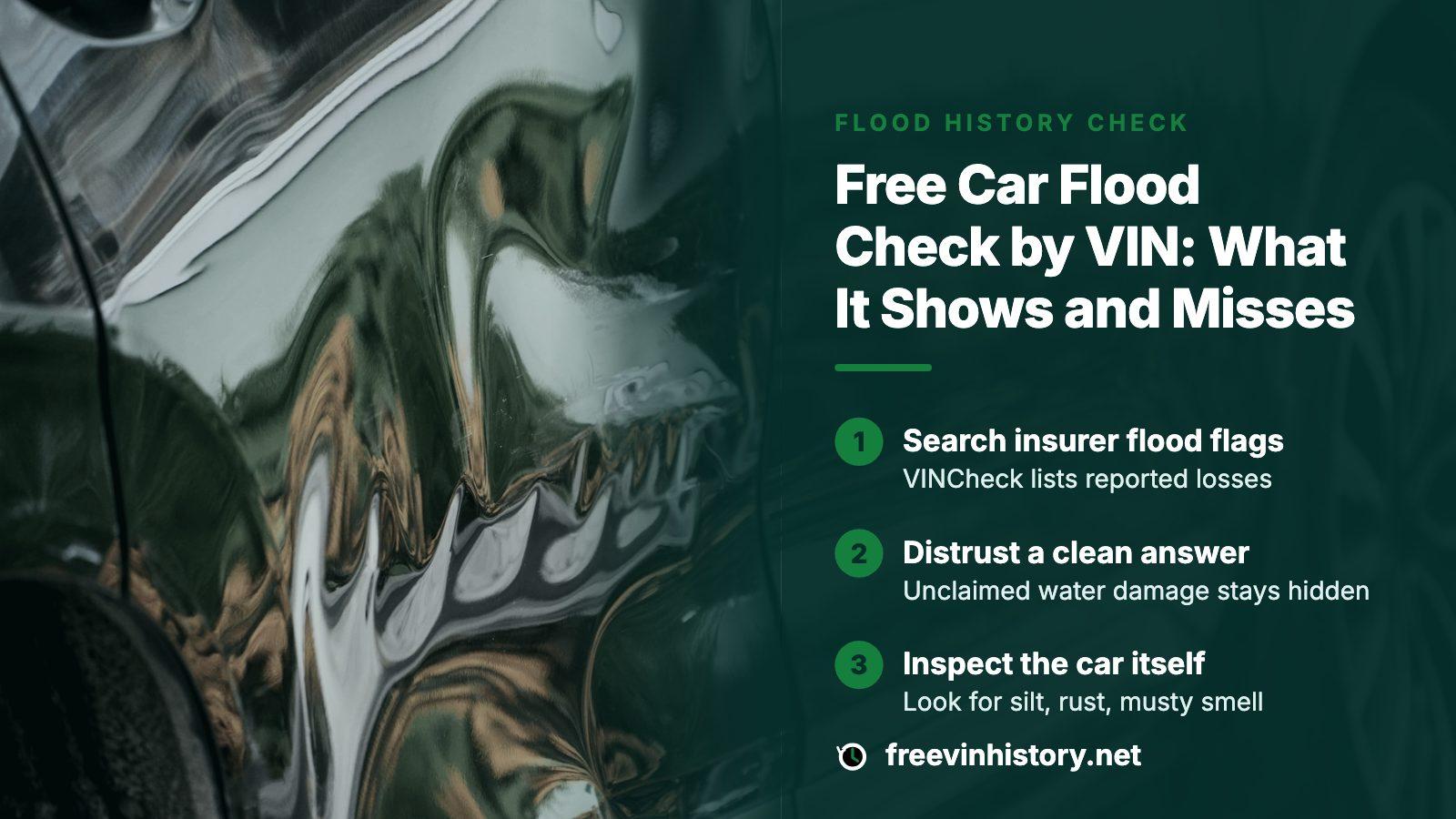
THE SHORT ANSWER
Partly. NICB's VINCheck costs nothing and flags cars an insurer reported as flood damaged or salvage, with a limit of five lookups per IP address each 24 hours. It misses floods that never produced an insurance claim or a title brand. Run it, add the preview from FreeVINHistory to see whether title and auction records exist, inspect the car, and buy the paid report only once one car has earned a closer look.
- Free flood lookup
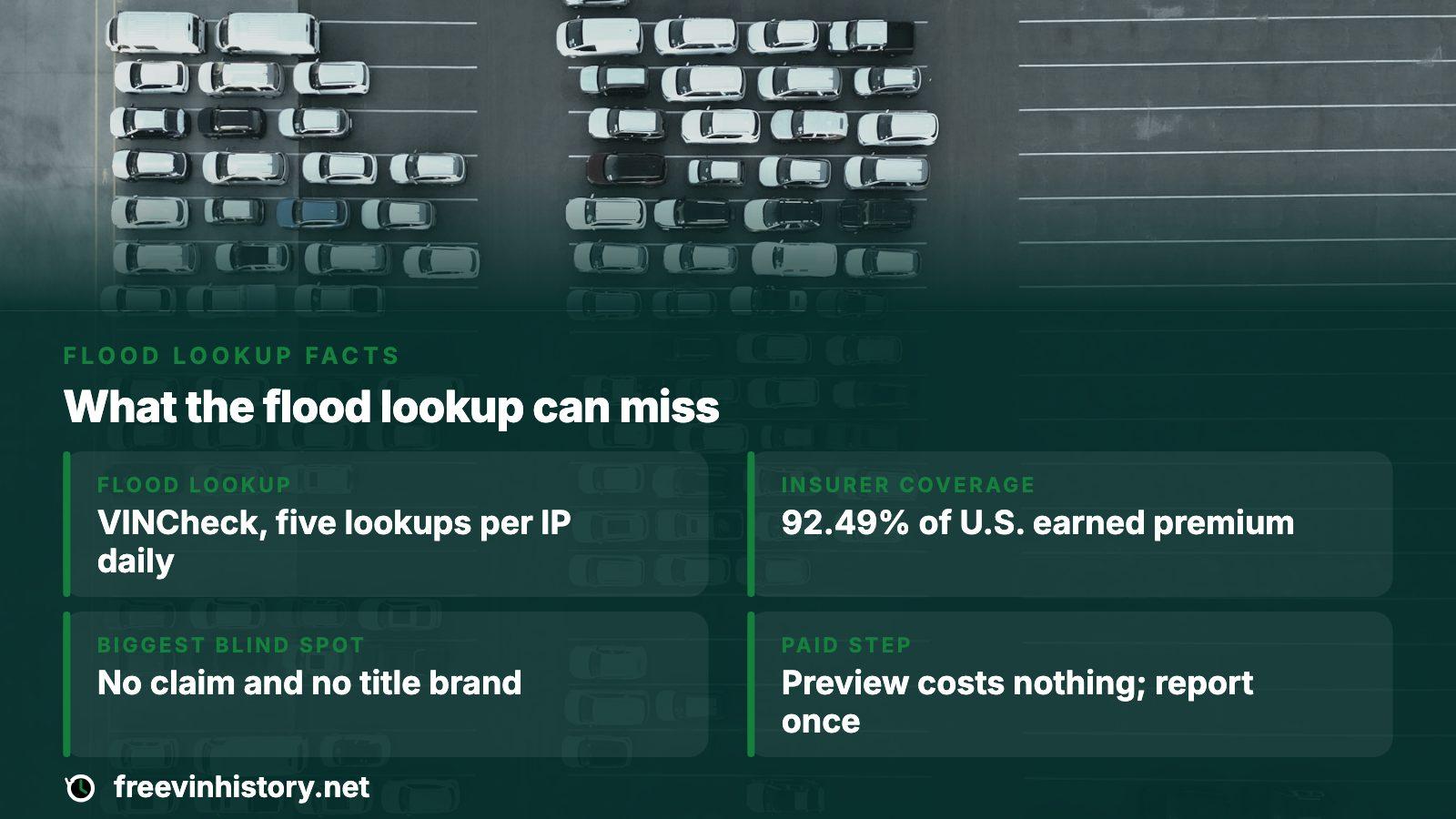
- NICB VINCheck, capped at five lookups per IP address a day
- Insurer coverage
- Members behind 92.49% of U.S. earned premium (August 2026)
- Biggest blind spot
- Floods with no insurance claim and no title brand
- Paid step
- Preview is free of charge; paying for the full report happens just once
What the no-cost flood lookup actually searches
The only no-cost tool that carries flood records belongs to NICB, the insurance industry's crime bureau. VINCheck searches the claim files of member insurers, whose premiums add up to 92.49% of the U.S. total as of August 2026, and answers with a simple indicator: stolen and not recovered, salvage, or flood damaged.
Insurance files are all it reads. Police records and insurers that opted out sit outside the search, a mistyped VIN can miss a record that exists, and NICB itself says a clean answer is no guarantee. Past five lookups from a single IP address within 24 hours, NICB turns you away until the next day.
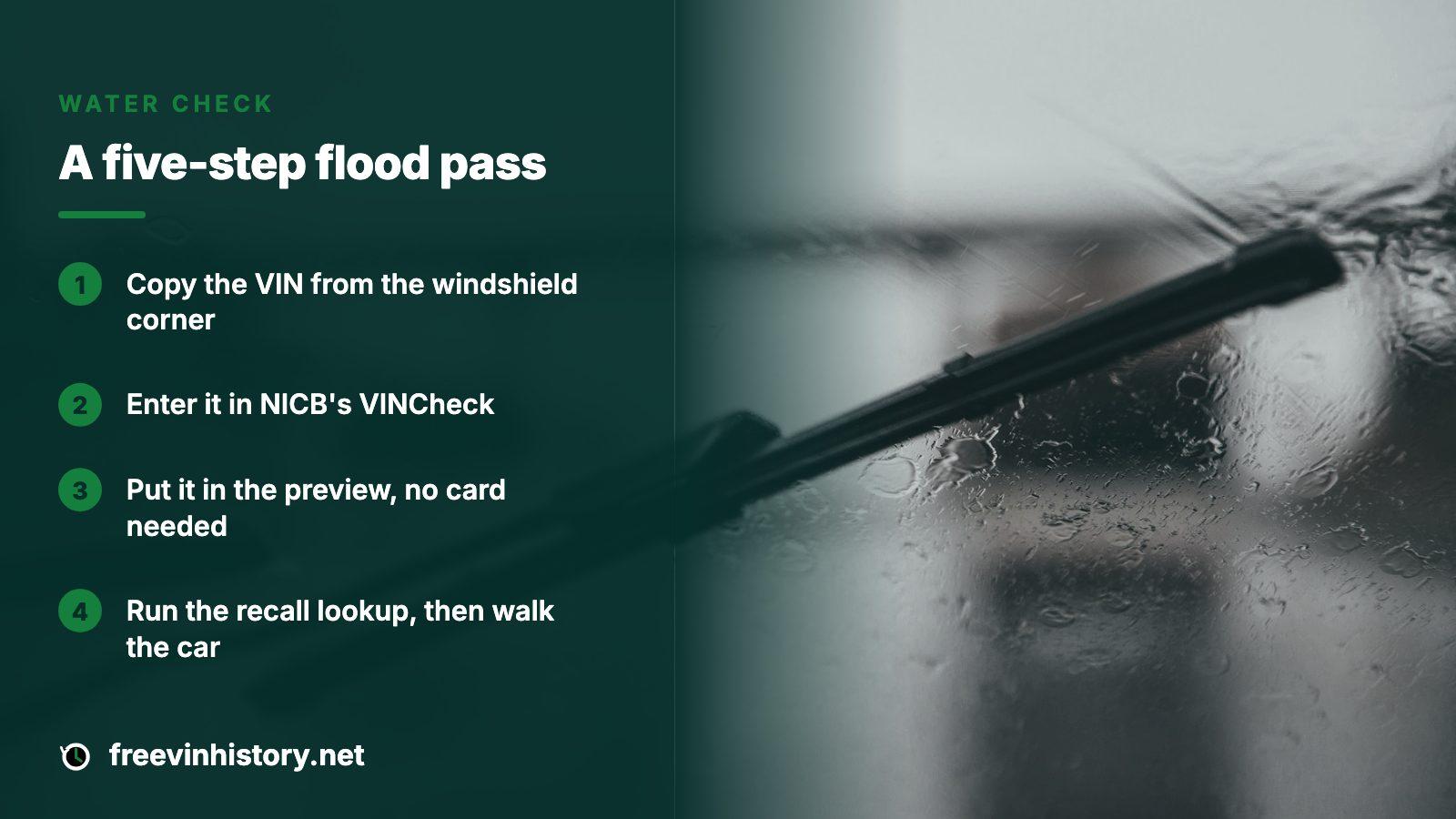
A free pass in five steps
- Copy the VIN from the windshield's lower left corner, 17 characters, and check it against the registration card. One wrong character points every lookup at a different car.
- Enter it in NICB's VINCheck and note any flood, salvage or theft flag.
- Put the same VIN into the FreeVINHistory preview. It needs no card and shows tallies of title and auction records, photos where they exist and the open recall count.
- Run NHTSA's recall lookup. It cannot detect water, but a dealer repairs a recalled part free, so clear any open one before you buy.
- Walk the car with the checklist below, and book a mechanic before you hand over a deposit.
Why a clean answer can still be a flooded car
A flood leaves a record only when somebody files one. NICB warns that an uninsured owner who never made a claim may sell the cleaned-up car on its original clean title, and that dishonest sellers haul flooded cars to another state to pick up a fresh-looking one, a trick called title washing.
Even a totaled car's label depends on where it lands. The Justice Department's title system says a water-recovered car may be branded flood in one state while another state has no such category, and until every state and yard reports as required, a clean search can be a false negative.
From an NHTSA owner complaint
A 2016 Kia Optima owner filing with NHTSA says a history report looked unremarkable, so they bought from a dealer in Kansas. Seven months and about $9,000 of loan-funded repairs later, shop after shop told them the car had spent a long time under deep water. An electrical specialist added that corrosion had not yet broken anything but could. The owner says nobody disclosed flooding and the dealer went silent.
The report held only what had been filed. The water surfaced when mechanics examined the car, after the signature.
How a flood can appear on a title record
States pick their own wording, and Texas is a handy case because its DMV publishes the translation. Two national brands, one for freshwater and one for saltwater, collapse into one phrase on a Texas title.
| National brand | TxDMV meaning | Texas title wording |
|---|---|---|
| Flood Damaged | Freshwater flood, or a flood of unknown origin | Flood Damage |
| Salt Water Damaged | Saltwater flood | Flood Damage |
The split matters. The Justice Department says saltwater raises the odds of electrical faults, airbag sensors among them, and after Katrina truckloads of flooded Louisiana cars were reportedly hauled to distant states and sold where flood brands are not used. A Texas title reads the same either way, so ask where the car sat during any named storm.
Reading what comes back
| Result | Reading | Move |
|---|---|---|
| NICB shows flood or salvage | An insurer logged a loss; a salvage car may be rebuilt and titled again | Ask for every document and read the title history before a deposit |
| NICB is quiet, the preview lists title or auction records | The VIN has a file the insurer lookup does not summarize | Pull the full report and check when each brand was applied |
| Lookups are clean, but the cabin smells musty or shows silt | Your senses found what no record did | Stop and get a mechanic's written opinion, or walk away |
| A lookup returns nothing | A typo, or a VIN no participating state has reported yet, which the title system names as a likely cause | Recheck each character against the registration |
From an NHTSA owner complaint
One NHTSA complaint about a 2013 Ford F-150 describes a dealer sale pitched as low mileage and damage free, with a history printout promised at closing and never delivered. Roughly two weeks apart, the shop at a Ford dealership and a separate inspection company reportedly both recorded flood damage. The owner lists over $5,000 in repairs and 34 days in the shop, and says a registered-mail buyback request got no reply. All of it is the owner's account.
Whatever the dealer's side, the buyer's lesson stands: run the VIN yourself before signing, since a report promised at closing is a check you have not done.
What to check at the car itself
NICB and TxDMV offer nearly the same checklist, and TxDMV admits it will not catch every case.
- Look under carpets and mats, in the headliner and behind the dash for water stains, mildew, sand or silt.
- Feel for dampness where seat belts wind into their retractors.
- Check screws in the console and other dry spots for rust that water should not have reached.
- Look for mud or grit around the spare tire well, alternator, starter, power steering pump and relays.
- Notice shampooed carpet, faded upholstery or door panels, and a musty smell in the cabin or trunk.
- Work every lock, window and light; erratic electronics were the first sign in the Kia complaint.
Then hire your own mechanic. FTC recommends an outside inspection even on a certified car, with a written report that names the make, model and VIN and prices each repair. A dealer that blocks one is a reason to try another lot.
Where the preview ends and the full report starts
The preview is the cheap way to learn whether a car has a file worth reading. It tallies how many title and auction entries exist without opening them, so a busy count on a car NICB called clean is a reason to dig.
The full report is the step up for a car that survives that pass. On a water question it is useful for its title brands, its salvage and auction entries with photos, and its odometer and insurance records, which can show a trip through a salvage yard or auction lane before the seller owned it. Nothing renews and you pay one time. A lone report fits a lone car; a pack of 3, 5 or 10 suits a shopper who has a few waterlogged suspects.
Its limits match its sources: a flood nobody recorded stays invisible, so the mechanic still comes before the deposit.
Cost and next step
No card is needed for the preview. Each full report covers one car, nothing subscribes you, and today's rates sit on the pricing page. NICB's lookup and NHTSA's recall search cost nothing either, but the state route does: TxDMV's Title Check hands buyers to an approved provider that charges a fee.
If a lookup points to water, treat it as a stop sign: NICB lists electrical, airbag, engine, transmission, brake and fuel-system damage as possible results. If everything stays quiet, the inspection is still the last check.
Where this information comes from
- NICB: VINCheck lookup — what the free insurer lookup covers, its daily cap and its stated limits
- NICB: Buying a used vehicle — clean titles on uninsured flood cars, title washing and the physical warning signs
- NMVTIS (DOJ): For consumers — how states brand floods differently and why a search can miss records
- TxDMV: Water-damaged vehicles — how flood brands translate to a Texas title and what to inspect
- FTC: Buying a used car from a dealer — why an independent inspection matters beyond any history report
- NHTSA owner complaint 11723539 — owner experience, paraphrased
- NHTSA owner complaint 11192683 — owner experience, paraphrased
Sources and photos: Facts checked against the sources above in November 2026. Photos by Maxim Tolchinskiy, Thibault Valjevac and Iain on Unsplash; diagrams by FreeVINHistory.
Keep reading
- Free salvage title check by VIN: what the free lookups showWhat a salvage or total-loss flag means and how to read it before you deal with the seller.
- NMVTIS report: what the federal title record shows and missesHow the federal title database records brands, and what its short report leaves out.
- Free VIN check with pictures: what free sources show and where photos beginWhere photos from an auction lane can show what a clean-looking listing hides.
- PricingHow the one-time report and the packs are priced once the preview has done its job.
Frequently asked questions
Is there a truly free flood check by VIN?
Only in part. NICB's VINCheck carries no fee and returns insurer-reported flood, salvage and theft flags from member companies. Title brand dates and auction history belong to a paid report, which here follows the no-cost preview. After the records, a mechanic is the remaining check.
Can a car with a clean title still be flood damaged?
Yes. NICB says a flooded car may keep its original clean title when the owner was uninsured and never filed a claim, and moving a car between states is another way to shed a flood label. States also word water damage differently, so one state's brand may not match the next.
How long do flood problems take to show up?
NICB says electrical parts, sensors and control modules may fail months or years afterward, and airbags may not deploy as designed. The Kia owner above saw odd locks and windows soon after buying and was warned of corrosion later. A short test drive proves little.
Does NHTSA's recall lookup show flood damage?
No. The VIN and plate search lists unrepaired safety recalls only. It ignores recalls already fixed, announcements still being matched to VINs, campaigns from small makers, and safety recalls older than 15 years unless a maker extends them.
What if the seller says the car never saw a flood?
Treat that as a claim to test. Run the VIN through NICB and the preview, ask for the title and repair records, and have a mechanic look the car over.
Now check the car itself
The guide explains what to look for. The report shows what this VIN has on record.