THE SHORT ANSWER
No official free check shows pictures. The federal title record, NHTSA's recall lookup and decoder, and the NICB search tell you whether something happened to a car, not what it looked like. Photos of a damaged car come from auction listings. Run the free preview first, and if salvage or auction history turns up, the full report, one payment with no subscription, is where those pictures sit.
- Photos in federal title data
- None listed
- Official routes at no cost
- NHTSA recalls, NHTSA decoder, NICB search
- Source of salvage photos
- Auction listings, when the car had one
- The step up
- A preview first, then one payment for the report
What a free VIN check covers, and what it leaves out
Three official routes cost nothing and are worth running before you spend a cent. Each answers one narrow question about the number, and none was built to show you the car.
| Route | The question it answers | A limit to keep in mind |
|---|---|---|
| NHTSA recall lookup | Does this VIN have an open safety recall? | Recalls only, with nothing on past damage |
| NHTSA vPIC decoder | What was the car built as? | Uses manufacturer-reported data, and a blank field means no data rather than a missing feature |
| NICB VIN search | Was it reported flood damaged, stolen and unrecovered, or declared salvage? | Flood is reported only for cars that held a policy when the water hit |
The federal title record sits a step beyond these. Its data reaches buyers through approved providers, and each charges its own fee.
Why the federal record has no pictures in it
The Justice Department's description of an NMVTIS report names five items: the title's current state and most recent date, any brands, a mileage figure, whether the car was a total loss, and any salvage record. All five are text, and the page never mentions photos. The rule behind the system, 28 CFR Part 25, points the same way. States send titles, brands and mileage. Insurers file a monthly list of the cars they wrote off, limited to the newest five model years. Salvage yards file a monthly inventory of their own. A search of Part 25's full text turns up none of the words photograph, image or picture.
A second gap matters for salvage checks. An insurer must report that a car was a total loss, but the cause, whether flood, collision, fire or theft recovery, is only encouraged. A free salvage check can confirm a write-off and still leave you guessing what the damage was.
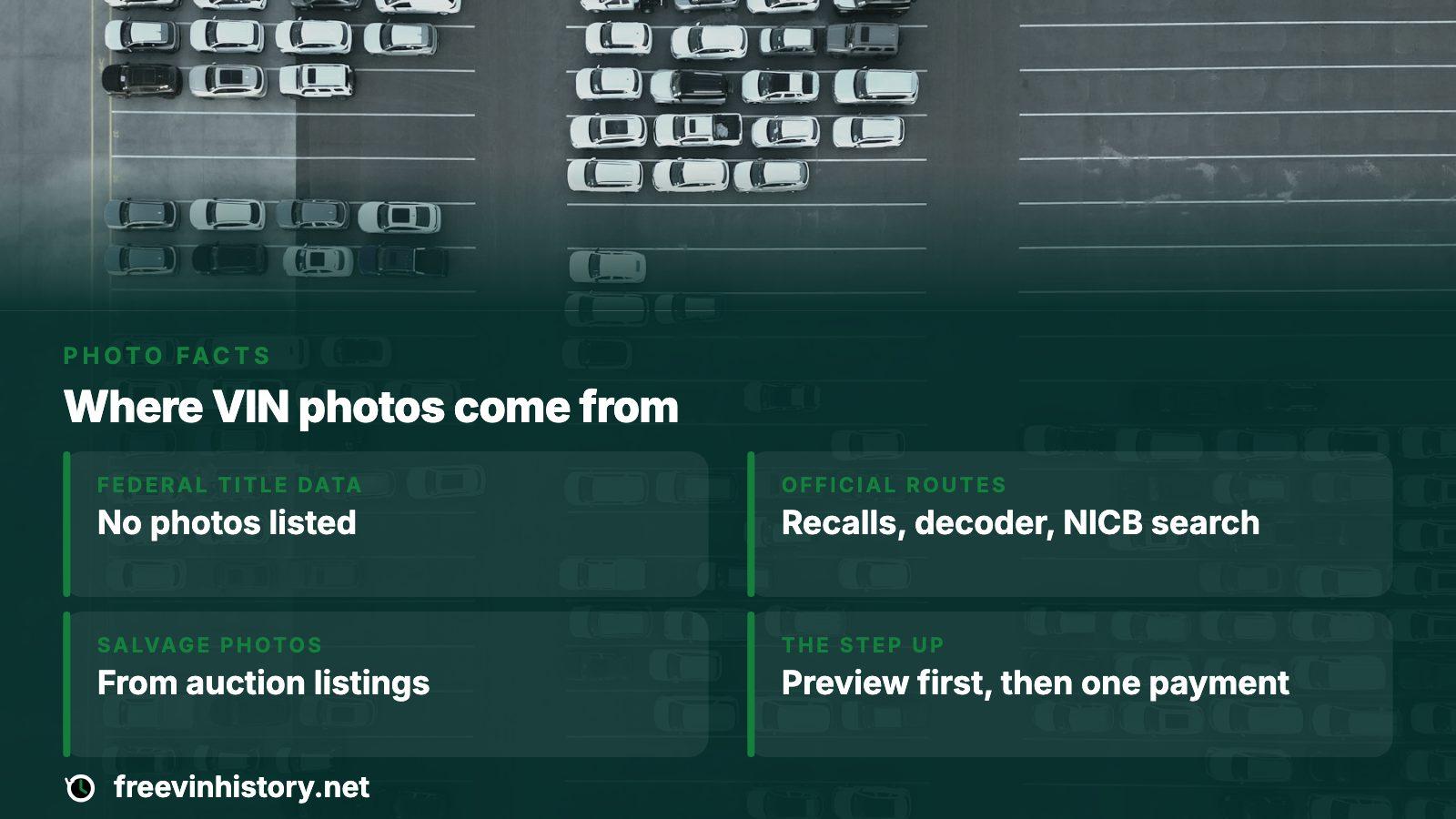
Where pictures of a salvage car actually come from
Pictures exist because somebody was selling the car. Copart's checklist for bidders urges them to go through the listing photos and to settle the title type, damage type, odometer reading, estimated repair cost and key status before bidding. Nothing in the federal reporting rule asks for the photos. The result is a lopsided trail: a car that went through an auction leaves photos behind, while a car repaired privately and never listed leaves none.
An empty photo trail proves nothing
No auction pictures only means no listing turned up for that VIN. The car may never have been auctioned, or it may have been damaged and fixed without any claim that a record captured. A blank is something to raise with both the seller and your mechanic.
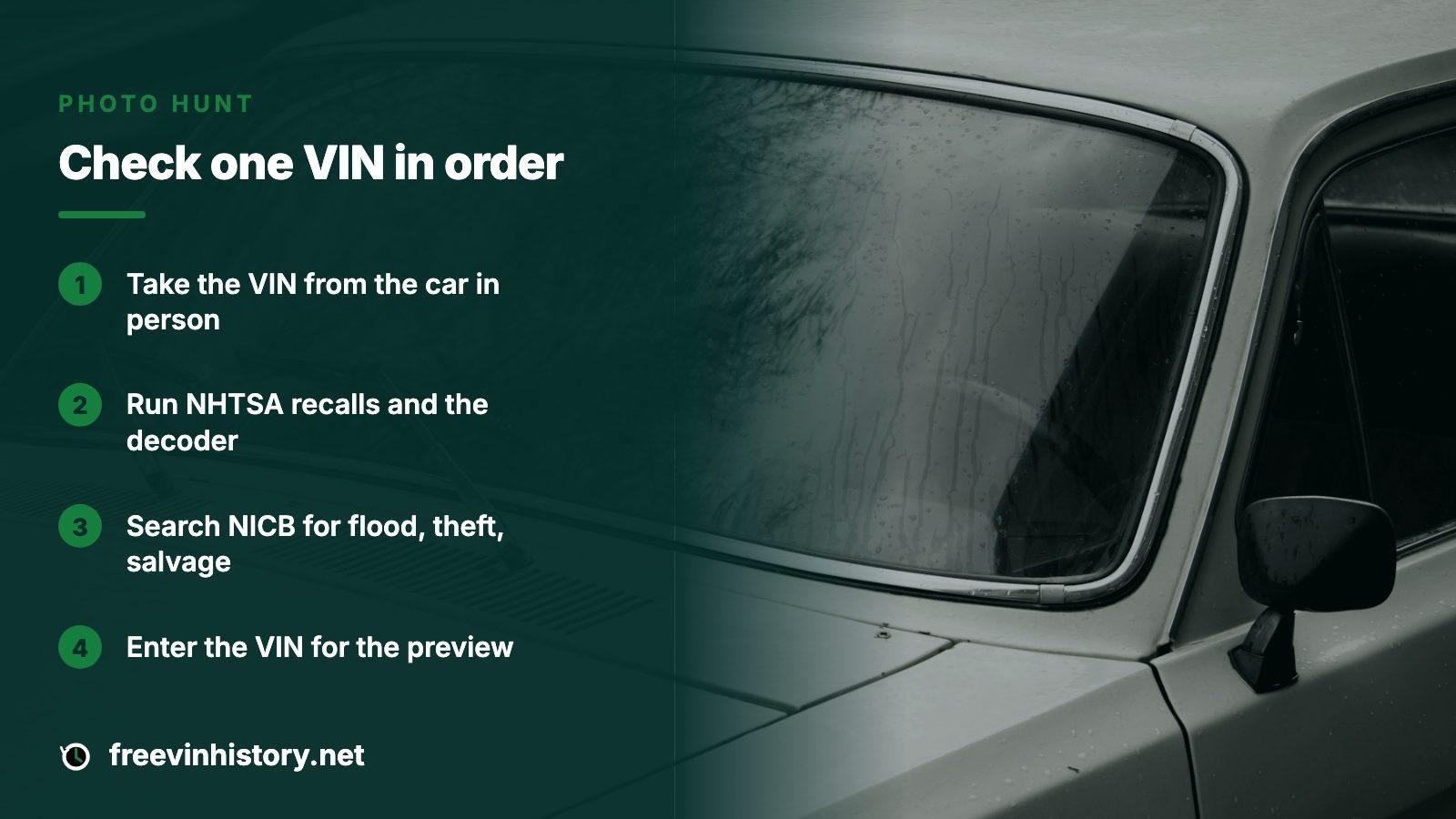
A free-first order for checking one VIN
- Take the VIN from the car in person, then check it against the listing. On a dealer lot the Buyers Guide shows the VIN too, so all three should agree.
- Run NHTSA's recall lookup and the vPIC decoder. The decoded year, engine and body style should match the listing.
- Search NICB's VIN lookup for flood, theft and salvage flags.
- Enter the VIN for the FreeVINHistory preview. It costs nothing, and it shows how many title and auction records exist before you pay for anything.
- Decide on the full report while the car is still unreserved, ahead of any deposit.
How to read the results and spot trouble
- A salvage or total-loss flag the seller never mentioned. Ask plainly, and pull the auction history before you talk price.
- A brand from another state. Brand rules differ, and some states have no flood brand at all, yet the federal system keeps every brand reported, so moving the car should not erase one.
- A write-off with no stated cause. Insurers need not give one, and auction photos are one way to fill that gap.
- Mileage that disagrees between two sources, or a reading lower than the dash shows.
- A seller who resists a dated photo set or an independent look at the car.
A clean screen is not a clean car
The Justice Department warns that reporting gaps can produce false negatives, and the FTC points out that no history report replaces a mechanic's hands-on look. Pictures of damage show you where to look. They do not certify the repair.
The pictures you can collect for nothing
The only free pictures tied to the car in front of you are the ones taken at the viewing. Ask the seller for dated shots of the interior and the VIN before you travel, then take your own. For a suspected flood car, the FTC's cues make a good checklist. Photograph what you can and note the rest:
- Silt or grit beneath the seats and behind the dash.
- Corrosion around the door openings.
- Carpet that is loose, stained or unlike the rest of the cabin.
- Musty odors, or a heavy cleaner smell in the cabin and trunk.
Saltwater is the worst case, because the Justice Department says it can leave electrical components, including the airbag sensors, prone to later failure. Compare your shots with any auction photos you find.
Where the full report picks up
The report answers what the free routes cannot. Its salvage and auction section is where pictures appear, for a car that went through an auction with photos on file. Title brands, odometer readings and insurance records sit beside it, so a flag from the free checks can be read against the detail behind it.
| Your question | Free route | Full report |
|---|---|---|
| Was it written off? | NICB flag | Insurance and salvage records |
| What did the damage look like? | No free route supplies this | Auction photos, where a listing exists |
| Was the title branded elsewhere? | Only through a provider's NMVTIS report | Title brands |
| Does the mileage hold up? | Latest reading in title data | Odometer readings |
What the preview and the report cost
The preview carries no charge and asks for no card. Buying is a one-time step: choose a single report, or step up to a pack once you have a shortlist. Pack sizes and current amounts are listed on the pricing page alone, which keeps them from drifting out of date elsewhere.
The order matters more than the price. Run the preview before you drive out, read the report before you leave a deposit, then book an independent mechanic. The FTC suggests asking for a written report with a repair estimate naming the make, model and VIN, which also gives you something to negotiate with.
Where this information comes from
- DOJ BJA: Understanding an NMVTIS vehicle history report — The five items an NMVTIS report holds and what it leaves out.
- DOJ BJA: NMVTIS for consumers — Brand rules by state, false negatives, and the saltwater warning.
- eCFR: 28 CFR Part 25, NMVTIS — What states, insurers and salvage yards must report, and that the cause of a loss is optional.
- FTC: Used cars — Free recall lookup, the VIN on the Buyers Guide, and why a report does not replace an inspection.
- FTC: How to steer clear of a flood-damaged car — What NICB's search covers, its insured-only limit for flood, and what to look for in person.
- NHTSA: vPIC VIN decoder — The federal decoder, built on manufacturer-reported data.
- Copart: Buyer education checklist — An auction operator telling bidders to review the listing photos and check title type, damage and odometer.
Sources and photos: Facts checked against the sources above in November 2026. Photos by Franck V., Tigran Shishmanyan and Iain on Unsplash; diagrams by FreeVINHistory.
Keep reading
- Free salvage title check by VIN: what the free lookups showWhat a free salvage screen can confirm about a write-off.
- NMVTIS report: what the federal title record shows and missesThe federal title record and what it holds.
- Sample reportA finished report to look over before you buy one.
- PricingSingle reports and packs, billed once with no subscription.
Frequently asked questions
Is there a free VIN check that shows pictures of the car?
Not from an official record. The federal title system, NHTSA's recall and decoder tools, and NICB's search report facts and flags, not photographs. Pictures appear when a car was listed at auction, so they sit in a full report's auction section. Run the preview first to see whether any such history exists.
Can a free salvage check show photos of the damage?
It can confirm a salvage or total-loss flag, but not the damage behind it. Insurers must report the write-off, while the cause, whether flood, fire or collision, is only encouraged. For pictures you need the auction listing, which the full report can include when one exists for that VIN.
Does an NMVTIS report include photos?
The Justice Department describes it as title status, brands, a mileage figure, and total-loss and salvage records. Photos are not among them. NMVTIS also leaves out repairs and recalls, which private providers cover separately. Check what a given provider's report includes before you buy it.
Why would a car have no auction pictures at all?
Pictures exist only if the car was listed for sale at an auction. A car repaired privately, sold outright or never claimed on can have none, and a gap does not clear it. Because reporting gaps can create false negatives, pair a blank result with an independent inspection.
What do I pay for after the free preview?
One payment covers one report, and packs cover buyers comparing several vehicles. No subscription is attached. The pricing page lists packs and amounts. The preview carries no charge and needs no card, so look at what records exist first.
Now check the car itself
The guide explains what to look for. The report shows what this VIN has on record.