THE SHORT ANSWER
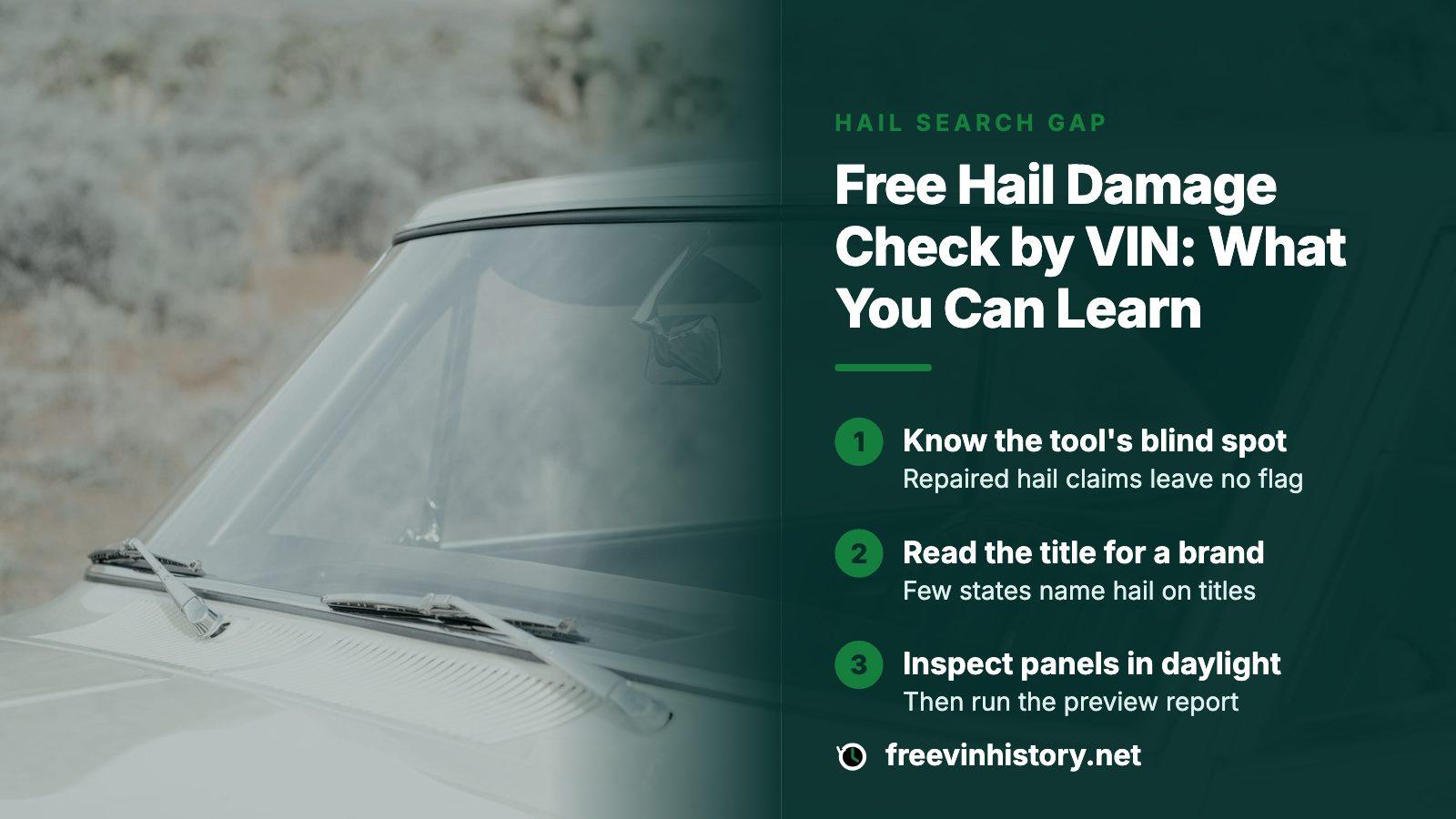
A free hail damage check by VIN is really a free salvage check with a gap. NICB VINCheck will flag a hail car only if a participating insurer reported it as salvage. A repaired hail claim, paid out and fixed, leaves no public flag. Use the free lookups, read the title for a brand, then run the preview and inspect the roof, hood and trunk lid in daylight.
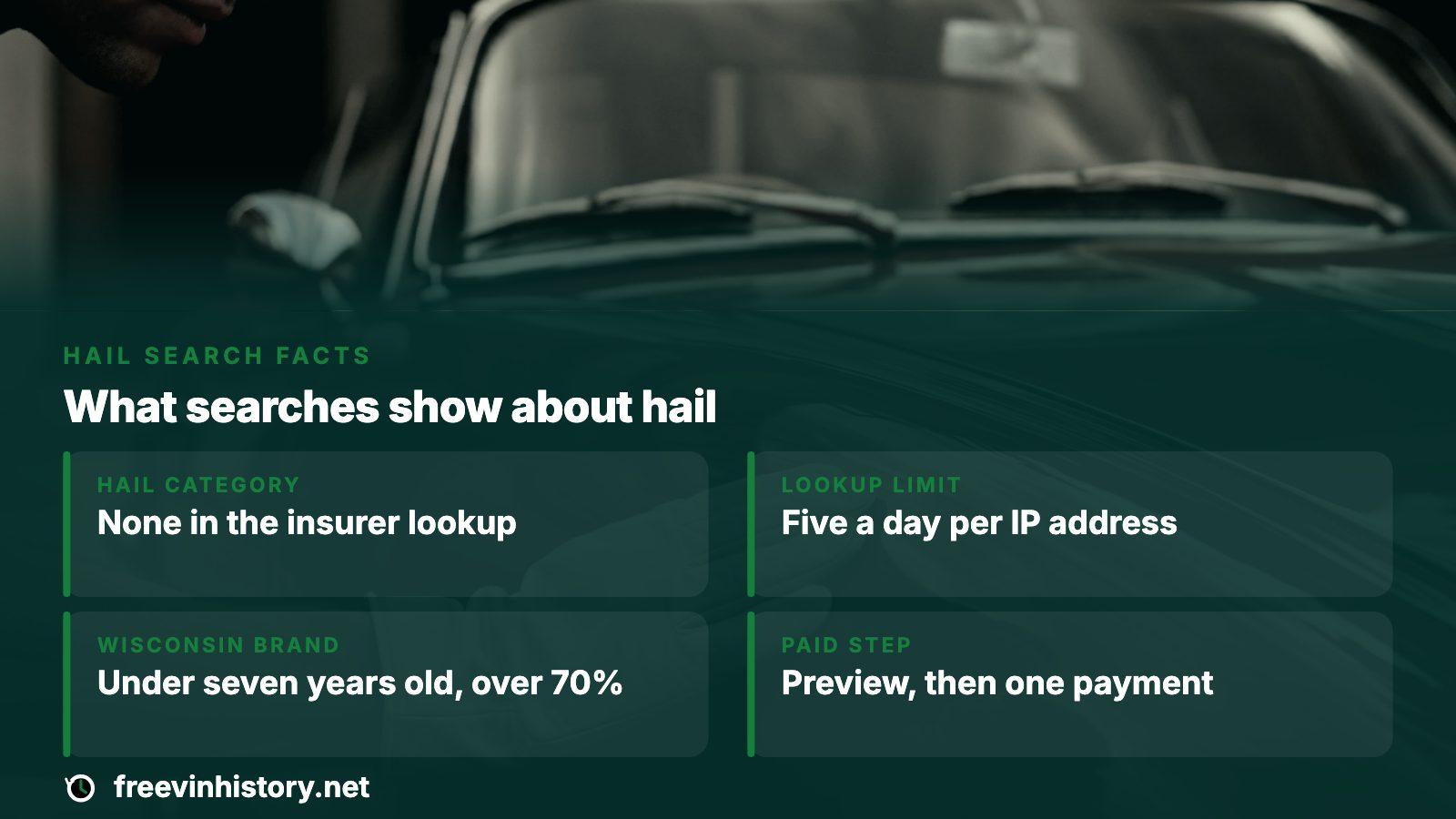
- Free tool with hail category
- None. NICB covers theft, salvage and flood only
- NICB lookup limit
- Five a day per IP address
- Wisconsin hail brand
- Under seven years old, repairs over 70% of value
- Paid step
- Free preview, then one payment for the report
Why hail is hard to search for by VIN
Hail is weather, and most databases are built around events with a paper trail of their own: a theft report, a total-loss declaration, a title brand. A car pitted by a storm and fixed with a paintless-dent repair may generate one insurance payout and nothing else. No state agency hears about it and no public flag attaches to the VIN.
That is the honest starting point for this page. What follows is how far the free sources reach, where they go quiet, and what you do at the car to cover the silence.
The free lookups worth running first
One federal tool and one industry tool carry no fee, and each answers only a small question. Neither one is labeled hail, so treat them as ways to catch the severe end of the problem.
| Free source | What it can show for a hail car | What it cannot show |
|---|---|---|
| NICB VINCheck | A salvage result if a participating insurer declared the car a total loss; theft not recovered; flood | A hail claim that was repaired, insurers that do not take part, any police record |
| NHTSA recall search | Open recalls on that VIN, useful because a stormed car may have sat unrepaired for months | Any weather damage; recalls already fixed; very new campaigns |
| The paper title | A brand printed by the issuing state, where that state uses one | Brands from states with no hail category, or damage that never reached the DMV |
NICB allows five lookups a day per IP address, counted over 24 hours, and warns that an empty result proves little. Believe it.
When a hail car does turn up as salvage
Insurers write a vehicle off when the repair bill climbs past a set share of its value. Hail can do that: a hood, roof and every panel dimpled at once adds up fast on a newer car. NICB describes a salvage result as exactly that, a company paying a claim instead of repairing the vehicle.
So a salvage hit on a car you thought was merely storm-marked is the signal to stop and ask what the claim covered. It may be hail, collision or something else, and the VINCheck answer does not say which. The seller's account and the title are the next documents to read.
From an NHTSA owner complaint
In August 2024 the owner of a 2019 Toyota RAV4 wrote to NHTSA that an insurer had totaled the car after hail. Toyota, the owner said, declined to fix a differential flaw named in a service bulletin, citing the write-off. The owner's view: the flaw predates the storm, so the title status is beside the point.
Take from this that a hail write-off can change what a maker will do for you later. Ask what the car's coverage looks like before you pay, not after.
One state that names hail on the title
Wisconsin is a useful example because its transportation department publishes a distinct hail-damaged brand. The brand is for a car younger than seven years that hail alone damaged, where the estimated or real repair cost, taking the larger, tops 70% of fair market value, and where the car was or could be fixed without replacing any non-mechanical exterior sheet metal or plastic.
Swap in even one replaced exterior panel and the same car gets a salvage brand instead. The salvage definition there carves hail out on purpose. Before a salvage car can be plated it has to clear a state inspection, after which the brand reads rebuilt salvage.
These are Wisconsin's thresholds for Wisconsin titles. Other states set their own numbers and wording, and many may print nothing about hail, so a title from elsewhere cannot be decoded with this page's figures.
Reading the title and asking the seller
Wisconsin's guidance to buyers is to look at the title's front side and put the brand question to the seller before signing. It travels well to any state. Sellers there owe a disclosure, and skipping it risks a penalty as high as 5,000 dollars, so one state clearly treats the matter as serious.
- Ask directly whether the car ever had a hail claim, and who paid for the repair.
- Request the repair invoice. A paintless-dent bill and a full panel-replacement bill describe very different cars.
- Compare the title's state with the state where the car was listed; a car that moved across a line may have shed a brand.
What to check at the car in daylight
Records cannot see a dimple. Stand the car in low sun, crouch at roof height and sight along the hood, roof and trunk lid for shallow rounded dents. Run a hand over the glass edges and look at the plastic trim, since small cracks and chalky patches show up there.
Mismatched paint sheen between panels suggests a refinish. A roof that reflects differently from the doors is worth a question. Bring a flashlight for the headlight lenses and the sunroof seal, and have a mechanic go over the underside if the asking price looks low for the trim.
Where the preview helps and where the report does
The free preview from FreeVINHistory tells you whether title, damage and auction records exist for the VIN, without a payment. That is useful triage: if it shows nothing at all, a shortlist of cars drops a name or stays put cheaply.
Once one car is a serious candidate, the full report is the step that reads the underlying entries: auction and salvage entries with photos where they exist, plus damage and accident records, title brands and mileage readings. Auction photos can show a roof full of dents that a seller's listing leaves out.
Costs, and a sensible sequence for a hail car
Starting the preview costs you nothing. The full report is a one-time buy with no renewal, and the pricing page lists the one-report and pack options. Save the purchase for the car you are about to bid on, not every listing you scroll past.
- Put the VIN through NICB VINCheck, then through the NHTSA recall search.
- Read the title and ask for the repair paperwork.
- Start the preview, and order the report for your final choice.
- Look the car over in daylight before any money changes hands.

Where this information comes from
- NICB: VINCheck lookup — what the free insurer lookup covers, its daily cap and why it has no hail category
- NHTSA: Check for recalls — what the VIN recall search shows and leaves out
- Wisconsin DOT: Title brands — the state's hail-damaged brand, its thresholds and the salvage carve-out
- NMVTIS (DOJ): vehiclehistory.gov — the federal title database's purpose and where to buy a report
- NHTSA owner complaint 11606143 — owner experience, paraphrased
Sources and photos: Facts checked against the sources above in November 2026. Photos by Wesley Tingey, Jakub Żerdzicki and Mohamed Gado on Unsplash; diagrams by FreeVINHistory.
Keep reading
- Free salvage title check by VIN: what the free lookups showWhat a salvage flag means when a hail claim ends in a write-off.
- Free open recall check by VIN: GM, Polaris and every other makeHow the NHTSA recall lookup works and what it leaves out.
- Free VIN check with pictures: what free sources show and where photos beginHow auction photos can show damage a listing hides.
- PricingHow the one-time report and the packs are priced.
Frequently asked questions
Can I check for hail damage by VIN for free?
Not directly. NICB's VINCheck reports theft, salvage and flood, and NHTSA's tool covers recalls. A hail car appears only if an insurer wrote it off or a state branded the title. Pair the free lookups with the preview and a physical inspection in daylight.
Does a clean NICB result mean no hail damage?
No. NICB itself cautions that a clear result is no promise, and only participating insurers supply the data. A hail claim that was paid and repaired may leave nothing behind. Count it as one input, then read the title and examine the panels.
Will hail damage always leave a brand on a car's title?
No. Wisconsin, for example, uses a hail-damaged brand only for newer cars with repair costs above 70% of market value. Other states differ, and many leave hail off the title entirely. Cosmetic hail damage that stayed under the threshold usually never reaches the title.
How do I find a hail-damaged car before buying?
Ask the seller about hail claims and request repair invoices, view the car in low sun, and compare panel finish. Then use the preview to see whether damage or auction records exist. An independent mechanic can confirm what the records cannot show.
Is a hail-damaged car a bad buy?
Not automatically. A cosmetically dented car can be a fair deal if the price reflects it and the repair was done well. The risk comes from a hidden write-off or poor repair. Check the title, get paperwork, and ask what the maker's coverage says.
Now check the car itself
The guide explains what to look for. The report shows what this VIN has on record.