THE SHORT ANSWER
Partly. NICB's VINCheck and NHTSA's recall search carry no fee, but neither names a lienholder, and the federal title system does not make states report one. Three routes do reach a lien: the title, the lender's own confirmation of payoff, and a state record where your DMV offers one. The preview shows how many title and auction records exist, which helps you decide on the paid report.
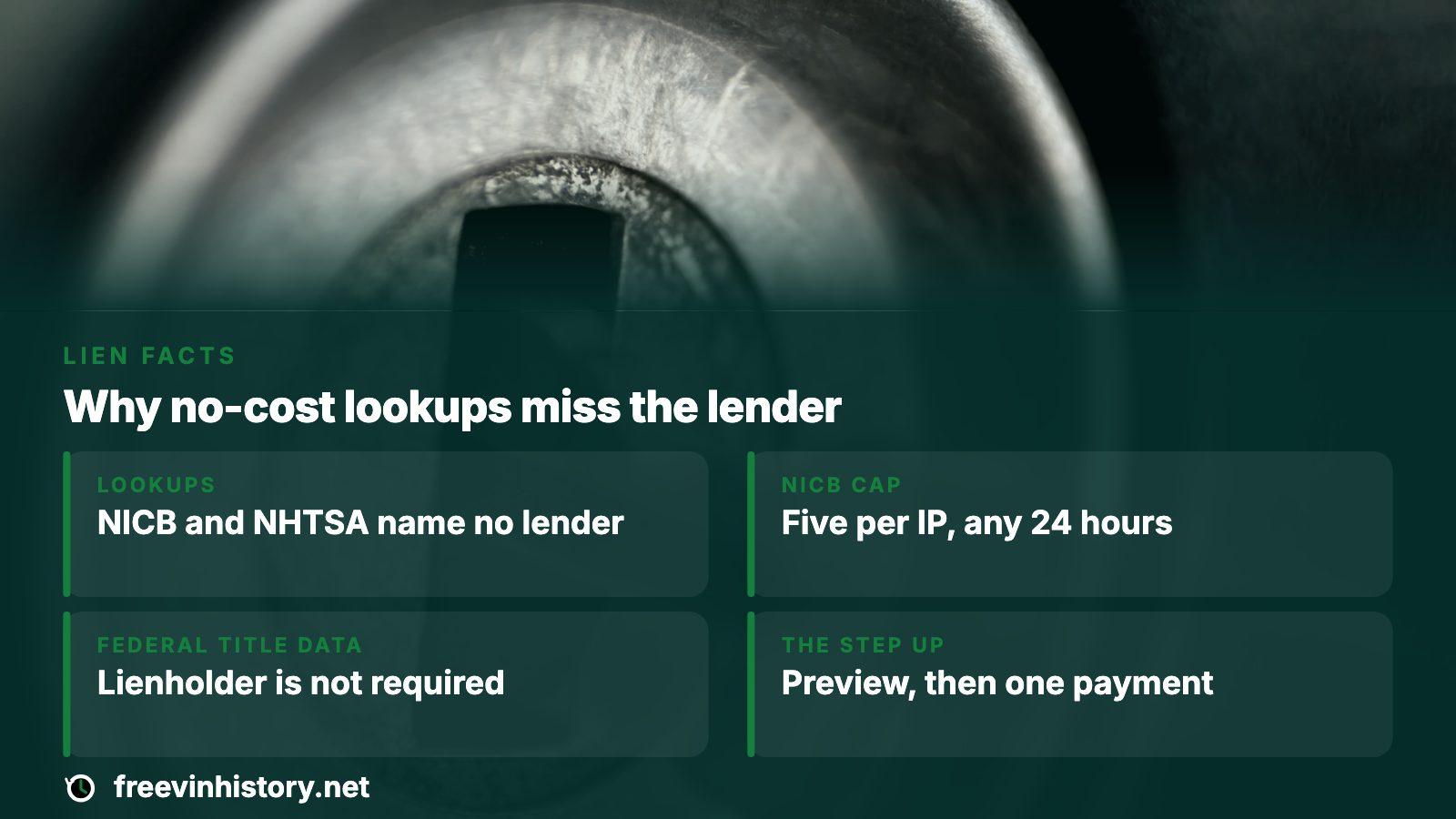
- Free lookups
- NICB and NHTSA, neither of which names a lienholder
- NICB cap
- Five per IP address within any 24-hour period
- Federal title data
- Lienholder is not a required reporting field
- The step up
- Preview at no cost, then one payment for the report
Where a lien actually lives
A lien is a lender's recorded claim on a financed car. It lives in the state's title record and the lender's files, which is why lookups built on insurer claims cannot see it.
Texas is a handy example. TxDMV says that when a car carries a lien, the lienholder receives the title, so a seller still paying off a loan may hold no paper title. Other states differ in the details. The takeaway for a buyer is the same everywhere: only the lender and the state can confirm a lien, and a seller's word or a photocopy cannot.
What the free national lookups return
Three sources top the results when people look for a lien check by VIN.
| Source | Cost | What it returns | Lien coverage |
|---|---|---|---|
| NICB VINCheck | No charge, with a daily cap | Theft reports from insurers where the car was never recovered, along with salvage and flood entries, from members covering 92.49% of U.S. earned premium (as of August 2026) | None; NICB warns encumbered titles may not show |
| NHTSA recall search | No payment step shown | Unrepaired recalls for one VIN or plate; repaired recalls and most of those over 15 years old are left out | None |
| NMVTIS report via an approved provider | Priced by the provider | Current title and brands, latest odometer reading, insurer total-loss and salvage findings, junk or salvage yard transfers | Not among the items DOJ lists |
NICB itself says VINCheck should not be a buyer's only check, and police files and insurers that declined to take part sit outside its search. A clean answer from any of the three tells you the car was not flagged for theft, salvage or recalls. It says nothing about a loan.
Why the federal title record will not name the lender
NMVTIS, run by the Justice Department, collects a short list of fields. Under 28 CFR 25.54, states are required to pass along only a handful of items: the VIN, the vehicle details printed on the title (brands included), the name of the owner, and junk or salvage acquisitions and odometer figures where the state collects or notes them.
A lienholder is not on that list. Anything beyond it flows only if the operator and the state agree, and updates are due once every 24 hours. DOJ adds that reporting is incomplete, that NMVTIS leaves out some of what a state records on a title, and that buyers should check the state's own title record. A paid NMVTIS report therefore cannot promise a lien answer either.
The no-cost checks that do reach a lien
Each step below costs only time and goes to a source that can see the loan.
- Start by asking who the lender is and whether the loan is cleared. Anyone with a live loan can name the lender and quote a payoff.
- Phone the lender yourself, using a number from its website or statements, not one the seller hands you. TxDMV tells buyers to verify financing history with the bank, finance company or agent.
- For a loan already cleared, ask for the lender's written release. In Texas, the county tax office wants a release letter or similar lender notice before it removes a lien from the record.
- With the seller present, match the seller's name and address to both the title and the registration.
- Ask your state DMV what title check it offers. A Texas tax office representative can review a title for errors and for salvage or legal flags.
How a paid-off loan becomes a clear title
A loan paid only days ago is the usual gray area in a private sale. TxDMV expects the lienholder to release the lien within 10 days of being paid, so a record still naming the lender soon after payoff may be innocent. With a paper title, the lender mails it to the owner once the lien is released. With an electronic record, the state holds the title, the lender reports the release, and the record converts to a paper title for the recorded owner.
Payoff in progress
A seller who says the loan was settled this week has not yet proved it. A release can lag payment by days, and paying on a promise means relying on the promise alone. Wait for the lender's written confirmation, or pay the lender directly so the release follows your payment.
Red flags around a lien
| Signal | Possible reading | Your move |
|---|---|---|
| Seller names a lender but calls the loan paid | The release may still be pending or unrecorded | Get the lender's written confirmation before money moves |
| Title name or address differs from the seller's | The seller may not be the owner of record | Hold the sale until the seller documents how the car arrived |
| Late-model car with no lienholder at all | NICB files this under cloned cars, which travel with counterfeit papers | Check the VIN with your DMV, order a title search, compare every paper |
| No fixed address, workplace or phone from the seller | TxDMV urges caution with such sellers | Walk away unless the lender and the state confirm the details |
Silence from a database is not an all-clear. Only the lender and the state can call a car unencumbered.
Where the preview and the paid report fit
FreeVINHistory opens with a preview that costs nothing and needs no card. Enter the 17-character VIN and it returns the year, make, model and trim, photos where they exist, the open recall count and tallies of title and auction records. It does not show a lienholder.
The tallies tell you whether the file behind a VIN is thin or busy. A busy one justifies the report, a single payment with no subscription, bought singly or as bigger sets (3, 5 or 10) for anyone comparing cars. The pricing page lists current rates. The report includes lien and impound entries where its sources have them. Since states need not send lenders to the federal title system, treat a lien line as a cue to phone the lender and an empty one as unproven.
A lien check in order, from the windshield
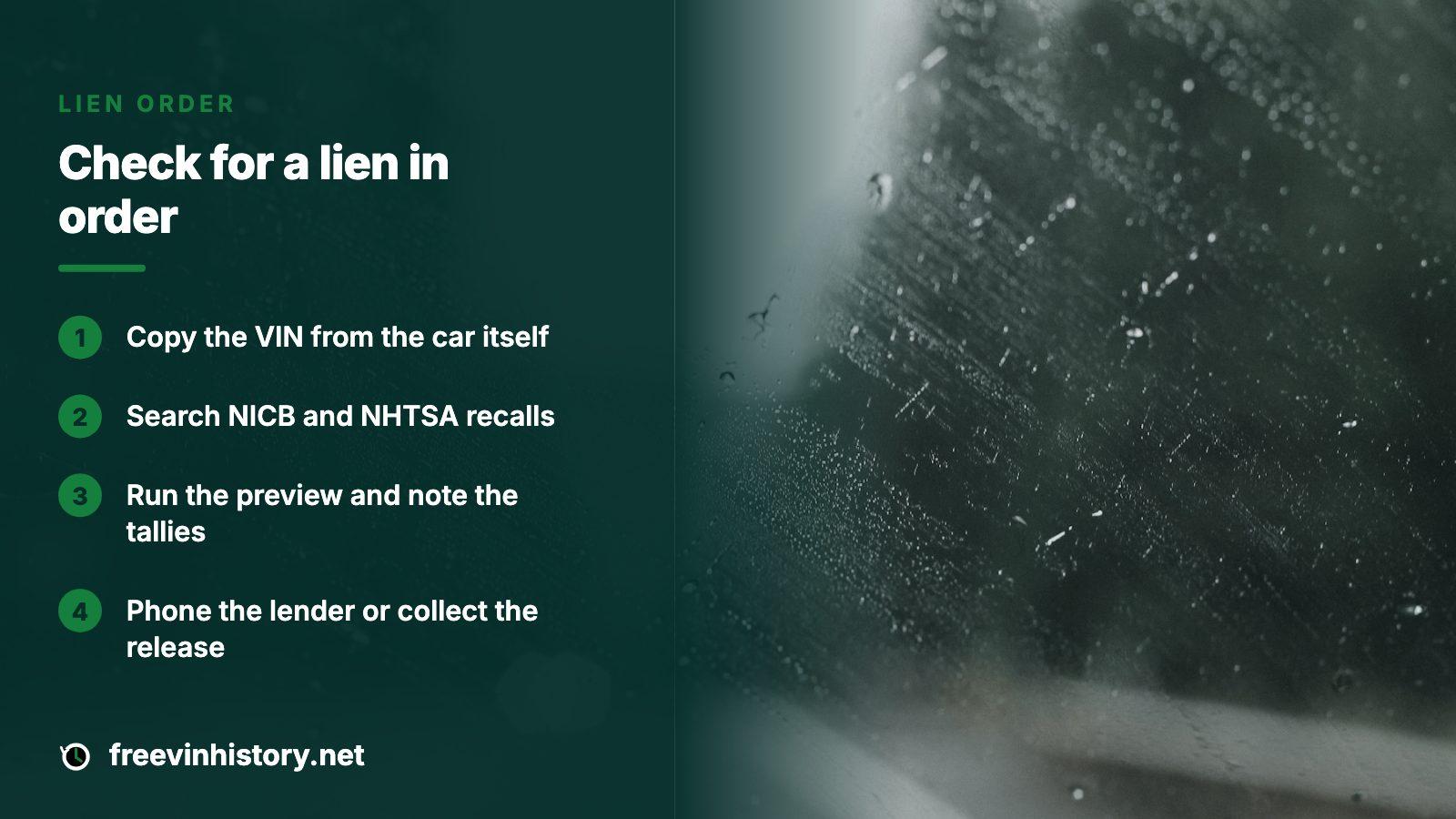
- Copy the VIN from the car itself. It sits at the lower left of the windshield, NHTSA says, with the registration card as a second place to match it. One wrong character can make a lookup miss a record.
- Search NICB's VINCheck and NHTSA's recalls. Both take seconds.
- Run the preview and note the title and auction tallies.
- Phone the lender or collect the release letter.
- Order the report only for a car you intend to buy, and read its lien and title entries next to what the lender said.
- Settle the payoff with the lender and keep the release in writing before driving away.
Where this information comes from
- NICB: VINCheck lookup — What the insurer-record search covers, its daily cap and the warning about encumbered titles.
- NICB: Buying a used vehicle — Cloning scams and the advice to question a late-model car with no lienholder.
- NHTSA: Check for recalls — What a plate or VIN recall search returns and omits, and where the VIN is printed.
- U.S. Department of Justice: NMVTIS for consumers — The records the federal title system searches and the limits DOJ states.
- 28 CFR 25.54: what states report to NMVTIS — The fields states must send, and why lienholder is not one of them.
- TxDMV: Add or remove a lien — Release timing after payoff and how paper and electronic records are cleared.
- TxDMV: Buying or selling a vehicle — Seller checks, matching the title to the seller and verifying financing with the lender.
Sources and photos: Facts checked against the sources above in November 2026. Photos by Annika Wischnewsky, Cole Keister and Derek Nelson on Unsplash; diagrams by FreeVINHistory.
Keep reading
- Free VIN check through the DMV: what a state agency will and will not showWhat a state title check adds, and where it stops, beside the call to the lender.
- NMVTIS report: what the federal title record shows and missesThe federal title record in full, including what it leaves out.
- Sample reportA finished sample, with its liens and theft tab, to read before you buy.
- PricingWhat one report costs, and the larger bundles, with nothing recurring.
Frequently asked questions
Can I get a lien check by VIN for free?
Only in part. The no-cost VIN tools return theft, salvage, flood and recall records, while a lien needs a human source: the lender, the title or a state record. The preview here costs nothing, and its record tallies show whether a paid report makes sense for that car.
Does NICB VINCheck show a lien?
No. NICB describes a search of participating insurers' theft, salvage and flood records and says other problems, encumbered titles included, may not appear. Lookups are unlimited over time but capped at five from one IP address within a 24-hour window, so a long shortlist can be spread over several days.
What deadline does a lender have once a loan is paid?
States set their own. Texas expects release within 10 days of payment, per TxDMV, after which the owner gets a paper title or an electronic release is recorded. Look up your state's rule, and ask the lender for written confirmation instead of waiting for a title to arrive.
What if the seller says there is no loan?
Ask to see the title and check that the name and address match the seller. A late-model car with no lienholder is not a green light, since NICB tells buyers to study the ownership pattern on those cars. A title search and a DMV check of the VIN come next.
Does the preview show whether a car has a lien?
No. It covers year, make, model and trim, photos where on file, the open recall count and tallies of title and auction records, with no card needed. Lien and impound entries are in the paid report, which is a single payment; the pricing page lists rates and the larger bundles.
Now check the car itself
The guide explains what to look for. The report shows what this VIN has on record.