THE SHORT ANSWER
Partly, and the part is small. A DMV keeps the title but seldom issues a buyer's history by VIN. New York's page reports the issue date and liens, Texas passes the VIN to an approved provider of national title data for a small fee, and Massachusetts words its status check for owners. Use NICB and NHTSA first, try the preview next, and spend on the report once one car is the real candidate.
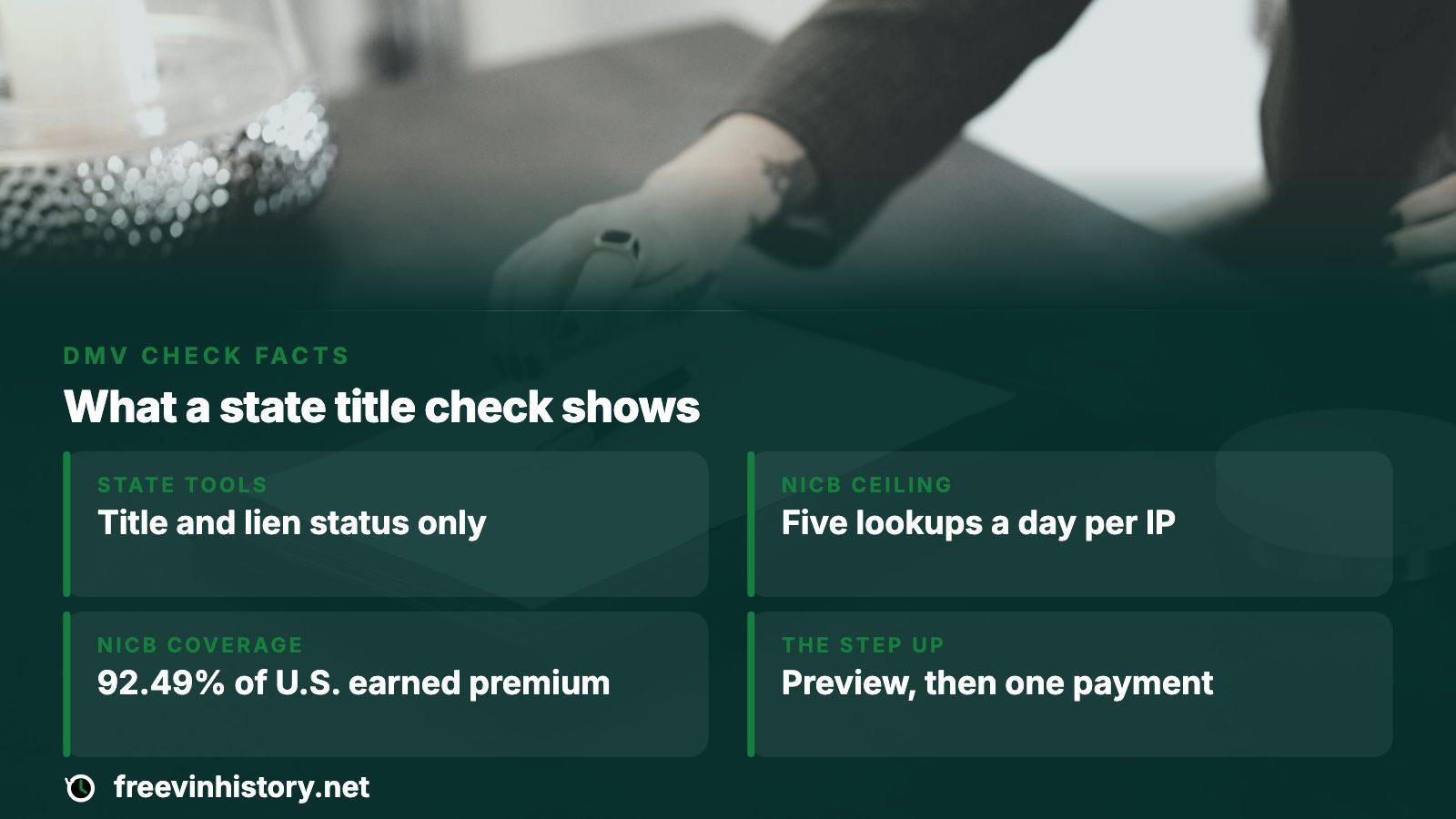
- State tools
- Title and lien status, not a full history
- NICB ceiling
- Five lookups a day per IP address, unlimited over time
- NICB coverage
- Insurers behind 92.49% of U.S. earned premium (August 2026)
- The step up
- Preview at no cost, then one payment for the report
What the DMV holds, and what it hands out
A car's title lives at the DMV. The file names the owner and any lender, and it carries the brands that follow a car after an insurer, a salvage yard or another state reports damage. One federal law, 18 U.S.C. 2721, forbids state motor vehicle offices to knowingly disclose people's personal information beyond a list of permitted reasons, among them safety and theft work, recalls, courts, police, insurers and notices to owners of towed cars. A used-car shopper is not named among them.
So states publish small tools keyed to a VIN. New York's says plainly that it shows nothing about the owner. For the car's past, those tools point elsewhere.
Three state pages, three different answers
Search by state and the pages disagree about what a buyer gets.
| State | What the page offers | What comes back | Cost and limits |
|---|---|---|---|
| Texas | A Title Check page that forwards the VIN to a Justice Department-approved provider | Past stays at a junk or salvage yard, insurer total losses, title brands | Paid at the provider; TxDMV puts the starting price at a couple of dollars |
| New York | An online title and lien status page | Title issue date, lien count, each lienholder's name and address | Wants VIN, model year and make; no fee listed; owner details withheld |
| Massachusetts | An online title status check | Issue date, mailing recipient, paper or electronic title, lienholder | No fee; the page is written for owners of Massachusetts vehicles |
None of these returns mileage trends, auction photos or theft entries. They say who holds the paper, not what became of the car.
The two national lookups to run first
NICB's VINCheck matches a 17-character VIN against theft, salvage and flood claims reported by member insurers, whose premiums make up 92.49% of the U.S. total as of August 2026. Each IP address gets five NICB searches a day, with no ceiling over time. NHTSA's tool asks something else: whether a safety recall on this particular car is still unrepaired.
- VINCheck reads participating insurers' records and nothing else. Police files are outside it, and NICB says a clean answer guarantees nothing.
- A stolen, badly wrecked or title-troubled car may return no match at all, NICB notes.
- NHTSA's search skips recalls already fixed, safety recalls past their 15th year unless the maker offers longer cover, tiny manufacturers and non-safety service campaigns.
The national title record behind the state pages
Texas hands buyers to NMVTIS, the title database the Justice Department oversees. State titling offices, insurers, salvage yards and recyclers feed it. The consumer report reduces to five indicators: where the title sits now and when it was last titled, brands, the latest odometer figure, any total loss, and any salvage record. DOJ says the brevity is deliberate.
DOJ flags two limits. A clean report may still be a false negative because reporting has gaps, and states define brands differently, so a car called salvage in one state may carry no brand in the next. The system also omits some of what a state records on its own title, so DOJ suggests requesting that record before deciding.
Approved providers sell the reports, and the DOJ page names no price. Per TxDMV, a few big history brands sell NMVTIS data to dealerships alone.
A sequence that begins at the vehicle
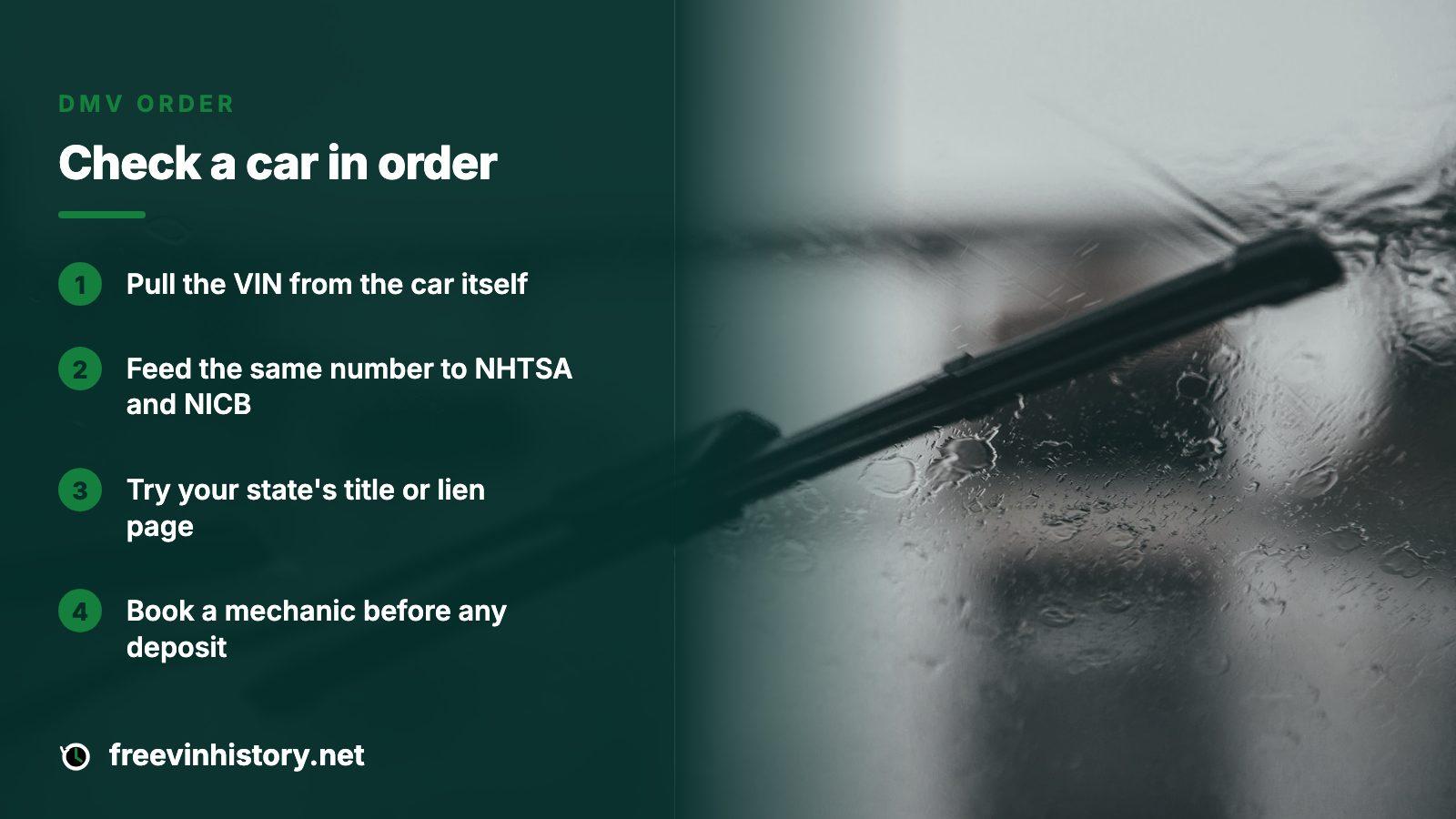
- Pull the VIN from the car itself, standing outside and peering in at the dash corner nearest the driver, then check the sticker on the door or jamb. Both should match the title and the insurance paperwork, since a single wrong character derails every search.
- Feed the same number to NHTSA and to NICB.
- Try your state's title or lien page, if one exists. Insist on seeing the paper title too, since TxDMV advises against closing a private sale without it, and check its VIN against the car.
- Run the preview for the year, make, model and trim, any photos on file, the open-recall count and the title and auction tallies. No card is asked.
- Save the report for a car you are prepared to buy, and request the state title record if it lists a brand.
- Book a mechanic before a deposit changes hands. DOJ urges an independent inspection on top of a title report.
Reading the answers: brands and red flags
TxDMV's brand list is a handy decoder, though states word brands differently.
- Salvage: damaged beyond a jurisdiction's cost threshold, yet rebuildable.
- Rebuilt: ex-salvage that passed the required inspections.
- Junk: no title or registration, ever again.
- Water damage: flood water was the cause.
- Odometer: recorded mileage is untrue.
- Manufacturer buyback: returned or repurchased, as lemon laws provide.
- New state-assigned VIN: not a defect by itself, but research it.
Patterns matter as much as labels. A lender named on the state page after the seller swore the car was clear is one. A flood car with a spotless title is another; NICB says it happens when the owner never filed a claim. Title washing, meaning a damaged car retitled through another state, hides the same thing. Cloning is worse: a thief copies a lawful car's VIN onto a stolen one, and the buyer never legally owns it. NICB's counter is to have the state agency check the VIN, run a title search, and look hard at who owned any recent model that shows no lienholder.
A title record is not a condition report
Title pages speak to paper history only. TxDMV's page sends buyers to a separate history service for accident repair records and to a mechanic for the car's condition.
Where the free route stops
Stack up the lookups and you hold recall status, insurer-reported theft and salvage flags, a title date and maybe a lien count. That works as a screen and falls short as a biography of the car.
Absent are accident records, mileage readings across years, auction photos, and impound and lien entries. NICB says full reports reach beyond insurers to DMV title records and auction data, and most carry a fee. The paid report here gathers those entries for one VIN.
The preview, the report and the cost
The preview costs nothing and works as a counting step. A title or auction tally above zero means records exist and merit a full read before you haggle. A zero shrinks the doubt without ending it, since damage that nobody reported sits in no database.
The report is one payment. Choose one report, or stock up with 3, 5 or 10 when the shortlist runs long. Nothing renews, and no subscription exists. The pricing page has current rates. Order before you hand over a deposit, while what you learn can still move the price or end the deal.
Where this information comes from
- NICB: VINCheck lookup — What the insurer-record search covers, its daily cap and NICB's own warning about relying on it.
- NHTSA: Check for recalls — What a VIN recall search returns and the categories it leaves out.
- U.S. Department of Justice: NMVTIS for consumers — Where federal title data comes from and the limits DOJ states for it.
- Texas DMV: Title Check, look before you buy — How a state page routes buyers to approved providers, with its brand list and wrong-brand steps.
- New York DMV: Check a title or lien status — The fields a state title and lien page returns and what it keeps out.
- Massachusetts RMV: Check the status of your vehicle's title — A state title status check with no fee, and the details it returns.
- 18 U.S.C. 2721: release of motor vehicle record information — The federal privacy limit on what a state motor vehicle agency may release, and the permitted uses.
Sources and photos: Facts checked against the sources above in November 2026. Photos by Richard R, Thibault Valjevac and Annika Wischnewsky on Unsplash; diagrams by FreeVINHistory.
Keep reading
- Car lien search free: what the free tools show and what they missLien questions in depth, including the call to the lender that settles them.
- NMVTIS report: what the federal title record shows and missesThe federal title record in full, including what it leaves out.
- Free salvage title check by VIN: what the free lookups showWhat free tools can and cannot say about a salvage or rebuilt brand.
- PricingWhat one report costs, and the larger packs, with nothing recurring.
Frequently asked questions
Is there a free VIN check through the DMV?
Some states offer a narrow one. New York's page reports a title issue date and liens, and Massachusetts lists no fee for its status check. Neither speaks to damage or mileage. For brands you go through approved providers of national title data, and the preview here tallies title and auction records first.
Why doesn't the DMV pull a history on a car I don't own?
Federal privacy law limits what state agencies release from motor vehicle records, and a private shopper is not a named use. New York's page, for instance, shows no owner details at all, only the title and lien facts. A national title report is the practical route for a buyer.
A title check shows a brand I think is wrong. What now?
Take it up with the state that applied it. TxDMV says to obtain a signed statement on that state's letterhead saying its records lack the brand or applied it by mistake, then send it, along with a request to drop the brand, to the Vehicle Titles and Registration Division, which decides whether a clean title issues.
If NICB comes back clear, was the car never wrecked?
Not necessarily. VINCheck holds only what participating insurers filed about theft, salvage and flooding, so damage that never became a claim with one of them leaves no record to match. NICB itself urges more due diligence, and recommends a full report if something is flagged.
How does an NMVTIS report differ from a full history report?
The federal consumer report is short on purpose, with five indicators. DOJ says private providers add repair and recall information that NMVTIS lacks. A history report layers accident and damage records, mileage readings and auction photos over the title brands, which is why reading both helps.
Now check the car itself
The guide explains what to look for. The report shows what this VIN has on record.