THE SHORT ANSWER
Not with a single lookup. NICB's VINCheck reports theft, salvage and flood records, and NHTSA's recall search reports open recalls, so neither shows mileage. Readings live in title records, which the federal NMVTIS system gathers and approved providers sell. What costs nothing: compare the title with the dash, read service paperwork, inspect tires and pedals. The preview here shows whether title and auction records exist, and the paid report lists the odometer entries.
- Free official lookups
- NICB VINCheck and the NHTSA recall search, neither of which returns mileage
- Where readings are kept
- Titles, state files and the federal NMVTIS report
- Federal civil remedy
- Three times the loss, with a $10,000 floor
- What the preview shows
- Counts of title and auction records, not odometer readings
What the free official lookups actually return
Two lookups come up in every used-car checklist, and neither reports mileage. NICB's VINCheck takes a 17-character VIN and looks for insurer-filed theft, salvage and flood entries. The NHTSA recall tool reads the same VIN against manufacturer safety campaigns that still await a repair. Run both, but a clean answer from either tells you nothing about whether the dash number is honest.
| Source | Cost | What comes back | Mileage? |
|---|---|---|---|
| NICB VINCheck | No charge; five lookups per 24 hours from one IP address | Insurer-reported theft, salvage and flood flags | No |
| NHTSA recall search | No charge; up to 100 VINs per search | Open safety recalls for that VIN | No |
| NMVTIS report (Justice Department) | Paid, through an approved provider | Title state and date, brands, total loss, salvage, latest odometer entry | Yes, the latest entry |
| The paper title | No charge | Mileage the seller declared at transfer | Yes, as declared |
Where odometer readings are really stored
Mileage gets written down whenever a car is sold or inspected. Each sale puts a mileage statement on the title, and the Justice Department's NMVTIS collects what state title offices, insurers, auto recyclers and salvage yards file with it. Its short report keeps the latest reported odometer entry as one of five indicators. Consumers buy that report from an approved provider, and the department's list shows no prices.
Coverage has gaps. NMVTIS represents roughly 87 percent of U.S. vehicles, yet not every state reports into it, and the Justice Department warns that a search can come back falsely empty. States also hold fuller title files than the federal copy, and each NMVTIS report explains how to request the state's version. The department advises learning each state's rules before leaning on any report.
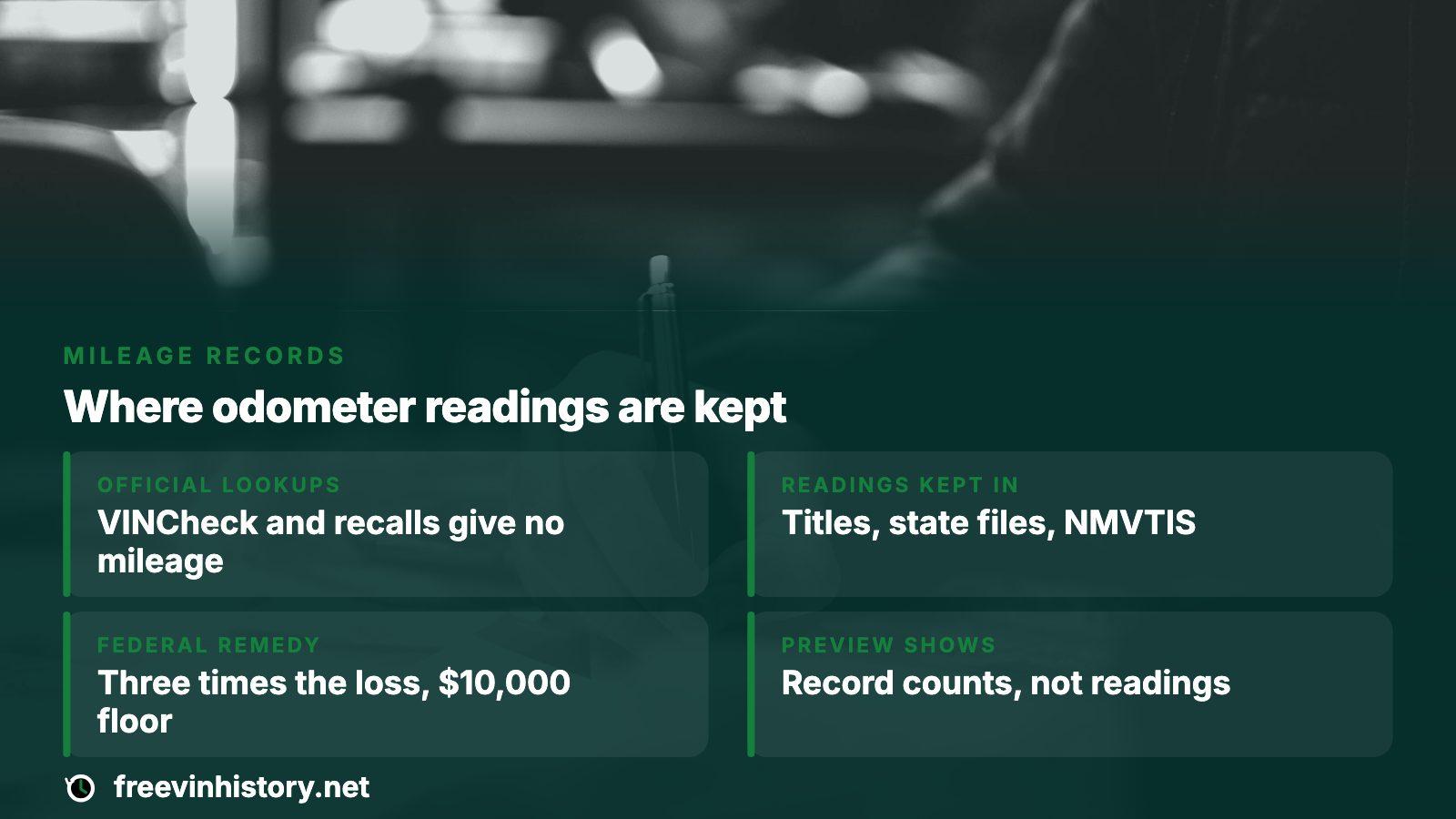
Checks that cost nothing and work on any car
NHTSA estimates that more than 450,000 vehicles are sold every year with a false reading, so test the number rather than trust it. The most useful tests are physical:
- Compare the mileage written on the title with the dash. A smudged, blank or hard-to-read entry is a reason to slow down.
- Gather anything carrying a mileage: service invoices, inspection papers, oil-change stickers on the windshield, door frame or glove box.
- Check the tires. A display of 20,000 miles or less should still carry the original set.
- Study the pedal rubber for gas, brake and clutch, and weigh its wear against the dash figure.
- Confirm the VIN on the car agrees with the title and registration, then run NICB and the recall search.
A tampered digital odometer is harder to catch than a mechanical one, NHTSA warns, since no visible drum or gear is left to inspect. Records outrank the display.
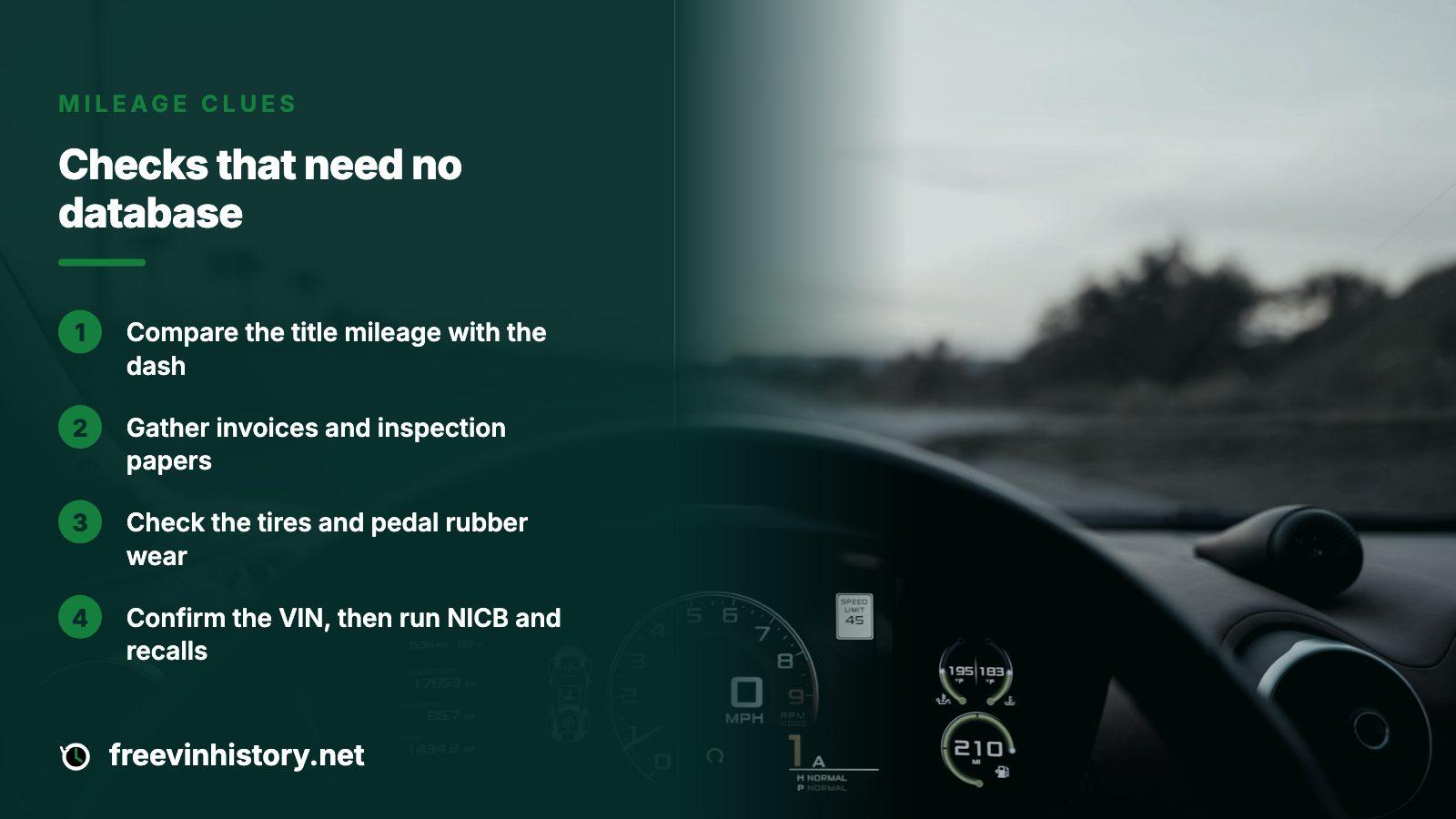
Run the VIN before any money moves
Copy all 17 characters from the plate by the driver's side of the dash, then again from the registration or insurance card, and make sure they agree. A number in an advert is whatever the seller typed. After NICB and the recall search, enter it in the FreeVINHistory preview to see the car's identity and tallies of title and auction entries. The preview is a first look, not a mileage readout.
From an NHTSA owner complaint
A shopper looking at a 2014 Ram 1500 at a local dealer saw 138,000 miles on the odometer. A history report obtained before buying listed 251,000 miles for 2023, so the truck was never bought, and the dealer had not yet heard about the gap.
The lesson is timing. The report was read before payment, and an earlier entry above the dash figure is exactly the mismatch to put to a seller in writing.
How to read a mileage history for red flags
Line the readings up by date. They should only climb, at a pace the car's life could explain. Anything else needs an answer you can verify.
- A later entry lower than an earlier one, or a dash figure below a dated record.
- A title that states one mileage while the registration or a repair invoice states a very different one.
- A blank mileage line on the title, or wording that the true mileage is unknown. A seller is obliged to flag a reading known to be wrong, so that label is candid, but it should move the price.
- A leap between two dates far larger than any ordinary year of driving.
A thin record proves little either way. States differ in what they report, so a short list may reflect the state, not the car.
What the law says about mileage at the point of sale
Federal law requires a written mileage statement from the seller on the title at transfer, plus a note that the reading is wrong when the seller knows it is. Vehicles of model year 2010 or older are exempt from that statement, and so are vehicles 20 years old or older.
It is a federal crime to disconnect, reset or alter an odometer in order to change the mileage it shows, or to use a device that makes it read wrong. Someone who can show intent to defraud may recover triple what the fraud cost them, with $10,000 as the floor, plus costs and reasonable lawyer's fees. The deadline to sue is 2 years after the claim arises.
Where the free preview stops and the mileage detail starts
The FreeVINHistory preview costs nothing and needs no card. For a VIN it returns the car's identity, photos when the records include them, an open-recall tally and how many title or auction entries exist. It does not list odometer readings.
A count above zero is a reason to read the records. The full report adds odometer readings by date, accident and damage entries, title brands, and photographed salvage and auction history, so you can set one date against another rather than guess from the dash. A single purchase covers one report; for a shortlist there are bundles of 3, 5 or 10. Nothing is subscribed or auto-renewed, and amounts sit on the pricing page alone.
When the numbers disagree: what to do next
A mismatch is evidence, not a verdict. Keep copies of the listing, the title, the registration and every report, then put the gap to the seller in writing and wait for an answer you can check.
From an NHTSA owner complaint
The buyer of a 2018 Chevrolet Silverado 1500, bought in a private sale, learned at registration that the title was incorrect and the mileage did not line up. The mileage at registration was 43,000, while a history report indicated 149,000.
The signed title is only as honest as whoever signed it, so check records before the sale. If you have already paid, NHTSA says an individual case goes to your state enforcement agency, while a large-scale scheme goes to its Vehicle Safety Hotline, 888-327-4236. Its odometer office cannot pursue a consumer's claim and suggests talking to a private attorney. A mechanic's inspection still catches wear that no record lists.
Where this information comes from
- NHTSA: Odometer fraud — The buyer checks NHTSA recommends, the disclosure rule and exemption, and who takes complaints.
- NICB: VINCheck lookup — The three record types the free lookup returns, its daily limit and the gaps NICB states.
- U.S. Department of Justice: NMVTIS for consumers — The odometer entry in the federal title system, its coverage figures and reporting gaps.
- NHTSA: Check for recalls — What the VIN recall search returns and how many VINs go through in one bulk search.
- 49 U.S.C. 32710: civil actions by private persons — Treble damages or a set minimum, the two-year deadline and attorney's fees.
- NHTSA owner complaint 11715460 — owner experience, paraphrased
- NHTSA owner complaint 11702678 — owner experience, paraphrased
Sources and photos: Facts checked against the sources above in November 2026. Photos by Nathan Dumlao, Dennis Eusebio and Owen Michael Grech on Unsplash; diagrams by FreeVINHistory.
Keep reading
- NMVTIS report: what the federal title record shows and missesThe federal title record that carries the latest reported odometer entry.
- Free Carfax service history: what exists at no cost and what does notService stamps and invoices as a second set of dated mileage evidence.
- Sample reportA look at how odometer readings sit beside title and auction records.
- PricingWhat one report costs, plus packs of 3, 5 or 10, with nothing recurring.
Frequently asked questions
Can I check a car's odometer for free by VIN?
Not through a lookup that returns readings. The free NICB and NHTSA tools cover theft, salvage, flood and recalls. At no charge you can compare the title with the dash, read maintenance paperwork, inspect tires and pedals, and run the preview to see whether title and auction records are on file.
Is there a free Carfax odometer check?
Carfax is a separate company with no connection to this site, so its own pages show what it gives away. If the seller already holds a report from any provider, ask to read its odometer entries. Otherwise use the official steps above and the preview, then buy a report for the finalist.
Can a digital odometer be tampered with?
Yes. NHTSA says a tampered digital odometer is even harder to detect than a mechanical one, since nothing visible moves. Its advice is to read the car's condition together with a detailed history report. Pedal, seat and tire wear should fit the number, and dated records should climb steadily.
Does an NMVTIS report show the odometer reading?
It shows the latest reported reading, one of only five indicators in a short report, and consumers buy it from an approved provider. Because state reporting is still incomplete, an empty result is not proof of a clean history. Treat it as one source among several.
What if the mileage looks wrong after I already bought the car?
Save every document and report, then contact your state enforcement agency about an individual case. A successful fraud claim can pay triple the actual losses or $10,000, whichever is higher, but the suit has a 2-year clock. NHTSA advises consulting a private attorney about your options.
Now check the car itself
The guide explains what to look for. The report shows what this VIN has on record.