THE SHORT ANSWER
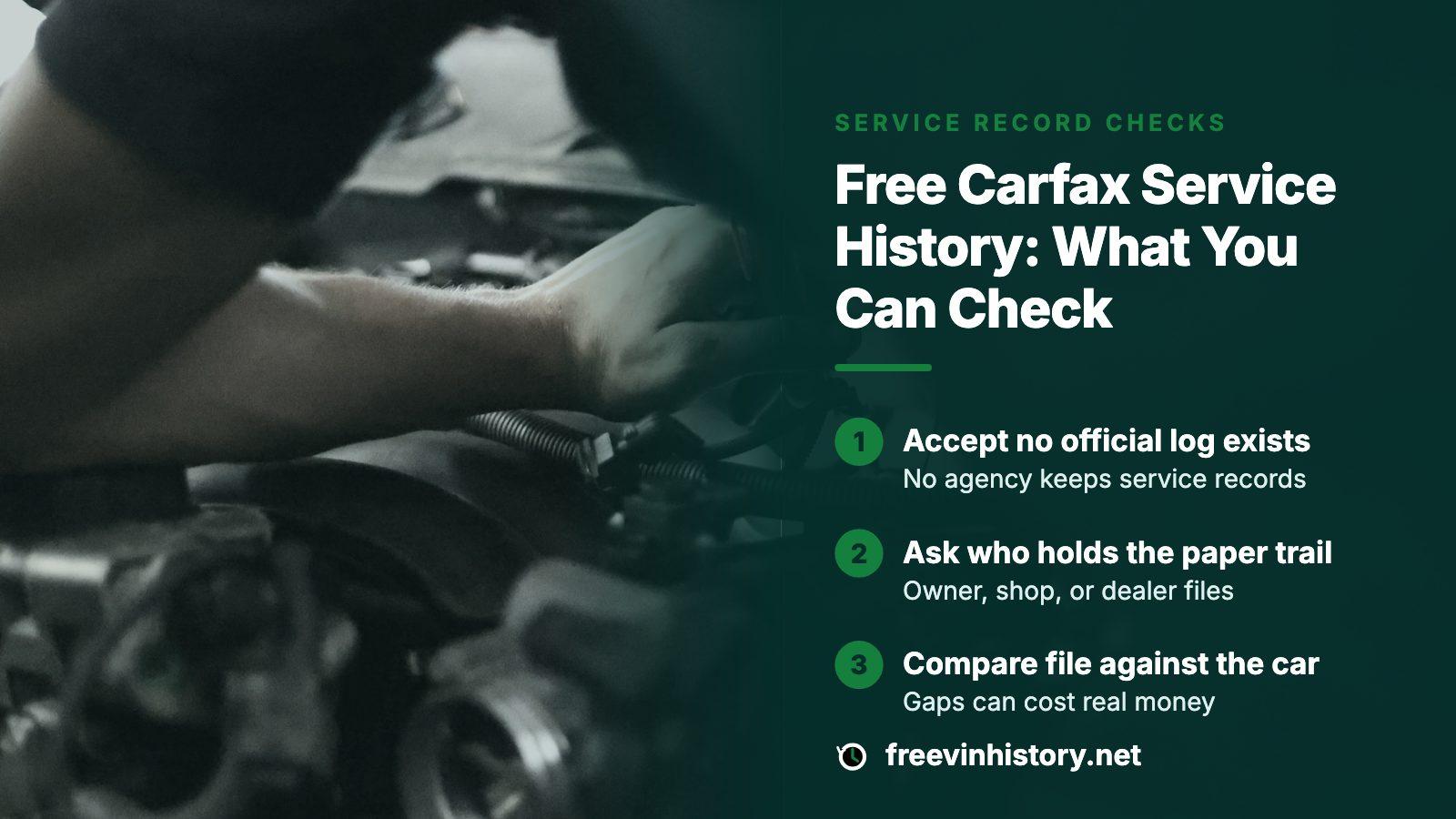
No government or no-cost official tool holds a car's service history. NHTSA's recall search, its VIN decoder and NICB's VINCheck cost nothing, but they cover recalls, factory data, theft and salvage, not maintenance. For your own car, collect repair orders from the shops. As the buyer, put the question to the seller and the shop, then run the free preview before deciding on a report.
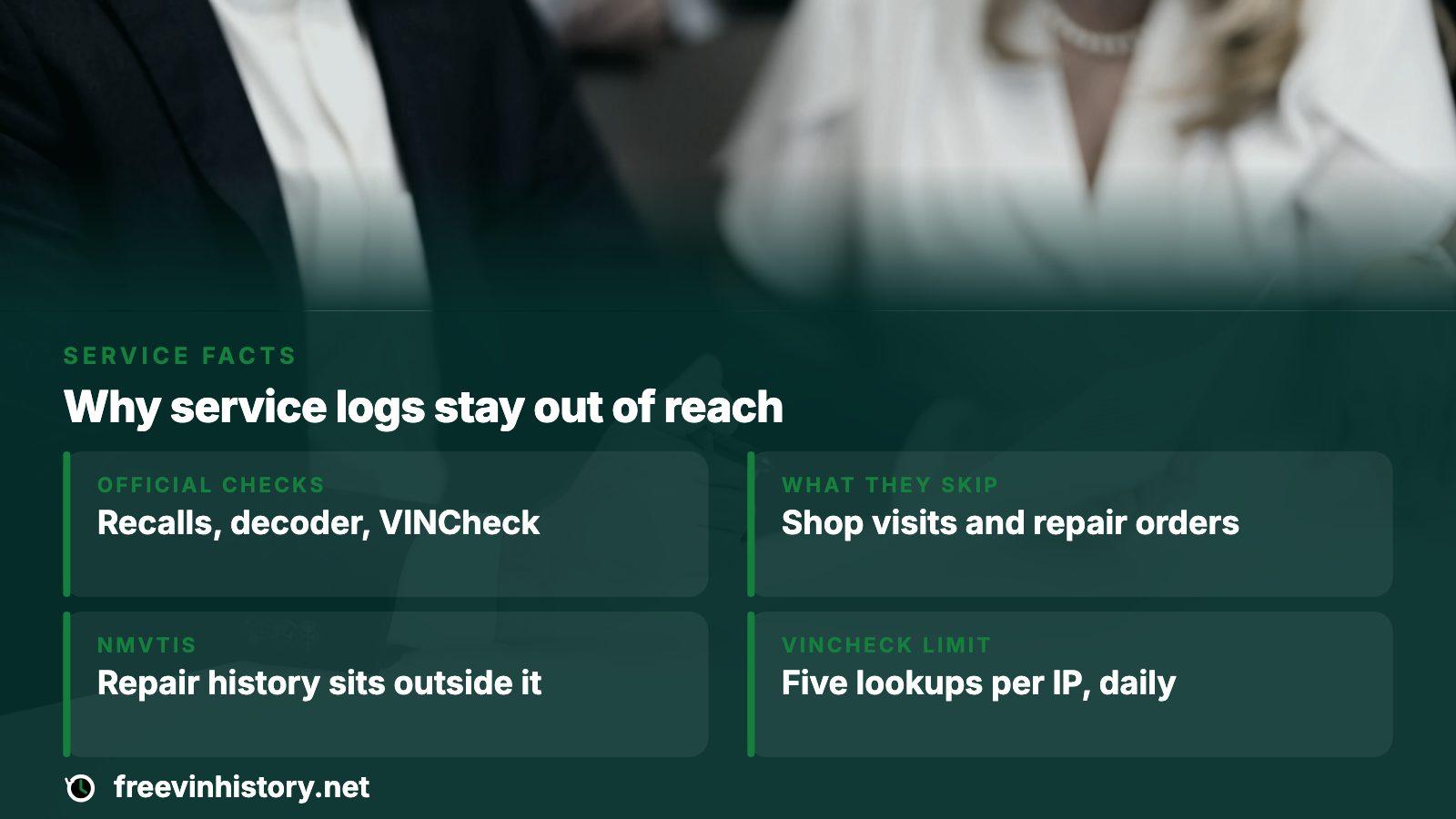
- No-cost official checks
- NHTSA recall search, NHTSA VIN decoder, NICB VINCheck
- What they skip
- Shop visits, repair orders and routine upkeep
- NMVTIS and repairs
- Repair history sits outside the federal title system
- VINCheck limit
- A daily cap of five lookups from one IP address
Why no free source keeps a service log
Government databases track titles, recalls and complaints. None was built to record what a shop did to one car on one afternoon. The Justice Department's title system, NMVTIS, says plainly that repair histories and maintenance data come from private providers and sit outside it. NICB, the insurance-industry non-profit behind VINCheck, draws the same line in its own FAQ: reports that pull in service history exist, and most of them cost money.
That is the honest answer to the search. A free Carfax service history is not something any official tool can hand over, and FreeVINHistory has no tie to Carfax or any other report brand, so what those reports list and charge is a question for their own sites. The sections below cover the routes that do cost nothing.
What the no-cost checks show, and what they skip
| Check | Run by | Shows | Skips |
|---|---|---|---|
| NHTSA recall search | Federal agency | Recalls on that VIN still waiting for a repair | Recalls already repaired, recalls past the 15-year mark, maker campaigns that are not safety recalls |
| NHTSA VIN decoder | Federal agency | Build details the maker filed: plant, engine, body style | Owners, repairs, how the car was used |
| NICB VINCheck | Insurance-industry non-profit | Theft, salvage and flood entries that member insurers reported | Police records and insurers that do not take part |
The recall row is the one that touches service. A dealer's recall repair is a service visit, yet the federal search lists only recalls still open. A clean result means nothing is outstanding on that VIN. It does not show that a repair was done, or where, so ask for the paperwork.
For your own car: build the file yourself
An owner's best no-cost source is the shop. After any visit, ask for the completed repair order and check that it names the work, the parts and the odometer reading when the car came in and went out. Photograph it the same day and file it by date. Follow the maker's schedule in the owner's manual, since a gap in the file is hard to explain later.
From an NHTSA owner complaint
The owner of a 2010 Honda Accord told NHTSA that a spark plug fouled again in late 2018, after a warranty campaign covering the problem had ended. The dealer said a goodwill repair would depend on seeing every maintenance record. The earlier dealership could not supply its older files because it had been bought out, so the owner paid for the repair.
Take from it that a shop's file is not yours. Dealerships change hands and systems get replaced, and a request for old records can come back empty. Your own copies are the only set nobody else controls.
Buying a car: who may hold the paper trail
| Who | What they may hold | How to ask |
|---|---|---|
| The seller | Receipts and repair orders kept over the years | Ask to see the whole folder before the test drive and read the mileage on each page |
| The shop or dealership that did most of the work | Its own file of visits on that car | If the seller has no copies, ask whether the shop will share its file |
| The previous owner | The story from before the current seller | Worth a call when the seller knows little about the car's past |
| The state titling agency | A complete copy of one title record | Request the record for that VIN instead of relying on a summary |
Paper shows what was billed, not what was done, and a thin folder is not proof of neglect. Treat every record as a claim to test. A seller with nothing at all has told you something about price too: the car has to earn its way on inspection results.
When a blank history costs real money
The cost of an empty file tends to arrive late, at the first big repair.
From an NHTSA owner complaint
An owner who bought a 2018 Honda Accord used, at about 90,000 miles, wrote that they kept to the recommended maintenance afterward. At about 120,000 miles a dealership found a failed head gasket, a repair of roughly $5,000. Honda turned down a request for goodwill help: the car was out of warranty, and the company said it held no dealership service history for it.
Whatever upkeep the owner did, Honda saw no dealership record, and that absence was part of the refusal. Ask for older invoices before you pay, not after the engine fails. If none exist, price the car as one with unknown upkeep and let an independent mechanic's inspection set the number.
Reading a service file against the car itself
Go through the pile twice, once for what it says and once for what the car shows. These mismatches deserve a direct question to the seller:
- Mileage that stalls or slips backward between visits.
- Long silences, where the car clearly kept running but no entry exists.
- Receipts from a shop you cannot reach by phone or find on a map.
- A tidy folder on a car with worn tires, a lit dashboard warning or damp seals.
- No recall paperwork on a model that has open recalls, which the NHTSA lookup will reveal by VIN.
Where a full report earns its place
FreeVINHistory's report is not a maintenance log and will not list oil changes or brake jobs. Its use is the cross-check. It carries odometer readings from other records, title and salvage history, and accident and damage records, so the seller's folder can be held up against something the seller did not write.
| The folder suggests | The report can show |
|---|---|
| Low mileage and steady upkeep | Odometer readings from other records to compare with the invoices |
| Never in a crash | Accident and damage records, plus any insurance loss |
| A clean title | Title brands such as salvage or flood |
| Recalls handled | Open recalls, which the NHTSA search also shows at no cost |
The preview is free and comes first. A report is a single payment, and anyone comparing several cars can buy a bundle instead, sized 3, 5 or 10. Nothing renews, and prices sit on the pricing page only.
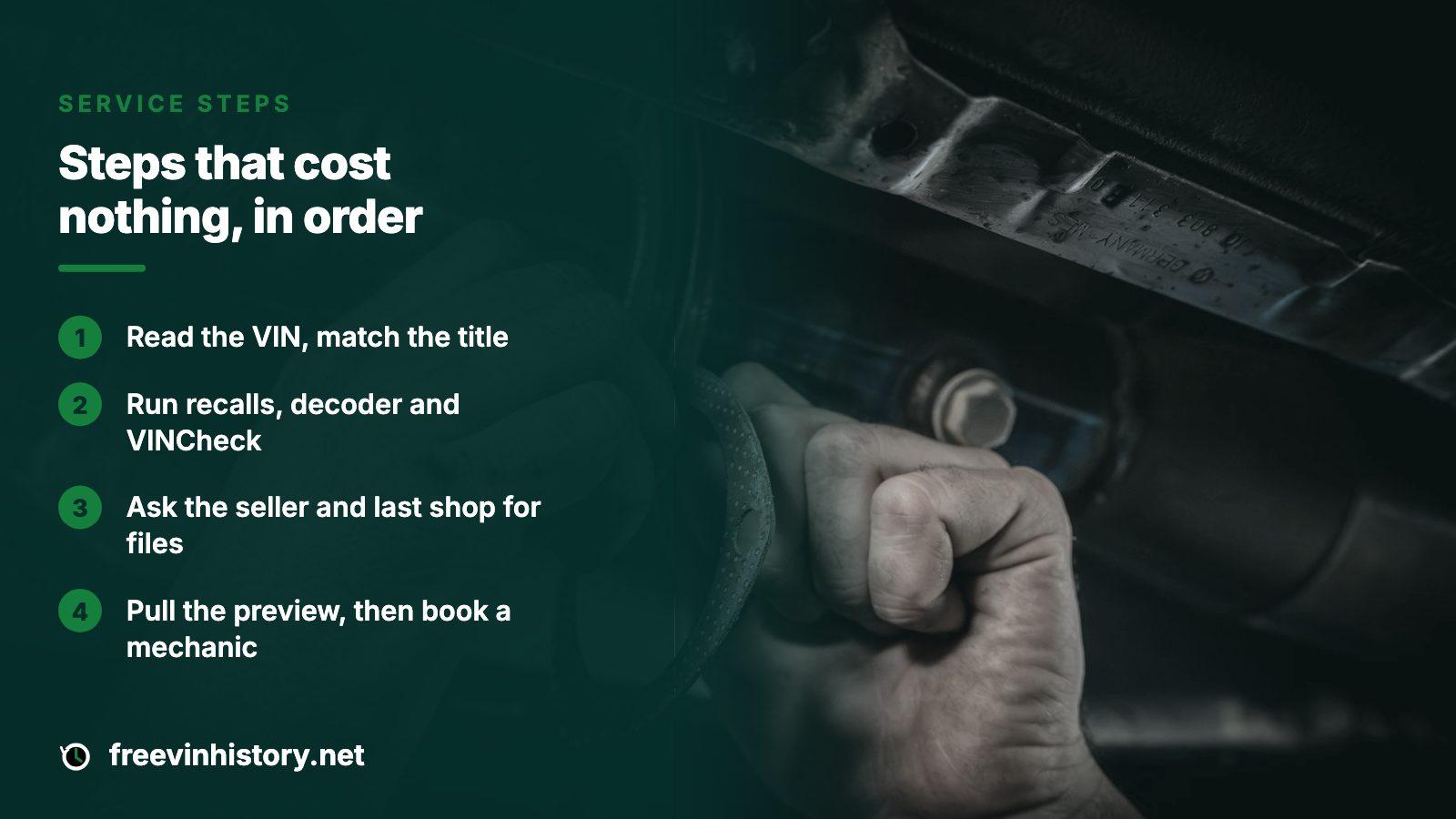
A sensible order for the steps that cost nothing
- Read the VIN off the car yourself, then check it against the number printed on the title and the seller's papers.
- Run NHTSA's recall search and decoder, then NICB's VINCheck.
- Ask the seller for the folder, and ask the shop on the newest invoice for its file.
- Pull the preview. If records exist and the car is a real candidate, buy one report before any deposit.
- Book an independent mechanic for a hands-on look, and ask for the findings in writing.
Paper is not the car
Service files and history reports both describe records. Federal consumer guidance puts it bluntly: no report can replace a mechanic's independent look, and the NMVTIS buying tips urge one strongly.
Where this information comes from
- NHTSA: Check for recalls — What the VIN recall search shows (unrepaired recalls only) and what it leaves out.
- NICB: VINCheck — The no-cost theft, salvage and flood screen, its search limit and its own caution about full reports.
- NMVTIS: Understanding a vehicle history report — The federal title system's indicators, and its statement that repair and maintenance data sit outside it.
- NMVTIS: Buying tips — Asking owners, dealers and shops for maintenance records, and the push for an independent inspection.
- FTC: Used cars — Why a history report does not replace an independent inspection.
- NHTSA owner complaint 11756560 — owner experience, paraphrased
- NHTSA owner complaint 11277576 — owner experience, paraphrased
Sources and photos: Facts checked against the sources above in November 2026. Photos by Mustafa Sheikhmouss, Martin Fennema and Carrie Allen www.carrieallen.com on Unsplash; diagrams by FreeVINHistory.
Keep reading
- Free previous owners check by VIN: what you can see and what stays privateWho owned the car before, and who to call for the older records.
- Free odometer check by VIN: what you can verify before you payTest the mileage on the invoices against other readings.
- Free Carfax report: what the free checks show and when to step upWhat the no-cost official checks cover when no report was ever bought.
- Sample reportA finished report to read before deciding whether to buy one.
Frequently asked questions
Can I get a Carfax service history for free by VIN?
No official tool offers one. The federal title system leaves repair and maintenance data out, and NHTSA's search covers recalls only. You can ask the seller for paperwork and the shop for its file. For what Carfax lists or charges, its own site is the place to look, since FreeVINHistory has no connection to it.
How do I see the service history of my own car for free?
Start with the shops. A shop that handled most of the repairs may pass along its file, and each can reissue completed repair orders. Fill gaps from your own receipts and photos. If a shop has changed hands, expect holes, as one NHTSA complainant found. Keep scans from now on.
Does NHTSA show whether my recall was repaired?
Its VIN search lists only unrepaired recalls, and a clean car returns a count of zero. A recall already fixed does not appear, so the lookup cannot prove a repair happened. Ask the dealer for the repair paperwork. Recalls past the 15-year mark are skipped too, unless the maker extends coverage.
Will a FreeVINHistory report list oil changes and repairs?
No. It is built around odometer readings, title and salvage history, accident and damage records and similar entries, not shop-by-shop maintenance. Use it to test a seller's folder against something independent. You see the preview before paying, the full report costs a single payment, and prices live on the pricing page.
Should I walk away from a car with no service records?
Not automatically. Missing paper means the upkeep is unknown, so the car has to prove itself: run the recall and insurer checks, pull the preview, and pay an independent mechanic to inspect it. A seller who refuses an inspection is a better reason to leave than an empty folder.
Now check the car itself
The guide explains what to look for. The report shows what this VIN has on record.