THE SHORT ANSWER
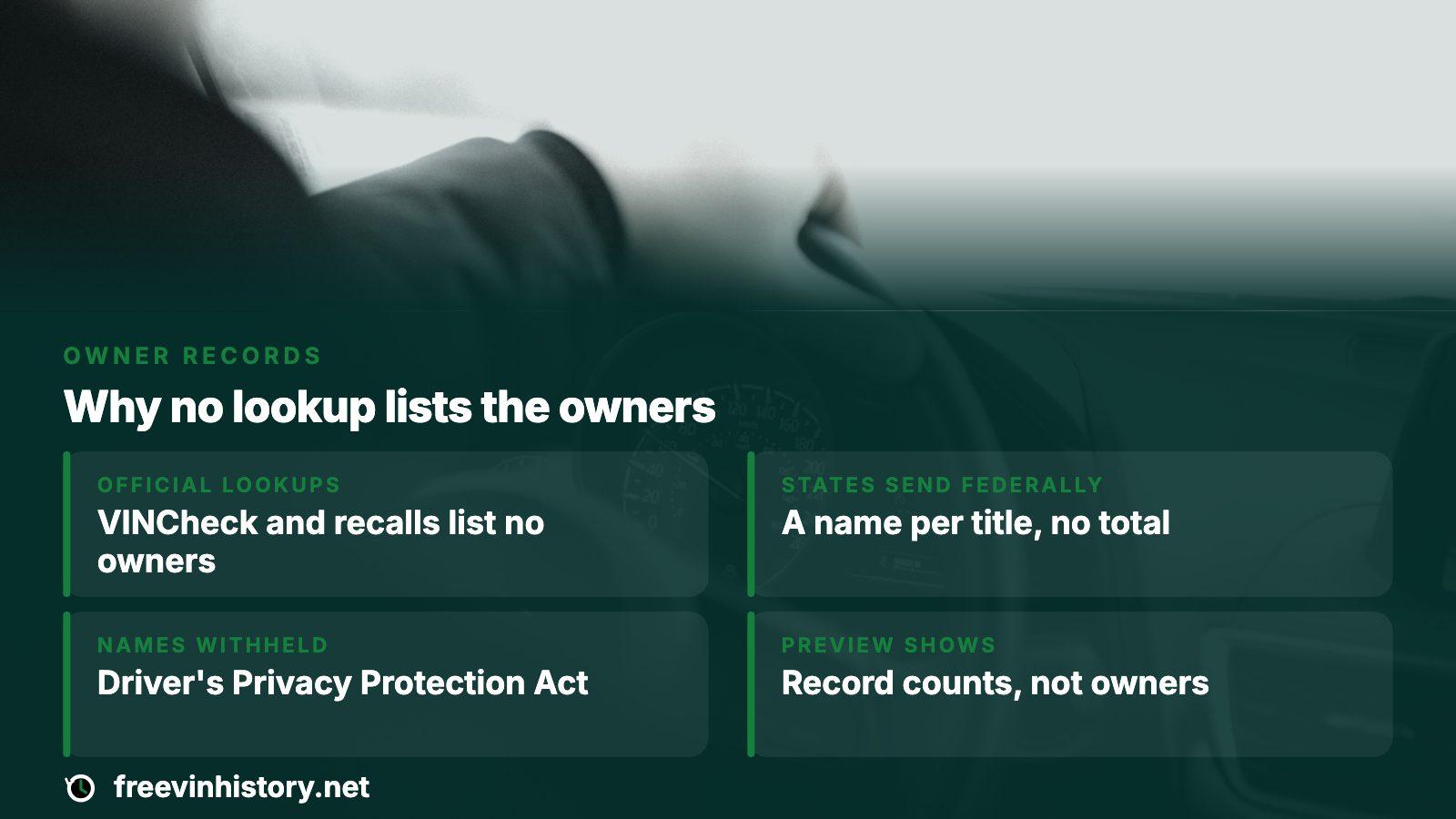
Not by name, and not from any official lookup. NICB covers theft, salvage and flood records, and NHTSA covers open recalls. Owner names live in state title records guarded by the Driver's Privacy Protection Act, and the federal title report's five indicators include no owner count. At no cost you can read the paper title, the seller's paperwork and the glove box. The preview shows which record types exist, and the paid report adds an ownership and use-type entry.
- Free official lookups
- NICB VINCheck and the NHTSA recall search, neither of which lists owners
- What states send federally
- The name on each title issued, with no owner total
- Why names are withheld
- The Driver's Privacy Protection Act limits DMV disclosure
- What the preview shows
- Counts of title and auction records, not owners
What the free lookups cover, and what they skip
Two no-cost lookups appear on every used-car checklist, and both work from the VIN, not from a person. NICB's VINCheck asks participating insurers whether the car was reported stolen and unrecovered, salvage or flood damaged. NHTSA's recall search asks whether a manufacturer repair is still outstanding. Neither records who has held the title.
| Source | Cost | What comes back | Owner detail |
|---|---|---|---|
| NICB VINCheck | No charge; capped at five lookups a day per IP address | Insurer-reported theft, salvage and flood flags | None |
| NHTSA recall search | No charge; up to 100 VINs at a time | Safety recalls not yet repaired for that VIN | None |
| Federal title report (NMVTIS) | Paid, through an approved provider | Title state and last title date, brands, odometer, total loss, salvage | No owner count among the five |
| Paper title in the seller's hands | No charge to read | Name it was issued to, brands, mileage written at issue | Current titled owner |
Why no lookup hands over a list of names
Under a Justice Department rule, every state sends its titling data to the federal system once every 24 hours. The required items include the name of the person or business each certificate was issued to, plus the VIN, any brands, salvage information and the odometer statement. A name like that is personal information in a state motor vehicle record.
Federal privacy law, the Driver's Privacy Protection Act, keeps a state DMV from releasing such data, name and address included, unless the request fits a listed use. Those uses cover government agencies, safety, theft and recall work, insurers investigating claims, court proceedings, towing notices and a request that comes with the person's written consent. Plain curiosity about a used car does not qualify. A consent letter from a former owner does, and so does a lawsuit, which is a matter for an attorney.
An owner count is a tally, and tallies can be wrong
The federal rule asks for a name per certificate and never for a total, so a figure labeled owners is the report writer's own arithmetic on title events. Read a fuller record for dates and states as well as the headline number.
From an NHTSA owner complaint
A 2008 Toyota RAV4 owner wrote to NHTSA in 2025 about the report the dealer had provided: it listed 2 owners and mileage near the dash figure. Another report found later, the owner said, listed 4 earlier owners and a reading of 172,000 miles shortly before the dealer took the car in, and a section on odometer tampering was missing from the dealer's copy. The RAV4 was undrivable and more than $9,000 was still owed.
Pull a report yourself, using the VIN you copied from the car, instead of trusting the ownership line in a copy the seller hands you.
No-cost ways to learn how the car was kept
Several checks cost nothing and tell you more about ownership than any lookup can.
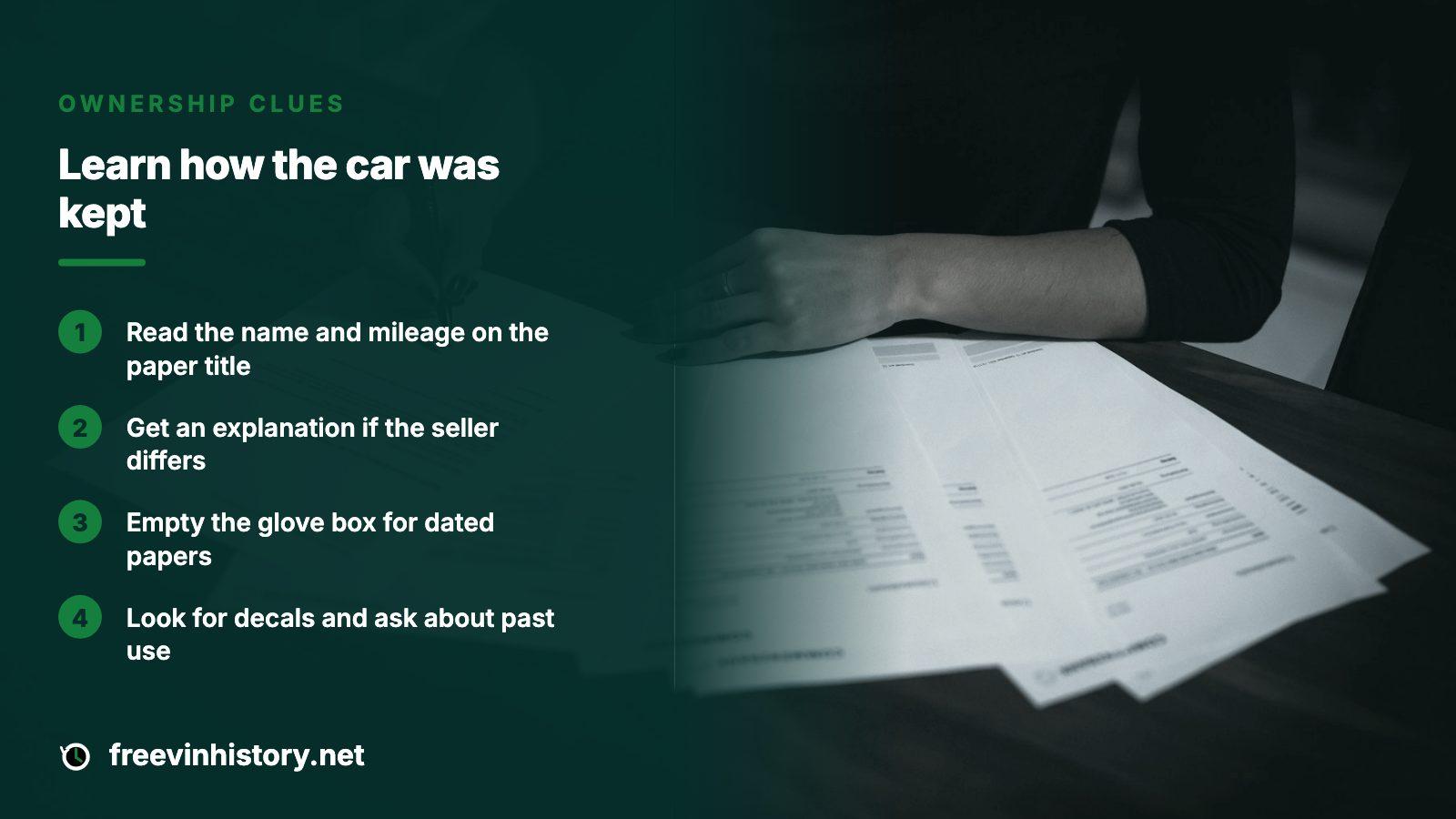
- Ask to see the paper title and read the name, any printed brand and the mileage recorded at the last transfer.
- If the person selling is not the one named on the title, get an explanation before going further.
- Empty the glove box. Old registrations, repair invoices and inspection slips carry dates, places and sometimes the business that ran the car.
- Look for decals: oil-change reminders, dealer badges, fleet or rental tags near the mirror or the door frame.
- Ask how long they have owned it, where they bought it and whether it ever did rental, delivery or business work.
- Confirm all 17 characters of the VIN agree with the title, then run NICB and the recall search.
How the car was used can matter more than how many owned it
One title line can cover a household car or a vehicle a company worked for years. Mileage and wear differ, and an owner count will not say which you are looking at.
From an NHTSA owner complaint
Someone who bought a 2019 Toyota Highlander in March 2020 said they had asked outright whether it had been a rental, and had read a history report that looked spotless. A few months on, a rental company's decal under the mirror and then a rental company's registration in the glove box told a different story. The owner faulted the report for omitting that use.
Treat use as its own question. Ask it in writing, look for physical clues like these, and read the report's use entry when you have one.
Recalls follow the VIN, not the owner
NHTSA's recall search takes a VIN, so a change of owner does not alter what it returns. It lists repairs still outstanding, which means a fix a past owner already had done will not appear. Campaigns from more than 15 years ago usually do not show, and small manufacturers are skipped. Manufacturers mail notices to the registered owner on record, one reason a later buyer can learn of a recall late. Run the search for the exact VIN before you buy and again afterward.
Where the preview stops and the report starts
The FreeVINHistory preview needs no card. For a VIN it shows the vehicle's year, make, model and trim, photos when the records include them, how many recalls are open, and how many title and auction records exist. It does not list owners or count them.
The paid report is where an ownership and use-type entry appears, beside title brands, odometer readings, accident and damage records, and photographed salvage or auction history. Dates can be set against each other instead of guessed at. It does not name individuals. One purchase covers one report. For a shortlist, a bundle of 3, 5 or 10 is available, there is no subscription, and amounts appear on the pricing page only.
Reading an ownership entry and what to put to the seller
Use the entry to generate questions, not to settle the case.
- Many title events on a young car, or several close together, deserve a direct question about why.
- A car bought from another state should have been run through the federal system before retitling. Ask where it was titled before, and watch for brands that show on one record only.
- A rental, fleet or business entry changes how to read the mileage and the wear.
- An ownership line that disagrees with the seller's account, or mileage that drops between dates, goes back to the seller in writing.
A thin record proves little, since no source is complete. Finish with an independent mechanic's inspection, which the Justice Department urges alongside any history report.
Where this information comes from
- NICB: VINCheck lookup — The three record types the free lookup returns, its daily search cap and NICB's own caveats about gaps.
- NHTSA: Check for recalls — What a VIN recall search shows and omits, and how recall notices reach registered owners.
- U.S. Department of Justice: Understanding an NMVTIS vehicle history report — The five indicators in the federal title report and the Justice Department's inspection advice.
- 28 CFR 25.54: responsibilities of the States — What each state must send federally, including the name on each certificate, and the title check before out-of-state retitling.
- 18 U.S.C. 2721: release of personal information from motor vehicle records — The privacy limit on DMV disclosure and the list of permitted uses, including written consent.
- NHTSA owner complaint 11643081 — owner experience, paraphrased
- NHTSA owner complaint 11425318 — owner experience, paraphrased
Sources and photos: Facts checked against the sources above in November 2026. Photos by Shadow Photography, Dimitri Karastelev and Miles Loewen on Unsplash; diagrams by FreeVINHistory.
Keep reading
- NMVTIS report: what the federal title record shows and missesThe federal title record that sits behind any ownership sequence.
- Free Carfax service history: what exists at no cost and what does notDated service stamps and invoices as a second view of how the car was kept.
- Sample reportHow an ownership entry sits beside title and auction records.
- PricingWhat one report costs, plus packs of 3, 5 or 10, with nothing recurring.
Frequently asked questions
Can I see previous owners' names for free by VIN?
No. A VIN lookup returns facts about the car, while names sit in state title and registration records that federal privacy law restricts. The paper title shows the current owner's name, and a former owner can consent in writing to a release. In a legal dispute, ask an attorney.
How many owners has this car had?
Only a tally compiled from title events can answer that, and no free official source publishes one. Paid reports state a count, but check dates, states and mileage before trusting it. A young car with many title entries justifies questions, and a single owner can still mean a fleet or rental car.
Does the NICB check show previous owners?
No. VINCheck searches participating insurers' files for theft, salvage and flood entries. By NICB's count those insurers write 92.49 percent of earned U.S. premium, and searches are limited to five a day per IP address. It returns no owner, count or title history.
Is a one-owner car safer to buy?
Not automatically. One owner might be a careful driver or a business that worked the car hard, so ask how it was used and read the service papers. Steadily climbing mileage across dated records, a clean recall search and a mechanic's inspection tell you more than the count.
What should I do before paying for a report?
Check that the VIN stamped on the car matches the title, run the NICB and NHTSA lookups, then try the preview to see which record types exist. If the car is a serious candidate and records are on file, buy a report for that VIN rather than for every listing.
Now check the car itself
The guide explains what to look for. The report shows what this VIN has on record.