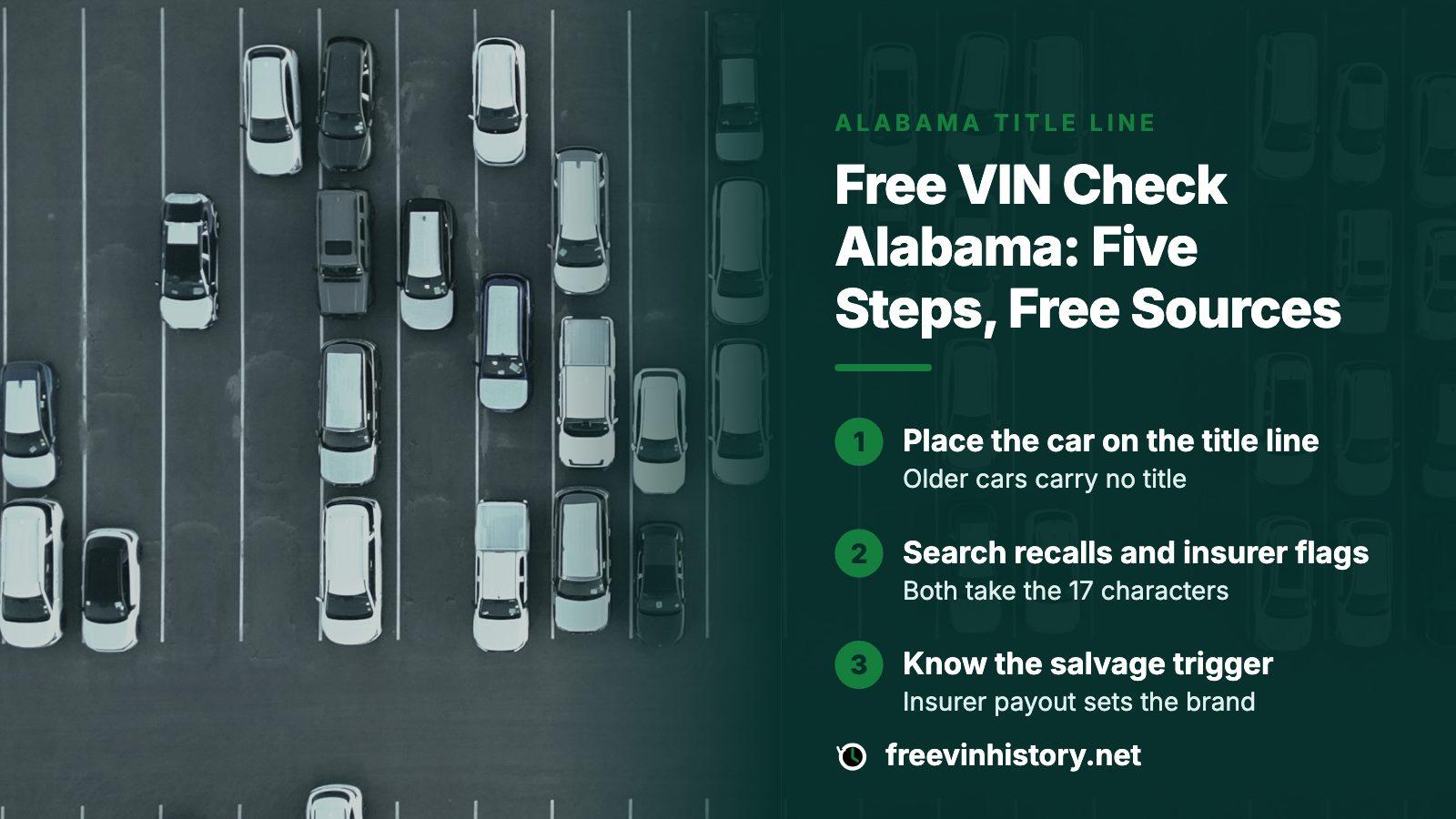
THE SHORT ANSWER
Run the federal recall search and the insurers' VINCheck on the 17-character number, both at no charge. Then place the car against Alabama's title line by model year, since older cars carry no title at all. If the car is titled, add a title-brand report. Together these catch recalls, theft, total losses and brands, but not repairs or mileage over time.
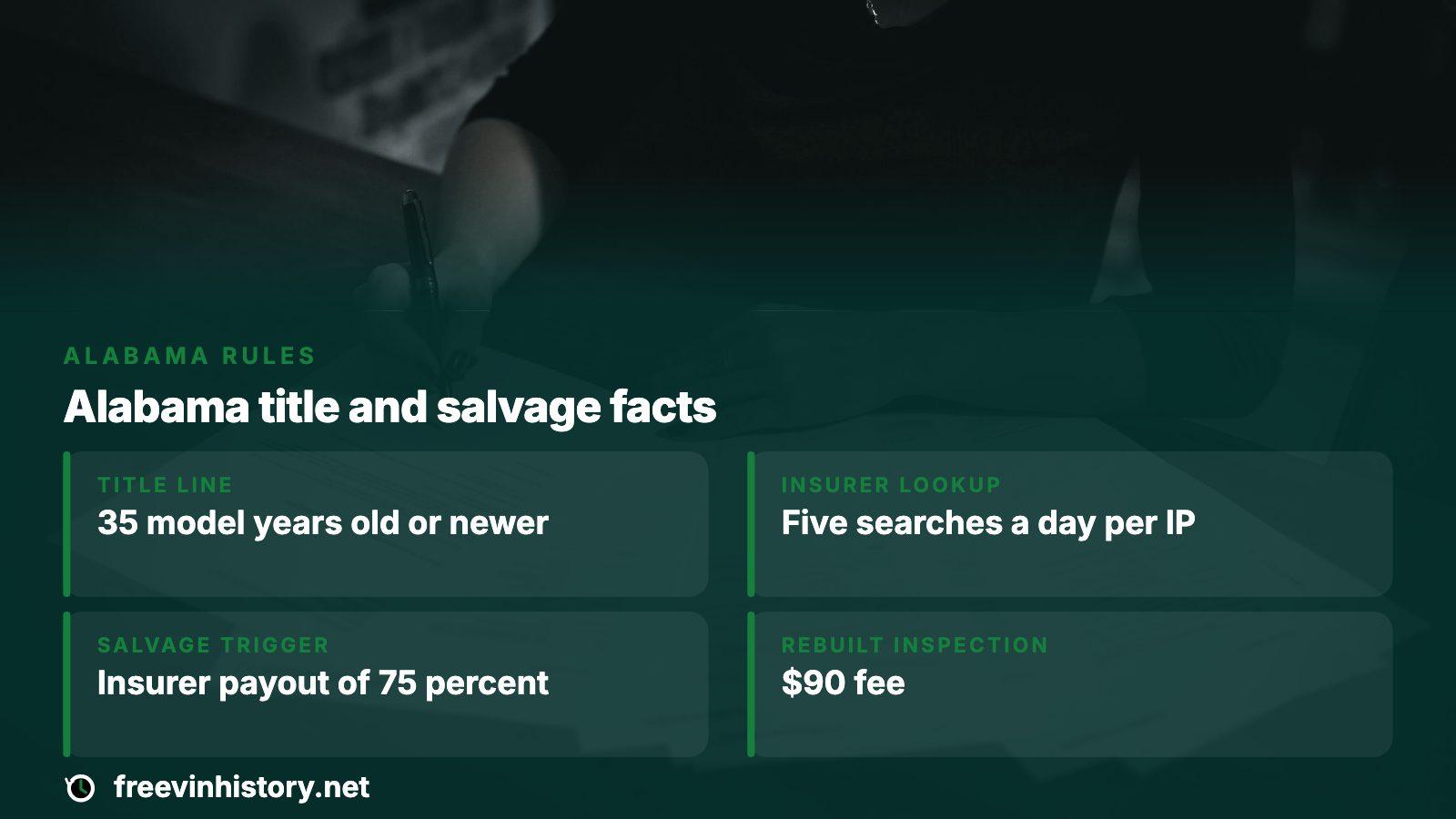
- Title line
- Cars not more than 35 model years old need an Alabama title
- Insurer lookup
- Five VINCheck searches per day from one IP address
- Salvage trigger
- Insurer payout on damage of 75 percent or higher
- Rebuilt inspection
- $90 fee, inspector calls within 1 to 2 weeks
The check at a glance
No Alabama page takes a VIN and hands back a history. Titling belongs to the state, recalls to the federal safety agency, and theft and write-off records to the insurers. Because each source has its own job, work through them in order and pause the moment one raises a doubt.
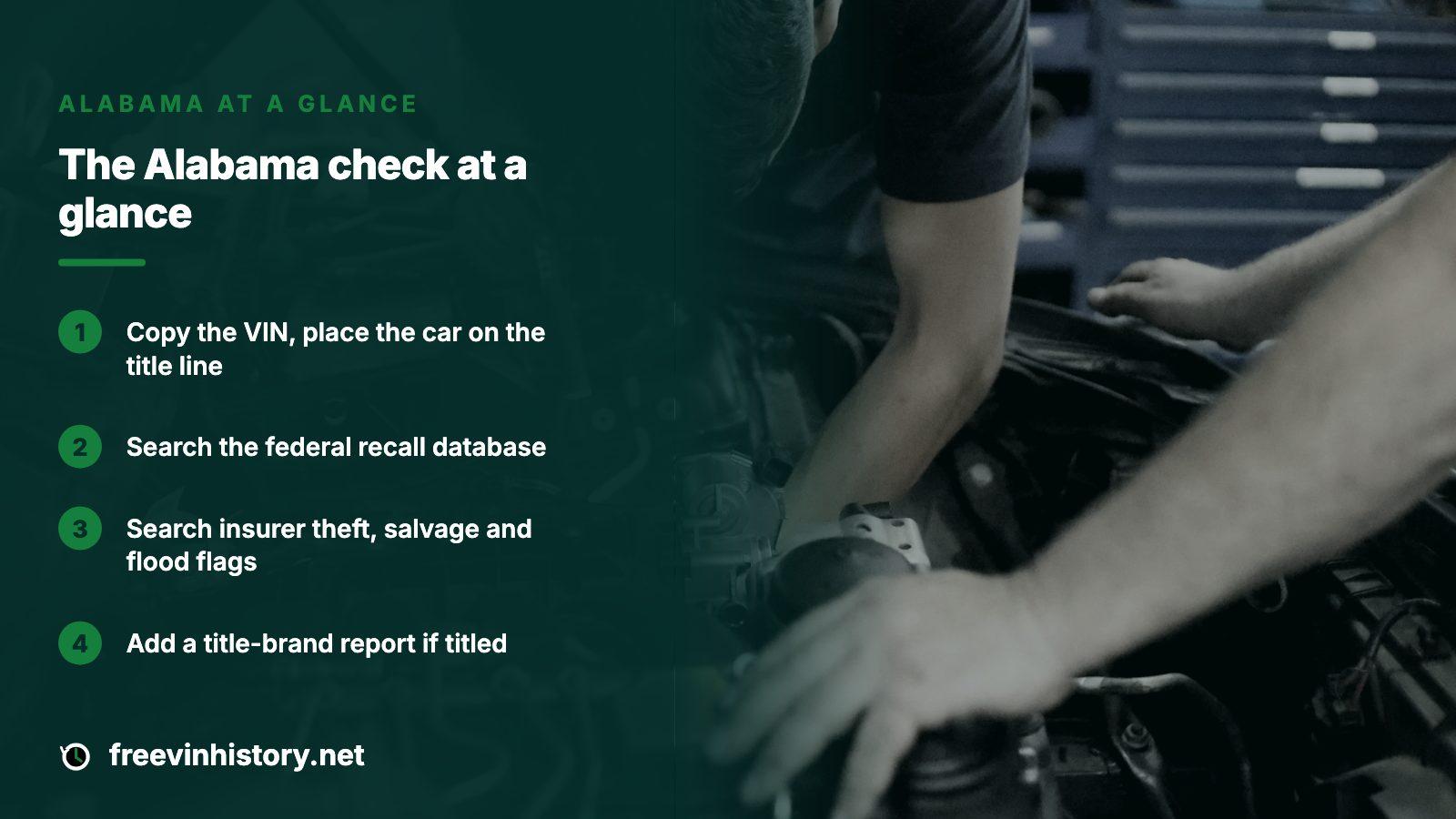
- Copy the VIN from the car and decide which side of the title line the car sits on.
- Search the federal recall database for unrepaired safety recalls.
- Search the insurers' database for theft, salvage and flood flags.
- Ask what the title paperwork and the state's salvage rules say about this car.
- Add a title-brand report, and then a preview of a full report, if the car is titled and worth buying.
Step 1: copy the VIN and place the car against the 35-year line
Read the number off the vehicle, not off the listing. The dash plate on the driver's side is the usual spot, and the registration card repeats it. Photograph it and type it in twice, since the insurer search wants all 17 characters right and may come back empty after one slip.
Next, work out the model year, because Alabama draws a title line by age. Under Section 32-8-31, a car up to 35 model years old that is registered in the state must carry an Alabama title, while an older one is exempt and gets none. The boundary is a moving age, not a calendar year, so a car titled last year can drop outside it this year.
Step 2: the federal recall search
On NHTSA's recall page you enter a VIN, or a plate with its state, and the answer is about that one car: whether a recall remains unrepaired. A car in good standing returns a count of 0 unrepaired recalls. The page also states what it cannot show, and that is worth reading closely:
- campaigns where the repair was already done
- new announcements still waiting on their VIN lists
- campaigns beyond 15 years, unless the maker stretches coverage
- small manufacturers, and service campaigns with no safety angle
When you are weighing several cars, the same page will take up to 100 VINs in one go.
Step 3: the insurers' theft, salvage and flood lookup
NICB's VINCheck is a free search of records supplied by member insurers. A hit means the car was reported as stolen and not found, or reported salvage or flood-damaged. The members account for 92.49% of earned premium nationwide, which is wide coverage but short of everything.
Two limits shape its use. The daily allowance is five lookups from any one IP address, so stretch a long shortlist over several days. Only insurance entries show up, which leaves out police files and insurers who opted out.
Quiet does not mean spotless
NICB itself describes the tool as a quick screen rather than a full history, and says a car can have been stolen, wrecked or burdened with a title problem while the search shows nothing. Read a blank result as one data point.
Step 4: what Alabama's paperwork and salvage rules tell you
The department's Motor Vehicle pages list online services for replacement titles, liens and rebuilt titles, and a request form for title and registration files. Its status page follows an application somebody already filed, so it cannot describe a car you are merely considering. Start with the paper title: read the brand area and the lienholder line before anything else.
Alabama has wired NMVTIS into ALVIN, its titling system. The federal history is consulted when an application is processed and once more before issuance, so a brand applied elsewhere gets recorded on the Alabama title. That safeguard operates at issuance, which means a car never retitled here gets no such pass.
Under Code of Alabama 32-8-87, a write-off happens when a payout settles damage of at least 75 percent of the car's fair retail value, and the department calls that a salvage vehicle. Becoming rebuilt takes a state inspection. The department lists $90 by cashier's check or money order, along with the salvage title, receipts for swapped parts and proof the applicant owned the car before salvage. The inspector then reaches out within 1 to 2 weeks.
Step 5: a title-brand report, then a preview
The Justice Department's NMVTIS report stays narrow: where the title stands and its latest date, brands, odometer, total loss and salvage. A short or empty one is a fine outcome. The department's used-car tips put the cost at up to $4, sold through approved providers.
That still leaves the car's ordinary life unexplained. This site's preview costs nothing and shows whether accident, auction, lien, theft or mileage entries sit behind the VIN. Reading them takes a payment per VIN. A shopper with a long list can buy several lookups together, in sets of 3, 5 or 10, and there is no subscription to cancel. Check the pricing page for current rates.
Red flags to act on before paying
- The seller has no title and the car is within 35 model years of the current year.
- A salvage or flood flag appears and the seller never mentioned it.
- A recall is open and the seller says it was handled, with no paperwork.
- The VIN stamped on the car and the one typed on the paperwork differ by a single character.
- The car is old enough to need no title, and the seller offers only a bill of sale.
Because the recall page skips repaired campaigns and NICB skips some insurers, the seller's paperwork is your cross-check. Any mismatch is a reason to pause and ask, or to leave.
What the no-charge steps cannot tell you
Everything above works from records that someone filed: a recall, an insurance claim, a state brand. A car that was fixed after a collision without an insurance claim leaves none of these. The same goes for mileage between owners and for auction photos.
| Question | Free sources | Needs a report |
|---|---|---|
| Open safety recall | Yes, NHTSA | Adds it alongside other records |
| Insured theft or total loss | Yes, NICB | Adds salvage and auction entries |
| Title brand history | Partly, state paperwork | Yes, with odometer readings |
| Repairs after an accident | No | Where records exist |
| Auction photos | No | Yes |
After the checks: the inspection
The Justice Department's buying tips add the old advice: pay an independent mechanic to look the car over, drive it on hills and highways and in traffic that stops and starts, and ask for maintenance records. A history search shows which records exist. Only someone under the car can say what shape it is in.
If the free steps came back clean and the car is titled, a preview is a reasonable last stop before you commit to an inspection fee.
Where this information comes from
- Alabama Department of Revenue: which vehicles must be titled — Supports the 35-model-year title rule and the exemption section.
- Alabama Department of Revenue: salvage and rebuilt vehicles — Supports the total-loss threshold and the rebuilt inspection fee and steps.
- Alabama Department of Revenue: NMVTIS in Alabama — Supports how the state uses NMVTIS history inside its titling system.
- Alabama Department of Revenue: Motor Vehicle division — Supports the list of title tools, including the application status page.
- NHTSA: check for recalls — Supports what the recall search shows, what it omits and the batch limit.
- NICB: VINCheck lookup — Supports the insurer-only scope, the daily cap and the clean-result caution.
- U.S. Department of Justice: understanding an NMVTIS report — Supports the list of what an NMVTIS report covers.
Sources and photos: Facts checked against the sources above in November 2026. Photos by Iain, Mustafa Sheikhmouss and Dimitri Karastelev on Unsplash; diagrams by FreeVINHistory.
Keep reading
- Car title search by VIN free: what you can see before you payTitle lookups worth running on a car from any state.
- Free open recall check by VIN: GM, Polaris and every other makeMore on reading recall results and what the search leaves out.
- Free salvage title check by VIN: what the free lookups showHow to confirm whether a car was ever declared a total loss.
- Free VIN check in Georgia: what the state and federal lookups showA neighboring state with a different title record and fee structure.
Frequently asked questions
Is there a free VIN check for Alabama cars?
Pieces of one. NHTSA's recall page and NICB's lookup cost nothing and need only the VIN. The Department of Revenue lists title tools but no free history lookup for a car you do not own. A report fills the gaps, and the preview on this site shows which records exist before you pay.
Why does the seller have no title for an older Alabama car?
Alabama issues no title for a motor vehicle past 35 model years, so a seller may legitimately hold only a registration and a bill of sale. On a newer car, a missing title is a serious warning and a good reason to walk away.
Does a clean insurer-database result mean the car was never wrecked?
No. NICB only searches records from participating insurers, and a wreck repaired without a claim leaves nothing. Police files are not searched either. Use it to rule out an insured theft or total loss, then add a title-brand report and a mechanic's inspection.
What does a salvage title mean in Alabama?
The department describes a salvage vehicle as one where a total-loss settlement was paid on damage of at least 75 percent of the car's value. The car can later be rebuilt after a state inspection. Ask the seller for the inspection paperwork and the bills for replaced parts.
Can I look up an Alabama car by license plate?
The recall page accepts a plate and state, but only to return recall status, and nothing on these pages gives an owner's name. The reliable route is the VIN, taken from the car and matched against the seller's title or registration card.
Now check the car itself
The guide explains what to look for. The report shows what this VIN has on record.