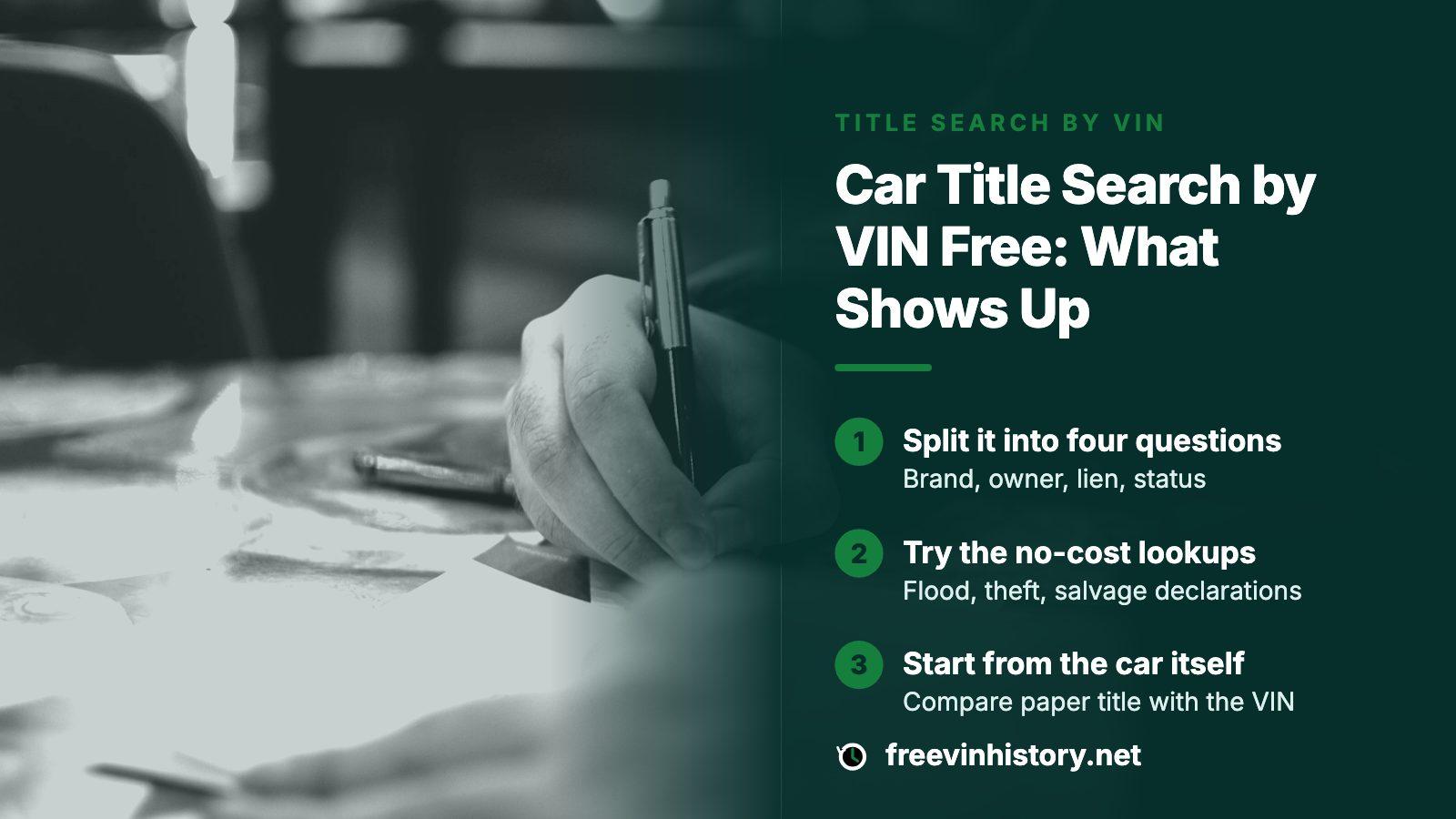
THE SHORT ANSWER
Partly. NICB's VINCheck costs nothing and checks for flood damage, an unrecovered theft or a salvage declaration. New York's DMV shows a title issue date and any liens. Neither one reads the brands states stamp on titles; that record is sold through approved providers at a fee. Run the no-cost checks, add the preview's tally, and pay for the report only on a car you are serious about.
- No-cost insurer screen
- NICB VINCheck: flood, unrecovered theft, salvage
- State title page
- New York returns the issue date, lien count and lienholders
- Brand history
- Federal title record, sold by approved providers at their own fee
- Paid step
- Preview asks for no card; a report is bought once
A title search is really four questions
Shoppers type one phrase but usually want four answers. Whether a no-cost tool can supply each depends on who keeps the record.
| The question | Who holds the record | No-fee route |
|---|---|---|
| Did a state issue this title, and when? | The state titling agency | Only if the state runs a status page; New York's gives the issue date |
| Was it ever branded salvage, flood or junk? | The federal title record, fed by the states | None directly; approved providers sell it, each at its own fee |
| Did an insurer write it off or lose it to theft? | NICB's database | Yes, through VINCheck |
| Is a lender still on the title? | The state, which records lienholders | Only where a state page lists liens, as New York's does |
The no-cost lookups, one at a time
NICB's VINCheck costs nothing. Type in the VIN and it checks three things: flood damage, a theft with no recovery, and a salvage declaration. The Justice Department points buyers to it for items such as flood damage. Treat a flag as a reason to dig and a blank as one data point.
A state page can add the title itself. New York's DMV asks for the VIN, model year and make, then returns when the title was issued, a count of liens and the lienholders' names. Owner details stay hidden. The page names no fee and is silent on who may use it. Texas goes another way: its title check hands the buyer to an approved provider of the federal record.
NHTSA's recall search is not a title tool. It tells you whether that exact car has an unrepaired safety recall and says nothing about brands or damage. It still earns a minute, because a manufacturer's dealer repairs a recalled part without billing the owner.
Why the brand history sits behind a fee
Brands live in NMVTIS, the Justice Department's title system. Every state and the District of Columbia, 51 jurisdictions in all, feed it, and a state taking in a car from elsewhere screens it against the system before issuing its own title. A brand a state applies stays in the record for good, so a later retitling elsewhere cannot erase it there.
None of that is a free lookup. The law behind the system says it must run on user fees, so reports are fee-for-service and each approved provider names its own price. The Justice Department pages and TxDMV quote figures that disagree with one another, so read the fee on the provider's own screen. Some listed names sell to dealers only, so confirm a provider serves the public.
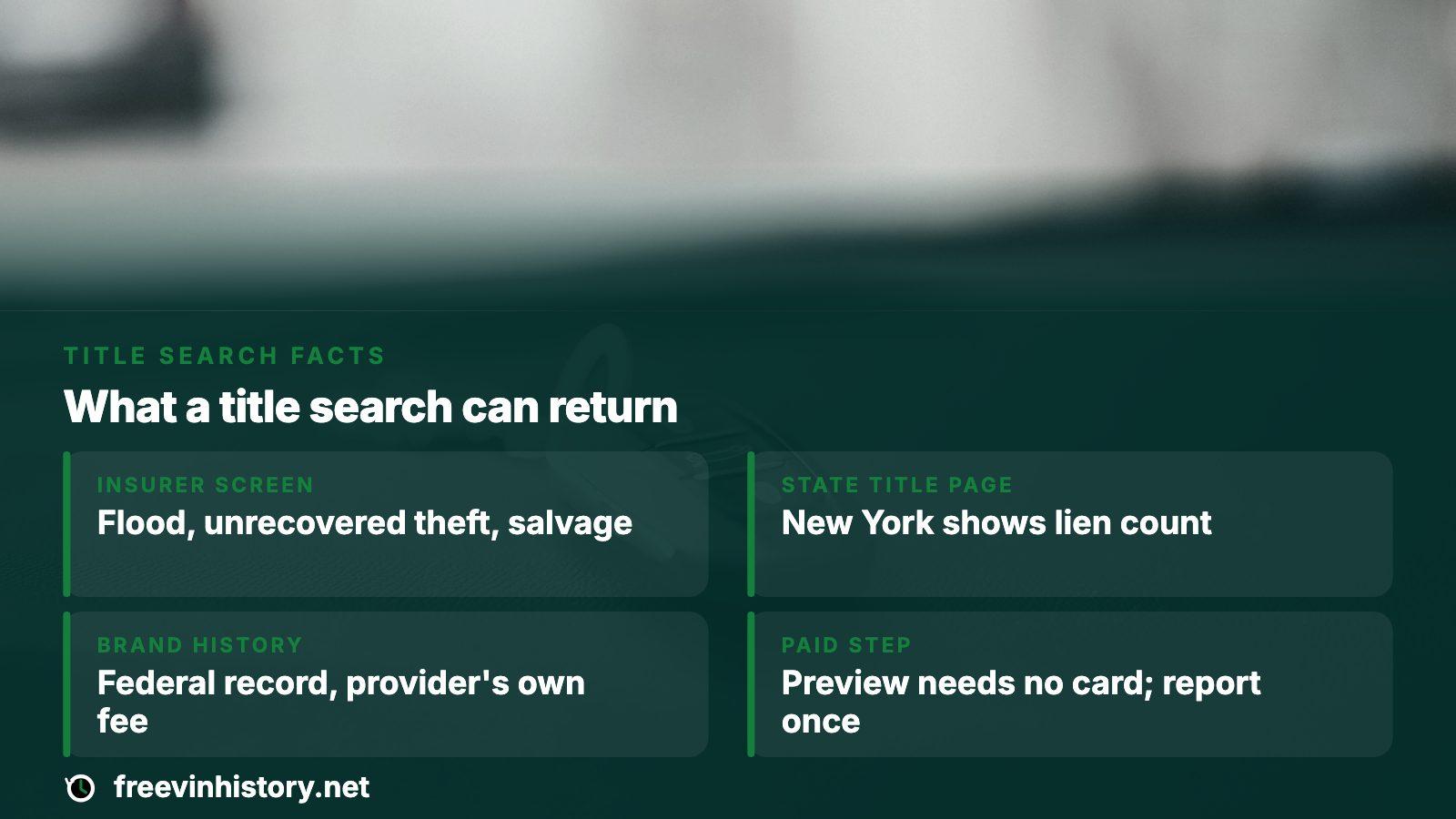
A sequence that starts at the car
- Locate the 17-character VIN near the windshield's lower left and check it against the registration card. A number copied from an advert is the seller's word, not the car's.
- Run NICB's VINCheck and keep a dated screenshot, flag or no flag.
- Try your state's title page if it has one. New York's needs the VIN, model year and make.
- Query NHTSA's recall lookup with the VIN and jot down any open item.
- Enter it in this site's preview, which totals title and auction entries so you can judge whether a full read is warranted.
- If anything surfaced, or the car is a finalist, order the report and show the seller its findings before a deposit changes hands.
The narrowest, cheapest screens come first, and none should wait until after the handshake.
What each brand is telling you
Texas publishes the brands it recognizes, and the definitions work as a translation key elsewhere, since states do not brand damage alike.
| Brand | What it means | Your next move |
|---|---|---|
| Salvage | Damage passed a cost threshold the jurisdiction sets; the car can be rebuilt | Ask what was damaged and whether anyone repaired it |
| Rebuilt | Once salvage, since passed the required inspections | Ask who did the work and see the paperwork |
| Water damage | Damaged only by flood water | Treat as high risk and book an independent inspection |
| Odometer | Mileage reported as not true | Distrust the dash; compare the reading history |
| Manufacturer buyback | Returned or bought back under lemon-type laws | Ask why it went back |
| VIN replaced | Reissued under a replacement number the state assigned | Often harmless; ask why the number changed |
A total loss can still be a sound car
If a stolen car goes unfound for 30 days, an insurer may declare it a total loss. Should it reappear unharmed, the label remains and the car can be sold in running order. Check the date and reason behind the entry before deciding.
When the free answer comes back empty
Reporting is uneven, and the Justice Department says so. Sources feed the title record independently, with no shared definition of damage, so a search can return a false negative such as no junk or salvage history. States send updates on different clocks: some as each title transaction happens, others daily or within days. Insurers and salvage yards file monthly.
Gaps follow the state, too. Some exempt older vehicles from titling, and the federal record omits repair history altogether. Insurer filings reach back only four model years beyond the present one, so a very old car leans on other feeds.
Silence is not a clean bill
A quiet report is good news, the DOJ says, but it is short on purpose and promises nothing. Pair it with a mechanic's look before you commit.
Checks on paper that no database replaces
Records tell you what was filed. The paper in the seller's hand tells you whether that person can pass the car to you. Texas says never to buy privately without the title, signed and dated by the seller with the odometer reading entered, and to file for a new title inside 30 days of the purchase.
Then test the car. The FTC's position is that no history report stands in for hiring a mechanic: reports can mention crashes and flood damage but typically leave out mechanical problems. Have the mechanic put a repair estimate in writing with make, model and VIN on it, then use the figure to bargain. A dealer who refuses an outside inspection has handed you a reason to visit another lot.
The preview first, then one payment
No payment is involved in the preview. Type in the VIN and it totals the entries filed against it, so you learn whether titles, auctions or other records exist before spending anything. A total above zero means there is something to read. A zero narrows the doubt without ending it.
The report is purchased once; nothing renews. Pick one, or stock up with 3, 5 or 10 when the shortlist grows. Current rates sit on the pricing page. Run it while the car is still unreserved, because a brand or write-off found late has less power to move the price.
Where this information comes from
- U.S. Department of Justice: NMVTIS for consumers — What the federal title record holds, how brands persist, and the false-negative warning.
- U.S. Department of Justice: NMVTIS FAQs — Fee-for-service funding, reporting schedules and what a report leaves out.
- FTC: Used cars — The advice to get a history report and what NICB's VINCheck covers.
- FTC: Buying a used car from a dealer — Why a report cannot stand in for an inspection, and the written estimate.
- NHTSA: Check for recalls — What the VIN recall search returns and the cases it leaves out.
- New York DMV: Check a title or lien status — The fields a state title and lien page returns.
- TxDMV: Title check, look before you buy — How Texas routes buyers to providers, its brand definitions and private-sale title steps.
Sources and photos: Facts checked against the sources above in November 2026. Photos by Owen Michael Grech, Wesley Tingey and Bence Balla-Schottner on Unsplash; diagrams by FreeVINHistory.
Keep reading
- NMVTIS report: what the federal title record shows and missesThe federal title record in detail: what it holds and what it misses.
- Free salvage title check by VIN: what the free lookups showHow salvage and write-off flags show up in the no-cost lookups.
- Free VIN check through the DMV: what a state agency will and will not showWhat state agencies do and do not hand out by VIN.
- PricingWhat a report costs, one at a time or in a pack, with nothing recurring.
Frequently asked questions
Can I search a car's title by VIN for free?
Only in parts. NICB's VINCheck costs nothing, New York's status page lists no fee, and the preview on this site tallies entries. The brand history itself is sold by approved providers. Whatever the screens say, ask the seller to show the physical title and make sure its VIN matches the car.
Does a free VIN check show a salvage title?
It shows a salvage declaration, not a brand a state printed. A brand applied by a state sits in the federal title record, so a clear NICB answer still leaves that file unread. Read the title the seller shows you against whatever the brand search returns.
Can a title look clean when the car has been damaged?
Yes. States brand damage by their own rules, so one may brand a car salvage where another does not, and damage nobody reported leaves no entry. Search results can also come back falsely empty. That gap is why a clean answer should be followed by an inspection rather than treated as proof.
Why would a federal title record cost anything?
Federal law requires the system to be paid for by user fees instead of federal money, so each approved provider sets a price for its reports. Several pages give different figures, which means the only reliable number is the one shown by the provider you choose, before you pay.
A report lists a brand the seller never mentioned. Now what?
Ask for the title and any repair paperwork, and hold off on a deposit. The provider that sold the report handles disputes and must give you a way to reach the titling state, which holds the full record. If the seller cannot explain it, the price should reflect it or you should walk.
Now check the car itself
The guide explains what to look for. The report shows what this VIN has on record.