THE SHORT ANSWER
Type the VIN into two public tools: NHTSA's recall page, then NICB's VINCheck. Each answers in seconds without a charge, flagging open recalls and insurer-reported theft, write-offs and floods. Louisiana's notarized bill of sale adds a seller's written promise about liens, which is a statement rather than a search. Title brands and mileage need a report preview.
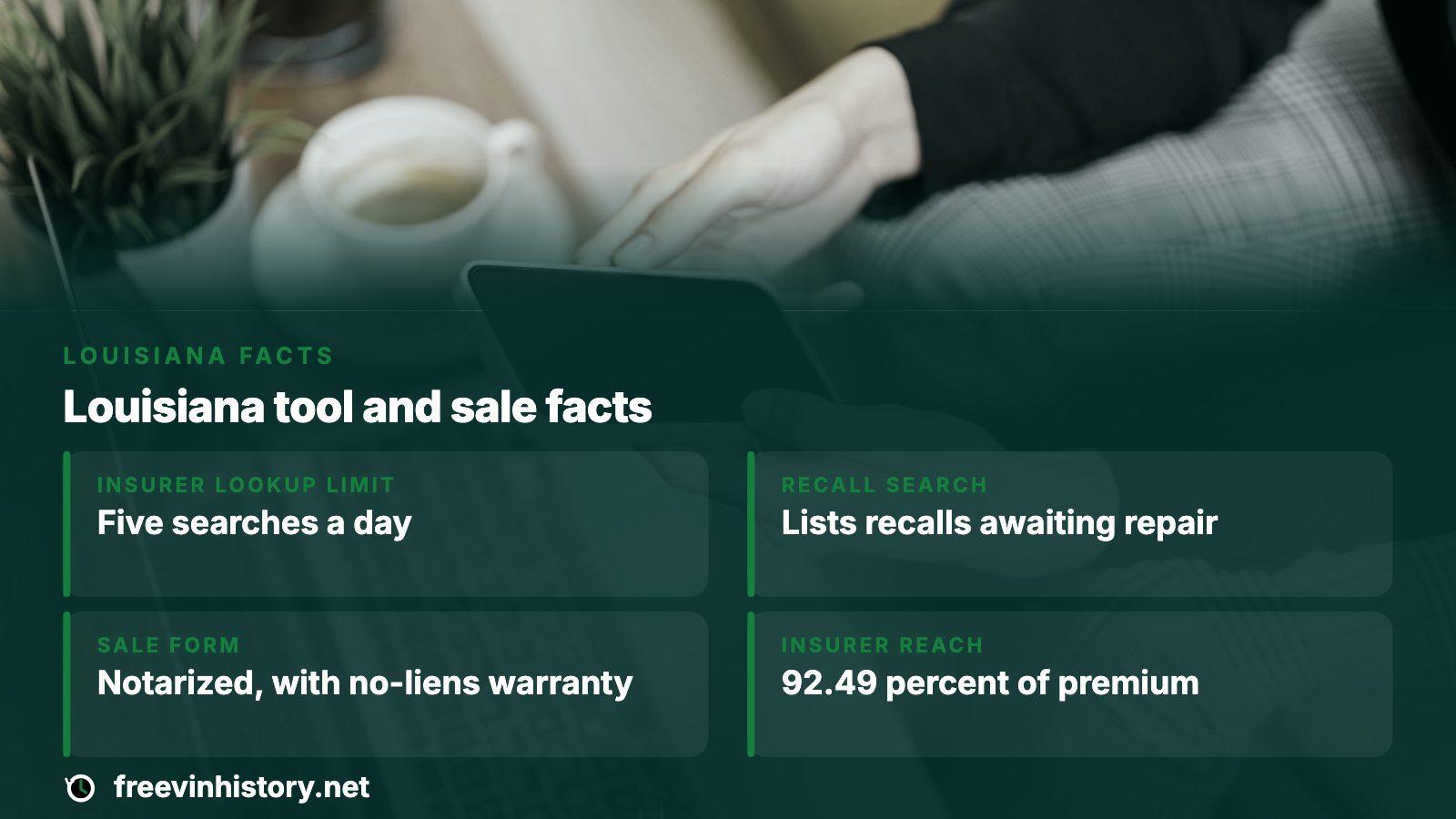
- Insurer lookup limit
- Five searches a day from one connection
- Recall search
- Lists recalls still awaiting a repair on that VIN
- Louisiana sale form
- Signed before a notary, with a no-liens warranty
- Insurer data reach
- Covers 92.49 percent of earned premium
What a free check covers in Louisiana
Free has a narrow meaning in this market. Two public tools accept a VIN and answer with no login and no payment: the federal recall page and the lookup run by the insurance industry's crime bureau. Each reads one kind of record, so each answers one question only.
The recall page asks whether the maker owes this exact car a repair. The insurer database asks whether a member company logged it as stolen, totaled or flooded. Neither shows who held the title, what the odometer said at each sale, or whether a lender still has a claim. Use the pair as a quick screen for loud problems, and decide afterward whether the car earns a closer look.
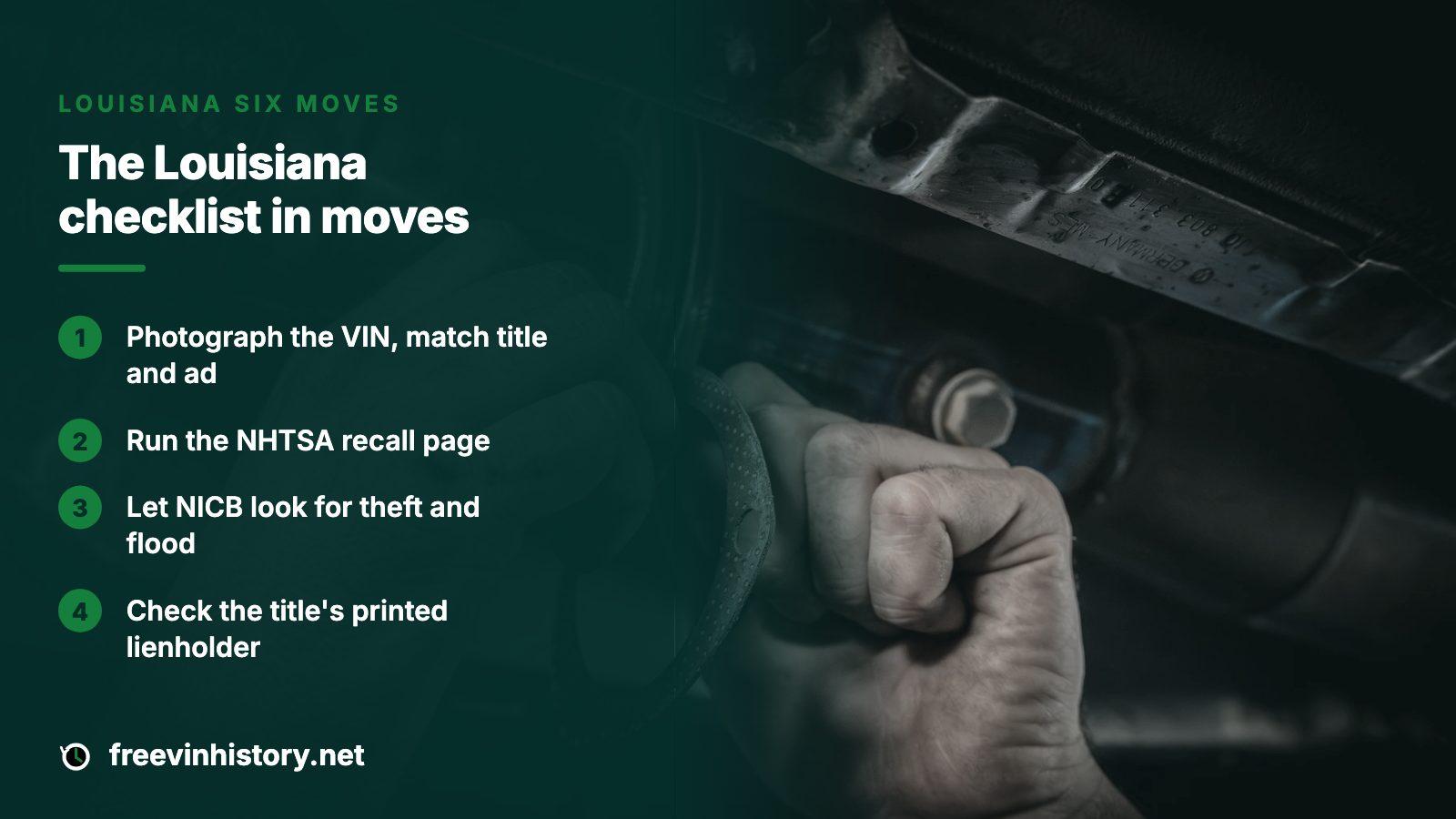
The Louisiana checklist in six moves
- Photograph the VIN on the vehicle first, then hold it up against the title and the ad.
- Run the NHTSA recall page and write down anything still open.
- Let NICB VINCheck look for theft, salvage and flood marks.
- Look at the title for a printed lienholder before you book the notary.
- Open a report preview to learn which title and mileage entries exist.
- Hire an independent inspector if the car clears every step above.
Steps two and three take about a minute each. Step four costs only attention, and it counts for more in Louisiana than elsewhere because of how sales are papered, covered below.
Free sources side by side
| Source | What it answers | What it leaves out |
|---|---|---|
| NHTSA recall page | Whether this VIN has a recall still waiting for repair | Repaired recalls, small makers, non-safety campaigns, recalls past the 15-year mark |
| NICB VINCheck | Insurer-filed theft, write-off and flood entries | Police records, insurers that opt out, repairs, mileage |
| Notarized bill of sale | The seller's written statement that no liens exist | Any check that the statement is true |
| Report preview | Which record types exist for the VIN | The detail itself, which sits in the paid report |
Step two in detail: the recall search
On NHTSA's page you may enter the VIN or, alternatively, a plate along with its state; the VIN is the sturdier input. Plates are matched through state motor vehicle files, which sometimes still point to a prior owner's vehicle. A car with nothing outstanding returns the line reading zero unrepaired recalls for that VIN.
Read the gaps as closely as the result. Recalls that were already fixed do not appear, nor do announcements so new that their VINs are still being added, nor campaigns from very small builders. Coverage also stops past 15 years unless the maker extends it, so an older Louisiana pickup can show clean and still have a past the tool never reached. A clean screen says the maker owes nothing today. It says nothing about yesterday.
Step three in detail: what the insurers' lookup can flag
VINCheck compares your number with theft and salvage entries from member insurers, a group writing 92.49 percent of earned premium across the country. A hit means a member declared the car stolen and not recovered, a total loss, or flood-damaged. A written-off car can lawfully be repaired and given a new title, so a hit calls for questions rather than an automatic no.
- Enter all 17 characters exactly, since a typo can hide a real record.
- Plan around five searches a day from one connection, and shortlist cars first.
- Silence is not proof: only participating insurers appear, and police files are not searched.
Where this check stops
NICB calls its lookup handy and free, yet stops short of calling it a history, and urges buyers to dig further before paying.
Step four: what the Louisiana bill of sale proves
The state's Bill of Sale of a Movable is designed for signing in front of a notary public. Its blanks cover parish, seller, buyer, make, model, year, VIN, price and date, and the seller conveys with full and general warranty of title. Near the bottom, the seller warrants that the vehicle carries no mortgage, lien or encumbrance at all or its attached accessories.
That beats a scribbled receipt, yet it remains a promise. The form has no space for flood, collision damage or mileage, and nothing on it shows anyone consulted a lien record. The Office of Motor Vehicles pages explaining Louisiana's transfer steps refused automated access when I tried them, so confirm today's requirements with that office before the appointment.
- Ask to see the title early and study the lienholder area.
- Read the title's VIN against the car's plate one character at a time.
- Keep your own signed copy of the notarized form.
Step five: when the preview and report are worth it
NICB says full history reports pull from wider sources than its own database, such as DMV title records, auctions and service shops, and that most cost money. That gap is where surprises live: a brand applied in another state, a mileage figure that drops between two sales, an earlier auction listing with photos.
Here, the first stop is a free preview that lists what kinds of entries the VIN has, so a brand or accident entry shows itself before you spend anything. The report that follows is a one-time payment for one vehicle, with nothing recurring, and the pricing page lists the options. The preview is the only free piece.
The federal title record behind a report
The Justice Department's title system, NMVTIS, tracks five items: the title's current state and the date it last moved, any brands, the odometer figure, whether it was ever a total loss, and salvage history. The inputs come from state titling offices, insurance carriers, scrapyards, salvage lots and recyclers, all obliged by federal law to file. Labels like junk, salvage or flood stay attached when the car changes states.
The department calls an empty result a good result, since the record is meant to stay short. It holds no repair or maintenance data, which private providers add. For a car arriving in Louisiana from another state, the multi-state brand record is the piece a local check cannot supply.
Reading the results: when to walk away
- An open recall the seller never mentioned and will not fix before the sale.
- A theft, salvage or flood hit the seller waves off with no paperwork.
- A lienholder printed on the title, plus a promise to deal with it later.
- A title VIN that differs from the car's VIN by even one character.
- A seller who resists a report preview or an inspection.
One red flag does not end the deal on its own, but each needs a documented answer before money moves.
Where this information comes from
- NICB: VINCheck lookup — Supports the insurer lookup scope, the daily search limit and its stated limits.
- NHTSA: Check for recalls — Backs the description of the recall lookup and its blind spots.
- Louisiana State Police: bill of sale form — The state form with its notary block and the seller's no-liens statement.
- U.S. DOJ NMVTIS: Understanding a vehicle history report — Supports the five federal indicators and where the data comes from.
Sources and photos: Facts checked against the sources above in November 2026. Photos by Richard R, Martin Fennema and Jakub Żerdzicki on Unsplash; diagrams by FreeVINHistory.
Keep reading
- Car lien search free: what the free tools show and what they missHow to test a seller's no-liens promise.
- Free open recall check by VIN: GM, Polaris and every other makeMore on reading recall results and their gaps.
- Free flood check by VIN: what the free tools show and missWater damage matters for Gulf-region cars.
- PricingHow the one-time report payment works.
Frequently asked questions
Is there a free VIN lookup for Louisiana vehicles?
Free lookups exist by source, not as one statewide tool. NHTSA handles open recalls, while NICB handles theft, write-off and flood entries from insurers. Neither shows title history. A preview here shows which other records exist, and the full report is a paid purchase.
Does the notary check for liens on the car?
The state form records the seller's warranty that no liens exist and has a notary signature block. Nothing on it shows a lien database was searched. Read the title for a lienholder yourself and add a title record check before you sign.
Can I check a Louisiana car by license plate?
NHTSA's recall page lets you try a plate and state, though the match comes from state files and might land on a former owner's vehicle. The agency then suggests using the VIN. For a fuller history, take the VIN from the car, the title or the seller.
What does a clean NICB result mean?
It means no participating insurer logged that VIN as stolen, salvage or flood. NICB itself cautions that a clear answer proves little, because police records and non-member insurers are outside the search, and damage never claimed through insurance leaves no entry.
What does the full report add after the free preview?
Detail the free tools cannot reach: title records and brands, odometer readings across time, and salvage or auction entries. The preview costs nothing and lists which entries are there. The report is paid once, never as a subscription, with sizes shown on the pricing page.
Now check the car itself
The guide explains what to look for. The report shows what this VIN has on record.