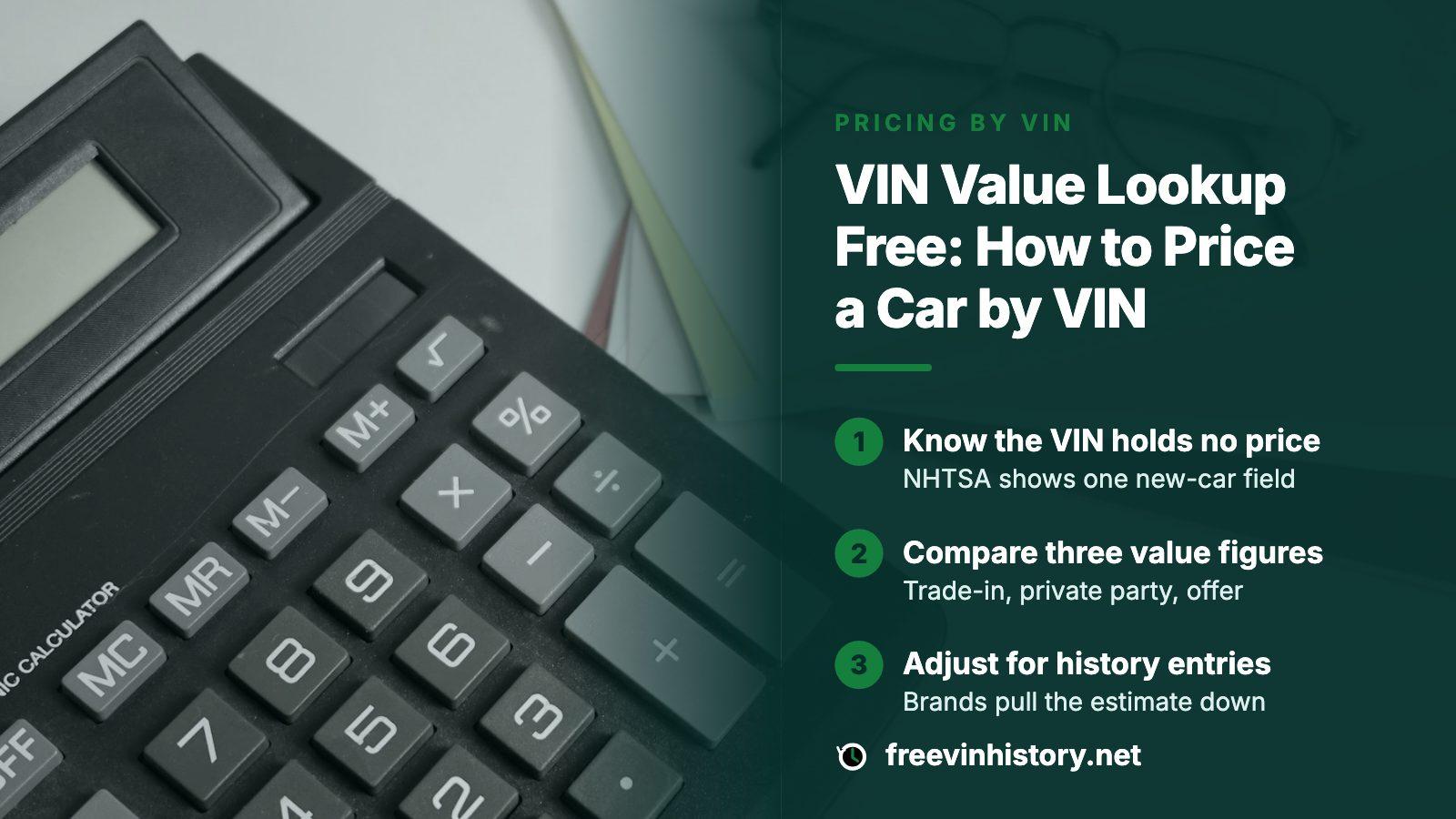
THE SHORT ANSWER
No free official lookup returns a market value for a VIN. NHTSA's decoder includes one price field, a new-car figure, and it was blank on a test VIN. Valuation guides supply the estimate, asking for mileage and condition as well as the VIN. Odometer readings, total loss entries and title brands can then pull the real price below that figure. FreeVINHistory's free preview shows what kinds of records are on file for the car before any payment.
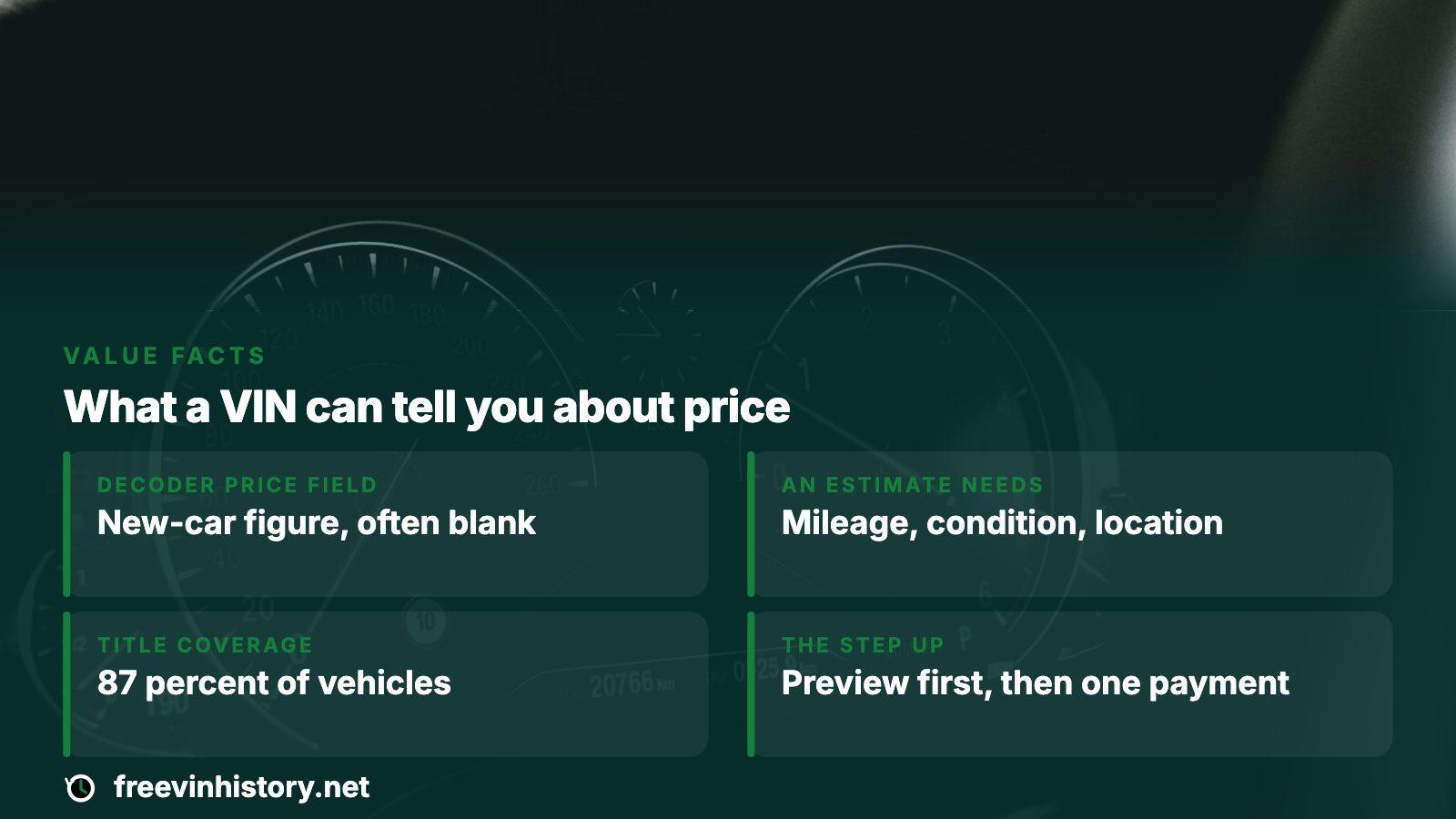
- Federal decoder's price field
- A new-car figure, blank on the test VIN
- What an estimate needs
- Mileage, condition and location on top of the VIN
- Title system coverage
- 87 percent of vehicles, so a search can miss a record
- The step up
- Free preview first, then one payment for the report
Why the VIN alone cannot hold a price
A VIN is a serial number. It records who built the car, the model line and body, the assembly plant and the engine family. Nothing in it changes after the car leaves the factory, while a price changes with every mile and every repair. That mismatch is why any page promising a value from the number alone deserves a second look.
NHTSA's decoder shows the gap plainly. Its variable list has exactly one price entry, Base Price, which is a new-car figure for a vehicle carrying only its standard equipment. There is no entry for market value, mileage or condition. On a test run with a sample Accord VIN, the decoder filled 35 of 154 fields and left the price field blank. NHTSA adds that an empty field means it holds no data, not that the item does not exist.
What each source returns for a VIN
| Source | What it returns | Gives a value? |
|---|---|---|
| NHTSA VIN decoder | The maker's own data on the car: make, model, year, body, engine, plant | No. The price field is a new-car figure |
| NHTSA recall records | Recall campaigns for the vehicle, each with component, summary and remedy | No. No record carries a price |
| Federal title system (NMVTIS) | Title brands, salvage and total loss entries, last reported mileage, hand-offs to recyclers | No. The Justice Department page does not claim one |
| Valuation guide | Two figures: what a dealer might pay in trade, and a private sale price | Yes, an estimate |
| FreeVINHistory preview | The car's basic identity and the kinds of records on file | No, but it shows what is worth reading |
Read the last column and the pattern is clear: only the valuation guides produce a dollar figure, and they build it from mileage, condition and location that you supply. The VIN simply tells them which car to price.
How to run the lookup
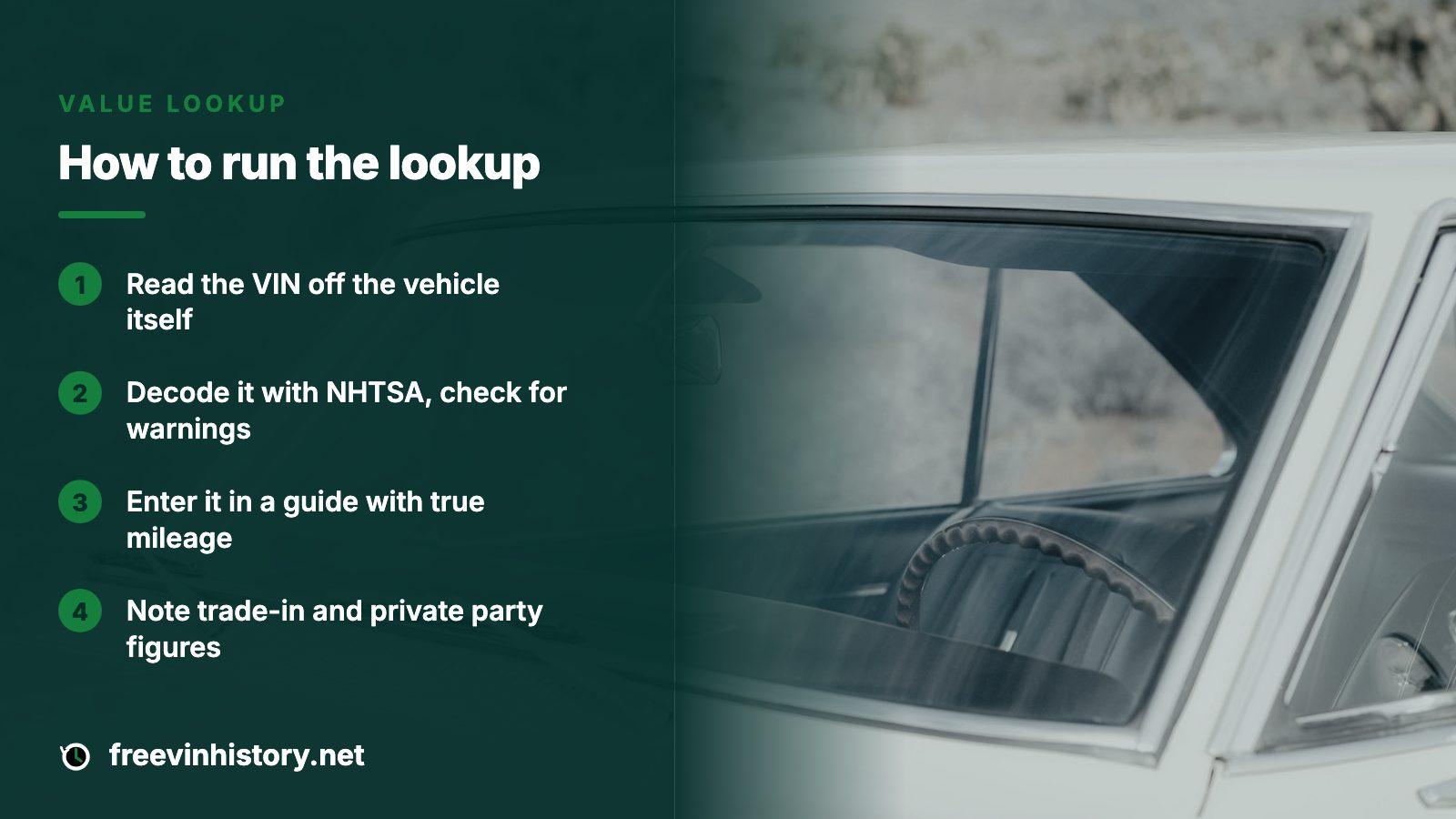
- Read the VIN off the vehicle itself, and treat the advert's number as unverified. The Texas DMV points to the driver's side corner where the dashboard meets the windshield, seen from outside, and to the door-jamb sticker. The title and insurance card should carry the same number.
- Decode it with NHTSA. A mistyped character often trips a check-digit warning, and a decoded year or body style that disagrees with the listing needs an explanation before any price talk.
- Enter the VIN in a valuation guide, then the true mileage and an honest condition grade. Grade the car the way a stranger handing over cash would.
- Write down two figures, trade-in and private party. They answer different questions, covered below.
- Run the FreeVINHistory preview on the same VIN to see whether title, damage or odometer entries exist. None of the earlier steps can tell you that.
History entries that pull the estimate down
Kelley Blue Book's car values page lists options, condition, mileage and where the vehicle sits as the drivers of a used price. A title brand is not among them, so confirm the title is clean before leaning on any figure. Entries worth looking for:
- A brand on the title record: junk, salvage or flood, in the Justice Department's wording.
- An insurer's total loss or salvage determination. The same page cautions that a total loss is not always a destroyed or worthless car, so read the detail.
- A hand-off to a recycler or salvage yard.
- A latest reported odometer reading that disagrees with the mileage the seller quotes, which breaks the mileage input your estimate rests on.
- An open recall. The remedy text in NHTSA's recall records describes the repair as free of charge, so it is a line in the negotiation, not a reason to walk.
One entry can outweigh the estimate
If the record shows a salvage or flood brand, the guide's number no longer describes the car in front of you. Ask the seller for the paperwork behind the entry, and have a mechanic inspect the repairs before any deposit changes hands.
Where a free estimate stops being safe
A quiet result is the risky one. The Justice Department says its title system holds 87 percent of the vehicle population, with more than half of states reporting, so a search can miss a record. It also calls its consumer report intentionally short and warns that a clean report is not the whole story.
The FTC adds a limit that covers every history, free or paid: reports tend to list crashes and flood damage but not mechanical faults. A price built from a guide and a clean record is still a hypothesis until a mechanic has seen the car. The FTC suggests asking for the repair estimate in writing, with make, model and VIN on it, and using it to bargain. A dealer who refuses an independent inspection is one to leave.
Reading trade-in, private party and offer figures
Kelley Blue Book frames its trade-in range around a dealer's likely bid this week, and its private party value around a fair price between two individuals. It says the private figure usually runs higher. Pick the one that matches your side of the deal.
An estimate is also not money on the table. The same site lists an Instant Cash Offer as a separate service, an official offer redeemable at participating dealers. Kelley Blue Book says it updates pricing at least weekly, so a figure saved last month has gone stale; date every screenshot you keep.
From the free preview to the full report
FreeVINHistory covers the part of a value check that no estimate tool can see. Its preview takes the VIN and returns the car's basic identity and the kinds of records on file, at no charge, so you learn whether a title, damage or auction entry exists before paying.
The report itself is one payment per purchase, with no plan behind it. Buy a single report for one car, or a larger bundle when you are comparing a shortlist; the pricing page lists the sizes and the figures. For a value question the parts to read are the market value, brands on the title, mileage entries, and damage and salvage records with auction photos, because together they test the estimate against the car's past.
Before you agree on a number
- Ask a dealer for the out-the-door price in writing, so advertised discounts and late add-ons surface before you arrive.
- Read the Buyers Guide posted on the car: it states whether the sale is as is or backed by a warranty, and the FTC says it overrides the sales contract.
- Hire an independent mechanic and keep the written estimate.
Order the report once a single car is left on your list and a deposit is the next step. A finding can still move the price then, and it cannot afterward.
Where this information comes from
- NHTSA: vPIC VIN decoder — What a decode returns, that the data is maker-reported, and how a supplied model year is handled.
- NHTSA: vPIC variable list — The Base Price variable and its definition, and the absence of any market value variable.
- U.S. Department of Justice: NMVTIS for consumers — What a title search shows, who reports into it, its coverage and why a clean result is not complete.
- FTC: Buying a used car from a dealer — Limits of a history report, written out-the-door prices, the Buyers Guide and independent inspections.
- Texas DMV: How to find the VIN — Where the VIN appears on the car and in the paperwork.
- Kelley Blue Book: What's my car worth — Which details its value form accepts, and how it defines trade-in, private party and instant offer figures.
- Kelley Blue Book: Car values — What its used values depend on and how often its pricing is refreshed.
Sources and photos: Facts checked against the sources above in November 2026. Photos by Cht Gsml, Wesley Tingey and Viktor Theo on Unsplash; diagrams by FreeVINHistory.
Keep reading
- Free salvage title check by VIN: what the free lookups showHow brand and total loss entries show up before you pay for anything.
- Free odometer check by VIN: what you can verify before you payMileage drives every estimate, so test the figure the seller gives.
- Sample reportSee where market value sits in a finished report, beside the history behind it.
- PricingSingle reports and larger bundles, each paid once, no subscription.
Frequently asked questions
Is there a completely free VIN value lookup?
Not one that starts and ends with the VIN. Free steps exist for the pieces: NHTSA's decoder pins down the exact car, and valuation guides produce an estimate once you add mileage and condition. Read each page's terms for charges or email requirements before typing anything. FreeVINHistory's preview is a no-charge first look, and the report that follows is bought once.
Can I get a car's value from just the VIN?
The VIN settles which car you mean, which matters because trim and engine change the price. The rest of the price comes from mileage, condition and location, and none of those live in the number. Expect any valuation page to ask for them, and treat a result that did not ask as a guess.
Why do trade-in and private party values differ?
They answer different questions. A trade-in range reflects what a dealer might pay this week, while the private party value reflects a sale between two individuals, and Kelley Blue Book says the private figure usually runs higher. Use trade-in if you are selling to a dealer and private party if you are buying from or selling to an individual.
Does a free VIN value lookup show salvage or flood history?
The decoder and the recall lookup do not. Brand history and salvage entries sit in the federal title system, which consumers reach through a report bought from a provider. The FreeVINHistory preview shows whether such entries exist, and the full report shows the detail, so you can adjust the price you were quoted.
Do I have to pay for the full report?
Yes. The full report is a one-off purchase for a single car, with bundles of three, five and ten available for shortlists. The preview ahead of it costs nothing and shows which records exist. No subscription and no renewals; the pricing page lists the figures.
Now check the car itself
The guide explains what to look for. The report shows what this VIN has on record.