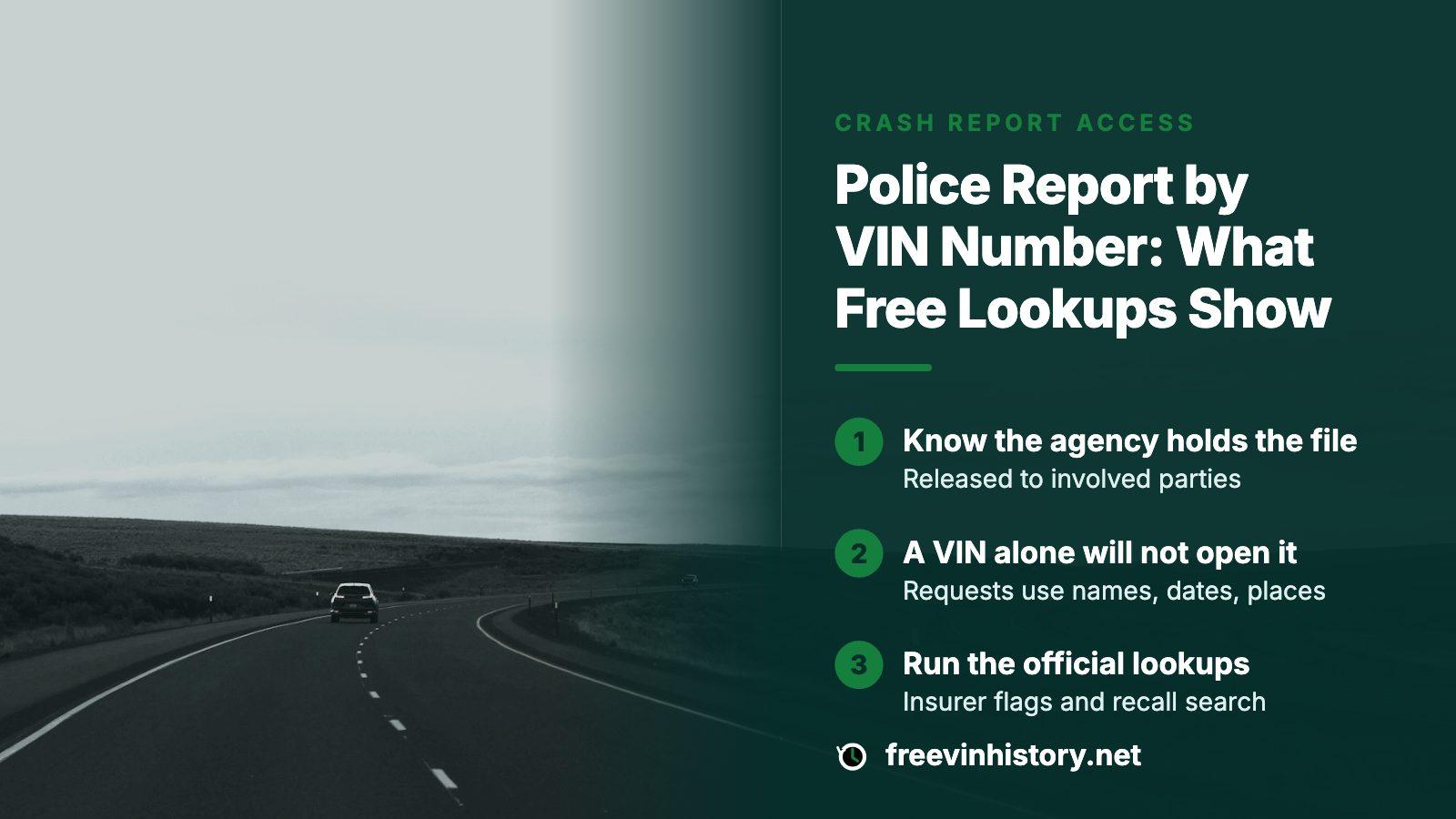
THE SHORT ANSWER
No. A VIN does not open a police crash report. The investigating agency keeps the file and releases it to people involved, owners and insurers, using details such as the crash date and location. The free official lookups do not read police files either: NICB reads participating insurers' records, NHTSA reports recall status, and the federal title report holds five indicators with no accident log. A paid history report is the practical way to see accident entries for a VIN.
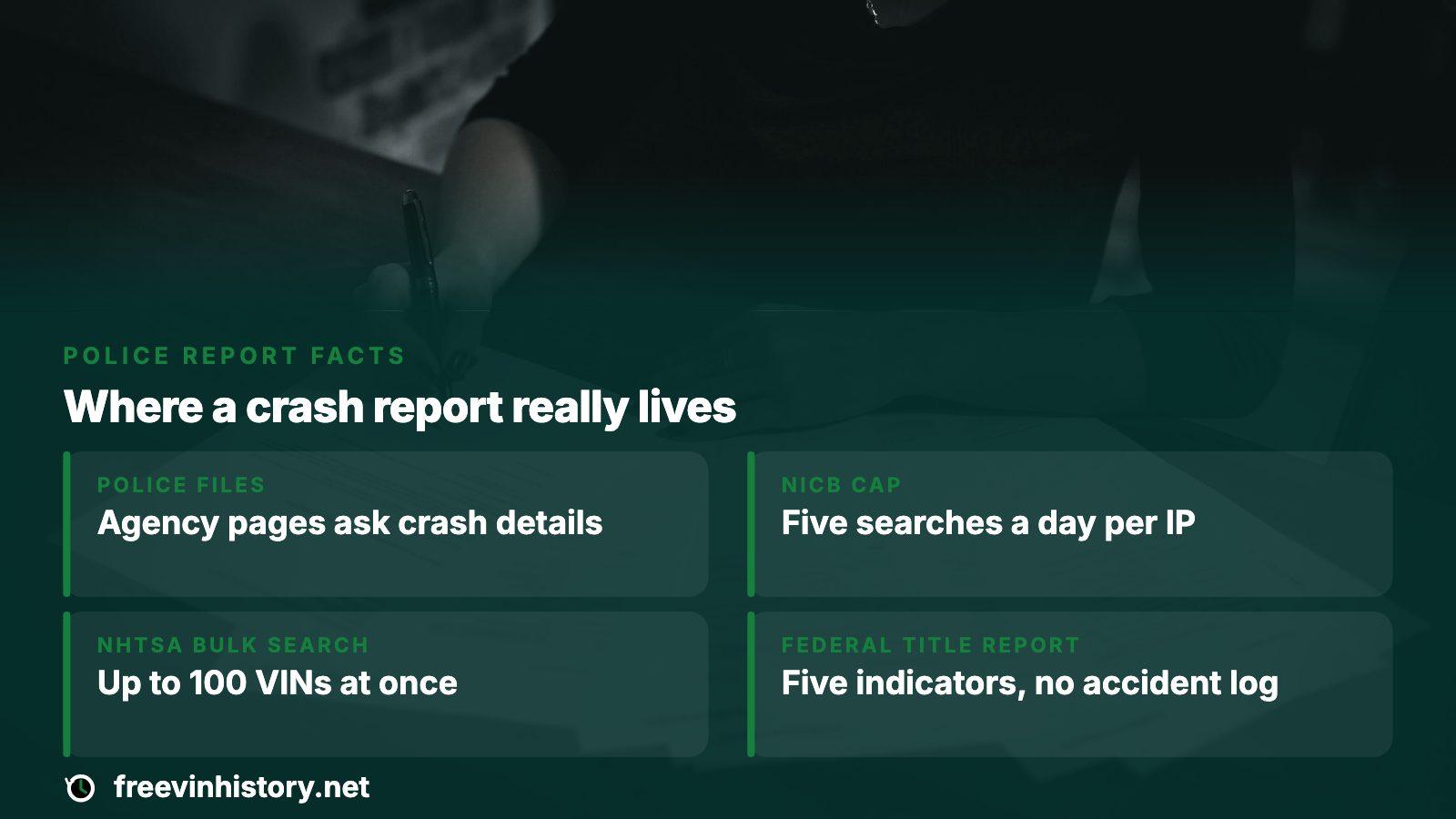
- Police files by VIN
- Agency pages ask for crash details, not a VIN
- NICB VINCheck cap
- Five searches a day per IP address
- NHTSA bulk search
- Up to 100 VINs at once
- Federal title report
- Five indicators, no accident log
Where a police crash report actually lives
A police crash report belongs to the agency that worked the crash, and some states hand copies out through a transportation or motor vehicle department instead. The file is built around the crash, so the way in is the crash too: when it happened, where, and who was involved. Two states show the pattern.
| State | Who releases copies | How you ask | What the page asks for |
|---|---|---|---|
| California | Highway Patrol | Online crash portal, or form CHP 190 at an Area office | Approximate date is fine, plus location and driver or owner; no VIN requested |
| Texas | TxDOT | Online purchase system; the copy arrives by email | Searches run on a crash ID; no VIN mentioned |
Other states differ in the small print, not in the logic. Work out which agency investigated before you go hunting for a form.
Who is on the list to receive one
California releases copies to a party of interest: drivers, passengers, pedestrians, owners, legal representatives and insurers holding a claim or policy number. Texas asks whether you are directly concerned in the crash or have a proper interest, and hands everyone else a redacted copy. It also keeps crash data for 10 years plus the current year, so an old crash can simply be gone.
Read the eligibility line first
Neither list names a shopper who has not bought the car yet. Owners appear on both, but whether a crash from before your ownership qualifies is the agency's decision, so read its page or ask its office before paying a fee.
The VIN is on the officer's form, but not on the request form
Illinois publishes its instruction manual for officers, and it shows why this confuses people. The officer enters the car's 17-character VIN and the titled owner's name and address, then circles the damaged areas on a diagram of the vehicle. The number is inside the file. Neither agency page above offers a search by VIN.
For a buyer the practical lesson is simple. A seller who says the car had a police report can give you the date, the location and the agency, and those are the details a request wants. A VIN alone does not get you there.
What each free official lookup does with a crash
| Lookup | Cost and limit | What it returns | Reads police files? |
|---|---|---|---|
| NICB VINCheck | No charge; five searches a day per IP address | Stolen-not-recovered, salvage and flood flags from participating insurers | No, it skips law enforcement records |
| NHTSA recall search | Up to 100 VINs in one bulk search | Whether that VIN has an unrepaired safety recall | No, the page covers recalls only |
| Federal title report | Sold through approved providers | Brands, odometer reading, total loss and salvage entries, plus the title's state and date | No, accident history is not a listed category |
Insurers that take part cover 92.49% of the premium earned across the U.S., a large share that still leaves some cars out. A salvage flag means an insurer judged repairs too costly and paid the claim, which is as close to a crash verdict as the free tools get. The federal report is fed by state titling offices, junk and salvage yards, auto recyclers and insurance carriers, so it knows brands and total losses but has no category for an ordinary collision. A crash that stayed under the write-off line leaves little for any of the three to show.
When the VIN on a police report belongs to a different car
A history entry is only as dependable as the VIN behind it. One owner's complaint to NHTSA describes the kind of mismatch that can turn up.
From an NHTSA owner complaint
The owner of a 2018 Chevrolet Malibu wrote that a history report placed the car in an accident in Tennessee in October 2020, when it was in Iowa. The Chattanooga police report, they said, carried the same VIN for a 2002 minivan owned by a rental company, with Colorado plates. They had bought the Malibu from a rental company in March 2019, and they asked NHTSA to investigate how two vehicles could share one VIN.
No outcome is given in the complaint, so read it as a warning rather than a verdict. The takeaway is practical: a crash entry has to fit the car in front of you. Compare its date and state with where the car actually lived, check every VIN character on the paperwork, and ask whoever issued an odd entry to show where it came from.
Running the free pass in a sensible order
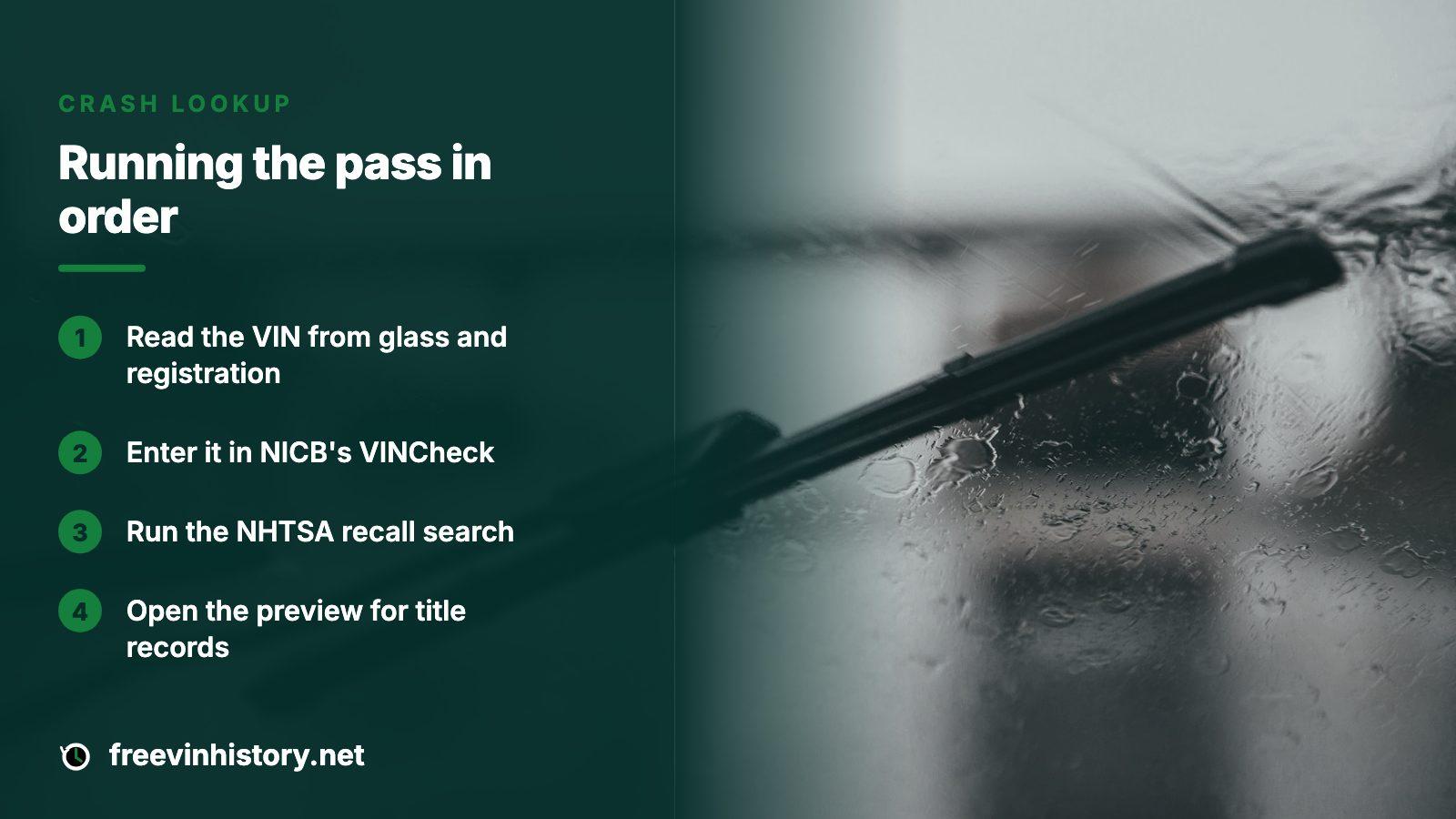
- Read the 17 characters from the windshield corner and the registration card, and compare them. The number in a listing is whatever someone typed.
- Enter it in NICB's VINCheck. Five searches a day per connection suits a short list and cramps a long one.
- Run the NHTSA recall search, which takes a whole shortlist of up to 100 VINs in one go.
- Open the FreeVINHistory preview for that VIN and see whether any title or auction records turn up.
- If the seller mentions a police report, ask for the crash date, the location and the agency, the details a form such as California's asks for.
Where the preview ends and the paid report picks up
The FreeVINHistory preview comes first and costs nothing. Type in a VIN and it identifies the car and tells you whether title or auction records turn up, which is enough to judge if a fuller read is worth the money.
Each report is a one-off payment, with larger packs on offer to anyone comparing several cars. Nothing renews, and amounts are listed on the pricing page. The report lays out crash and damage entries, photos from salvage and auction listings, and the title's brands, so you read what happened instead of inferring it from a count.
What it is not
A history entry is a summary attached to a VIN. It is not the officer's file, which on Illinois's form carries the owner, the damage diagram and the point of first contact. For that copy, the place to ask is still the investigating agency.
Before any money changes hands
- Treat a clean free result as unfinished work. NICB says a clean answer is no guarantee of a clean history, and the federal title report calls itself intentionally concise.
- Book an independent mechanic whatever any report says. The Justice Department's own page on its title report recommends an inspection alongside it.
- If the seller disputes an entry, ask where it came from, then compare its date and state with where the car lived.
- Save dated screenshots of each answer, because recall data and title records keep updating.
Where this information comes from
- NICB: VINCheck lookup — What the insurer-fed lookup returns, its daily cap, and NICB's own statement that police records are not queried.
- NHTSA: Check for recalls — What the VIN recall search shows and leaves out, plus the bulk-search limit.
- NMVTIS (Department of Justice): Understanding a report — The five indicators in the federal title report and its advice to inspect the car.
- California Highway Patrol: Request a crash report — Who qualifies for a copy and which details the request form asks for.
- TxDOT: Crash reports and records — How Texas releases crash reports, who gets a full copy, and how long records are kept.
- Illinois DOT: SR-1050 crash report instruction manual — What an officer records on the crash form, including the VIN and the damage diagram.
- NHTSA owner complaint 11470598 — owner experience, paraphrased
Sources and photos: Facts checked against the sources above in November 2026. Photos by John Kakuk, Thibault Valjevac and Dimitri Karastelev on Unsplash; diagrams by FreeVINHistory.
Keep reading
- Free accident history check by VIN: what shows up before you payWhat the free sources can say about a crash, source by source, before you pay for anything.
- NMVTIS report: what the federal title record shows and missesThe federal title record in detail: brands, odometer entries and total-loss history.
- Sample reportA look at how an accident entry and its damage details appear in a finished report.
- PricingWhat one report costs, plus packs of 3, 5 or 10, with nothing recurring.
Frequently asked questions
Can I get a police report with only a VIN?
Not through the agency pages checked for this guide. California's form asks about the crash date and place and about the driver or owner, and Texas searches by crash ID. Illinois's officer form has a VIN field, but public requests are built around the crash, so get the date, place and agency from the seller first.
Does NICB VINCheck show police reports?
No. NICB says the lookup returns insurance records only, from participating insurers only, and that it does not query law enforcement records. It answers whether a car was reported stolen and not recovered, salvage or flood damaged, with five searches allowed per IP address in 24 hours.
Is there a free way to see a car's accident history by VIN?
Only in pieces. NICB covers insurer write-offs, NHTSA covers open recalls, and the federal title report covers brands, odometer and salvage entries. A crash that never became a total loss may appear in none of them, which is why the FreeVINHistory preview is the next stop.
Will the paid report include the actual police report?
No. A history report lists accident and damage entries tied to the VIN, a summary rather than the officer's file. The report is a single payment, and the preview comes first at no charge. For the officer's copy, go to the agency that investigated and read who it releases to.
Is a clean free result enough to buy a used car?
No. NICB says a clean result is no guarantee, and the federal title report is intentionally concise, so a quiet answer only shows those sources had nothing to say. Add an independent inspection, the preview for title and auction records, and a direct question to the seller about any crash.
Now check the car itself
The guide explains what to look for. The report shows what this VIN has on record.