THE SHORT ANSWER
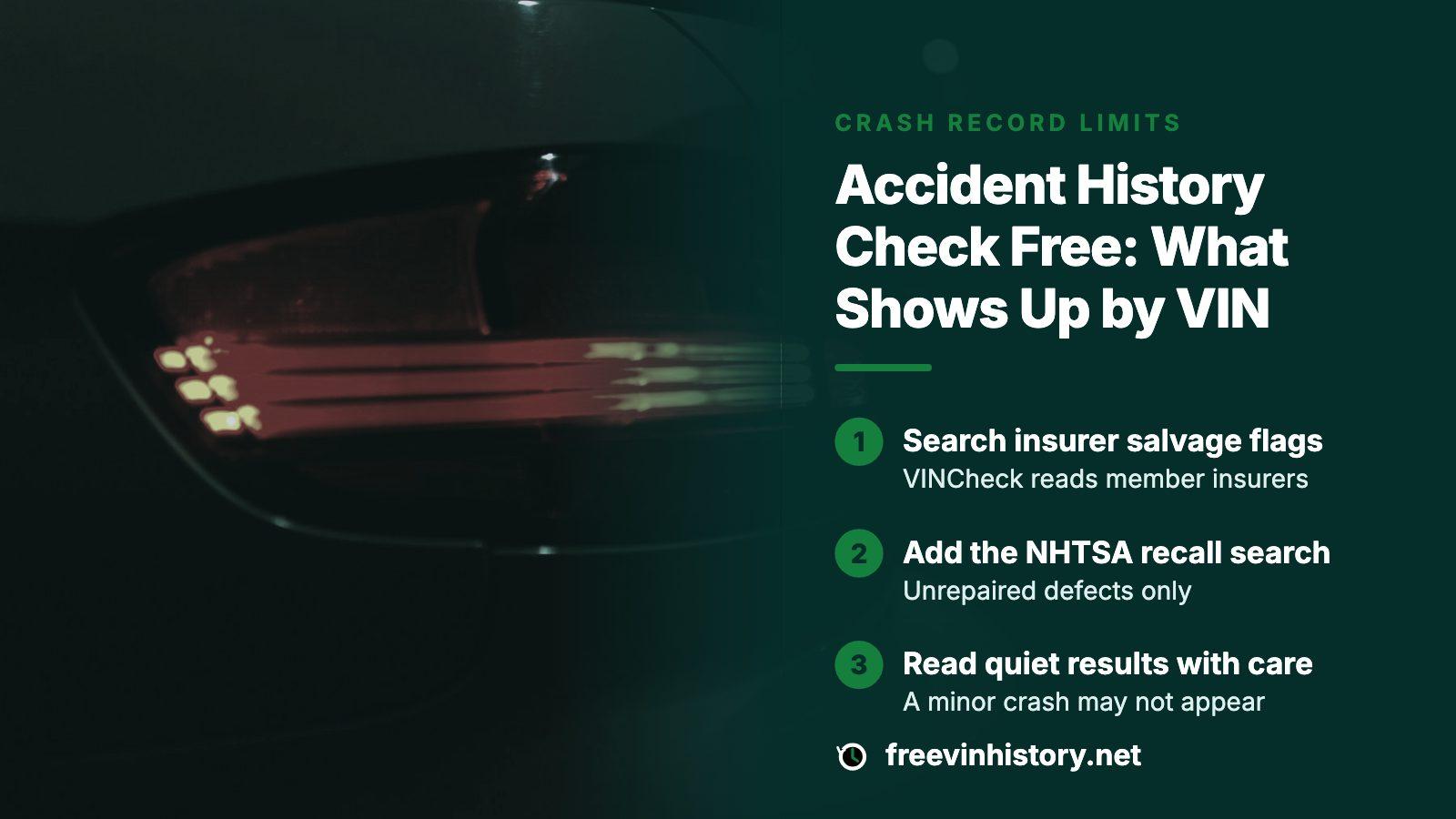
Partly. Two free tools touch accident history: NICB's VINCheck reports whether a member insurer recorded the vehicle as salvage, flood damaged or stolen and unrecovered, and NHTSA's recall search reports unrepaired safety defects. A crash that stopped short of a write-off appears in neither. Crash-level detail, where anyone reported it, sits in a paid report, while the preview costs nothing and tells you if title and auction records are on file.
- Free official lookups
- NICB VINCheck and the NHTSA recall search
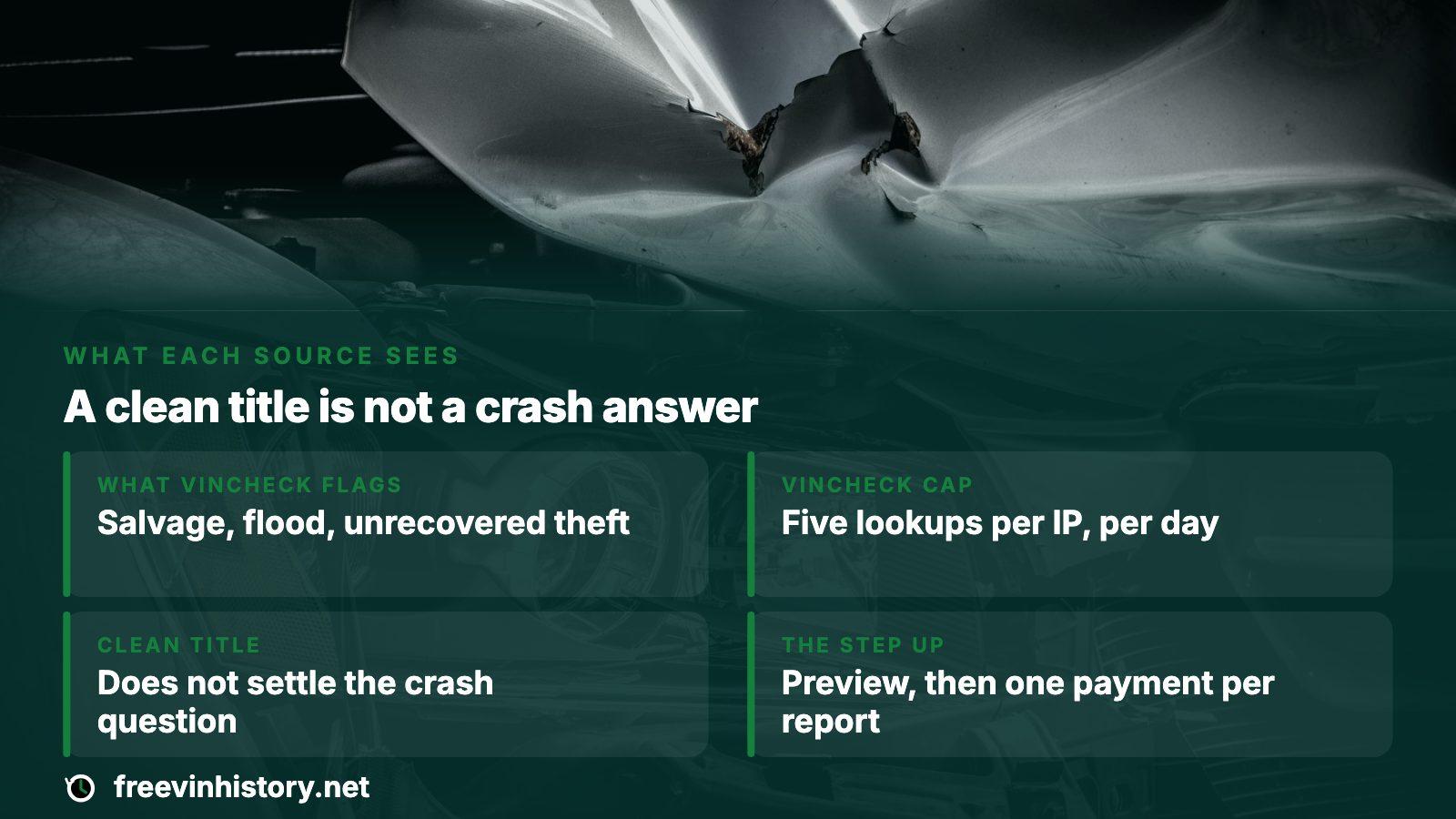
- What VINCheck flags
- Salvage, flood and unrecovered theft, from participating insurers
- VINCheck cap
- Five lookups from one IP address per day
- The step up
- Start with the free preview, then pay once for each report you open
What the free sources can say about a crash
Neither free source keeps a list of crashes. NICB's VINCheck matches your VIN against records submitted by member insurers and answers three questions: was the car stolen and never recovered, declared salvage, or flood damaged. Salvage comes closest to an accident verdict, since it means an insurer judged repairs too costly against the car's value and paid the claim instead.
NHTSA's recall search covers another subject. It says whether a manufacturer's safety repair is still owed on that VIN, and nothing about collisions. Together the two show one slice well: cars an insurer gave up on. A crash that stopped short of a write-off leaves both tools with nothing to display.
Source by source: what each one can and cannot see
| Source | Cost | Can show | Cannot show |
|---|---|---|---|
| VINCheck (NICB) | Nothing, five searches a day per IP address | Salvage, flood and unrecovered-theft flags from participating insurers | Police files, insurers that opted out, any crash short of a write-off |
| Recall search (NHTSA) | Nothing | An unrepaired manufacturer recall on that VIN | Repaired recalls, recalls past 15 years, small makers, any damage history |
| Federal title report (Justice Department) | Paid, through an approved provider | Brands, the last odometer entry, plus total-loss and salvage records | Anything outside its five indicators, and states that do not report |
The federal report is deliberately short, and its data comes from insurers, recyclers, salvage yards and titling agencies instead of from body shops.
Running the free pass on one car
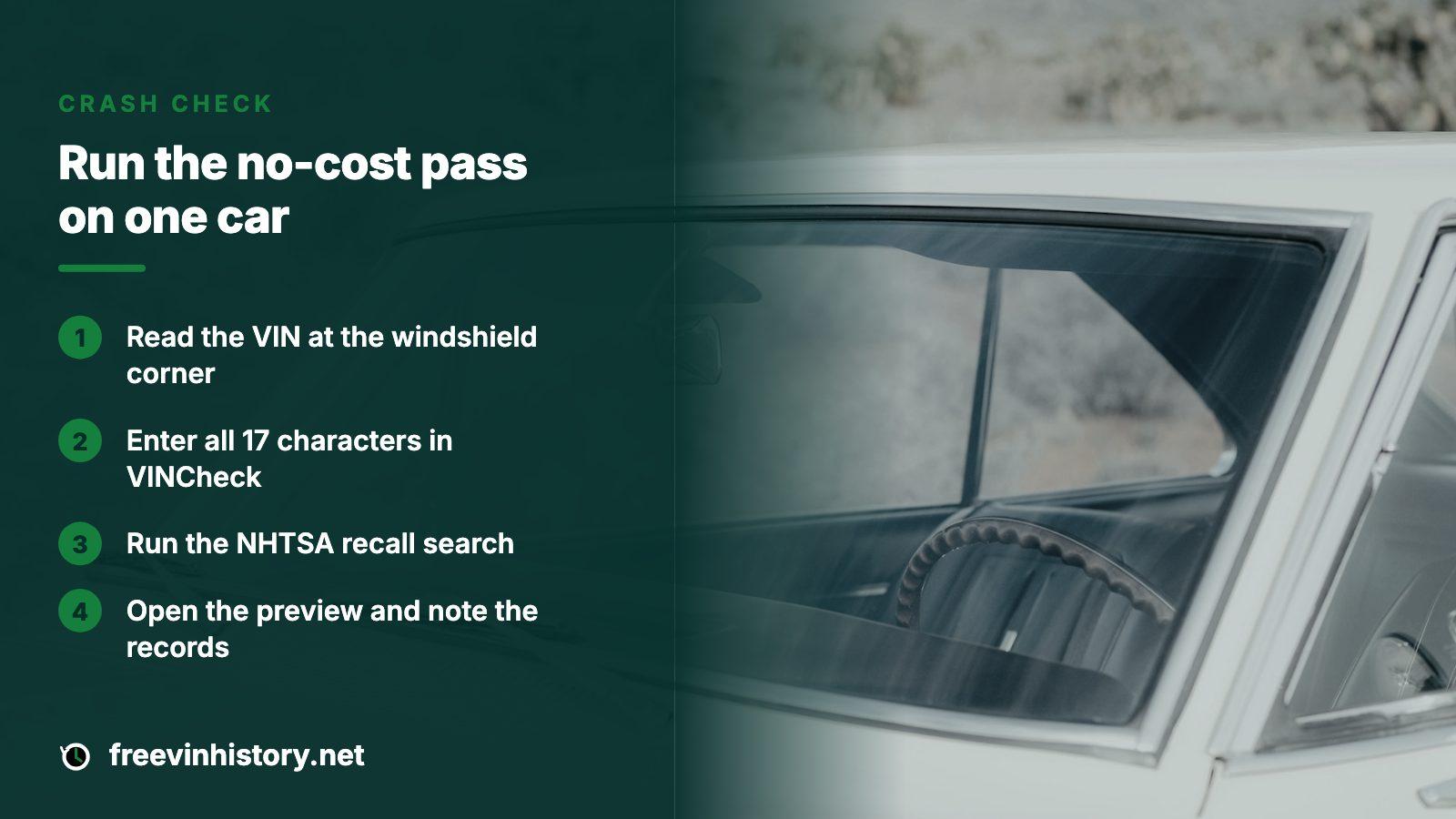
- Read the VIN from the car, at the bottom corner of the windshield, and compare it with the registration or insurance card. The number in an advert is whatever the seller typed.
- Enter all 17 characters in NICB VINCheck. One wrong character can hide a genuine record, and a long shortlist can burn through the daily cap from a single connection.
- Run the NHTSA recall search. If you are weighing a whole shortlist, up to 100 VINs go through in one bulk search.
- Open the FreeVINHistory preview for the same VIN and note whether title and auction records are on file.
- Save a dated screenshot of each answer. Recall lists grow as VINs are added, so an old result goes stale.
Why a quiet result is not the same as no accident
NICB spells out the limit itself. VINCheck returns insurance records only, from participating insurers only, and a car could be seriously damaged with nothing showing. Those insurers represent 92.49% of earned U.S. premium as of August 2026, a large share but not all of it.
The federal title system has gaps of its own. Its records reach 87 percent of vehicles in the country and include roughly 20 million total-loss and salvage entries, yet more than half of the states report into it, which is why the Justice Department warns that a search can return nothing even for a damaged car. Private databases can share those holes.
What a quiet answer proves
It proves no participating insurer logged a write-off under that VIN. It does not prove the car was never hit, never repaired badly or never sold through an auction. Treat silence as a reason to keep checking, not as permission to buy.
When two reports disagree about the same car
Reports are assembled from different sources, so a clean one proves less than it seems. The federal report is intentionally concise, built on five indicators, and the FTC notes that a report can mention accidents and flooding but usually skips mechanical faults.
From an NHTSA owner complaint
A buyer of a 2016 Hyundai Elantra told NHTSA the dealer sold it as certified pre-owned with no accidents, and the history report the dealer handed over looked clean. When the car started skipping sideways over bumps, the owner ordered a second report, which listed 2 accidents. The dealer then produced a checklist from a sister store recording frame repairs and air bag deployment, and bought the car back for the purchase price.
The lesson is practical: a report the seller supplies is one source, picked by the seller. Run the VIN yourself, ask where the car sat before this lot, and treat any auction or damage entry as something to put to the seller.
A clean title does not settle the crash question
Titles and accidents live in separate records. NICB notes that an uninsured owner who never filed a claim can resell a cleaned-up flood car on its original clean title, and that title washing moves a salvage or flood car to another state to collect a clean one. States also disagree on what earns a brand, and only some use a flood brand at all.
From an NHTSA owner complaint
An owner of a 2022 Tesla Model 3 said they bought it from a rental company with roughly 46,000 miles and a clean title, though the vehicle history showed a prior accident. After the car stopped charging, the owner reports that a Tesla service center declined the job, citing the accident.
Whatever the wider dispute, the point holds: an accident on record can surface at a service counter even when the title looks perfect. Ask for the title answer and the accident answer separately.
Where the preview stops and the full report starts
FreeVINHistory puts a preview after the official lookups. Enter a VIN and it returns the car's year, make, model and trim, photos when the records include them, an open recall count and tallies of title and auction records. It needs no card and costs nothing.
Those tallies work as a hint: if records exist, damage may be on file. The paid report adds damage and accident entries, auction and salvage history with photos, title brands and odometer readings, so you can read what happened instead of guessing from a count. It is one payment per report. If your shortlist is long, multi-report sets of 3, 5 or 10 are offered, nothing renews, and amounts appear only on the pricing page.
Before any deposit changes hands
- Run the free pass and the preview on every car still on your list, and save the paid report for the finalist.
- Treat a salvage, flood or write-off entry as both a price question and a safety question. NICB warns that flood water can harm wiring, sensors, brake lines and fuel systems, and electrical faults can show up months or years later.
- Book an independent mechanic whatever any report says. The FTC calls a history report no substitute, and a dealer who refuses an outside inspection is a reason to shop elsewhere.
- Ask the mechanic for a written estimate naming the make, model and VIN; its totals give you something concrete to haggle over.
- On a private sale, NICB adds a title search and a check of the VIN with your state's motor vehicle agency.
Where this information comes from
- NICB: VINCheck lookup — What the insurer-fed lookup returns, its daily cap and the gaps NICB states itself.
- NICB: Buying a used vehicle — Title washing, flood cars with clean titles and the private-sale checks NICB suggests.
- U.S. Department of Justice: NMVTIS for consumers — What the federal title system holds, its coverage figures and why a search can miss a record.
- FTC: Buying a used car from a dealer — Why a history report cannot replace an independent inspection, and how to run one.
- NHTSA: Check for recalls — What the VIN recall search returns, what it leaves out and where the VIN is printed.
- NHTSA owner complaint 11055846 — owner experience, paraphrased
- NHTSA owner complaint 11532182 — owner experience, paraphrased
Sources and photos: Facts checked against the sources above in November 2026. Photos by Johnathan Kaufman, Wesley Tingey and Clark Van Der Beken on Unsplash; diagrams by FreeVINHistory.
Keep reading
- Free salvage title check by VIN: what the free lookups showThe insurer total-loss flag in detail, the closest free signal to a serious crash.
- Free VIN check with pictures: what free sources show and where photos beginHow photos from salvage and auction records show damage a count cannot.
- NMVTIS report: what the federal title record shows and missesThe federal title record that holds brands, odometer entries and total-loss history.
- PricingThe price of a single report, the 3, 5 and 10 report sets, and confirmation that nothing recurs.
Frequently asked questions
Can I check a car's accident history for free?
Partly. NICB's VINCheck reports salvage and flood flags from member insurers, and NHTSA reports open recalls. Neither lists collisions one by one, so a car that was hit and repaired without a write-off can look spotless in both. The preview shows whether title and auction records exist, and the paid report lets you read them.
Is there a free accident report by VIN?
Not a full one from an official source. The Justice Department's title report covers brand history, odometer, total loss and salvage, and approved providers sell it. Be wary of any page that promises a complete crash list before it states a charge.
Before buying a used car, how do I find out whether it has been in a crash?
Stack the sources. Run NICB and NHTSA, preview the VIN, buy a report for the car you like, then pay a mechanic to look it over. NICB suggests a certified mechanic and the FTC suggests a written estimate carrying the VIN. Records show what somebody reported, while the inspection shows what the car looks like today.
Does a salvage result mean the car was in an accident?
It means an insurer wrote the car off and paid out, because repairs cost too much against its value. The cause might be a crash, a flood or a theft that ended badly. A salvage car may be lawfully rebuilt and given a new title, so ask for the repair records and have it inspected before you negotiate.
Does a free check work for an older or imported car?
Less well. NICB covers insured U.S. vehicles, with some motorcycles and boats included, and the NHTSA recall search skips international vehicles, small makers and most recalls past 15 years. A thin result on such a car may reflect missing coverage rather than a clean past, so lean harder on an inspection.
Now check the car itself
The guide explains what to look for. The report shows what this VIN has on record.