THE SHORT ANSWER
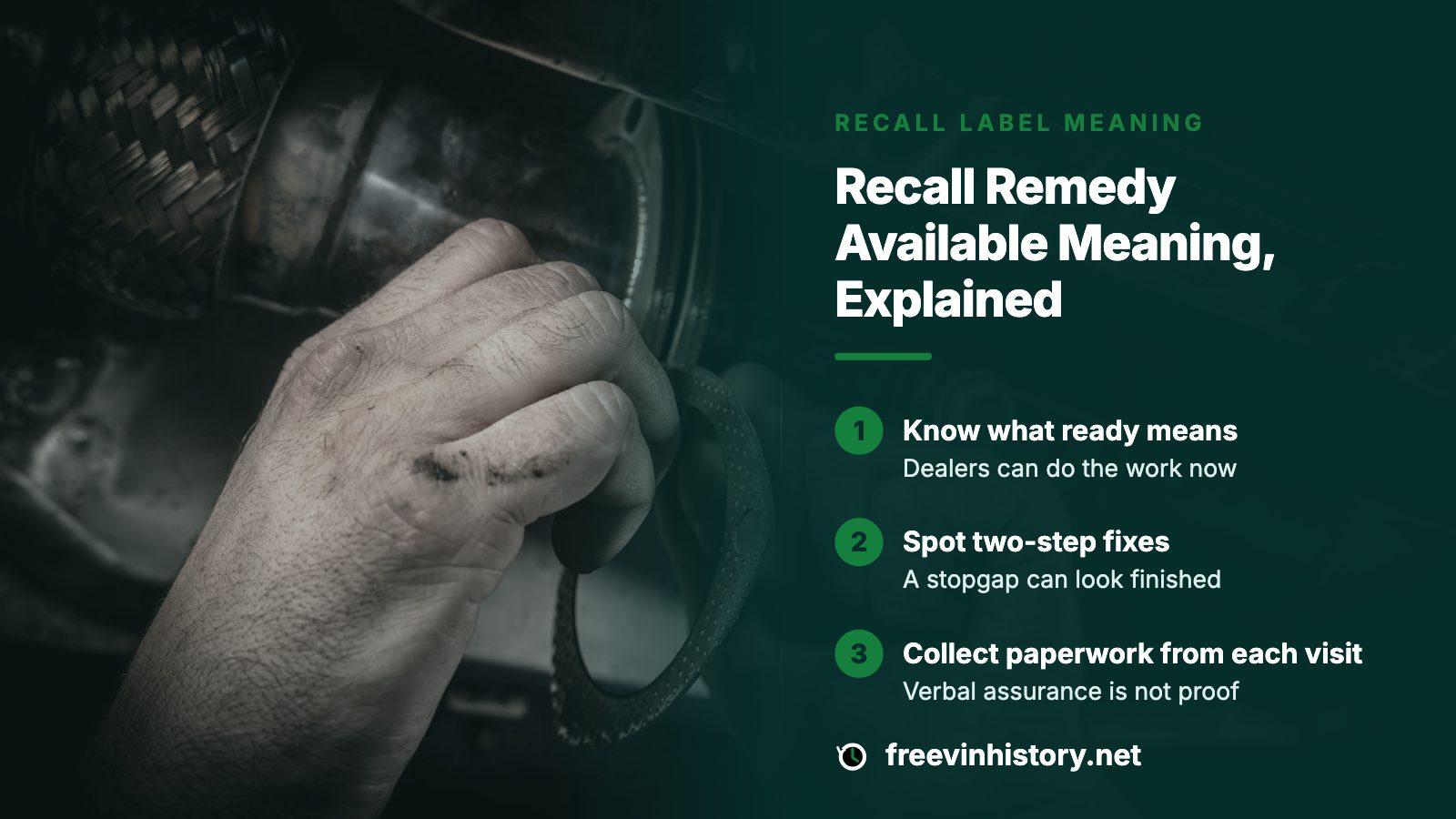
A recall marked remedy available has a repair, replacement or refund program that dealers can carry out now, at no cost to the owner. The opposite label, remedy not yet available, means the car is covered but the maker has no fix ready. Neither label says the work was done. Look for the line that reads unrepaired on the VIN search, then book the dealer.
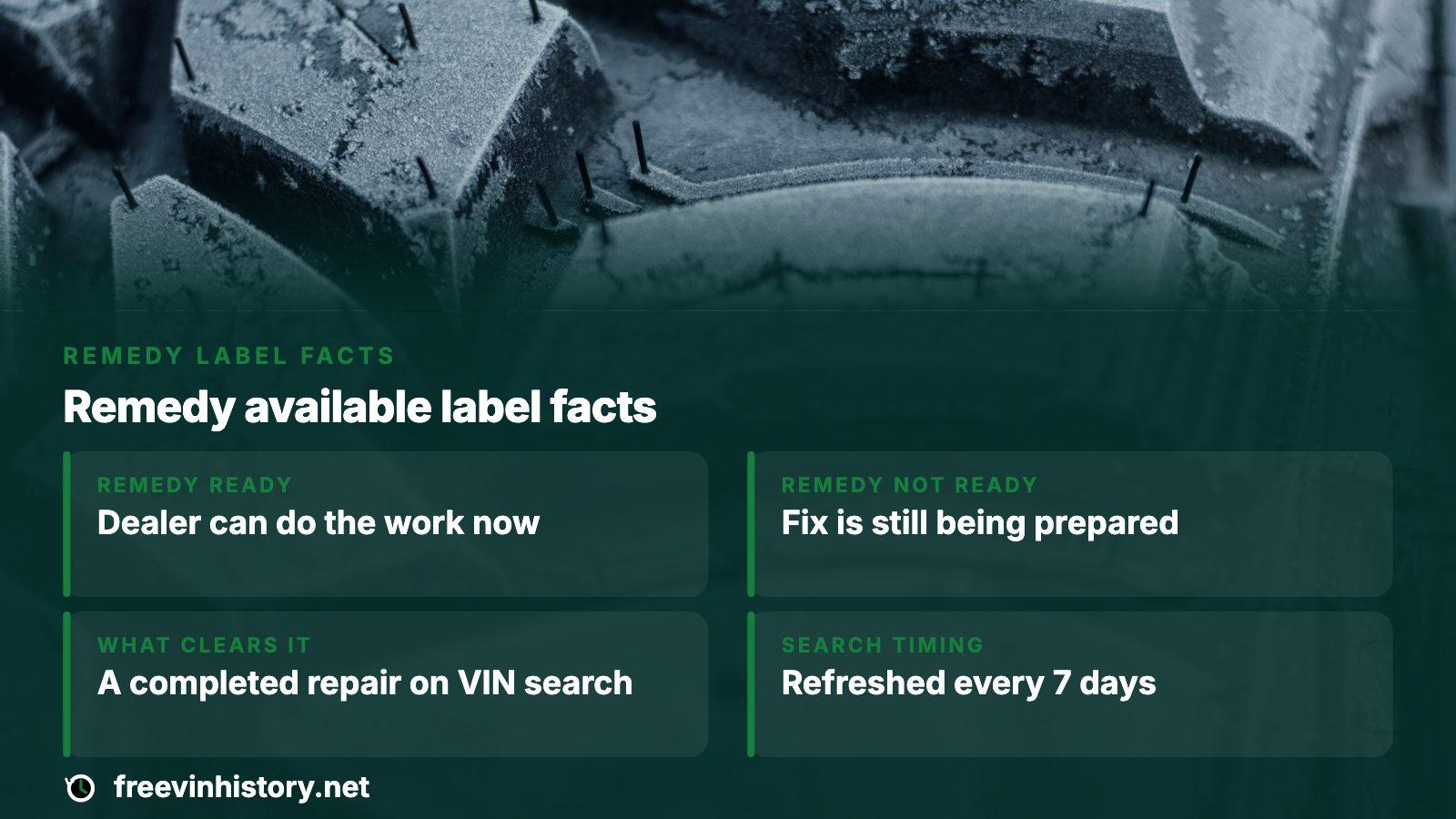
- Remedy ready
- Dealer can do the work now, free of charge
- Remedy not ready
- Car is covered, fix is still being prepared
- What clears it
- A completed repair, shown on the VIN search
- Search timing
- Maker searches refresh at least every 7 days
What the label is telling you
A recall has two separate questions attached to it. The first is whether the maker has finished designing the cure. The second is whether your car has had it. A remedy-available tag answers only the first one.
On the free side of a vehicle history check, the official source is NHTSA's recall page. We read that page and the exact words remedy available were absent, so the wording you see on a listing or a report belongs to whoever printed it. The idea underneath comes straight from federal rules: a repair program exists, and dealers can start work.
Plain reading
Remedy available: the fix exists. It says nothing about whether this car got it. A used car can carry the label for years if no one ever brought it in.
The other label: remedy not yet available
Federal rule 49 CFR 573.15 makes large makers run a public recall search by VIN. Where a recall reaches the car yet the cure is unfinished, the search has to state coverage and add that no remedy can be had yet. Each unfinished recall also needs a line with its NHTSA campaign number, when the defect was reported, a brief risk description, and the remedy program.
| Status | What it means | Your move |
|---|---|---|
| Remedy available, unrepaired | Fix is ready, this car has not had it | Book the dealer, ask for the campaign number |
| Remedy not yet available | Car is covered, no fix yet | Follow interim advice, check back often |
| Repaired | Work done and recorded | Keep the repair order |
| No unrepaired recalls | Nothing open for this VIN today | Search again before you pay |
Safety recalls must appear ahead of any other information on those results, so an open item is hard to miss on a maker's own page.
When the fix arrives in two steps
Some recalls start with a stopgap. NHTSA's data on the 2017 Ford F-150 shows the pattern in campaign 18V894, reported on 18 December 2018. Water can corrode the block heater cable splice and raise a fire risk. The remedy text says dealers first disable the cable, then replace it once parts are available, free of charge.
Campaign 19V278 followed on 8 April 2019 for trucks already repaired under the first one, after damage to the splice connector during the first visit was suspected. There, dealers disable the heater and a second notice is mailed when replacement cables are ready.
- A stopgap visit can leave the recall record looking handled while the real part is still pending.
- A repaired recall can return as a brand-new campaign number.
- Ask the seller for the paperwork from every visit, not a verbal assurance.
What waiting for parts looks like for an owner
People who file NHTSA complaints put the wait between a letter and a repair in plain language. These are public records, and they are single reports, not a measure of how common a delay is.
From an NHTSA owner complaint
An owner of a 2023 Toyota Corolla filed in October 2023 after a notice for steering campaign 23V480 arrived. The part was not yet available at the local dealer, and the owner felt the maker had exceeded a reasonable time. The complaint adds that the VIN tool confirmed parts were not available. No failure had happened.
From an NHTSA owner complaint
Another Corolla-year owner booked a dealer visit for a driver airbag recall, left the car, and within 20 minutes was told the repair could not happen. The dealer, the recall center and the brand each redirected the owner elsewhere, and the owner said driving a brand-new car with that open airbag recall felt unsafe.
The lesson for a buyer: a ready remedy on paper is not the same as a part on a shelf, so confirm the repair can be booked before you rely on it.
What the law gives the owner
Section 30120 of the federal vehicle safety statute requires the maker to cure the defect at no charge once the vehicle is brought in. For a car the maker picks one route: a repair, a swap for an equivalent vehicle, or a refund net of reasonable depreciation. Should it choose repair and then not finish properly within a reasonable period, replacement or a refund becomes its duty.
Sixty days without an adequate repair, counted from the day the car was presented, is treated as initial proof that the delay was unreasonable. The statute's sale limit applies to new vehicles in a dealer's stock when the notice arrives. The text we read does not extend that limit to an ordinary used car, so a used car can change hands with an open recall.
NHTSA's own advice to owners is to heed whatever interim safety instructions the maker sends and let the dealer replace the recalled part at no cost.
Checking the car in front of you
Run the 17-character VIN, not the make and model. NHTSA says a year, make and model search gives general results, while a VIN search tells you whether a specific vehicle needs a repair. Its VIN search leaves out a few things worth knowing, and the page is explicit about them.
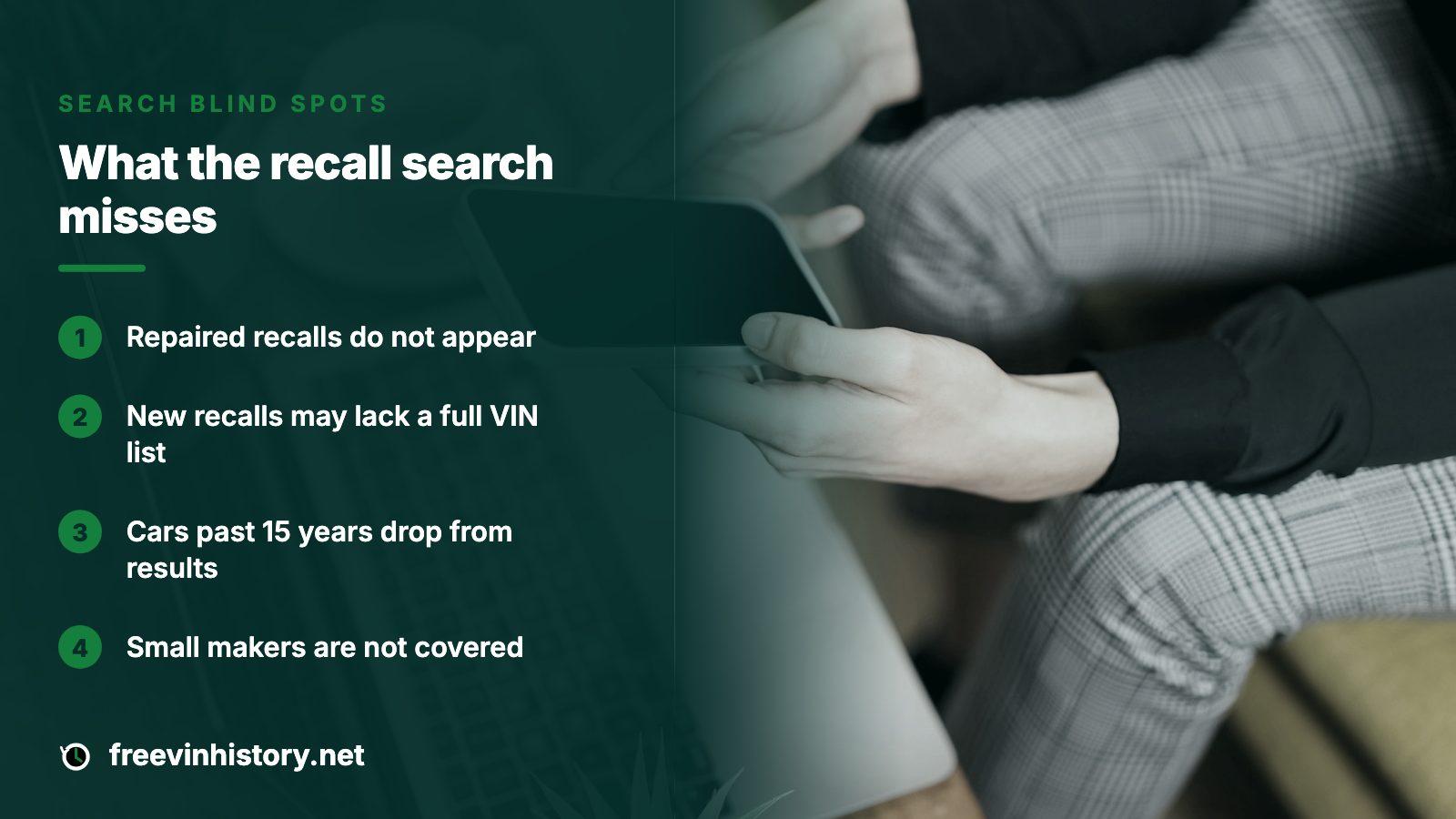
- Repaired recalls do not appear, so a clean result can hide a past campaign.
- Some new recalls lack a full VIN list at first, since VINs are added continuously.
- Anything past 15 years of age drops from the results, with an exception where the maker extends coverage.
- Small makers, some ultra-luxury and specialty brands, and non-safety campaigns are not covered.
- International vehicles are not covered.
The all-clear message is worded as zero unrepaired recalls tied to the VIN. Save a dated screenshot, because the answer changes when new campaigns land.
Where a full history report fits
NHTSA's page and the maker's own search cost nothing and stay the first stop for recall status. They say nothing about title brands, crashes or mileage, which is the other half of what a buyer needs.
Our preview costs nothing, and it counts open recalls next to the title and auction records it can find. If that car survives your shortlist, the full report is a single purchase that never renews; packs of 3, 5 or 10 cover a long shortlist. Current prices sit on the pricing page. An open recall with a ready remedy is usually a dealer visit, so weigh it against what the rest of the history shows.
Where this information comes from
- NHTSA: check for recalls — What the VIN search shows and leaves out, and how makers must remedy a recall.
- 49 CFR 573.15: public recall information — The not-yet-available wording and the fields an unfinished recall must show.
- 49 U.S.C. 30120: remedies — Free fix, repair, replace or refund, and the reasonable-time rule.
- NHTSA recalls data: 2017 Ford F-150 — Two-step remedy text in campaigns 18V894 and 19V278.
- NHTSA owner complaint 11550411 — owner experience, paraphrased
- NHTSA owner complaint 11550307 — owner experience, paraphrased
Sources and photos: Facts checked against the sources above in November 2026. Photos by Martin Fennema, Jakub Żerdzicki and Joan on Unsplash; diagrams by FreeVINHistory.
Keep reading
- Free open recall check by VIN: GM, Polaris and every other makeStep-by-step recall lookups by maker, and how to read the result.
- Airbag deployment reported: what the entry means on a history reportAnother airbag-related line a report can show, and what it means.
- Free vehicle history report: what the free sources showWhat the free sources show about a car beyond recalls.
- PricingWhat one report or a pack costs, with nothing recurring.
Frequently asked questions
Does remedy available mean the recall was fixed?
No. It means a repair, replacement or refund program is ready to carry out. Whether this car received it shows only on the VIN search, where an unrepaired recall is listed and a repaired one drops off. Treat the label as the maker's status, not the car's.
Is it legal to buy a used car with an unrepaired recall?
Usually yes. The federal sale limit we read covers new vehicles sitting in a dealer's stock when the notice arrives, not ordinary used cars. Still, ask for the campaign number, book the free dealer repair, and weigh the risk described in the recall.
What if the dealer says the part is not available?
Write down the campaign number and the date, follow any interim advice from the maker, and call the maker's customer service line printed on the recall record. NHTSA also keeps a Vehicle Safety Hotline, and owners can file a complaint describing the delay.
Does a clean VIN result mean there were never recalls?
No. NHTSA's lookup skips repaired recalls, campaigns beyond the 15-year mark, small makers and non-safety programs. Brand-new recalls can also be missing while their VIN lists fill in. Search once more right before paying.
How often does the recall data change?
Under the federal rule, a maker's search is updated weekly at the least and shows the date it last changed. NHTSA recommends two checks a year, and its free SaferCar phone app sends a notice if a recall appears for a vehicle you entered.
Now check the car itself
The guide explains what to look for. The report shows what this VIN has on record.