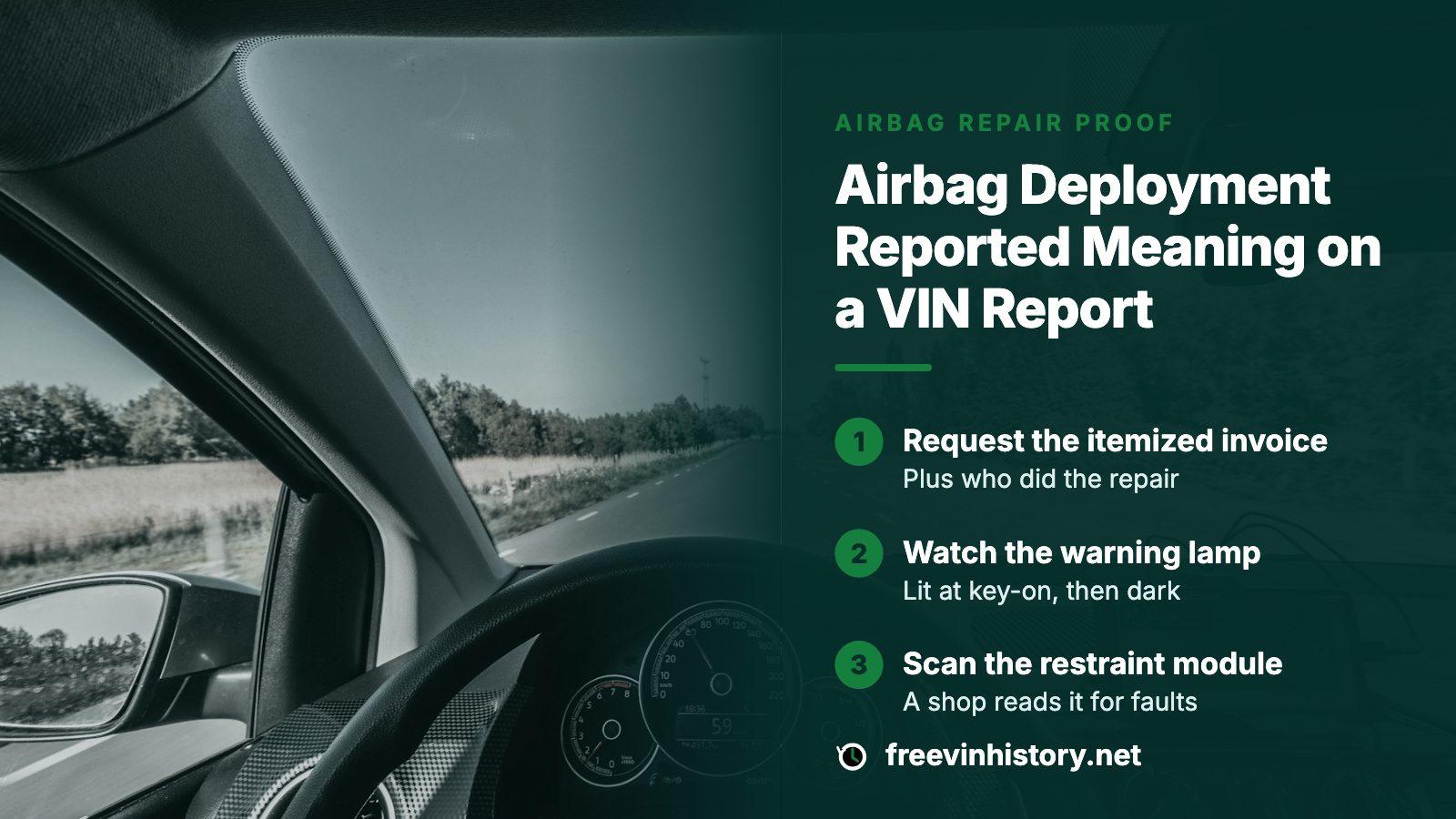
THE SHORT ANSWER
Airbag deployment reported means a source feeding the report noted that an airbag fired during a collision. A bag fires once, so a genuine deployment means the car needed new restraint parts. The entry does not say who did the repair or whether the parts were genuine. Neither NICB VINCheck nor NHTSA's recall search lists deployments, so this line usually appears only in fuller reports.
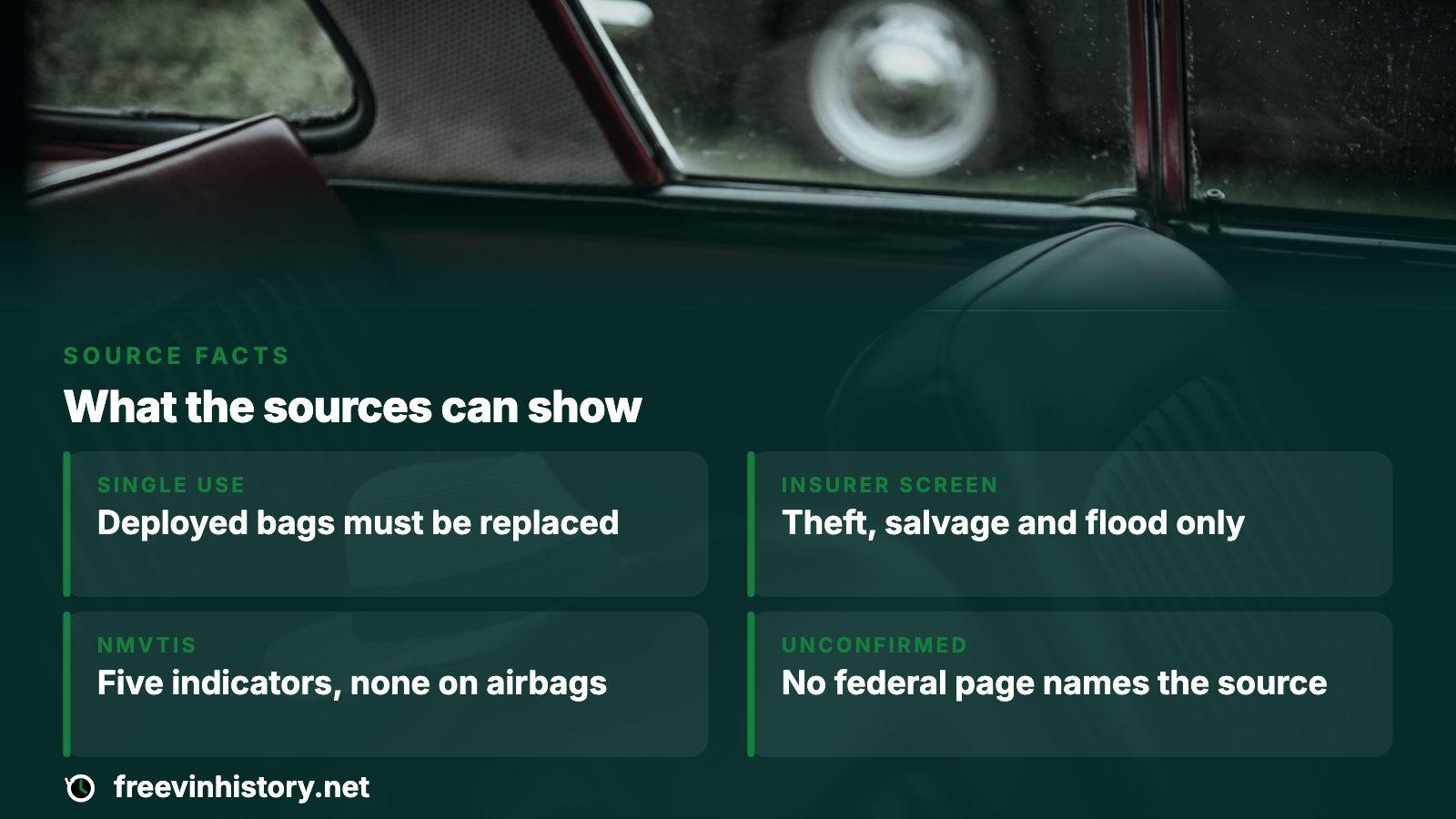
- Single use
- A deployed bag cannot be reused and has to be replaced before driving
- Free NICB screen
- Covers theft, salvage and flood records only
- NMVTIS
- Five indicators, none of them airbag deployment
- Unconfirmed
- No federal page names the data source behind this line
What the line says and what it leaves out
Read the phrase literally. Someone, somewhere, reported that a restraint went off. That someone might be a crash investigator, an insurer handling a claim, or a repair shop writing up an estimate. I could not find a federal page that defines this entry or says which feed produces it, so treat the exact origin as something to ask the report provider rather than assume.
What the line cannot tell you is just as useful. It gives no crash speed, no list of parts replaced, and no verdict on workmanship. Two cars can carry the identical wording, one repaired with factory modules at a dealer and one patched together with a dash cover and a resistor. The wording is a pointer to a question, and the question is about the repair.
How a bag ends up deployed
NHTSA describes the sequence plainly. Crash sensors tell the system's electronic control unit something violent is happening, the unit signals an inflator inside the bag module, and an igniter starts a chemical reaction that produces gas. The whole inflation takes less than a twentieth of a second.
Front and side bags are designed for moderate to severe crashes, though they can fire in a minor one. For a frontal hit, NHTSA sets the bar at an impact equal to a wall hit at 8 to 14 mph or more. Against a parked car that is close to your own size, the equivalent is roughly 16 to 28 mph or more. So a reported deployment signals a real impact, but not necessarily a catastrophic one.
Not every crash fires a bag
NHTSA says the design intent is not deployment in every collision. A belted occupant may be protected well enough in a gentler impact, and some passenger-side systems switch off when they sense a child or an empty seat. A history with no deployment line is therefore not proof that nothing happened.
Why a one-shot device changes the buying decision
Once a bag has fired it is spent. NHTSA says it cannot be refitted for another use, and only an authorized technician should swap it, before anyone drives the car again. A deployment therefore leaves a to-do list: new modules, usually a new control unit, and often belt and trim work around them.
That list is where used cars go wrong. One reason NHTSA gives for a bag staying shut in a later crash is that nobody replaced it after the first. It also warns that counterfeit bags have turned up in vehicles repaired after crashes, sold online to consumers and shops, and that they have failed in ways running from no deployment at all to throwing metal fragments.
The agency put out a consumer alert in 2024, citing at least three deaths and two severe injuries linked to poor aftermarket replacement inflators. It asked used buyers to learn the vehicle's history and confirm the inflators are genuine.
What the free official sources can and cannot show
Start with the free tools, since they cost nothing and each answers a narrow question. None of them was built to list deployments.
| Free source | What it checks | Shows a deployment? |
|---|---|---|
| NICB VINCheck | Stolen, written-off and water-damaged flags supplied by member insurers | No, though a salvage result means the insurer wrote the car off |
| NHTSA recall search | Unrepaired safety recalls on the VIN | No, and repaired recalls drop off the results |
| NMVTIS consumer page | Title status, brands, mileage readings, plus write-off and salvage entries | No, airbag deployment is not among its five indicators |
NICB caps free searches at five per day from one IP address, and a clean answer there comes with no promise from NICB itself. Use these tools to rule out the loud problems, then treat any quiet result as unfinished work.
What it looks like when the history and the dash disagree
From an NHTSA owner complaint
An owner of a 2008 Honda Accord told NHTSA that the airbag light stayed on, and the dealer wanted to replace the control module at a quoted $752.00. The car had 66,287 miles, and the owner added that an earlier keeper had been in a minor rear-end crash where the bags stayed shut. The shop covered a few safety parts free, yet the sensor fell outside that.
Take two things from it. First, a past collision can matter to the restraint system even when no bag fired, so a missing deployment line says little about the restraint system. Second, a lit warning lamp on a used car is a reason to book a scan first and settle the price second.
Reading the result on a car you are considering
Treat a reported deployment as a prompt for paperwork. The strongest answer a seller can give is an invoice listing the modules and control unit part by part, issued by a business you can call. A vague answer such as the dealer handled it should slow you down.
- Request the itemized invoice, along with who carried out the repair.
- Ask whether replacement bags were new factory parts, and where they were bought.
- Watch the warning lamp: lit at key-on, then dark within seconds.
- Look for mismatched trim, a re-covered steering wheel center, or fresh headliner sections.
- Have a shop read the restraint module for faults before you sign anything.
A deployment line combined with a salvage or total loss entry deserves extra caution, because it suggests the damage was serious enough that an insurer gave up on the car.
Where the full report is the next step
The free route ends at the edge of what NICB, NHTSA and NMVTIS record. NICB itself says a full report draws on a much wider set of sources, including DMV title records and auction data, and that most of those reports cost money.
Here the order is simple: run your VIN through the free preview, which costs nothing, and decide from there whether to buy the full report as a single one-time payment, with no subscription. For signs of a deployment, read the accident and damage records and the salvage and auction entries with photos, bearing in mind they only show what a source recorded. Pricing sits on the pricing page. Photos from before the repair can show the cabin as the crash left it.
A sensible order of checks
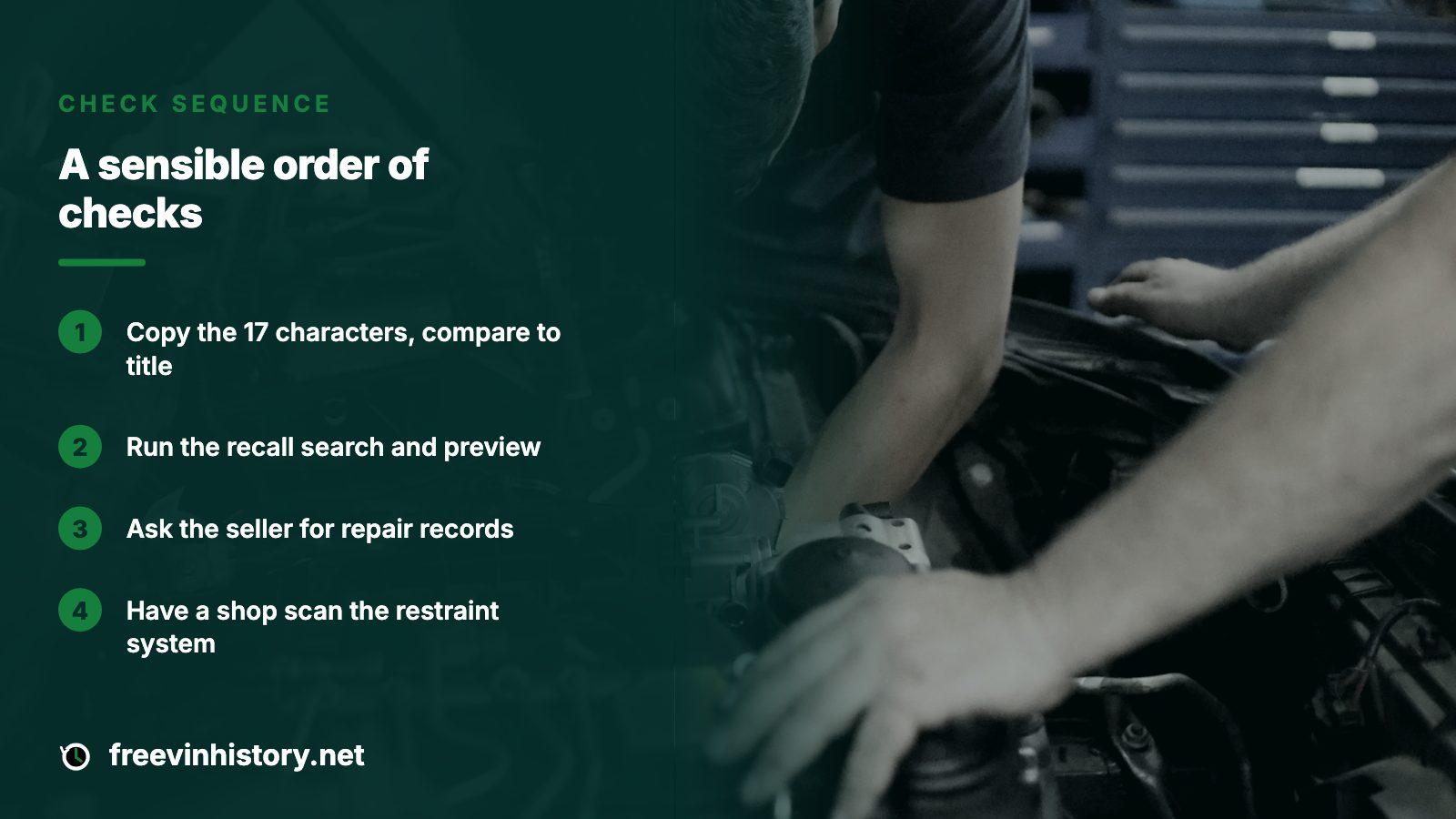
- Copy all 17 characters of the VIN from the car itself and compare them with the title or registration.
- Run the NICB screen and the NHTSA recall search, both free.
- Run the free preview here, then open the full report if the car is still a contender.
- Ask the seller for repair records on anything the report flags.
- Pay a shop to scan the restraint system and inspect the repair before you hand over money.
NHTSA also advises an independent inspection, and the NMVTIS site says the same: get one before buying.
Where this information comes from
- NHTSA: Air Bags — How a bag fires, the single-use rule, counterfeit bags and the used-car warning.
- NHTSA: Check for Recalls — What the free VIN recall search does and does not show.
- NMVTIS: Understanding a vehicle history report — The five indicators in a federal title report and where its data comes from.
- NICB: VINCheck — Free theft, salvage and flood screen, its daily limit and its stated gaps.
- NHTSA owner complaint 10781689 — owner experience, paraphrased
Sources and photos: Facts checked against the sources above in November 2026. Photos by Sander Jeurissen, Mustafa Sheikhmouss and Nik on Unsplash; diagrams by FreeVINHistory.
Keep reading
- Free airbag deployment check by VIN: what free tools can and cannot tell youThe free route for spotting a deployment, step by step.
- Structural damage reported: what the entry means on a history reportThe other entry that tends to appear next to a deployment.
- Total loss reported: what the line on a vehicle history meansWhat it means when an insurer wrote the car off.
- Free accident history check by VIN: what shows up before you payWhat free sources can say about a past crash.
Frequently asked questions
Does airbag deployment reported mean the car was in a bad accident?
It means a crash was severe enough, or at least sharp enough, to set off a bag. NHTSA says front bags are built for moderate to severe impacts but can fire in minor ones too. The entry alone does not rate the damage, so look for structural or total loss entries and ask for the repair invoice.
Can a car with a deployment on record still be safe?
Yes, if the restraint parts were replaced with genuine ones by a competent shop. The record only says the event happened. Ask for itemized repair paperwork, check that the dash lamp behaves normally, and have a technician scan the system. Without proof of the repair, assume the work is unverified.
Why does my report show no airbag deployment on a car that was in a wreck?
Bags do not fire in every crash, and no single feed captures every collision. NICB says its own results depend on participating insurers, and a clean result guarantees nothing. A repaired accident that never reached an insurer or a police file may leave no trace at all.
Is the airbag warning light enough to tell me the system works?
No. The lamp tells you the module is not reporting a fault it can detect right now. A used car can still hide a spent or counterfeit part behind a dark light, so treat the lamp as a first screen and let a shop read the restraint module.
Does the free NICB check show airbag deployments?
No. NICB VINCheck looks only at what member insurers have filed: stolen vehicles, salvage declarations and flood damage. A salvage hit shows an insurer paid out rather than repair, which points to serious damage, but the tool does not list deployments or other crashes.
Now check the car itself
The guide explains what to look for. The report shows what this VIN has on record.