THE SHORT ANSWER
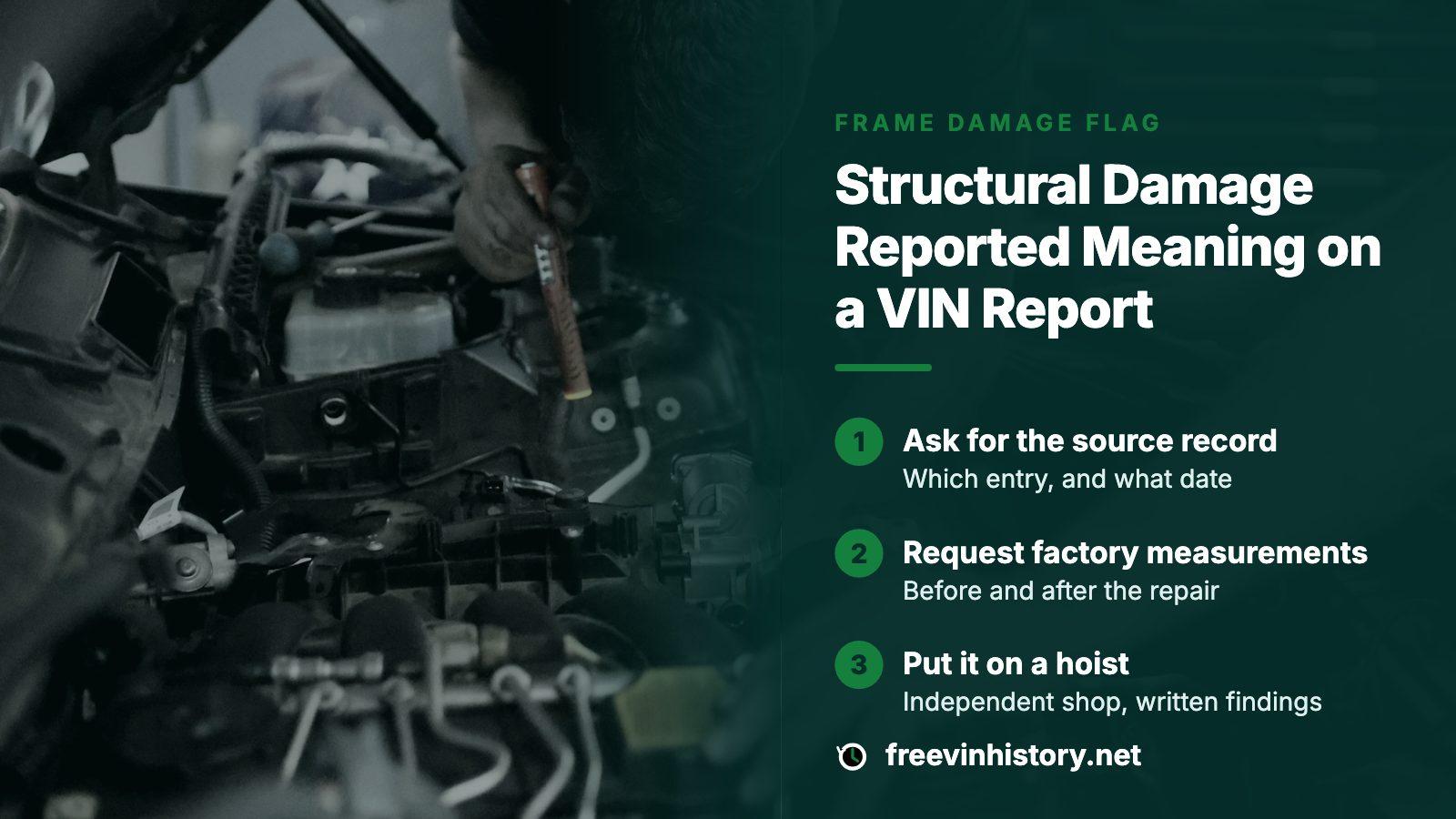
Structural damage reported means a record tied to the VIN points to harm in the load-bearing parts of the body, such as the frame or unibody, rather than cosmetic damage. It is silent on severity and on whether the repairs were done properly. Treat it as a flag, ask for the underlying record, and pay a body shop to measure the car before buying.
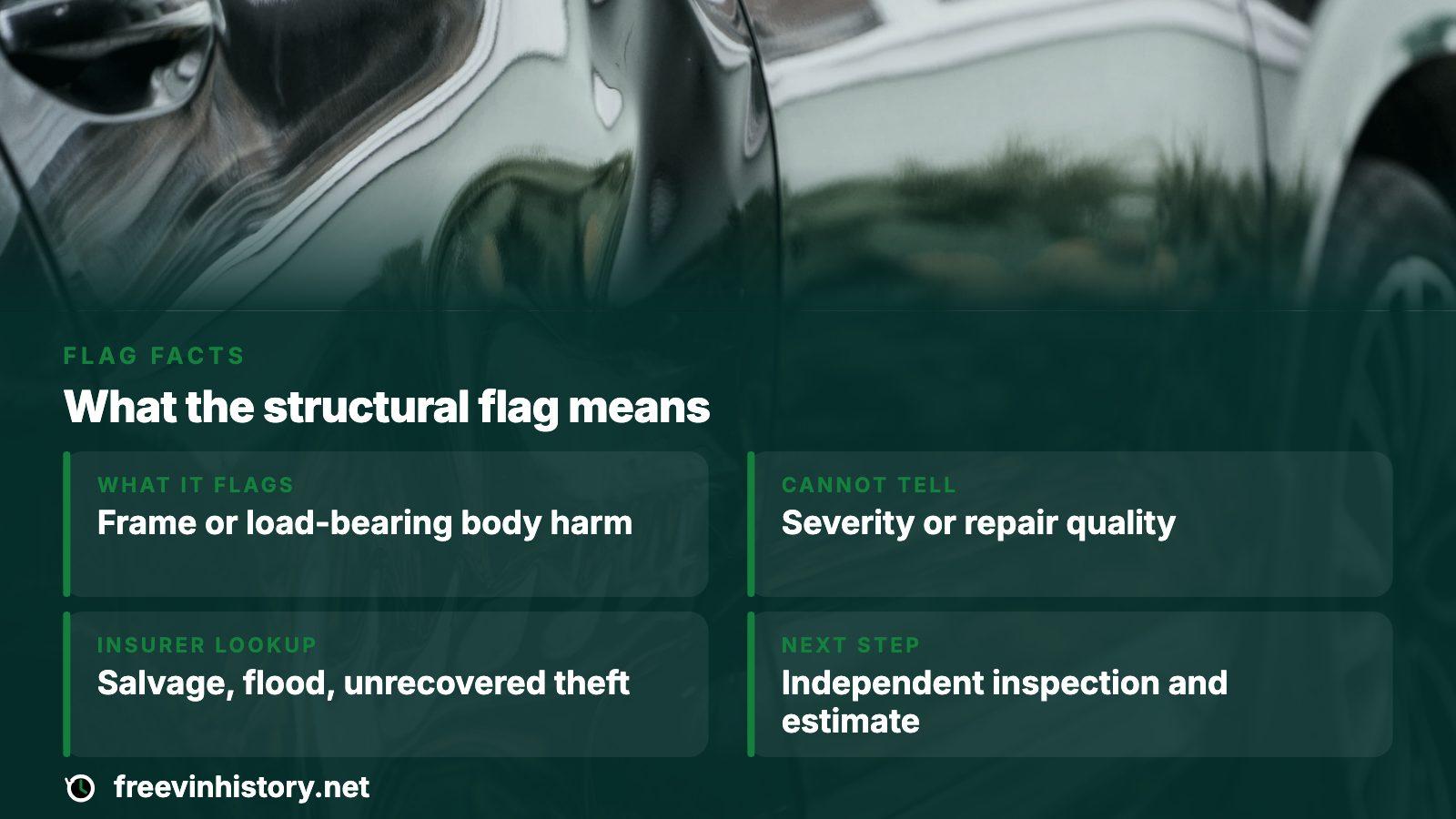
- What it flags
- Harm to the frame or load-bearing body, per a record tied to the VIN
- What it cannot tell you
- Severity, repair quality or whether the fix held
- Free insurer lookup
- NICB VINCheck: salvage, flood and unrecovered theft only
- Best next step
- Independent inspection with a written estimate
What the line says, and what it stops short of saying
On a history report, a structural entry is a pointer, not a diagnosis. Some record attached to the VIN, often an accident or damage report, mentioned trouble in the part of the car that carries crash loads: the frame rails, the unibody, the pillars or the floor pan. That is a different category from a scraped quarter panel, which a body shop can swap in an afternoon.
Report providers write these entries in their own wording, and we could not open any provider's published definition for the term, so we will not pretend there is one rule. What holds everywhere is the limit: the line records that damage was reported. Missing are the extent of the damage, the shop's method and how the car drives today.
Why this entry weighs more than a fender bender
A bolt-on part that was bent can be replaced and forgotten. The shell of the car cannot be swapped so simply. It was engineered to fold in a set pattern during a crash, and once that pattern has been used up, a repair has to pull the metal back to factory dimensions. Done well, the car can be fine. Done badly, you get tires that wear on one edge, doors that never quite close and a car that behaves differently the next time it is hit.
NICB warns that a wrecked or flooded car which was later restored may still hide unsafe parts, a danger to its occupants and to other road users. That is the reason a structural flag deserves more attention than its short wording suggests.
What the free official lookups show about it
| Free source | What it covers | Does it print a structural entry? |
|---|---|---|
| NICB VINCheck, capped at five lookups a day per address | Salvage, flood-damage and unrecovered-theft flags from participating insurers | No. It reports insurer categories only, and the agency admits it falls short of a full report |
| NHTSA recall search | Open safety recalls for the VIN | No. Collisions and past repairs are outside its scope |
| FreeVINHistory preview | Counts of title and auction entries, plus photographs when any were taken | Counts only; reading the entries takes the full report |
A clean answer from the first two is weaker than it looks. NICB warns that no clean result guarantees anything, since only participating insurers feed it and it does not query police records. The insurers taking part represent 92.49% of premium earned across the country (NICB's August 2026 figure), which still leaves some claims unseen.
Why the federal title record will not settle it either
The Justice Department's NMVTIS report rests on five items. The entry opens with the title state and date, followed by brand, odometer, total loss and salvage history. Structure is not among them. The report is kept short on purpose, and repair histories are left to private providers.
The federal rule for insurers points the same way. A carrier's monthly report must include its contact details, the VIN, the date it took the car, who it came from and the owner's name. The reason for taking the car, such as collision or flood, is something carriers are urged, not required, to supply. A written-off car can therefore appear without any note about what was hit.
Reading the gap
If a report shows structural damage and the free lookups are silent, the report is not contradicting them. The free tools simply never held that kind of entry.
How it connects to salvage and total-loss labels
Structural harm often costs enough to repair that an insurer writes the car off. Federal rules define a salvage automobile as one where the car's salvage value plus the repair bill would top its market value at the moment before the damage. NICB describes the same idea as repair cost passing a set percentage of value.
The link only runs one way. Structural damage can sit on a car that was repaired under the threshold and kept an ordinary title, and a low-value old car can be written off by damage that never touched the frame. So the absence of a salvage brand does not clear the structure, and a salvage brand does not prove it was bent.
Questions to put to the seller
- Which record produced the entry, and what date is on it?
- Was there an insurance claim, and can the seller show the repair invoice from the shop?
- Did the shop measure the body against factory dimensions before and after the work?
- Were any frame or body sections replaced, and with what parts?
- Will the seller let an independent shop raise the car on a hoist?
An answer that comes with paperwork is worth more than a confident one without. A seller who goes quiet at the third question has told you something.
The inspection is the real answer
The FTC states that no history report can stand in for an independent inspection, and it advises paying a mechanic regardless of a dealer's certified label. By the FTC's reasoning, a dealer who refuses a third-party inspection is a reason to shop elsewhere. Pick a body or collision shop for this one, since a general mechanic may not check frame alignment.
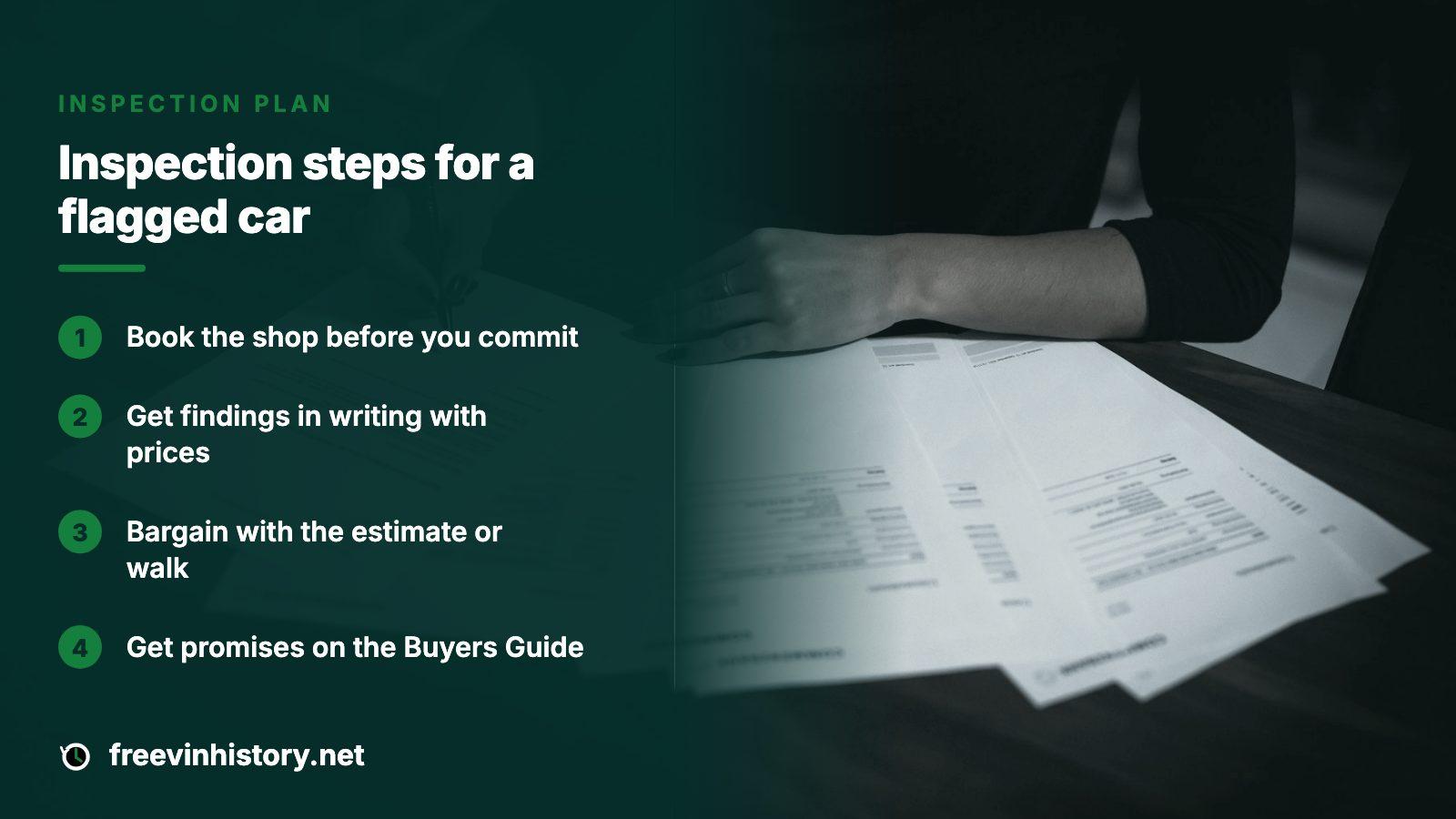
- Book the shop before you commit, and tell them a structural entry is on the report.
- Request the findings in writing, that name the make, model and VIN alongside a price for every repair required.
- Use that estimate to bargain, or walk away if the shop finds unresolved misalignment.
- Get promises on the dealer's Buyers Guide, because spoken ones are hard to enforce.
Where the full report fits
Start with the entry in our free preview, which tallies the title and auction records held for the VIN. Should the car stay on your list, the full report is a single payment, the amount being on the pricing page, and it opens the records behind the flag, with salvage and auction photos when available. Auction pictures are often the only place you can see the actual damage.
One reminder
The report tells you what was recorded. Only the car on a lift tells you what is true today.
Where this information comes from
- NICB: VINCheck lookup — What the insurer-fed lookup covers, its daily limit and its own warning that a clean result is no guarantee.
- NMVTIS: Understanding an NMVTIS vehicle history report — The five items the federal report holds and why repair detail is left to private providers.
- 28 CFR 25.55: insurance carrier reporting — The required fields in a carrier report and the encouraged but optional damage reason.
- 28 CFR 25.52: NMVTIS definitions — The federal wording for salvage, junk and total loss.
- FTC: Buying a used car from a dealer — Why an independent inspection is needed alongside a history report, and what to ask the mechanic for.
- NHTSA: Check for recalls — What the VIN recall search does and does not show.
Sources and photos: Facts checked against the sources above in November 2026. Photos by Mustafa Sheikhmouss, Dimitri Karastelev and Maxim Tolchinskiy on Unsplash; diagrams by FreeVINHistory.
Keep reading
- Total loss reported: what the line on a vehicle history meansThe write-off entry that often sits beside a structural flag, and how it is calculated.
- Free accident history check by VIN: what shows up before you payWhat the free sources can and cannot say about past collisions.
- Airbag deployment reported: what the entry means on a history reportAnother damage entry that points to a hard hit.
- Free frame damage check by VIN: what you can and cannot learnHow to check for frame trouble on a specific car.
Frequently asked questions
Does structural damage reported mean the car is unsafe?
Not automatically. The entry says a record mentions harm to the frame or load-bearing body. A shop that pulled the car back to factory dimensions may have produced a sound car, and one that cut corners may not. The report cannot tell the two apart, so an independent inspection with measurements is what settles it.
Will NICB VINCheck show structural damage?
No. VINCheck answers one thing: did a member insurer record the car as salvage, flood damaged, or stolen and never found. It does not print a structural entry, and NICB says it falls short of a full history report. A car can show nothing there and still carry a structural record elsewhere.
Can a car have structural damage and a clean title?
Yes. A title brand follows a total-loss or salvage decision, which turns on repair cost against value. A repair that stayed under the threshold, or one paid for privately, may never produce a brand. That is why a clean title does not clear the structure.
Should I walk away if I see this entry?
Not on the entry alone. Ask for the repair paperwork, get an outside collision shop to inspect and measure, and compare the written estimate to the asking price. Walk away if the seller refuses an inspection or the shop finds misalignment that was never fixed.
Where can I see what the entry refers to?
The free preview on this site counts title and auction records for the VIN. The full report opens those records, with salvage and auction photos when any were taken. Photos are not guaranteed, because a car that never went through an auction may have none.
Now check the car itself
The guide explains what to look for. The report shows what this VIN has on record.