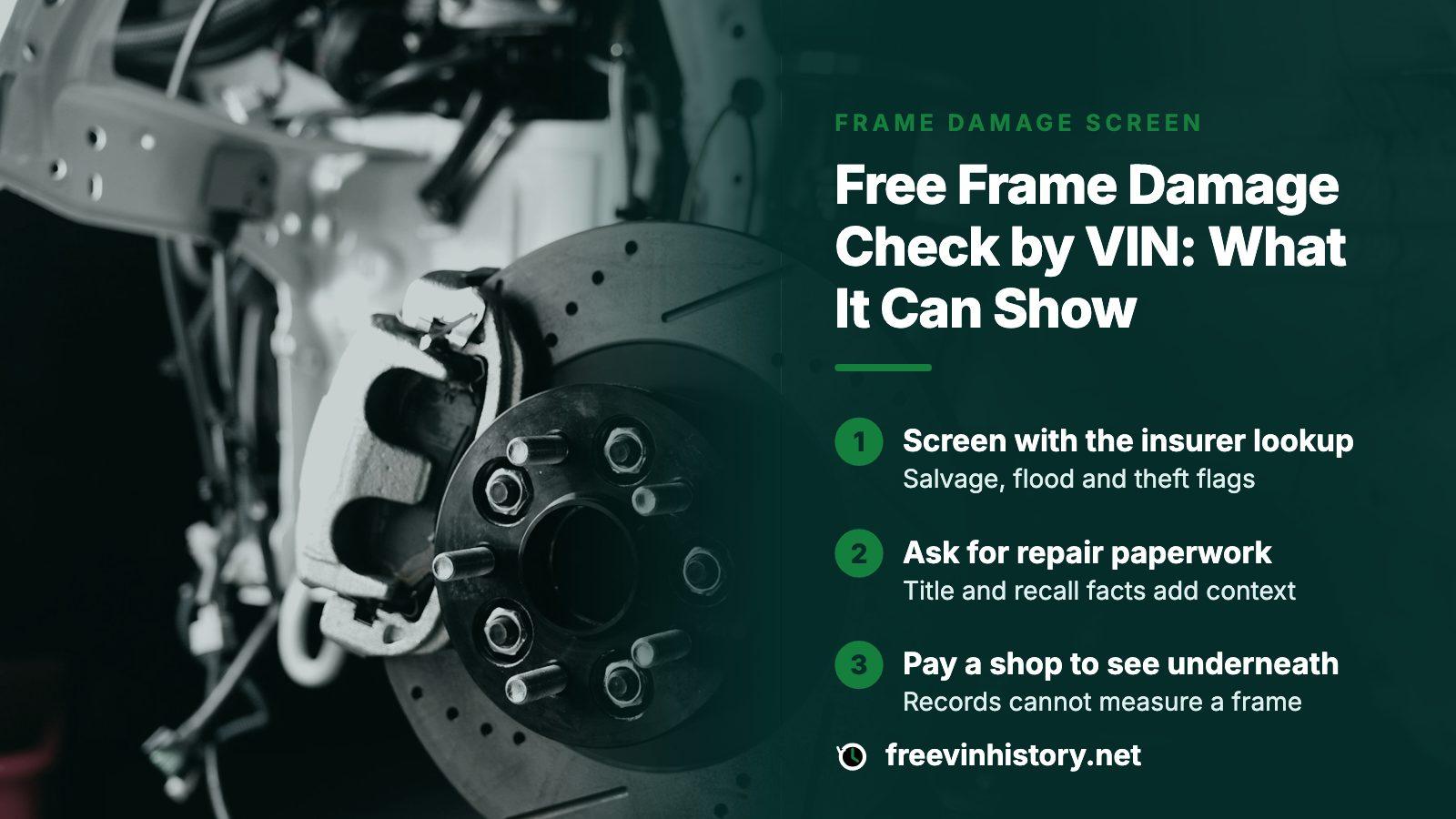
THE SHORT ANSWER
Run NICB's VINCheck first: it is free and flags cars an insurer reported as salvage, flood or stolen. Then read the title and recall facts, ask the seller for repair paperwork, and pay a shop to inspect the underside. None of the free sources I read measures a frame. Accident and auction details sit in a full report, which comes after the free preview.
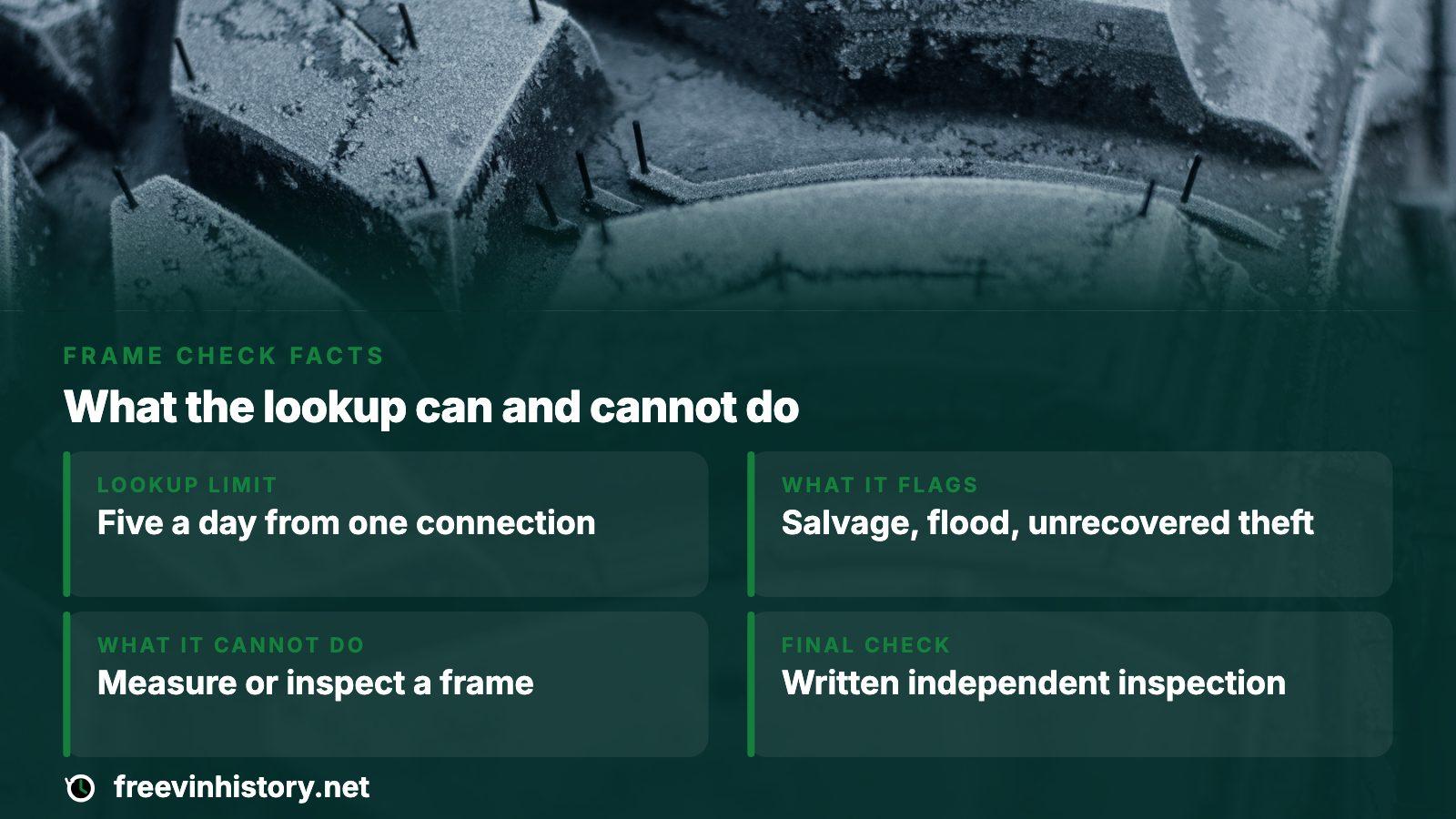
- Free lookup
- NICB VINCheck, limited to five lookups a day from one connection
- What it flags
- Salvage, flood and unrecovered-theft reports from insurers that take part
- What it cannot do
- Measure or inspect a frame
- Final check
- A written inspection from an independent mechanic
What a free check can reach on frame damage
Frame and structural damage is a physical condition, and the free official lookups work from paperwork. So a free check does not answer "is this frame straight." What it can answer is a nearby question: did an insurer ever decide this car was not worth fixing, and did a state ever stamp its title?
That matters because a badly bent car is the kind most likely to be written off. If a free lookup returns a salvage flag, you have a strong reason to dig further or walk away. If it returns nothing, you have learned only that no participating insurer reported it. The rest of this page is built around that gap, in the order a careful buyer would work through it.
The five-step free pass, in order
- Locate the VIN on the vehicle, then check it letter for letter against the ad and the title. A single wrong character among the 17 points every later lookup at some other vehicle.
- Enter it in NICB's VINCheck. You get a plain flag if a member insurer reported salvage, flood or an unrecovered theft.
- Type that VIN into NHTSA's recall page to see which safety repairs are still owed. It is silent on collisions.
- Request the title and any repair invoices from the seller, then see whether the paper brand agrees with the lookups.
- Book an independent inspection and ask the shop to look underneath, then to write down what it finds.
The first three steps take a few minutes and cost nothing. Frame problems usually surface in the last two, so leave them for the end but never drop them.
Which free source answers which question
| Where to look | Answers | Blind spots |
|---|---|---|
| NICB VINCheck | Salvage, flood or unrecovered theft reported by participating insurers | Insurers that do not participate, law enforcement records, any damage that never reached a claim |
| NHTSA recall search | An open safety recall on that specific car | Recalls already fixed, brand-new campaigns, anything older than 15 years, collision history |
| Federal title database (NMVTIS) | Title brands, latest odometer reading, total-loss and salvage-yard reports | Anything a state or insurer never reported; the format is intentionally short |
| Independent mechanic | The actual condition of the underbody and structure, in writing | Nothing about past owners or claims |
No row covers everything, and no row replaces another. The first three describe a car's paper trail. Only the last one looks at metal.
Why a clean result is not a straight frame
NICB states that its lookup falls short of a full history report, and that a car could be seriously damaged without any record showing up. Its data comes from member insurers representing 92.49% of earned premium in the country, so roughly the rest of the market is invisible to it.
The federal title database has gaps of its own. The Justice Department says only part of the country reports into it, so a search may come back falsely reassuring. Cash repairs, or a claim settled by a company that never reported, leave no mark in either place.
From an NHTSA owner complaint
Filed in 2020, one NHTSA complaint from the owner of a 2013 Honda Accord describes being told by a rideshare platform that the car had a salvage or rebuilt title. The selling dealer disputed that, and the owner's history printout listed no accident either. Two documents pointed one way, one pointed the other, and nothing in the complaint shows how it ended.
Take from this that records can contradict each other. When two sources disagree, treat the more worrying one as the one to chase down before any money moves.
If VINCheck shows salvage, read it this way
NICB defines a salvage result as an insurer declaring a total loss because the repair bill passed a set share of the car's value, and paying the claim instead. It adds that the car may lawfully be rebuilt and given a new title. A salvage flag therefore does not mean unsafe, and it does not mean fine.
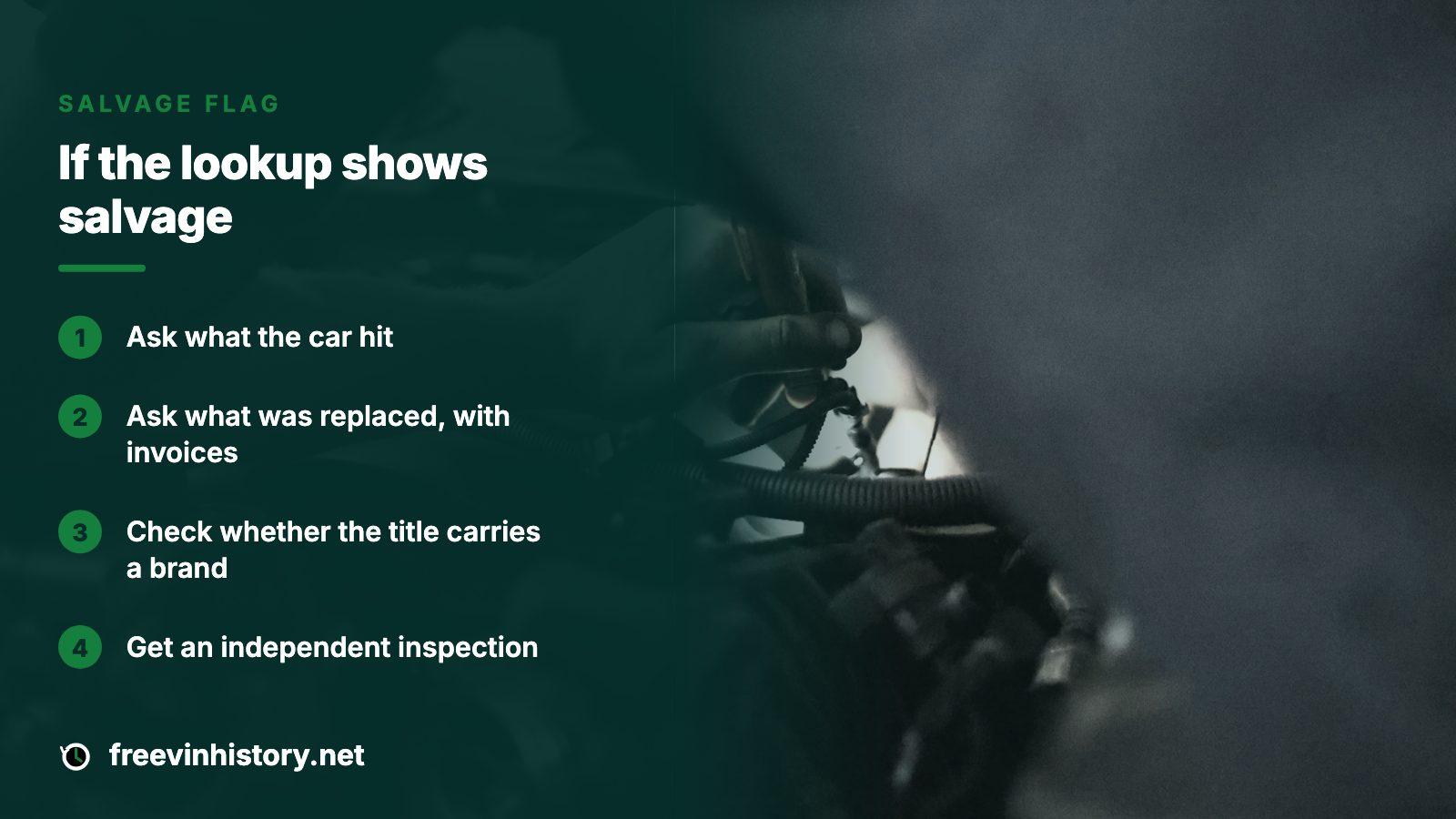
- Ask what the car hit and what was replaced, and ask for the invoices.
- Check whether the title now carries a brand, since states set their own thresholds and some will not brand a car another state would.
- Expect a lower price, and expect a lender or insurer to ask questions.
- Do not buy before a shop has looked at the structure and written up the result.
The same page notes that a vehicle moved to a different state can end up with a clean-looking title. That is called title washing, and it is why a lookup that comes back quiet still deserves the inspection.
Pay for the underside to be looked at
Per the FTC, no history report can stand in for an inspection by someone independent. Reports can name accidents and flood damage, it says, yet usually leave out mechanical faults. Hire the mechanic yourself, not one the seller suggests, and get the findings in writing, priced out, with the car's make, model and VIN on the page.
That estimate is also a bargaining tool. If the dealer refuses to allow an outside inspection, the FTC suggests going to another dealer, and that advice holds for any seller.
From an NHTSA owner complaint
A July 2026 NHTSA complaint comes from the owner of a 2013 Subaru Outback bought secondhand from an internet dealer. Their mechanic judged the subframe and exhaust poorly installed and quoted roughly $8,000, over half of what the car cost. The owner handed the car back and reports seeing it advertised again, same price, within weeks.
What to notice is the sequence. The mechanic's visit found what the listing never mentioned, and it came early enough for the owner to return the car.
Where the preview and the paid report come in
FreeVINHistory runs a free preview from the VIN, which shows you whether title, accident and auction records exist for the car before you spend anything. The preview costs nothing; the report beyond it is a purchase.
For frame questions the paid report is the next rung, since it can carry collision entries, salvage and auction records with pictures, and any title brand. Auction pictures come nearest to showing a bent car, but a car that skipped the auction lanes has none. Even then, no report can put a gauge on the structure.
Cost, and the order to go in
NICB's lookup, NHTSA's recall page and the preview on this site all cost nothing. The full report is one payment, never a subscription; current rates are on the pricing page, which also covers packs for buyers comparing several cars.
Run the free steps on each car you are considering, buy the report only for the one you would really bid on, and schedule the shop visit ahead of handing over a deposit.
Where this information comes from
- NICB: VINCheck lookup — what the free lookup flags, its daily limit and the limits NICB states itself
- NICB: Buying a used vehicle — title washing, and the advice to add a title search and a mechanic
- NMVTIS (DOJ): For consumers — contents of the federal title database and why it can miss records
- FTC: Buying a used car from a dealer — reason a history report is no replacement for a hands-on inspection
- NHTSA: Check for recalls — what the VIN recall search returns and what it omits
- NHTSA owner complaint 11365234 — owner experience, paraphrased
- NHTSA owner complaint 11750991 — owner experience, paraphrased
Sources and photos: Facts checked against the sources above in November 2026. Photos by Erik Mclean, Mustafa Sheikhmouss and Joan on Unsplash; diagrams by FreeVINHistory.
Keep reading
- Free salvage title check by VIN: what the free lookups showWhat a salvage or total-loss flag means and how to read it before you deal with the seller.
- Free accident history check by VIN: what shows up before you payWhat the free lookups say about collisions, and what they never record.
- NMVTIS report: what the federal title record shows and missesHow the federal title database records brands, and what its short report leaves out.
- PricingHow the one-time report and the packs are priced once the preview has done its job.
Frequently asked questions
Can you check for frame damage by VIN?
Not directly. A VIN lookup reads records, and no record measures a frame. It can reveal a salvage or total-loss history, and a paid report may add accident and auction details. To learn whether the structure is straight, a mechanic has to inspect the car.
Does a clean VINCheck mean no frame damage?
No. NICB cautions that a clear result is no promise of a clean past, because the data covers only participating insurers and a damaged car may never have produced a record. Treat it as one box ticked, then inspect the car.
Will a history report always show frame damage?
No. The FTC notes that a report can name accidents and flood damage, but it only knows what reached its sources. A repair done privately, or a claim never filed, leaves nothing for a report to find.
Is a salvage-title car always a frame-damage car?
No. Salvage means an insurer paid out because repair costs passed a threshold, and the cause can be flood, theft recovery or collision. It is still a reason to ask for repair records and a written inspection before you pay.
What does the paid report add beyond the free preview?
The preview shows whether records exist. The report opens the details, such as accident and damage entries, auction photos and title brands. Those help you decide whether a car deserves an inspection, but they do not replace one.
Now check the car itself
The guide explains what to look for. The report shows what this VIN has on record.