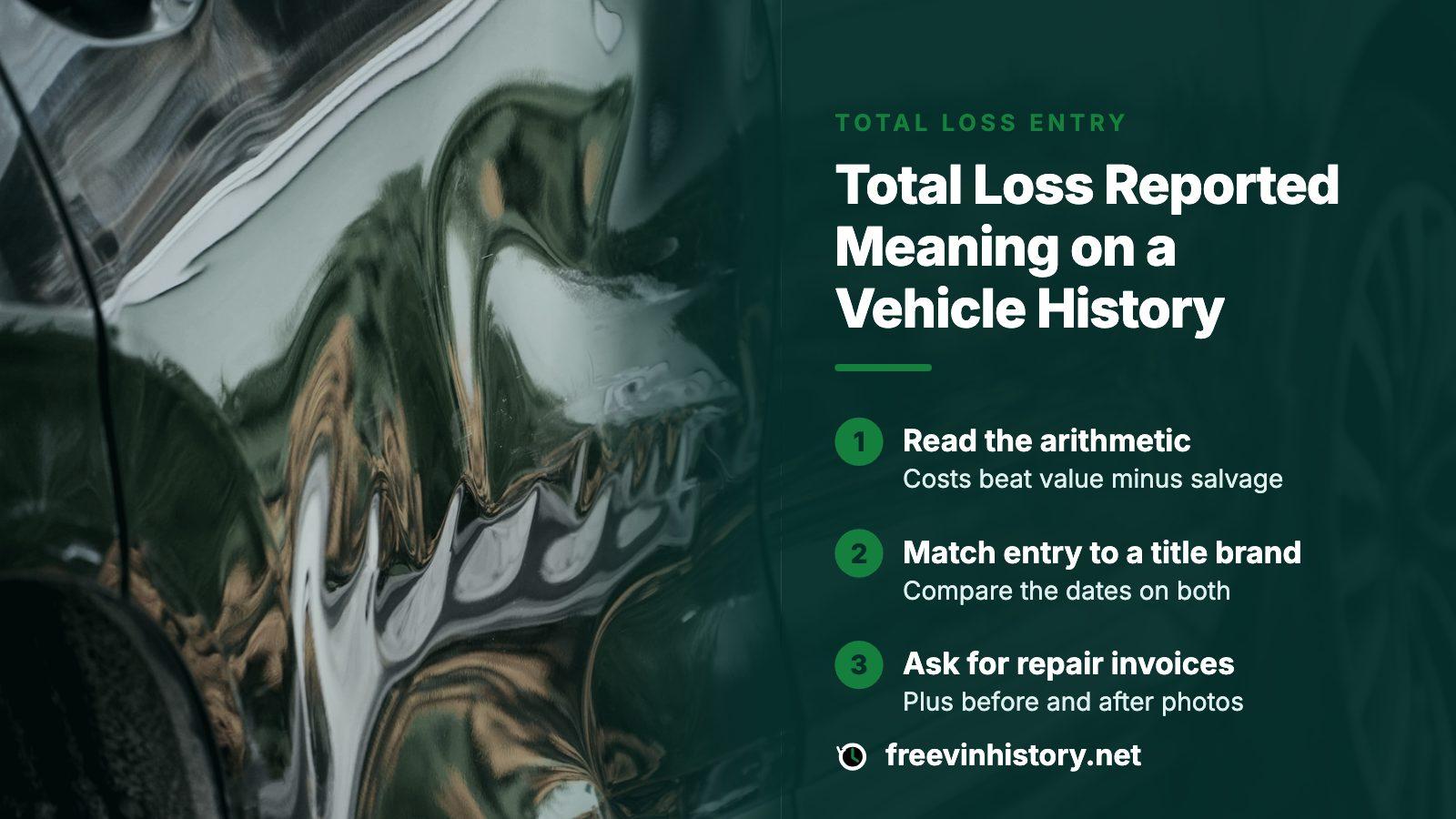
THE SHORT ANSWER
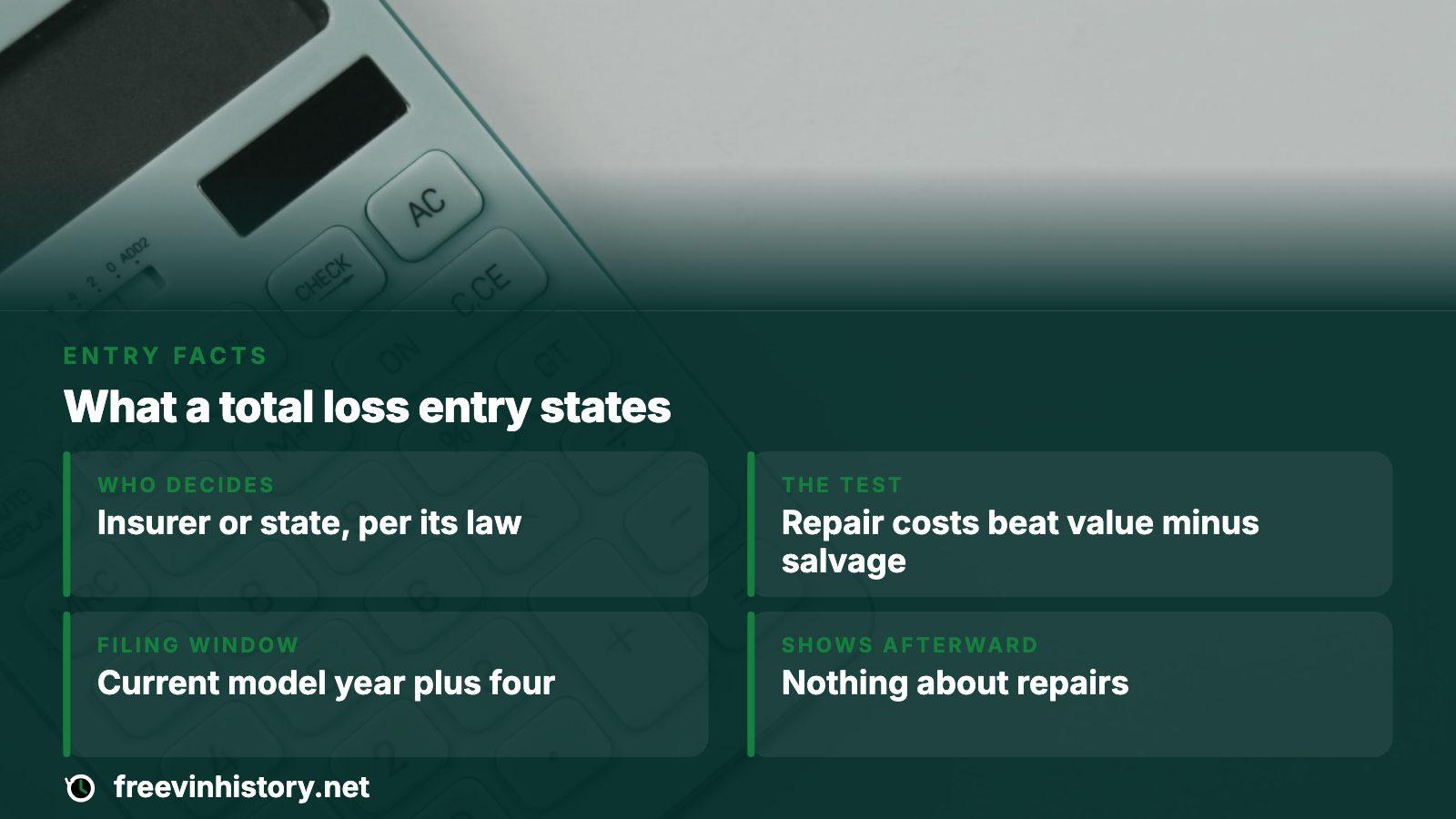
A total loss entry records that an insurer or a state treated the vehicle as not worth repairing when the damage occurred. Federal rules phrase the test as repair costs and related losses beating the car's pre-damage value minus its salvage proceeds. Nothing in the entry says whether the car was later rebuilt, so look for a matching title brand, then have an independent shop inspect it.
- Who decides
- An insurer under its policy, or a state under its own law
- The test
- Repair and related costs beat pre-damage value minus salvage proceeds
- Shows afterward
- Nothing about repairs, so confirm with title and inspection
- Free first step
- Preview on this site, then a one-time purchase for the full record
What the line is actually stating
Strip away the vendor wording and the entry is a statement about money at one moment. Someone with authority over the claim weighed what it would take to put the car right against what the car was worth, and the repair side won. From then on the vehicle carried a marker saying so.
Report vendors phrase this line in their own ways and I could not confirm any single wording from their pages, so this guide works from the federal rules and the Justice Department's vehicle history site. Those are the sources that define the term and name who has to file it.
The arithmetic behind a total loss
The federal definition is more detailed than most people expect. Repair cost is only the first item. Projected supplements, the extra charges a shop finds once panels come off, count too, as do projected diminished resale value and rental reimbursement expense. All of that is stacked up and set against a second figure: what it would cost to buy the damaged car at its value before the accident, reduced by whatever the wreck would sell for as salvage.
| Side of the comparison | What goes in it |
|---|---|
| Costs | Repairs, expected supplements, expected loss of resale value, rental reimbursement |
| Offset | Pre-accident value of the car, minus proceeds from selling the wreck for salvage |
A car does not need to be crushed flat to cross that line. A newer, pricey model with damaged sensors and a bent rail can get there on parts and labor.
Who files the entry, and for which cars
Each month, insurance carriers send the Justice Department's title system a list of cars they took into their possession and classed as junk or salvage. A car the carrier labeled a total loss belongs on it, whether state law or the company's own policy terms drove the call. Entries give the VIN, a date, who held the car beforehand, and the current owner.
- Only the current model year and four earlier ones fall under the duty, so an older wreck may never have been filed by its insurer.
- Salvage yards, recyclers and junk yards file their own inventories, including cars that arrived from insurers.
- Why the carrier took the car, such as flood or fire, is encouraged on the filing but not required.
That last point is why two entries that look the same can describe very different events.
How owners meet the term in practice
Most total loss decisions come after a crash, a flood or a fire, and NHTSA's owner complaint files hold plenty of first-hand accounts. They are filed about defects, not about title records, but they show how the decision lands on a real car.
From an NHTSA owner complaint
A 2012 Kia Optima owner told NHTSA the engine bay burst into flames without any warning while the car was being rocked free of a snowy driveway. Firefighters put it out, nobody was hurt, and the owner's insurer deemed the car totaled. The cause was never determined.
Take from this that a total loss line can trace to a fire with an unknown cause, which no report line will explain. Another owner of the same model year wrote that a recall notice for a structure campaign kept arriving after the car was totaled, and asked to be taken off the list. Paperwork outlives the car in some cases, and so can the car outlive its paperwork.
Total loss entry versus title brand
These are two separate records and a buyer needs both. A brand is a label that a state titling agency puts on the title, such as junk, salvage or flood. The federal system keeps the brand history from every state that applied one. The total loss line comes from the insurer's side of the process.
| Record | Who creates it | What it proves |
|---|---|---|
| Total loss entry | Insurer, or a salvage business that received the car | A loss decision was made, not what was done afterward |
| Title brand | State titling agency | The state marked the title with a damage label |
| Clean title, no entry | Nobody | Only that nothing was filed, not that nothing happened |
An entry with no brand might mean the state has not branded the title yet, or that the paperwork happened in a state with a different rule. Either way it is a mismatch worth asking about.
What the entry cannot tell you
The federal report is deliberately short. It sticks to title, brands, odometer, total loss and salvage history, and leaves out repair histories, recall details and maintenance data. A clean federal report is good news, but it covers only what was filed.
- Whether the car was rebuilt, and who did the work.
- How deep the damage ran: a flooded interior and a crushed rear end both read as a loss.
- Damage that never produced a claim, such as a repair paid out of pocket.
- Older wrecks outside the model-year window the carriers report on.
That is why the line works as a flag, and the inspection works as the verdict.
Weighing the entry as the buyer
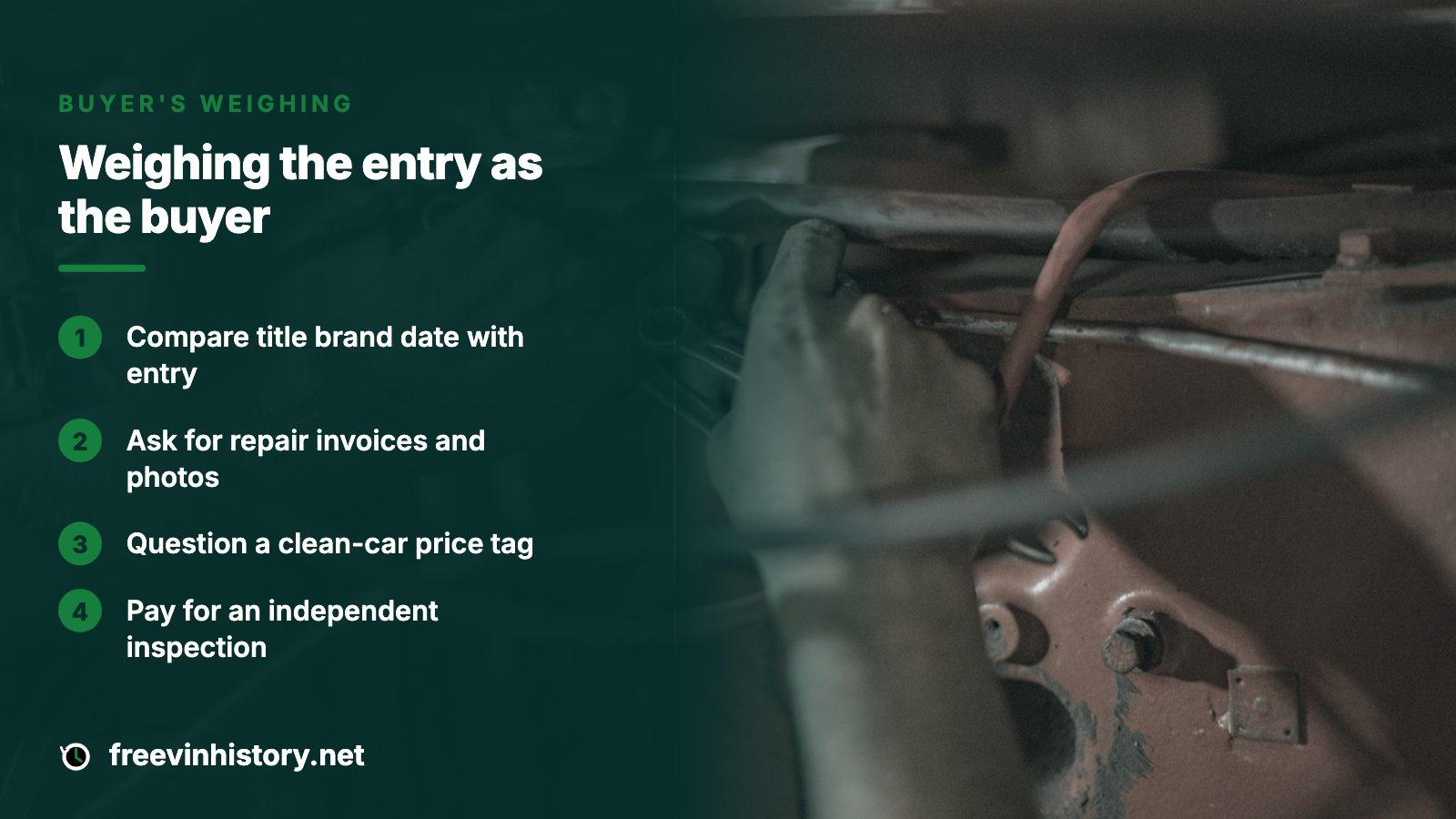
Start with the seller's story and set it beside the record. A seller who claims no history of claims, set against a report showing a loss decision, cannot be telling the whole truth. Ask directly, and listen for specifics: the date, the insurer, the shop, the paperwork.
- Check the title for a brand and compare its date with the loss entry.
- Ask for the shop's repair invoices, plus pictures taken before and after.
- Look at the price. A rebuilt car sold at clean-car money means the seller pockets the gap.
- Pay for an independent inspection, ideally one that checks frame measurements and airbag components.
The government's own advice to buyers is the same short list: an independent inspection, a federal title record and other sources of information, used together.
Checking the VIN before you commit
Put the VIN into the preview on this site first. It costs nothing and shows whether a salvage or damage record exists. The full report is bought once, with no subscription, and it lays out title, loss and salvage records together, so you are not stitching separate lookups. Current single and pack options are on the pricing page.
Free sources help too. The federal recall lookup costs nothing, and the title system's own site points buyers to a free insurance-crime database searchable by VIN. Neither replaces the full set of records, and I could not open the insurance-crime site to confirm what it returns, so test it yourself.
When the entry sits on your own car
Some owners find the line on a car they have driven for years. A common cause is an old insurance settlement that was accepted, after which the owner fixed the car personally. A repaired bumper does not erase the record.
If you plan to sell, disclose it before the buyer's report does. Bring the repair invoices and the inspection results. A documented repair on an old loss reads very differently from a buyer finding the entry cold and wondering what else was left out.
Where this information comes from
- NMVTIS site: what the federal report includes — the five indicators, the meaning of a brand, and what the federal report omits
- NMVTIS site: buying tips for used cars — inspection advice and pointers to no-cost sources
- 28 CFR 25.52: NMVTIS definitions — the federal wording for total loss, salvage and junk automobile
- 28 CFR 25.55: insurance carrier reporting — what carriers file, the model-year window and the optional reason
- NHTSA owner complaint 11176183 — owner experience, paraphrased
- NHTSA owner complaint 11533018 — owner experience, paraphrased
Sources and photos: Facts checked against the sources above in November 2026. Photos by Maxim Tolchinskiy, Nina Mercado and Sasun Bughdaryan on Unsplash; diagrams by FreeVINHistory.
Keep reading
- Insurance loss reported: what the entry on a history report meansThe broader insurer entry that a total loss decision sits inside.
- Free salvage title check by VIN: what the free lookups showWhich no-cost lookups can surface a salvage record and which cannot.
- Actual cash value on a car: what it means and how it is setThe value figure that a total loss payout is measured against.
- Free total loss check by VIN: what you can see before payingHow to look for a total loss record before you pay for anything.
Frequently asked questions
Does total loss reported mean the car cannot be driven?
No. It means someone judged repair uneconomical, not that the car stopped running. Many totaled cars are sold for salvage, repaired and returned to the road, and some owners keep and fix their own. Whether this one is safe depends on the quality of the repair, which only an inspection can answer.
Does a total loss mean the car has a salvage title?
They are related but separate. The federal definition of a salvage automobile takes in cars an insurer designated a total loss. The title brand, though, is applied by the state, so a loss entry can appear before, or without, a matching brand on the title. Compare both records.
Can an insurer report a total loss even if it paid nothing?
The federal rule has carriers list cars that came into their hands and were classed as junk or salvage, including any labeled a total loss under their own policy terms. A payout is not the trigger, so check dates and details rather than assuming a claim was paid.
How long does a total loss entry stay on the record?
The sources I opened set no expiry date for the entry. Repairing the car does not remove it, and the state brand history travels with the VIN across state lines. Treat any total loss line as permanent unless a state agency tells you otherwise in writing.
What should I do first if a report shows a total loss?
Ask the seller for the date, the insurer and the repair paperwork. Compare the entry with the title's brand history, then book an independent inspection. If the answers are vague or the price looks clean for the car's past, walking away is a reasonable result.
Now check the car itself
The guide explains what to look for. The report shows what this VIN has on record.