THE SHORT ANSWER
Actual cash value, often shortened to ACV, is what it would cost to buy a comparable car in your area right before the damage, minus your deductible and any documented deductions for condition or old damage. Insurers pick the comparables and the method, and state rules limit how. The figure belongs to a claim file, not to a VIN record.
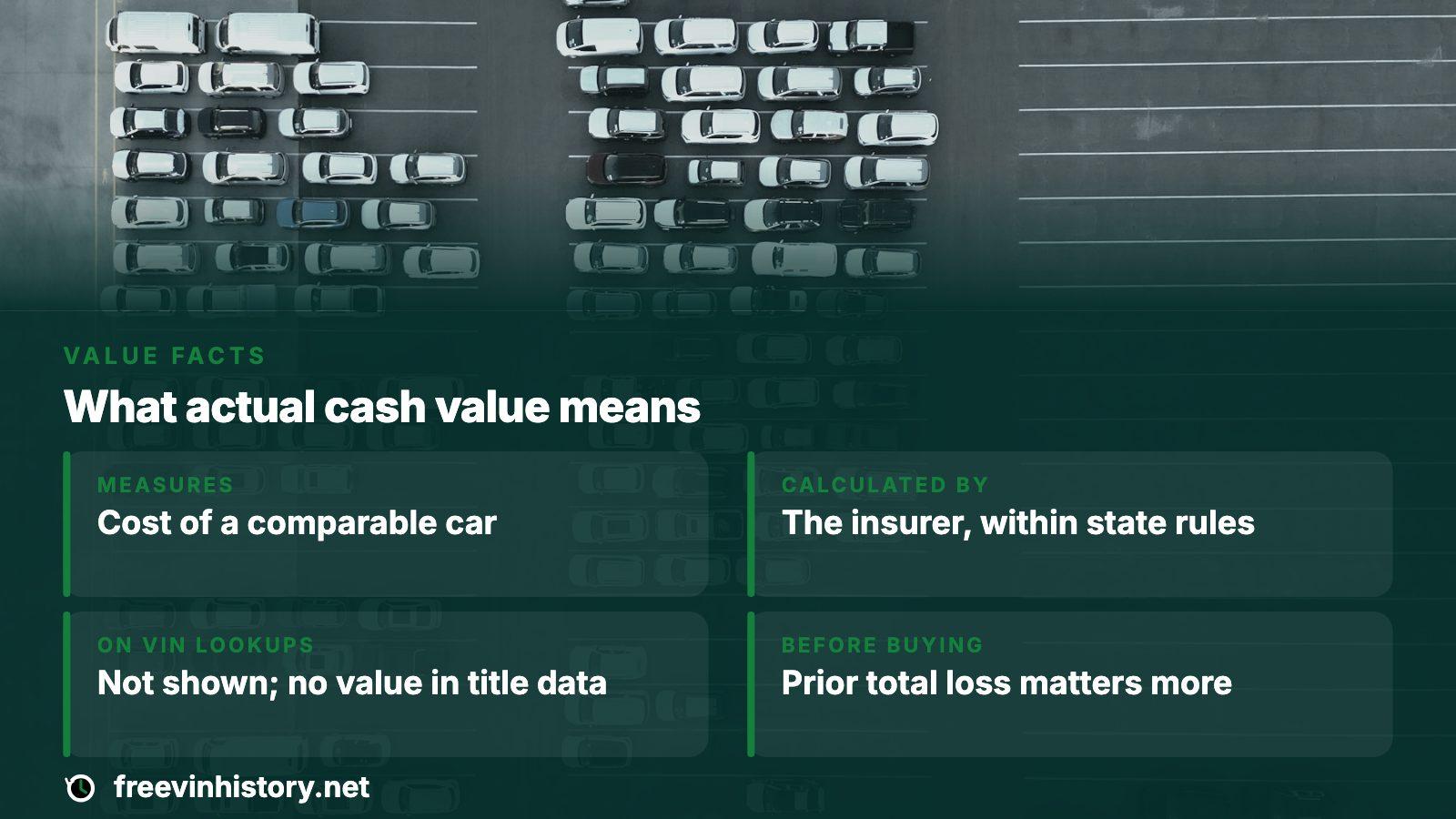
- What it measures
- Cost of a comparable car just before the loss
- Who calculates it
- The insurer, within state claim rules
- On free VIN lookups
- Not shown; federal title data carries no value figure
- Useful before buying
- A prior total loss entry matters more than any old payout
What the term means in plain language
Think of it as a replacement price with a time stamp. The question is not what you paid, what the loan balance is, or what the car meant to you. It is what a buyer would have handed a seller for a car like yours on the day before the crash, the fire or the flood.
Because the figure answers that one narrow question, it moves with the market. A pickup that was hard to find last spring can carry a higher number than the identical truck would this winter. Two owners with the same model can also get different numbers if their mileage, options or local listings differ.
How an insurer arrives at the number
Claim rules differ by state, so this guide leans on Washington's published rule for total losses, then compares it with California and Florida. Washington lets the insurer use one or more of four methods and requires that only a vehicle identified as comparable goes into the calculation.
- Current local data on a comparable car, searched within a reasonable distance of where your car is kept, capped at 150 miles.
- Quotes from two or more licensed dealers in that same area.
- Two or more comparable cars advertised for sale locally.
- A computerized valuation source that lists the comparables it used.
That last method comes with strings. The database has to cover 85 percent or more of the makes and models over a span of at least 15 years, and the comparables it cites must have been for sale within 90 days of the loss date, on either side.
What pushes the figure up or down
A comparable car in California means the same maker and model, the same or a newer model year, a similar body style, and options and mileage close to yours. Differences get priced in, and the rules say each adjustment has to be itemized in dollars rather than waved at.
| Item | Typical effect on a settlement |
|---|---|
| Mileage and options that differ from the comparables | Added or subtracted, with a dollar amount shown |
| Condition below average for the year and model | Can reduce it, but only if documented |
| Earlier unrepaired damage | Deduction capped at the value that damage actually removed (Washington) |
| Taxes and transfer fees | Included, since you would have paid them buying the car |
| Salvage value, if you keep the wreck | May be subtracted from the payment |
If a letter shows a deduction with no dollar figure behind it, that is a reason to ask questions.
Where it meets the total loss entry on a history
The federal definition of a total loss compares two things. On one side sit repair cost, expected supplements, expected lost resale value and rental reimbursement. On the other sits the car's value before the accident, minus what the wreck would fetch as salvage. When the first pile is bigger, the car is a total loss.
So the pre-accident value in that formula is a close cousin of actual cash value. A modest older car crosses the line fast, because its value is small. A late-model car with a bent frame can cross it too, because parts and labor are not.
Only the outcome travels onward. The history entry says a total loss was declared. It does not say what number the insurer used.
When the owner and the insurer do not agree
Disputes usually come from one of two directions: the owner thinks the number is too low, or the owner thinks the car should have been written off and the insurer thinks it can be fixed. Owners have described both to NHTSA.
From an NHTSA owner complaint
A 2014 Jeep Grand Cherokee owner reported that the vehicle, left in park on a slope, rolled into a ravine overnight and flipped twice. The owner said the adjuster, a tow driver and the body shop could not explain the roll, and that the insurer would not call it a total loss. The owner feared an unsafe repair.
The lesson is that the label total loss is a calculation, and the person holding the claim file runs it. If you disagree, ask for the comparables and the itemized deductions in writing, because the rules in the states read for this page tie the insurer to documentation.
Steps to question an offer
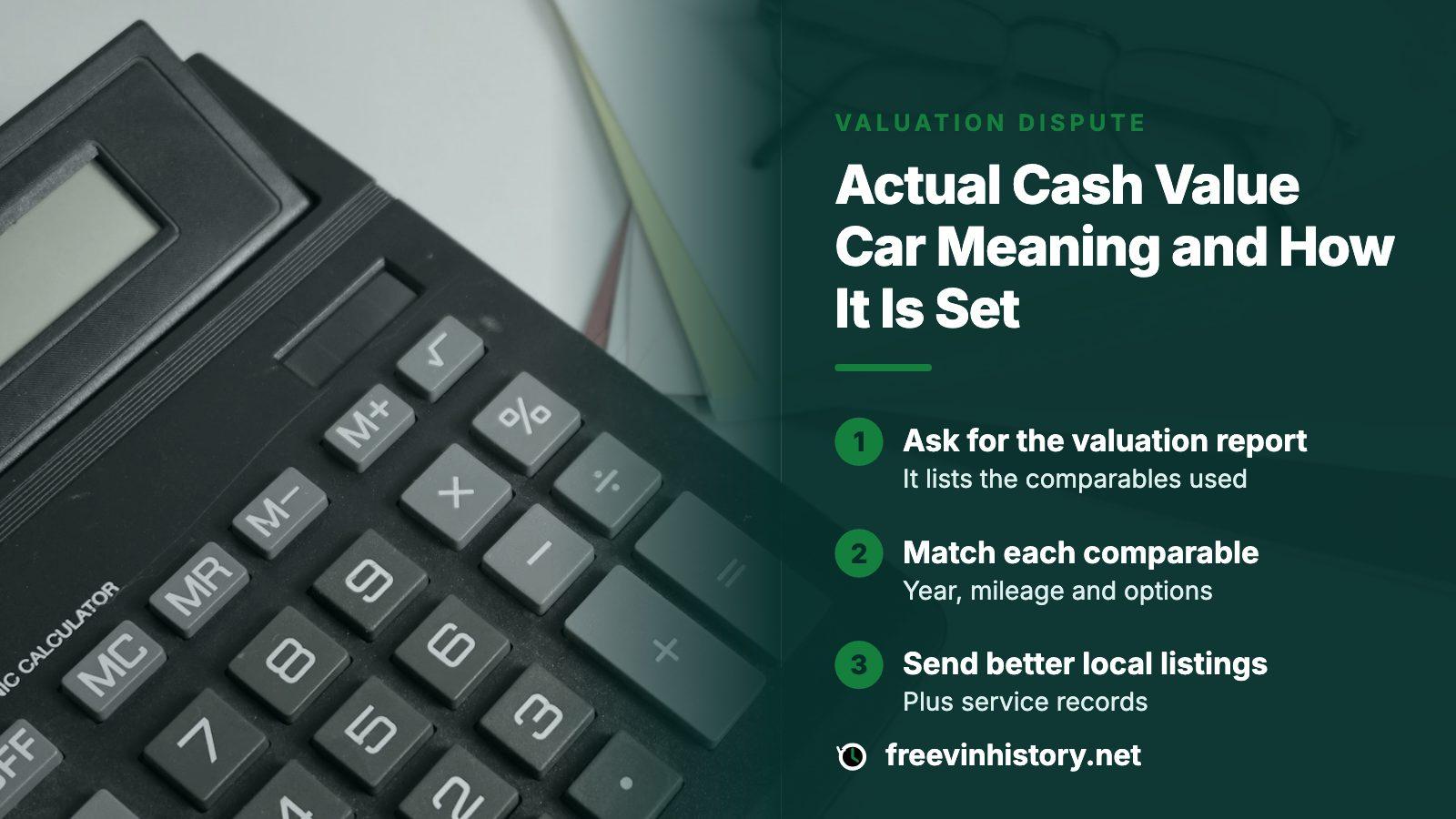
- Ask for the valuation report and the list of comparable cars used. Washington requires a copy on request.
- Check each comparable against your car: same model year range, similar mileage, matching options.
- Send your own listings or dealer quotes for cars that fit better, plus service records that show condition.
- If the policy has an appraisal clause and talks stall, either side may invoke it in Washington.
- Watch the clock after payment. Both Washington and California require a file to reopen if the payout would not stretch to a comparable car and you say so within 35 days.
Your state's insurance department publishes its own rules, so confirm the details there before relying on a Washington or California example.

What the free official sources show, and what they skip
The federal title system tracks five items. Title status and last title date come first, then brands, the odometer, and finally total loss and salvage events. By design it stays short: no repair records, recall data or maintenance entries, and no value. NICB runs a no-cost lookup you can search with a VIN, and NHTSA offers recall data at no charge too.
From an NHTSA owner complaint
A 2002 Honda Civic owner described a throttle that stopped responding at freeway speed. Dealers quoted repairs the owner said were worth more than the car. That repair-versus-value test is the same arithmetic an insurer runs after a crash, just applied to a breakdown.
The step up is a full report. Start with the free preview on this site, then pay once for the report if the car interests you. It lists total loss and salvage records alongside a market value, so you can see the loss event and a current price in the same place. That market value is a separate estimate, not the figure from any old claim.
If the seller mentions an old insurance payout
A seller may say the insurer paid out a certain amount and the car was fixed, as if that proved it was worth a lot. It proves very little. The payout reflected the market that day and the claim's deductions, and it says nothing about the quality of the repair.
What matters to you is whether a total loss or salvage entry exists, and whether the title carries a brand. A brand history can mean a buyer pays above what the car is truly worth. Ask for the repair invoices, run the VIN, and pay an independent shop to look at the structure before agreeing on a price.
Where this information comes from
- WAC 284-30-391: total loss settlement — Washington's methods for setting actual cash value, search radius, deductions and reopening rules
- 10 CCR 2695.8: California automobile claims — what counts as a comparable automobile and how adjustments are documented
- Florida Statutes 626.9743 — Florida's settlement methods and itemized-deduction requirement
- 28 CFR 25.52: NMVTIS definitions — the federal total loss and salvage definitions
- NMVTIS site: what the federal report includes — the five indicators and what the report leaves out
- NHTSA owner complaint 11081362 — owner experience, paraphrased
- NHTSA owner complaint 10730514 — owner experience, paraphrased
Sources and photos: Facts checked against the sources above in November 2026. Photos by Cht Gsml, Scott Graham and Iain on Unsplash; diagrams by FreeVINHistory.
Keep reading
- Total loss reported: what the line on a vehicle history meansWhat the total loss line on a history says and who files it.
- Insurance loss reported: what the entry on a history report meansThe wider insurer entry that a valuation dispute sits inside.
- Free VIN value lookup: what a VIN can and cannot tell you about priceWhat a value lookup by VIN can and cannot tell you.
- Free total loss check by VIN: what you can see before payingHow to look for a total loss record before paying for anything.
Frequently asked questions
Is actual cash value the same as what I paid for the car?
No. It is tied to the market just before the loss, not to your purchase price or loan balance. A car bought at a peak can come in under what you paid, and one bought cheaply can come in above. Mileage, options and local listings all move the figure.
Does actual cash value include sales tax and fees?
In the rules read for this page, yes. Washington and California both fold in taxes and transfer fees you would have paid buying the car, and California adds registration fees for the remaining term. Florida lets the insurer hold back sales tax until you actually incur it on a replacement.
Can I keep a totaled car and still get paid?
Often, but the insurer may subtract the salvage value from the payment. In California the insurer must tell you that the state DMV is notified and that resale and insured value may suffer. Washington keeps a salvage buyer's offer open for at least 30 days on request.
Will a free VIN check show what the insurer paid?
No. Federal title data stops at title status, brands, the odometer and loss events, with no values or claim amounts. A free lookup may show that a loss was declared. The amount stays in the insurer's claim file.
What if I find a comparable car for more than the offer?
Tell the insurer in writing within 35 days of payment. Washington and California both require the file to reopen when the payout fell short of a comparable car. The insurer must then find one at that price, pay the gap, buy it, or go to appraisal.
Now check the car itself
The guide explains what to look for. The report shows what this VIN has on record.