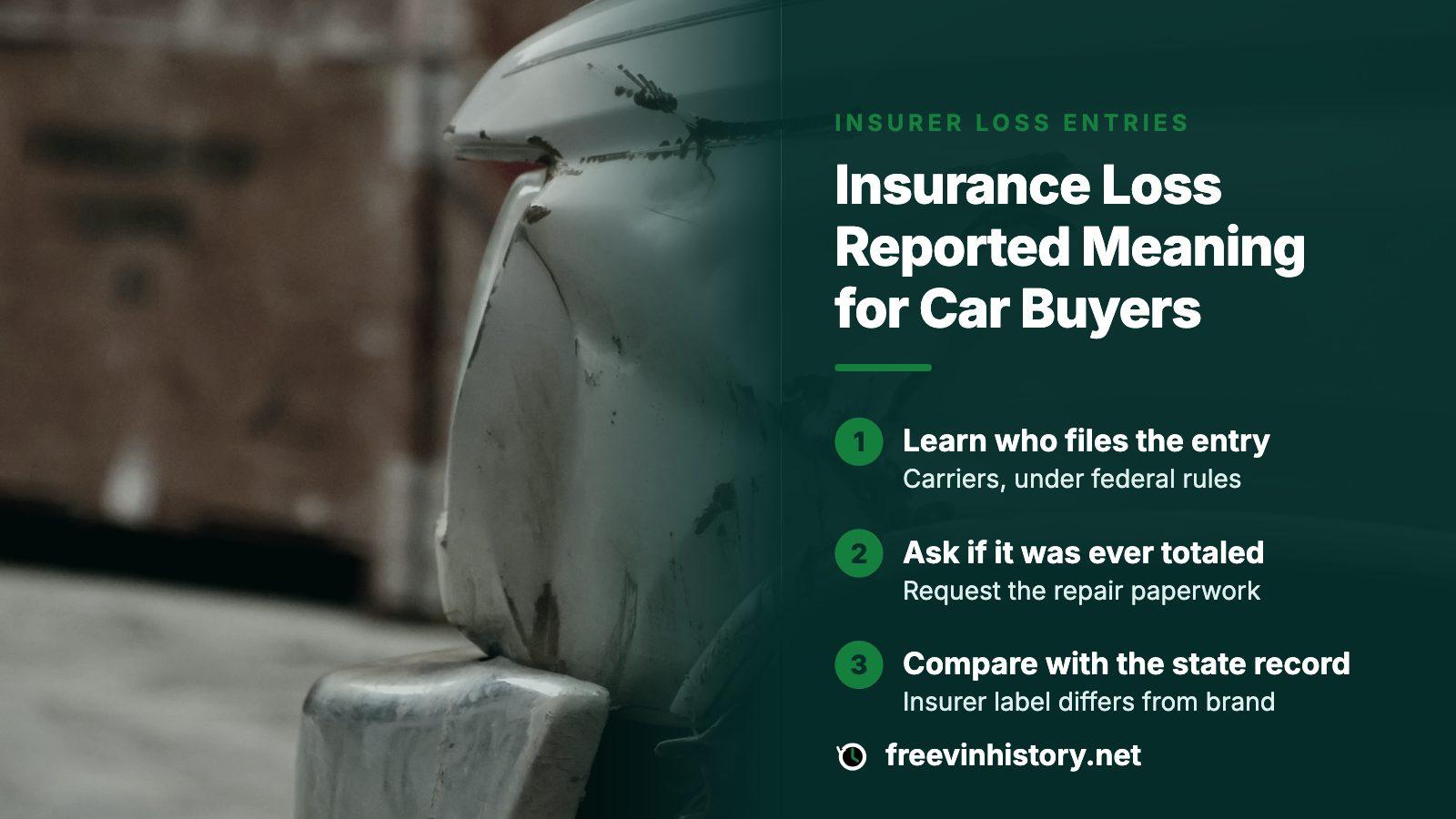
THE SHORT ANSWER
Insurance loss reported means an insurer made a loss decision on the vehicle, such as salvage or total loss, and passed it into a title or history database. Federal rules require carriers to file these decisions, claim paid or not. The entry does not say how bad the damage was or whether repairs were done, so set it beside the state's title file and get the car inspected.
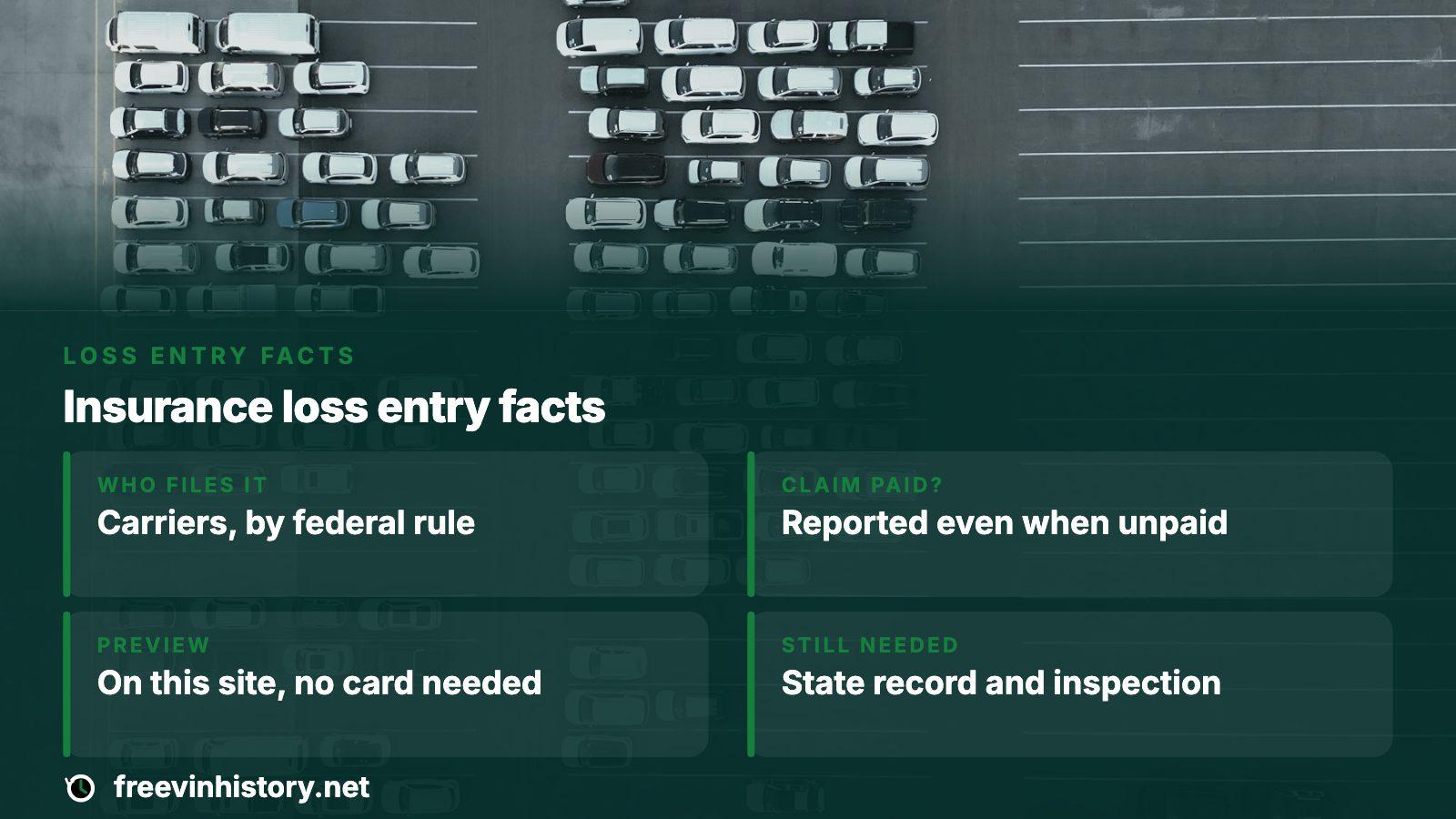
- Who files it
- Insurance carriers, by federal reporting rule
- Claim paid?
- Reported even when no claim is paid
- Free first step
- Preview on this site, no card needed
- Still needed
- State title record and an independent inspection
The plain meaning of the phrase
Different report vendors word this line in their own way, and I could not confirm any vendor's exact wording from its own pages, so this page works from the government rules that sit behind it. The underlying event is simple. An insurer examined a vehicle, decided it was a salvage or total loss case, and that decision was filed with the national title system.
Think of it as a note in the insurer's handwriting rather than the state's. A state brand such as salvage or rebuilt is printed on a title by a motor vehicle agency. An insurance loss entry comes from the company that handled the claim. The two often agree, and sometimes they do not, which is why a buyer wants both.
Where the entry comes from
The Justice Department's vehicle history site explains that insurance carriers, salvage yards, auto recyclers, junk yards and state titling agencies are all required by federal law to report into NMVTIS on a regular basis. For carriers, the duty falls on any business that underwrites auto insurance, and each month it files an inventory of vehicles it took into its possession that it ruled junk or salvage.
- Only recent cars are in scope: the newest model year and the four behind it. A ten-year-old wreck may therefore never have been filed by its insurer.
- A determination counts even when no claim was paid, for instance on a third-party claim.
- Fleets that insure themselves are not required to report, and neither is a rental company that does not underwrite policies.
- Carriers file through approved consolidators, and a salvage pool may file for them while the carrier stays responsible.
How an insurer arrives at a loss
California's insurance department describes the usual path. A trained appraiser looks over the car and puts a repair figure on paper. For modest damage, the insurer might skip that and request rival quotes from the owner. Under an ordinary policy the payout is capped at whichever is smaller: fixing the car, or its actual cash value, defined in California as fair market value unless the policy states something else.
That comparison is the heart of a total loss. When repairs would cost more than the car is worth, paying out the value is cheaper than fixing it. The car then has a salvage value, usually set by bids from salvage buyers. A low-value older car can reach that point after damage that a newer, pricier one would simply have repaired.
Why a loss is not always a wreck
The federal consumer page warns that a total loss decision does not necessarily mean a car was destroyed or is worthless. Its example is theft. When a stolen vehicle is not recovered within 30 days, an insurer may label it a total loss. If the car is found afterward in perfect condition, the label is not removed, and an insurer, auction company or pool may sell it in good working order.
Two cars, same line
One car has a bent unibody and a payout that exceeded its worth. Another was taken from a driveway, never found within the window, then recovered intact. Both can carry an insurance loss entry. Only the paperwork around them, and an inspection, tells you which one you are looking at.
What the entry leaves out
The entry does not give a repair bill, a photo of the damage or the name of the shop that fixed anything. The federal system calls itself intentionally concise and leaves out repair histories. It also is not the whole state file, and the Justice Department encourages buyers to look at the state title record before relying on a summary.
Coverage has holes too. The agency puts coverage at 87 percent of the vehicle population, though states that send data number just over half. Its database holds about 20 million salvage or total-loss entries. While some reporters stay silent, a clean search result can hide a past that exists. Private databases may carry identical blind spots.
Insurer label versus state brand
Each state sets its own thresholds and vocabulary. The federal page makes the point that a wreck branded salvage under one state's rules might escape the brand elsewhere, since each state draws its own cost-to-value line. Texas, for instance, defines salvage by repair cost passing a jurisdiction-defined share of retail value, and reserves junk for cars that can never be titled again.
| Record | Written by | What it tells you |
|---|---|---|
| Insurance loss entry | The insurer | A carrier judged the car a loss or salvage case |
| Salvage or rebuilt brand | A state titling agency | How that state labeled the car on its title |
| Junk brand | A state titling agency | Unsafe for roads, no resale value beyond parts, never retitled |
| Salvage yard or auction transfer | A yard, pool or recycler | The car moved through the salvage channel |
Reading the entry as a buyer
Treat the entry as the start of questions. Federal guidance reads a brand, total loss or salvage past as a caution that the vehicle could be unsafe, and a clean report as encouraging. A loss entry on a car being sold as clean-titled is the pattern worth slowing down for, since a seller may not have mentioned it.
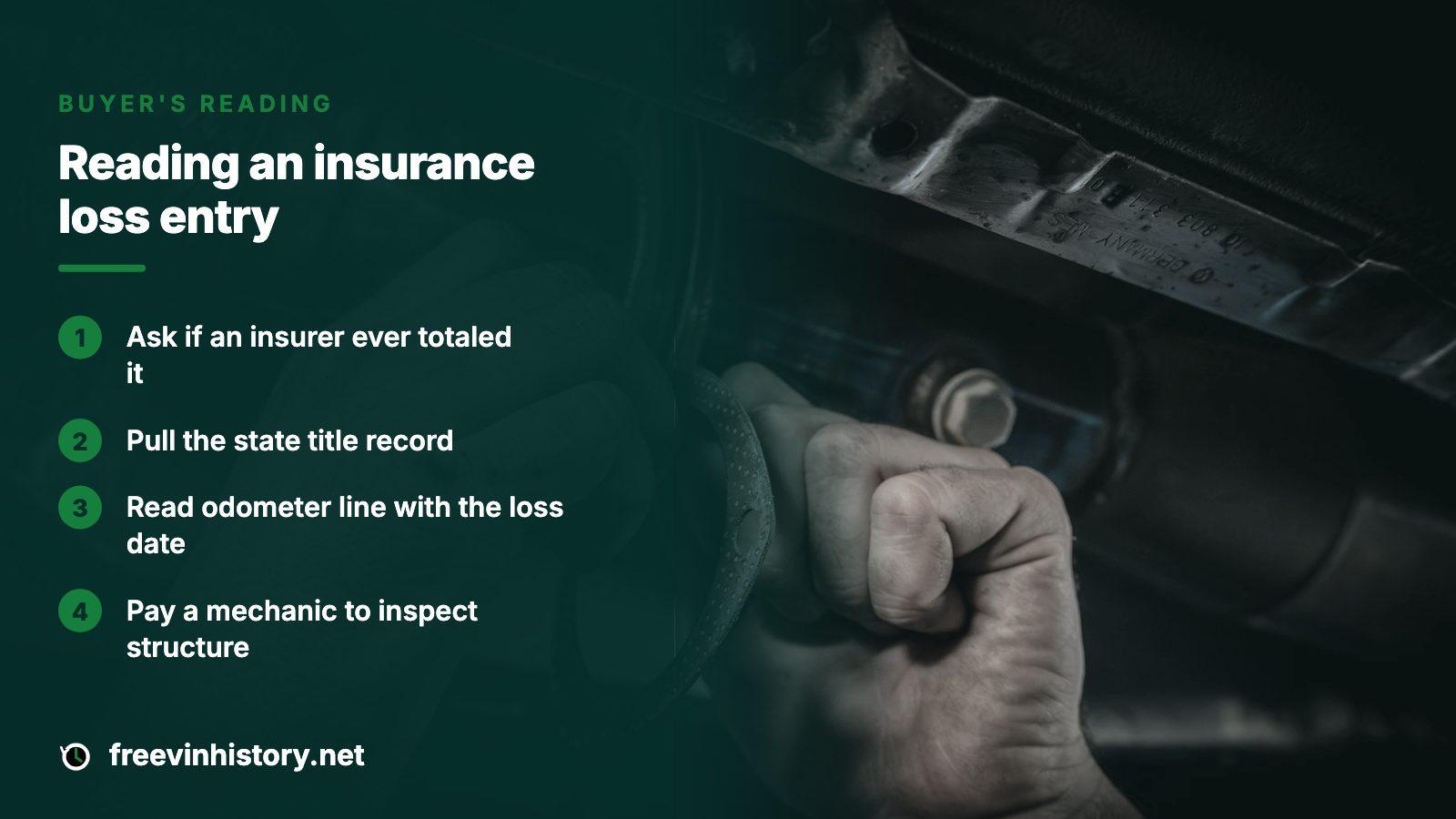
- Ask the seller directly whether an insurer ever totaled or declared the car salvage, and ask for repair paperwork.
- Pull the state title record and compare its brands with the entry.
- Look at the odometer line and the date of the loss together.
- Pay an independent mechanic to inspect structure, airbag components and electrical systems.
- Let the price reflect the history, or walk away.
Running the check before you commit
Begin with the free preview here: enter the VIN and see whether insurance, salvage or title records exist at all, with nothing spent. If it hints at an insurer-side record and the car still tempts you, the full report is the paid step up: one payment, no subscription, with the loss entry, title brands and odometer readings laid out together. Current rates are on the pricing page.
Texas's DMV advises running the VIN before any money changes hands or paperwork is signed, whether the seller is a dealer, a private party or an online auction. That timing matters for a loss entry, because the best moment to find one is before you have an emotional or financial stake.
If the entry is on your own car
Owners sometimes find a loss entry on a car they repaired or kept. California's guide explains that an owner who keeps a totaled car can take a smaller settlement, reduced by the best salvage bid, and then has to lodge a salvage certificate with the motor vehicle department. The entry itself will not vanish after repairs, so keep your estimates, receipts and inspection records to show a buyer later.
If you think a record is wrong, the federal FAQ says to contact the report provider about discrepancies and the state titling agency for the full title record. Disputes over an insurer's value offer have their own route, and many policies include an appraisal provision.
Where this information comes from
- NMVTIS: for consumers — insurer salvage determinations, the 30-day theft example, state differences and coverage gaps
- NMVTIS: understanding a vehicle history report — the indicators a federal report covers and what it leaves to private providers
- NMVTIS: frequently asked questions — who must report, which model years, and how to dispute a record
- California Department of Insurance: auto accident guide — how adjusters evaluate damage, actual cash value and salvage value
- Texas DMV: title check, look before you buy — how a state defines salvage, rebuilt and junk, and when to run the VIN
Sources and photos: Facts checked against the sources above in November 2026. Photos by Everett Pachmann, Martin Fennema and Iain on Unsplash; diagrams by FreeVINHistory.
Keep reading
- Total loss reported: what the line on a vehicle history meansThe most common insurer decision behind this entry, explained on its own.
- Title issue reported on a car's history: what it can meanWhat the state side of the record means when a title event is logged.
- NMVTIS report: what the federal title record shows and missesThe federal record that collects insurer filings and state brands in one place.
- Free salvage title check by VIN: what the free lookups showWhich no-cost lookups can show a salvage record and which cannot.
Frequently asked questions
Does insurance loss reported mean the car was in an accident?
Not always. The label can come from a crash, but a loss decision also covers theft, flooding and other events. A stolen car that was never recovered within 30 days can be labelled a total loss and keep that label even if found undamaged. Treat the entry as a reason to ask for details.
Will the entry disappear after the car is repaired?
No. The federal consumer page says a total loss determination is not removed when a car is later recovered in perfect condition, and a state brand stays a permanent part of the record once applied. Repairs change the car, not the history. Keep repair receipts and inspection notes to show later buyers.
Can a car have an insurance loss without a salvage title?
Yes. Thresholds differ by state, so the same damage may be branded in one and ignored in another. An insurer's decision can also precede any title action. That mismatch is why the insurer entry and the state title record should be read side by side.
If the report shows no loss, is the car safe?
No. Coverage is incomplete, so a lookup may come back empty on a car with a loss in its past, and reports leave out repair details. A clean result is encouraging, yet federal guidance still urges an independent inspection before purchase.
Can I decide on the free preview alone?
The preview shows whether records exist, a handy screen before spending anything. When a car is a real candidate, the full report lays the entries out in detail, as a paid one-time purchase. Either way, add a state title check and a mechanic.
Now check the car itself
The guide explains what to look for. The report shows what this VIN has on record.