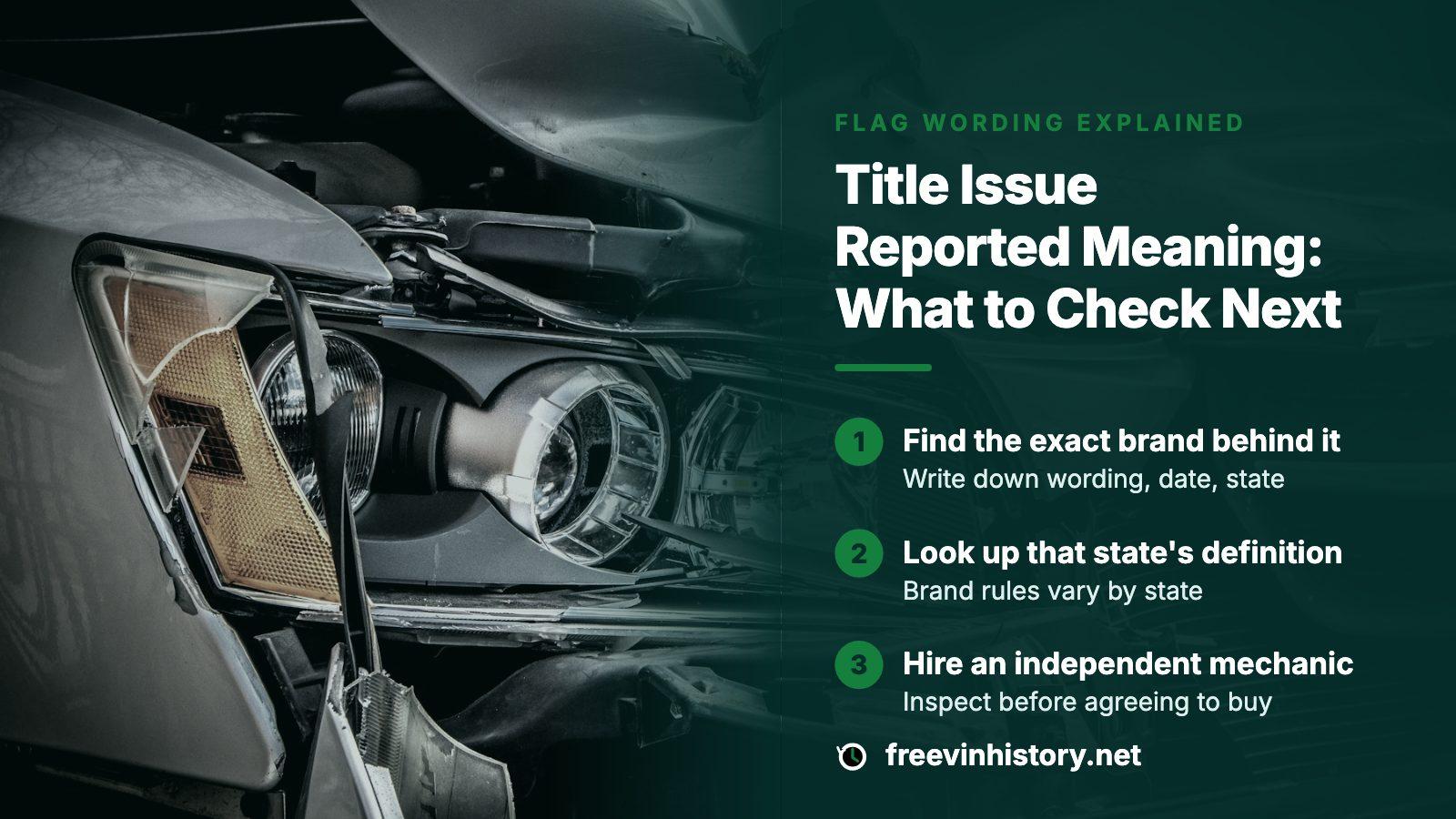
THE SHORT ANSWER
Title issue reported usually means a report found something unusual in the car's title record, such as a brand like salvage, junk, flood or rebuilt, or a mileage or VIN notation. The wording is a report's own shorthand, and no official page defines it. Look for the named entry underneath, then confirm it against the state's own title record.
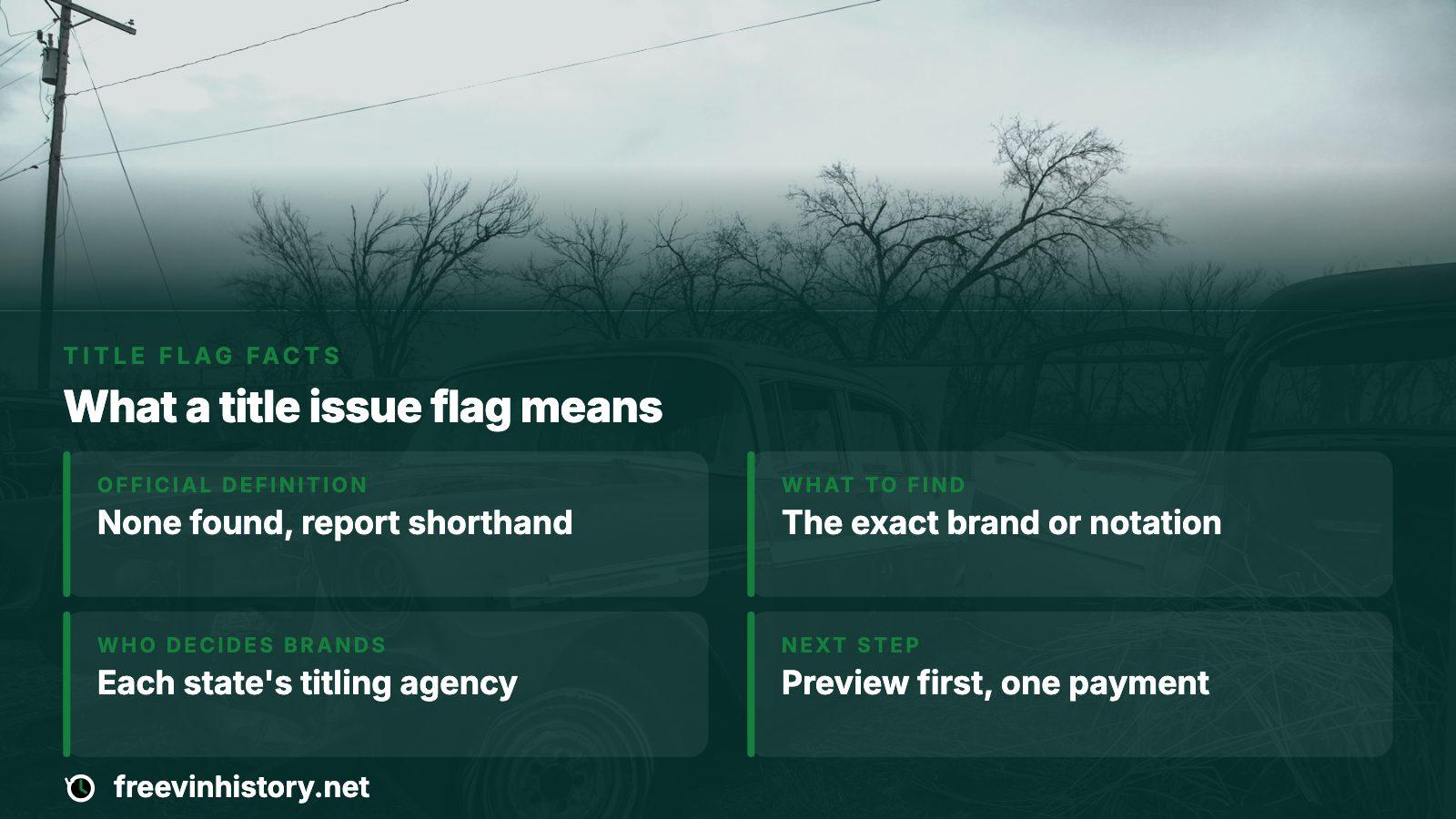
- Official definition
- None found; the phrase is report shorthand
- What to find
- The exact brand or notation behind the flag
- Who decides brands
- Each state's titling agency, under its own rules
- Next step
- Free preview first, one payment for the full report
What could and could not be confirmed
Before explaining anything, a fair admission. A search of the federal title-record pages, two state DMVs and the FTC's used-car advice turned up no definition of the exact phrase. It reads like a label a report company wrote for its own summary box. Guides that claim a single precise meaning are guessing.
What the official sources do describe is the thing such a flag almost certainly points at: a brand, or another notation, attached to the car's title record by a state. That is the useful thread to pull, and the rest of this page follows it.
The usual suspects behind the flag
Texas lists the brands its own title check can reveal. Reading that list shows how wide the word issue can stretch, from serious to merely odd.
| Notation | What the state says it means |
|---|---|
| Salvage | Damaged beyond a set share of its value; it can be rebuilt |
| Rebuilt | Was salvage, then passed the required inspections |
| Junk | Unsafe for the road; can never be titled or registered |
| Water damage | Damaged only by floodwater |
| Manufacturer buyback | Returned to or bought back by the maker, as under a lemon law |
| Odometer | Says whether the reported mileage is true or not |
| VIN replaced | The car got a fresh VIN from the state; often harmless, yet worth digging into |
California runs a different list, including former taxi, former police, grey-market and lemon-law buyback brands. The two states agree on the idea and disagree on the wording, which matters in the next section.
Why one state's brand is another state's blank
The Justice Department's consumer pages are blunt about this. Every state writes its own rules and vocabulary, and the federal database leaves those alone. Take a car with moderate damage: one state calls it salvage, the next state over sees damage below its cutoff and adds nothing. Only some states use a flood brand at all, and a few skip titling for older vehicles entirely.
Two identical cars with different home states can therefore carry different flags. When a VIN has moved between states, find out which one applied the notation and read that state's own definition.
Why this matters when you buy
Brands follow the VIN. A state's brand remains in the federal record, so crossing a border is not supposed to wash it off.
Where a title entry comes from
The federal title database holds a short list: which state titled the car now and before, when the title was issued, the newest mileage figure, theft if any, brands with the date each was added, and salvage or total-loss decisions. Repairs are not part of it.
Timing is uneven. A few states push each title transaction as it happens; the rest batch it daily or take several days. Insurers report monthly, listing cars they judged junk or salvage from the newest model year and the four preceding ones.
That lag means a freshly branded car may not show the flag yet. It also means an old flag can be the only trace of something that happened in a state that no longer holds the car.
When there is no flag at all
A missing flag is weaker evidence than it feels. The Justice Department warns that not every state or reporting business feeds the federal system, so a search can return a false no junk or salvage history. The sources are independent and do not share a single definition of vehicle conditions.
It also notes that an insurer may label a stolen car a total loss when it is not recovered within 30 days, and that label can stay even if the car later turns up in good shape. A flag can therefore be alarming and harmless, and a clean page can hide a problem. Neither tells the whole story alone.
How to read the entry you find
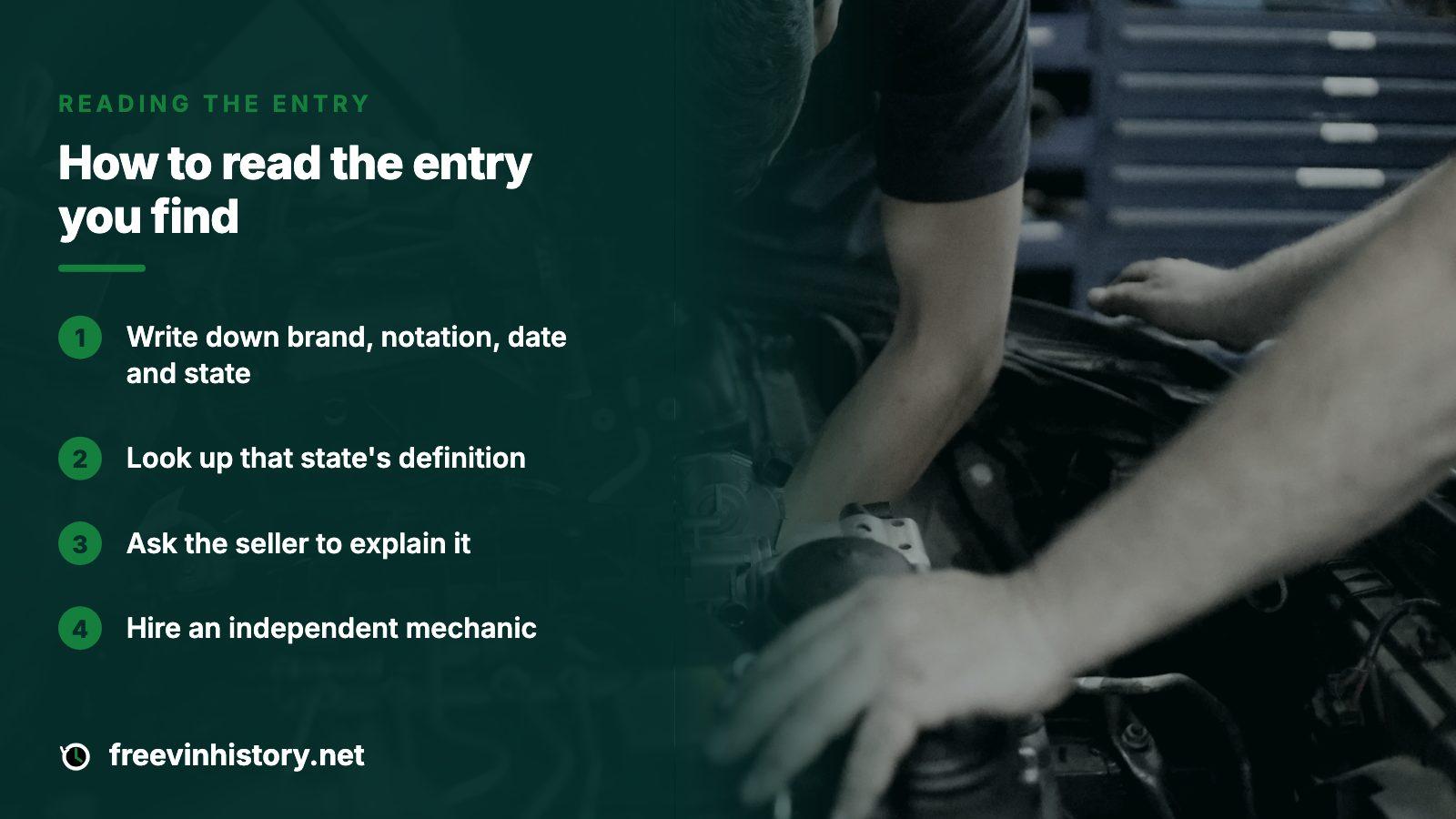
- Write down the exact words under the flag: the brand name, the notation, the date and the state.
- Look up that state's definition of the word on its DMV site, since wording differs between states.
- Ask the seller to explain it, and ask for the repair paperwork if the car was damaged.
- Compare the title in the seller's hand with the record: brand, VIN, owner name.
- Hire an independent mechanic to inspect the car before paying anything, including a deposit.
Texas is blunt on this point: it offers no warranty or consumer protection for used vehicles, which makes these checks your main safeguard.
Serious, awkward or just administrative
Not every title notation means the same level of risk, and sorting them is most of the job.
- Serious: junk, salvage, water damage or an odometer notation that says mileage is not true. These can mean unsafe repairs, hidden damage or overpaying.
- Needs a story: rebuilt, buyback, grey market and a replaced VIN. The car may be fine, but the history deserves paperwork.
- Often just context: former taxi or police use, which California says usually means high mileage.
California warns that some revived salvage vehicles were not repaired properly, and some carry stolen parts. A rebuilt car with real receipts and a clean inspection is a different animal from one with a vague story.
Where the full report earns its place
The free preview tells you whether a title record has something to show for a given VIN. The full report, bought once with no subscription, spells out the brand, the date and the state behind a flag, alongside the odometer and salvage history. That turns a vague warning into a specific question you can put to the seller.
Pricing lives on the pricing page. Even then, treat the report as the start of due diligence: the Justice Department says the federal record is short on purpose, and recommends reviewing the state's full title record too.
Where this information comes from
- NMVTIS: consumer information — State differences, permanence of brands, false negatives and the total-loss caveat.
- NMVTIS: understanding a report — The five indicators and what a brand is.
- NMVTIS: frequently asked questions — Report contents, update timing and insurer reporting.
- TxDMV: title check, look before you buy — Texas brand list and pre-purchase steps.
- California DMV: branded titles — California brands and revived salvage warning.
- FTC: buying a used car from a dealer — Limits of history reports and independent inspections.
Sources and photos: Facts checked against the sources above in November 2026. Photos by Clark Van Der Beken, Mustafa Sheikhmouss and Leo_Visions on Unsplash; diagrams by FreeVINHistory.
Keep reading
- Lien reported on a vehicle history report: what it meansThe other warning that often appears next to a title entry.
- Car title search by VIN free: what you can see before you payWhich no-cost title lookups exist and what they leave out.
- Total loss reported: what the line on a vehicle history meansWhat an insurer's total-loss decision does and does not say.
- Certificate of title meaning: what the document proves and what it hidesHow to read the paper title in the seller's hand.
Frequently asked questions
Does title issue reported mean the car has a salvage title?
Not necessarily. Salvage is one possible entry behind the flag, along with rebuilt, junk, flood or odometer notations. The phrase is report shorthand, so find the named brand underneath and check how the state that applied it defines the word.
Is a title issue the same as a title brand?
Brands are stamps that a state's titling office puts on a record to describe what happened to the car, with junk, salvage and flood as examples. A title issue flag may point to one, but a report company can use it for other notations too. Read the specific entry.
Can I still buy a car that shows a title issue?
Yes, if you understand it. Get the exact entry, ask the seller for repair records, confirm it with the state, and pay for an independent inspection. Walk away if the story is vague or the paperwork does not match the car.
Why does my report show nothing when the seller admitted damage?
Reporting is incomplete. Not every state or reporting business feeds the federal title system, and sources do not share definitions, so a car handled as salvage may carry no brand. Absence of a flag does not prove a clean history.
Where do I confirm a title issue officially?
Use the title record of the state that issued the title. Federal reports link to it, and state DMV sites explain their own brands. The federal record is deliberately short, so the state's full record is the stronger check.
Now check the car itself
The guide explains what to look for. The report shows what this VIN has on record.