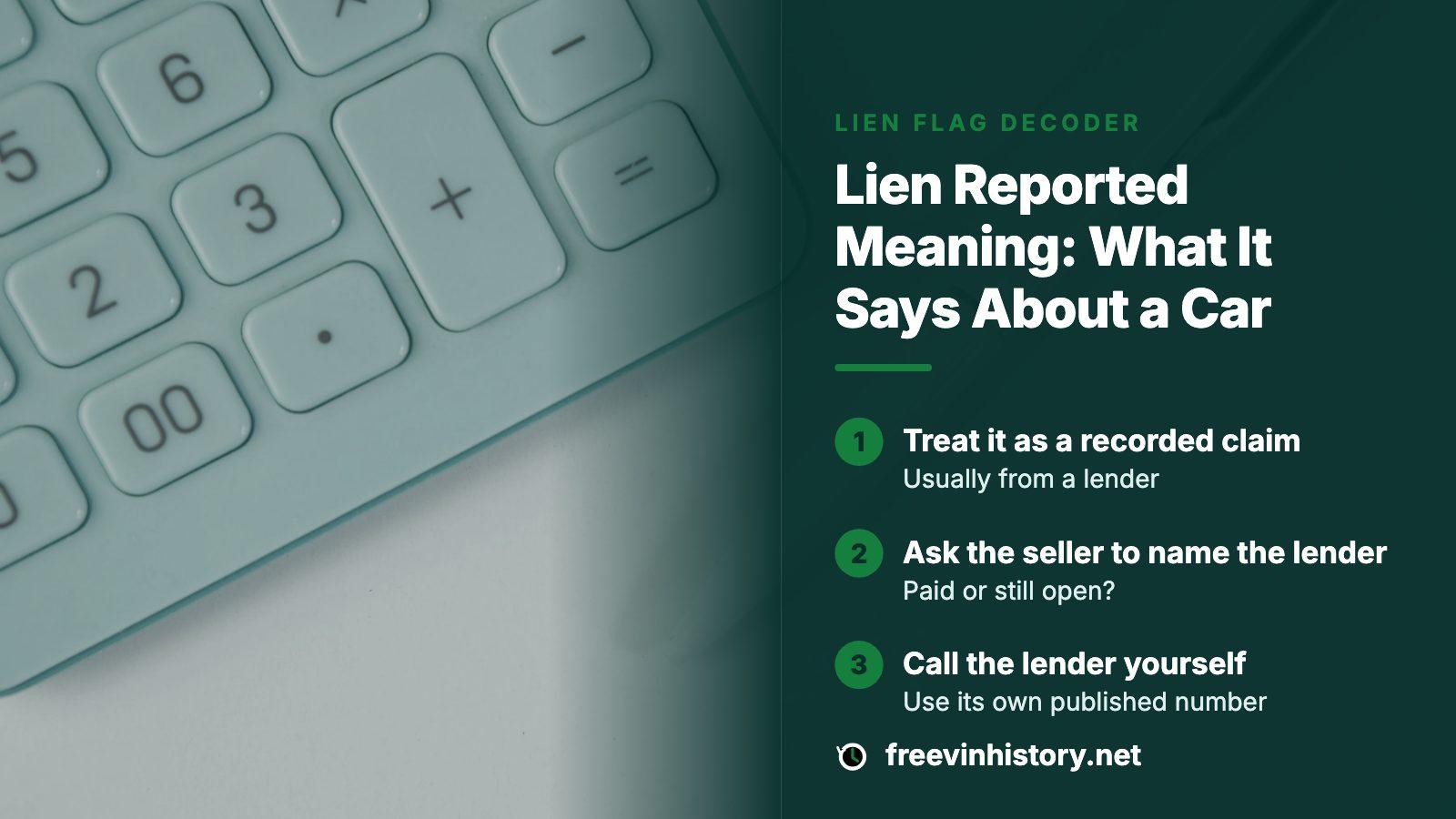
THE SHORT ANSWER
A reported lien is a note that someone other than the owner has a recorded claim on the vehicle, most often a bank that financed it. The claim may be live or may have been paid off and released. The entry alone cannot tell you which. Only the lender's confirmation and the state's title record settle it, so ask for both before you buy.
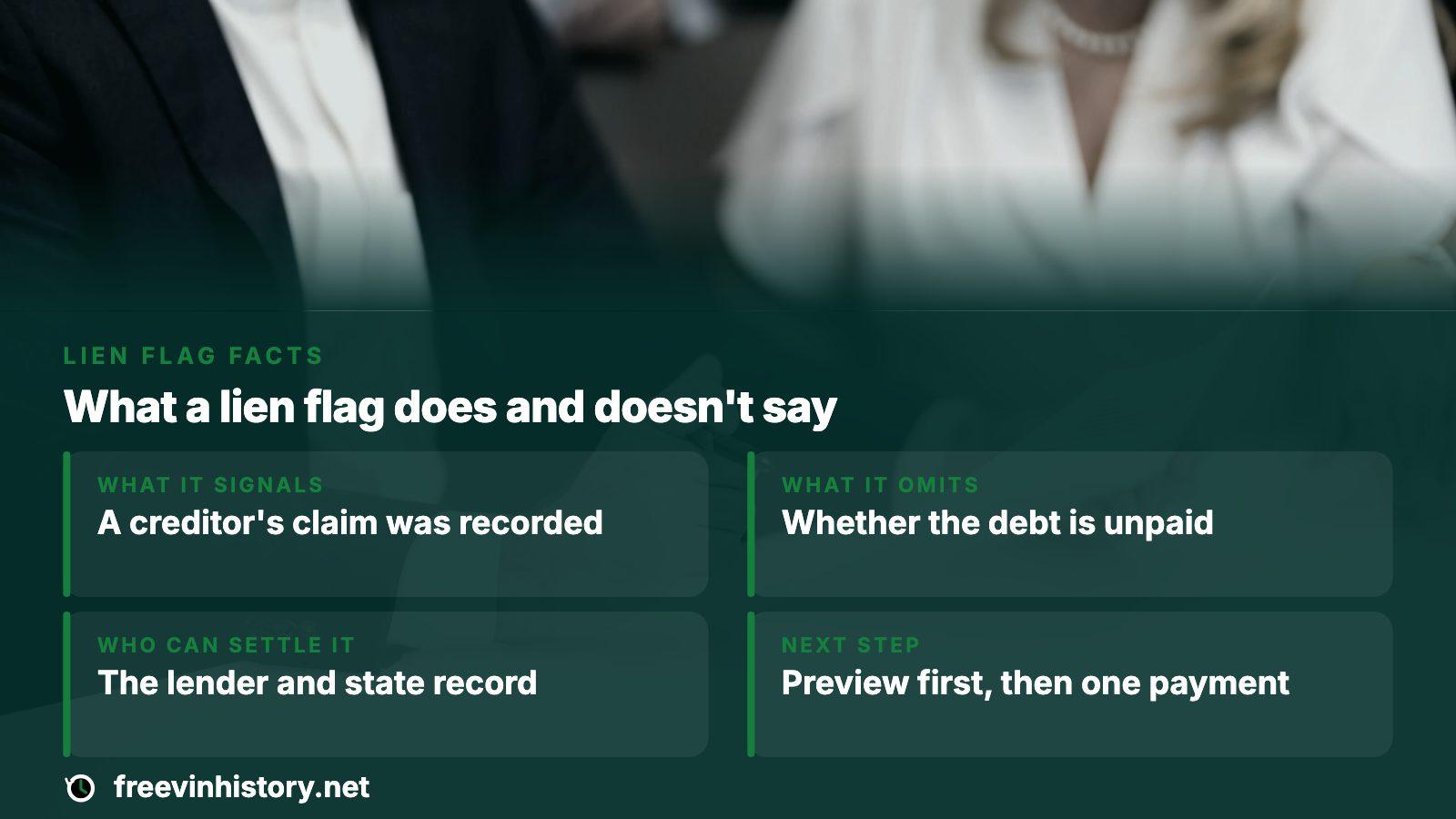
- What it signals
- A creditor's claim was recorded against the car
- What it does not say
- Whether the debt is still unpaid
- Who can settle it
- The lender and the state title record
- Next step
- Free preview first, one payment for the full report
The plain meaning of a lien flag
A lien is a legal claim on property to secure a debt. On a car, the familiar version is the loan that paid for it: the lender is recorded on the title, and the car answers for the loan until it is repaid. When a history report says a lien was reported, a record somewhere in the car's past carried that kind of claim.
California's DMV describes a title as carrying the lienholder's name and details whenever money is owed on the vehicle. That is the everyday picture, and it explains why the word shows up so often on financed cars. Plenty of ordinary, legitimate used cars have a lien in their past. The flag becomes a problem only when the claim is still open at the moment you hand over payment.
Open claim or old news
The entry is a snapshot of a record, not a verdict on the loan. It may describe a claim that is active now, or one the lender cleared months ago that the report still lists as part of the car's history. Reading it correctly means sorting it into one of three situations.
- Open and disclosed: the seller still owes money, says so, and arranges the payoff as part of the sale.
- Open and undisclosed: the seller never mentioned a loan. This is the dangerous case and the reason to ask.
- Released: the loan was repaid, the lender let go of its claim, and the record simply reflects the past.
You cannot tell these apart from the flag. You tell them apart by asking the seller who the lender is and then calling that lender yourself.
Not every lien comes from a bank
A shop that repaired a car, or a business that towed or stored it, can also have a lien when the owner does not pay the bill. California's DMV says that person has a claim on the vehicle, and that it can be resolved through the courts or through a sale the state's lien rules allow, provided the business is holding the car.
These claims are tied to a specific unpaid bill and are normally short-lived, but they matter for a buyer in one way: a car that went through a lien sale has a different paper trail than one sold by its owner. If a report ties a lien entry to a tow or storage business rather than a finance company, ask for the story behind it and for the paperwork that closed it out.
How a lien gets recorded and cleared
States keep the lien on the title record. In Texas the county tax office handles adding or dropping one, and a lender gets 10 days after it receives the final payment to let go. A paper title then travels to the owner by mail. Where the lien was electronic, TxDMV keeps the record and the lender arranges the removal behind the scenes.
Pennsylvania runs its liens electronically under a Vehicle Code mandate. When a dealer pays off a trade-in loan, the lender must release at once, and PennDOT mails a paper title to the dealer the next business day.
What this means for you
A lien is cleared by the lender acting, not by the seller promising. Until the lender releases it and the state record changes, the claim can still follow the car to its next owner.
What a report can and cannot see
The federal title system is a weak place to look for lender claims. Federal rule 28 CFR 25.54 has each state feed NMVTIS a short set of fields on a 24-hour cycle: VIN, brands, the certificate holder's name, junk or salvage acquisitions where a state collects them, and mileage disclosures. Lienholder is absent. Nor do the Justice Department's consumer pages list liens among report contents, and they warn that a state may hold more than the federal system does.
That is why a clean federal record never proves a car is free of debt. It also explains why a lien flag on a report is worth taking seriously when it does appear: it came from somewhere beyond that thin federal set. The state's own title record remains the authority.
How to confirm before you pay
- Get the seller to name the lender and state whether the loan is paid or still open.
- Call that lender on a number from its own website or statements, not one the seller supplies, and ask for the payoff status.
- Look at the title itself: does it show a lienholder, and does the seller's name match the person in front of you?
- If the loan is paid, ask for the lender's release letter or confirmation that the claim was removed from the state record.
- If the loan is open, close the sale only through the lender: a payoff made directly to it, then a clear title sent to you.
Texas sets out the paper-title version of this: a buyer or owner needs the title plus a release letter or notice from the lender named on it, along with the state application form.

Where a VIN preview fits in
Run the VIN before the test drive. The free preview here shows whether records of certain kinds exist for the car, so you learn early if a lien, a title problem or an auction history is waiting. A reported lien in the full report is then something to take to the lender, with the report in hand as your reason to ask.
The preview costs nothing. After it, you buy the full report once, with no subscription tied to it, and current rates sit on the pricing page. Keep one limit in mind: the report points you at the right question, and the lender and the state answer it.
Signs that should slow the deal down
- The seller has no title in hand and gives a vague reason.
- Title and registration carry a different name than the person selling.
- The seller pushes you to pay in cash before the lender is contacted.
- The lender named by the seller cannot be found, or its phone number leads nowhere. California's DMV keeps a listing of lenders that closed, merged or changed names, which can help trace one.
- A recent loan payoff is claimed, but no release letter exists yet.
None of these proves fraud on its own. Together they are reason enough to wait a week for paperwork.
Where this information comes from
- California DMV: vehicle titles — What a title lists, including the lienholder when money is owed, and the lender-lookup help.
- California DMV: lien sales for vehicles — Repair, tow and storage liens, and when a lien takes effect.
- TxDMV: add or remove a lien — The release window after payoff and paper versus electronic liens.
- PennDOT: electronic lien and titling FAQs — How liens are released and titles printed under the state's electronic program.
- NMVTIS: information for consumers — What federal consumer reports include and the advice to check the state record.
- 28 CFR 25.54: responsibilities of the states — The list of title fields states must send to the federal system.
Sources and photos: Facts checked against the sources above in November 2026. Photos by Sasun Bughdaryan, Alejandro Escamilla and Carrie Allen www.carrieallen.com on Unsplash; diagrams by FreeVINHistory.
Keep reading
- Car lien search free: what the free tools show and what they missWhich no-cost lookups reach a lien and which cannot.
- Title issue reported on a car's history: what it can meanThe other title warning that appears beside a lien entry.
- Certificate of title meaning: what the document proves and what it hidesHow to read the title that shows the lienholder.
- Repossession on a vehicle history: what the record means for a buyerWhat it means when a lender has already taken a car back.
Frequently asked questions
Does lien reported mean I cannot buy the car?
No. Many used cars were financed at some point. What matters is whether the claim is open when you pay. If it is, the sale can still go ahead, provided your payment reaches the lender, the lender releases its claim, and a clear title comes to you.
Can I be responsible for the seller's car loan?
A claim recorded against the car can stay with it when ownership changes, which is the risk. The details depend on state law, so confirm payoff and release in writing before you pay, and ask your DMV how it treats a sale that skipped the lender.
Who is the lienholder on a car I am buying?
Look at the title, where the lender is normally named, then ask the seller. If the lender has merged or renamed, California's DMV keeps a list of such institutions. Always verify by calling a number you found yourself.
Is a clean NMVTIS report proof there is no lien?
No. States are not required to send lienholder information to the federal system, and the Justice Department says its reports are concise and incomplete. Treat a clean federal result as one input, and check the state title record too.
The seller says the loan is already cleared. Is that enough?
Ask for the lender's release letter or written confirmation, and check that the title and state record agree. Texas, for example, wants that letter before a lien comes off a paper title. A spoken promise is not enough.
Now check the car itself
The guide explains what to look for. The report shows what this VIN has on record.