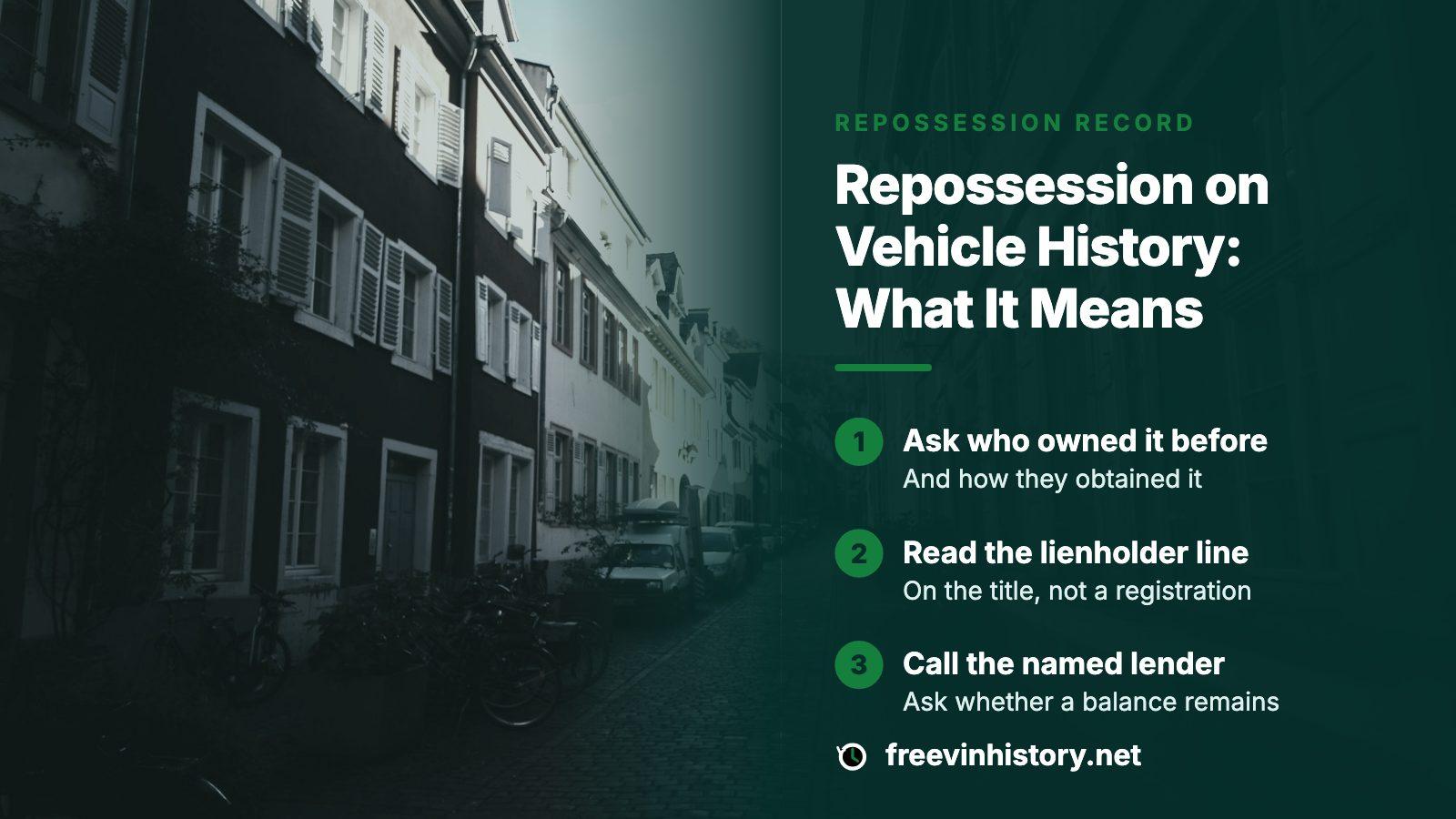
THE SHORT ANSWER
Repossession on a vehicle history is a note that a lender or its agent recovered the car because payments stopped. It is a past event tied to the VIN. It tells you nothing about mechanical shape, and the free federal title database does not list it among its indicators, so you confirm the details with the seller, the lender and the state title record.
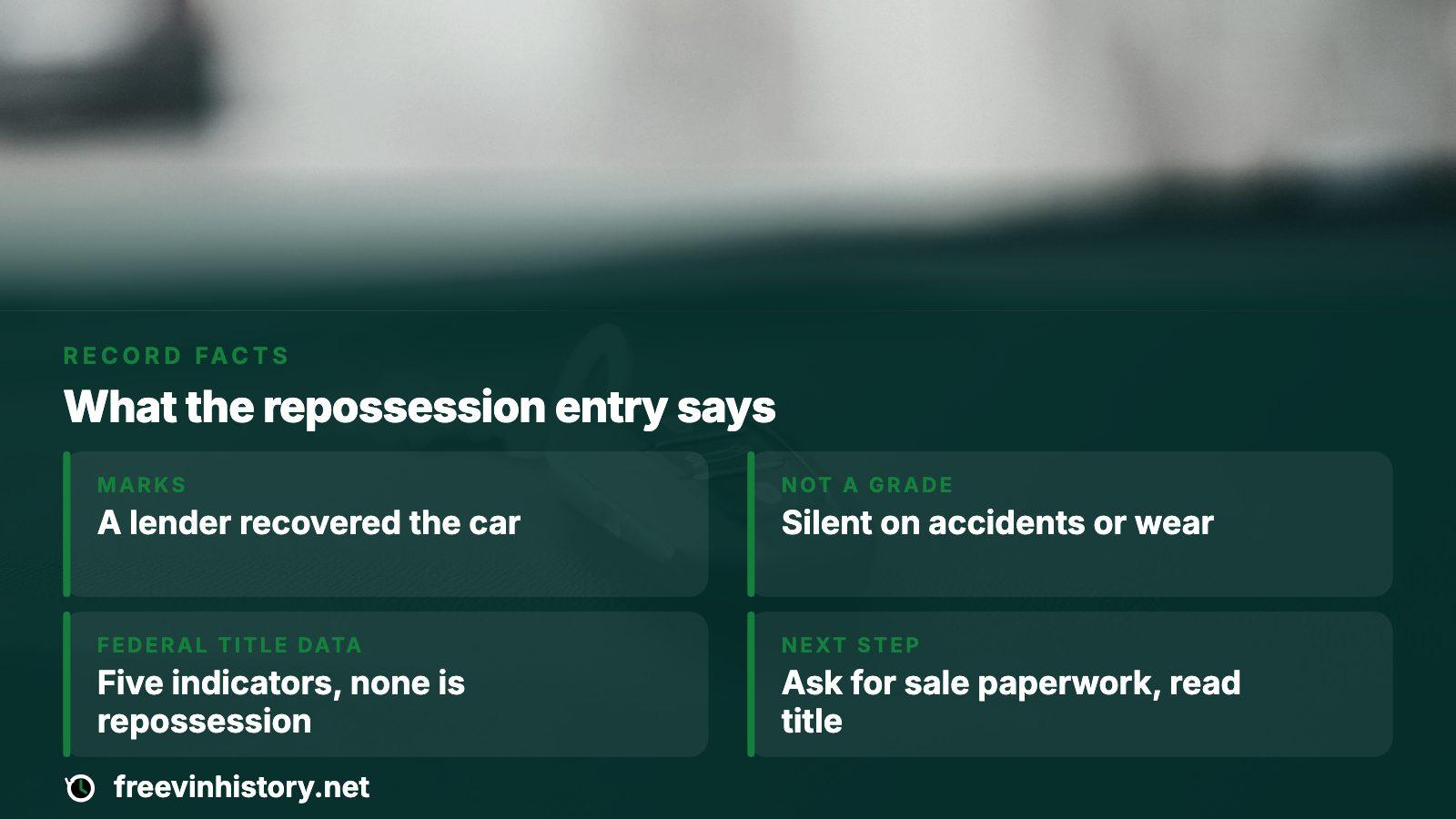
- What it marks
- A lender recovered the car after a loan default
- Not a condition grade
- Says nothing about accidents, wear or repairs
- Free federal title data
- Built on five indicators, repossession is not named among them
- Best next step
- Ask for the sale paperwork and read the state title record
The plain meaning of the entry
Someone borrowed money to buy the car, stopped paying, and the lender exercised its right to take the vehicle. That is all the word covers. A repossession line on a history is a pointer to that event, and it usually carries no detail about when, where or how the recovery happened.
The Federal Trade Commission explains that in many states a lender can act the moment the borrower is in default, and the loan contract defines what that means. A late payment is the usual example. No court order or warning may be needed, so a repossessed car can reach the market quietly.
Read it as a question, not a verdict
The entry says a previous borrower fell behind on the loan. It never says the car is bad. Use it to start asking for documents and to inspect harder, rather than to leave at once.
How a car ends up repossessed
Default is the starting point. Next the lender, usually through a recovery agent, collects the car from a street, driveway or lot. The FTC says the agent may come onto private land, yet a breach of the peace is off limits, and some states read that to include threats or entering a shut garage without consent.
Some loans come with a starter interrupt, or kill switch, that stops the engine when payments lapse. Per the FTC, contract terms and state law decide whether using it counts as repossession. A borrower can also return the car voluntarily, which may cost less in fees but leaves a similar trail.
- Default under the loan contract, most often missed payments
- Recovery by the lender or its agent without a court visit in many states
- Sale at auction or privately, or the lender keeps the car against the debt
- A new title or ownership record when the car is sold on
What happens to the car after the lender has it
The lender may keep the vehicle against the debt or sell it. The FTC adds that some states make the lender announce a public auction's time and place, or a private sale's date. The former owner might get the car back by paying off the whole balance plus storage and sale costs, or by bidding. A few states permit reinstating the loan instead.
For you as a buyer, the car on offer may be one step in that process. A lender auction often brings thin disclosure and little time to inspect, while a reinstated car may be back on the road with the loan still open.
| Outcome after repossession | What it can mean for the next buyer |
|---|---|
| Lender sells at auction | Car changes hands fast, often with limited inspection and paperwork |
| Lender sells privately | Sale terms depend on the state, so ask who ran it and when |
| Owner buys it back | Ownership may look unbroken while the history carries a repossession note |
| Loan reinstated | Same owner, same loan, repossession entry still tied to the VIN |
What the free official sources show
NMVTIS is a federal title database that a buyer can query before purchase. Per its consumer page, a search turns up title data, the newest mileage figure, any brands, and occasionally an old theft entry. The page calls the report intentionally concise, with five indicators aimed at fraud and theft. Repossession is not among them.
The page also warns of false negatives, such as no junk or salvage history, until every source reports. NMVTIS does not hold all a state keeps in a title record, and each report links to the way to reach the full state record, where a recorded lienholder or title change would show.
So a clean free result tells you less about repossession than it may seem to. It answers the theft and brand questions it was designed for. I did not find any federal page that says repossession is a standard reported item.
Following the paperwork trail
A repossession leaves the car with a title that may still show the lender, the old owner, or a dealer who bought it at auction. The state title record is the authority on who holds title and whether a lien is open. California's DMV, for example, names a Certificate of Repossession as one proof document a legal owner can offer when a lien must come off its record, and it treats unpaid repair, towing or storage liens as a separate matter from a lender's repossession.
Those are California rules. Other states use different forms, so ask your own motor vehicle agency.
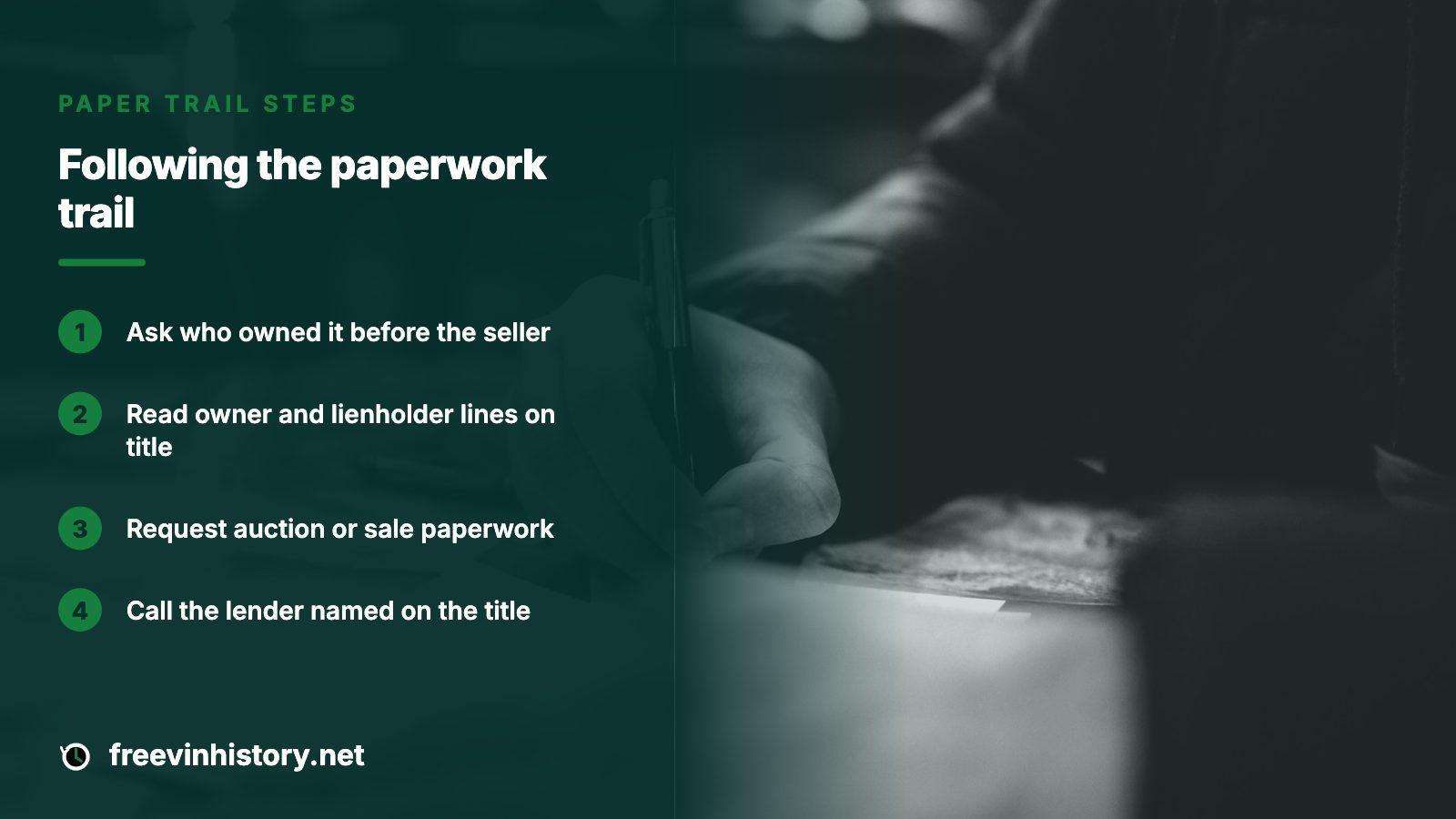
- Ask the seller who owned the car before them and how they obtained it.
- Ask to see the title, not a photo of the registration, and read the owner and lienholder lines.
- Request the bill of sale or auction paperwork if the car came from a lender sale.
- Order the state title record or the lien details through the motor vehicle agency.
- Call the lender named on the title and ask whether any balance remains.
The real risks when you buy one
Condition comes first. A borrower who could not make payments may also have skipped upkeep, and a car that sat in a lender lot may have been neglected. None of that appears in the note, so a pre-purchase inspection does what the record cannot.
The second risk is paperwork. A badly handled sale, or another party's claim, can surface when you try to register the car. A private seller's records and honesty are all you have to rely on.
Personal items and fees
The FTC says a lender cannot keep or sell belongings found inside a repossessed car until a state-set period has passed. If you buy a car that still holds someone's property, stop and report it to the seller before you drive away.
If you are the borrower or a seller
Repossession does not erase the debt. The FTC calls the shortfall between the balance owed and the sale price the deficiency. Its example is $15,000 owed on a car that sells for $8,000, leaving $7,000 plus fees, which most states let a lender chase in court if it followed the rules. Late payments or the repossession can also reach the credit report. A seller whose car was taken back and later recovered should keep every document, since the next buyer will ask.
Anyone who thinks a lender broke the rules can contact the state attorney general or a local consumer protection office.
Where the VIN preview fits
Run the VIN before you visit the seller. The free preview here shows whether records of certain kinds exist for the car, so you learn early whether a title problem, a lien or an auction history is waiting behind the listing. If a repossession or a related note turns up, you walk into the conversation with something specific to ask.
The preview costs nothing. If you want the full report afterward, you pay once with no subscription attached, and current rates sit on the pricing page. The report points you to the right question. The lender, the seller and the state title record answer it.
Where this information comes from
- FTC: Vehicle Repossession — How default, recovery, resale, buy-back, deficiency and personal property work for borrowers.
- NMVTIS: information for consumers — What the federal title database reports, its limits, and the link to full state title records.
- California DMV: lien sales for vehicles — One state's proof documents for removing a lien, and how it separates repair liens from repossession.
Sources and photos: Facts checked against the sources above in November 2026. Photos by Karwin Luo, Owen Michael Grech and Bence Balla-Schottner on Unsplash; diagrams by FreeVINHistory.
Keep reading
- Lien reported on a vehicle history report: what it meansWhat a lien entry means and who to ask about the balance.
- Title issue reported on a car's history: what it can meanThe title warnings that can sit beside a repossession note.
- Certificate of title meaning: what the document proves and what it hidesHow to read the owner and lienholder lines on the title.
- Car lien search free: what the free tools show and what they missWhich no-cost lookups can reach a lender's claim.
Frequently asked questions
Does a repossession on a vehicle history mean the car is unsafe?
No. The entry marks a lender taking the car back after missed payments, and it carries no information on crashes, repairs or wear. A repossessed car can be in good shape or neglected. Inspect the car, read the title, and judge the vehicle on what you find.
Can I buy a repossessed car and still owe the old loan?
A lender's sale is designed to settle the debt, but the paperwork decides what is still attached. Ask for the sale documents, read the lienholder line on the title, and call the lender named there. Do not hand over money until you know whether any lien remains open.
Will a free VIN check show a repossession?
Not reliably. The federal title database is built on five indicators and repossession is not named among them, and it can return false negatives while reporting is incomplete. Free tools help with theft and brands. For a lender's claim, look at the state title record and the title itself.
How long does a repossession stay on a vehicle record?
I could not find an official page that sets a time limit for vehicle history entries, so I will not state one. Credit reports follow their own rules and are a different record. Ask the report provider how long its sources keep an entry, and ask your state agency about title records.
Is a voluntary repossession different from a regular one?
For the car's record, the result is similar because the lender still ends up with the vehicle. The FTC says a voluntary return may mean lower fees, yet the borrower still owes any deficiency and the late payments or repossession can still show on a credit report.
Now check the car itself
The guide explains what to look for. The report shows what this VIN has on record.