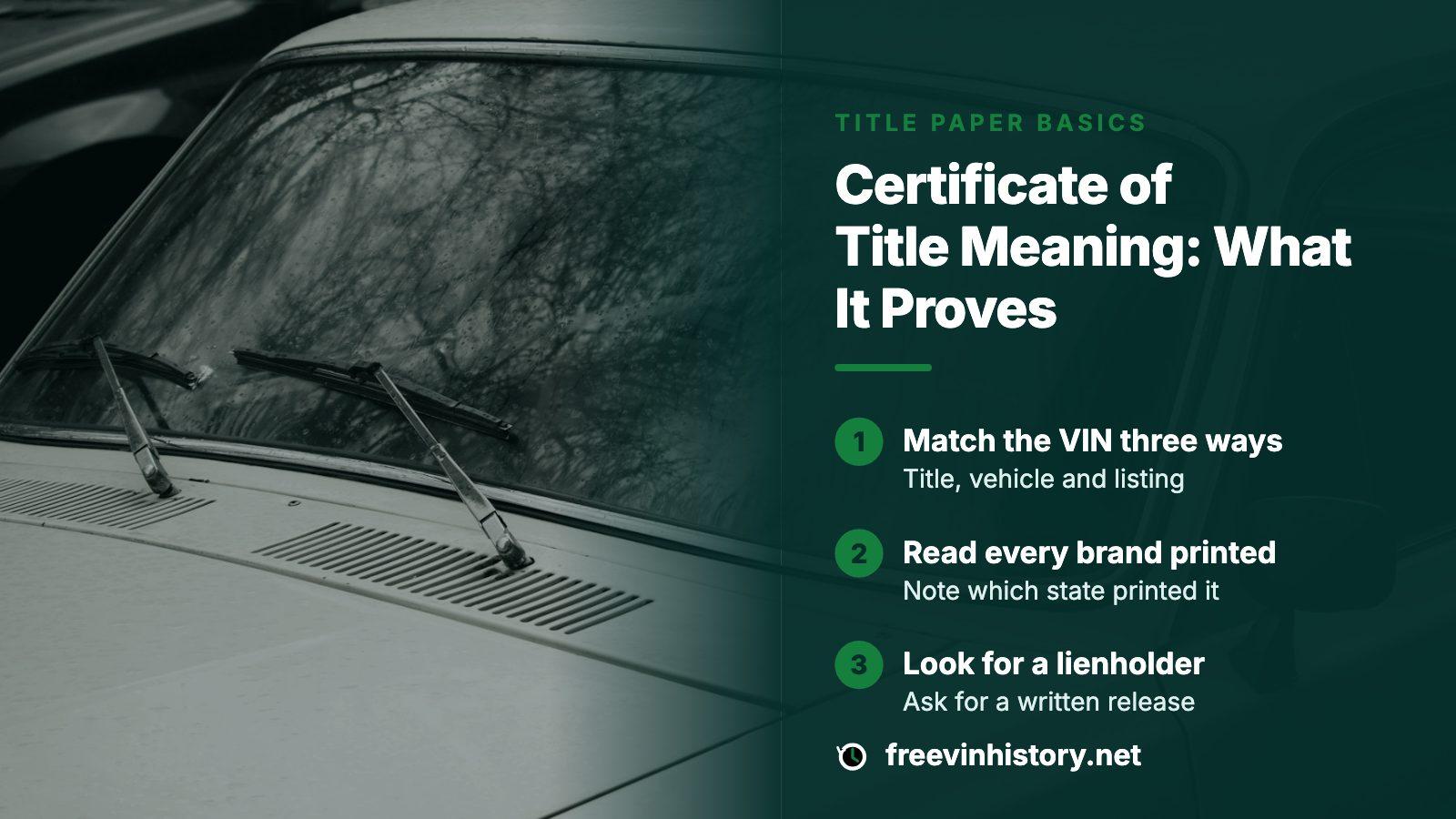
THE SHORT ANSWER
A certificate of title is the state's official ownership record for one vehicle, tied to its VIN. It may also carry the odometer figure, a lender's name and history brands. It proves who the state believes owns the car. It says nothing certain about damage, and a paper copy can omit brands that other states applied.
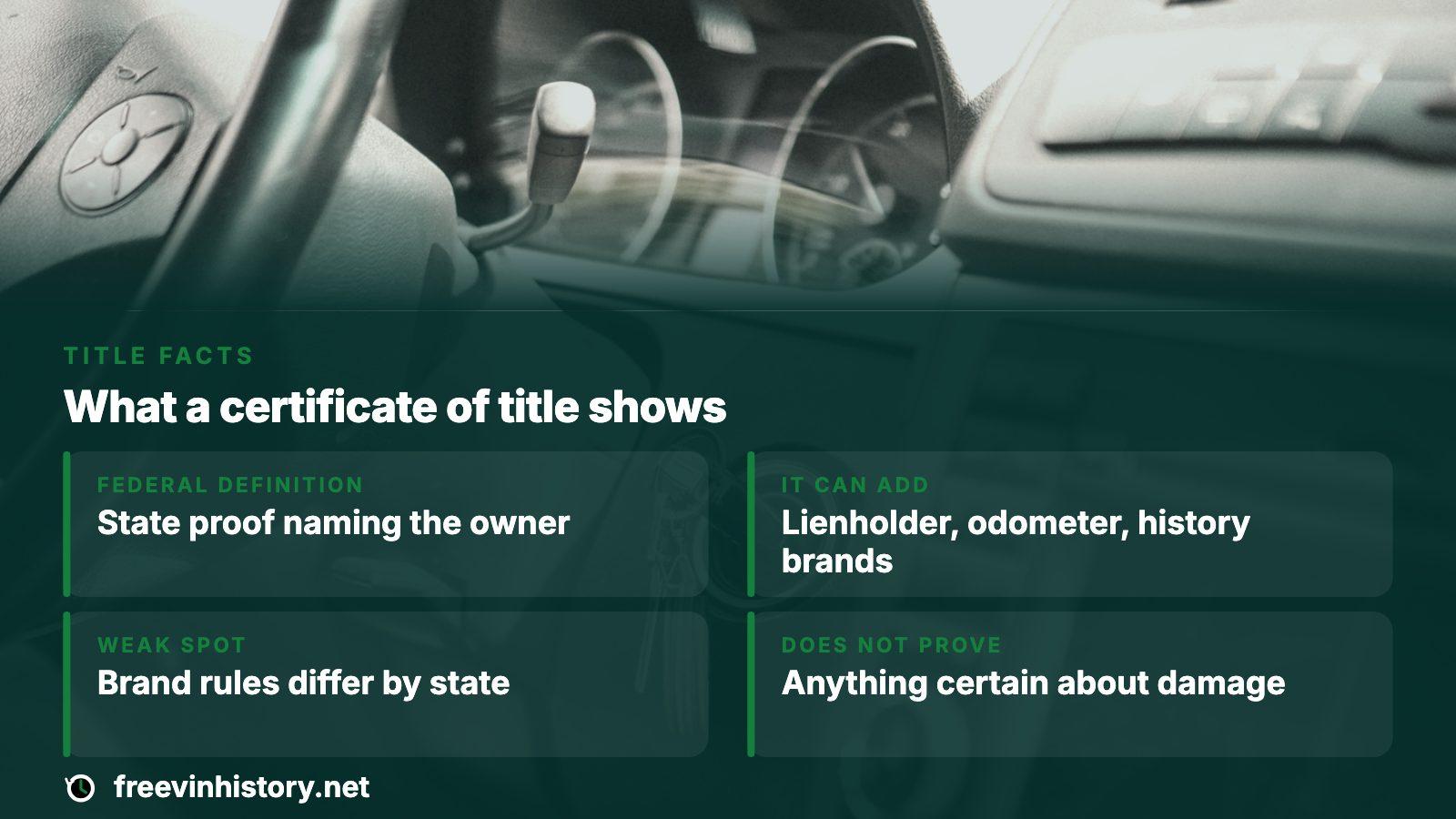
- Federal definition
- State-issued proof that names the owner of a vehicle
- What it adds
- Lienholder, odometer figure and history brands, depending on the state
- Weak spot
- Wording and brand rules differ by state, so a paper title can be incomplete
- Free step
- Read the paper, then run the VIN through official pages before paying
The plain meaning: ownership on paper
Federal rules for the national title database keep the definition short: the state issues it, and it shows ownership of an automobile. Brands, mileage and the lender's name are extras layered over that one job.
The title belongs to the vehicle, not a person. It travels with the VIN from owner to owner, and each sale should end with the state producing a new one in the buyer's name. A seller without it has no sale to offer yet, only a promise.
So a free look at any car starts here. The paper shows what the seller's state recorded at the last transfer, and official databases show whether that account holds together.
What a title can show
California's DMV lists what its certificate may contain. Most states follow a similar pattern with their own layout, so treat this as a checklist when the paper is in your hands.
| Entry on the title | What it tells you | What to ask |
|---|---|---|
| Owner name and address | Who the state recorded as the legal owner | Does the seller's ID match the name? |
| VIN, make, model, year | Which exact vehicle the paper covers | Does the VIN match the car and the listing? |
| Odometer figure | The mileage declared at the last issue | Is it close to the dash reading? |
| Lienholder | A lender with a claim, if money is owed | Has the lender released it in writing? |
| Brands | Conditions or events in the car's past | Which state applied it, and when? |
| Value | A figure the state may record | Is it used for anything in this sale? |
Brands: the part that changes the price
A brand is a tag a state pins on a vehicle to describe how it is, or once was. Salvage and junk are the famous ones. Texas also lists rebuilt, water damage, manufacturer buyback, gray market, and a note that a replacement VIN was assigned. California's newest titles show the brand inside a red box headed vehicle history, upper right.
A revived salvage car has been fixed up and registered again. Plenty were fixed properly. California's DMV cautions that others were never repaired or tested well, and some were rebuilt from stolen parts. Texas calls a car clear when nothing was reported on the day the check ran, which is a snapshot rather than a promise.
Same car, different wording
California's DMV notes that most states print history brands on the title but choose their own words. A term you know from home may carry a different meaning on a title issued elsewhere.
Liens and transfers: who else is on the paper
If a lender financed the car, its name stays on the title as lienholder until the debt is cleared and the claim released. Buy with the lien still open and the lender may be able to pursue the car you now own, so the written release matters as much as the seller's signature.
In California the title changes hands with every sale or change of owner or lender, and a seller there has five days to tell the DMV, which releases them from liability. In Texas the buyer owes the county a new title application within 30 days or pays penalties. Different states, same lesson: a signature on an old title is only step one.
What free official pages add to the paper
Data reaches the national system from states, insurers and salvage yards. Through an approved provider you can see current title entries, brand history, the latest reported odometer figures, any insurer total-loss ruling, and whether the car was sent to a junk or salvage operation. Texas says such providers charge a few dollars.
- The paper title: ownership, lienholder, declared mileage, brands the issuing state chose to print.
- The state's own title record: the full file, which the national report links to.
- The national system: brand history across states, salvage and total-loss entries.
- A mechanic's inspection: the only step that looks at the actual metal.
No one source tells the whole story. Together they catch most of what a listing leaves out.
Why a clean title can still mislead
Federal consumer pages are direct about the gap. A brand can vanish from a paper title when a new state issues the next title without querying the states that came before. After Hurricane Katrina, authorities described flooded cars being driven to states with no flood brand and sold to buyers who had no idea.
States also set different cutoffs. One may brand a damaged car salvage while another skips it because the estimate fell short of its threshold. Only some states use a flood brand, and a few exempt older vehicles from titling entirely.
A clean report is not proof
The Justice Department's consumer page calls a clean national report good news, yet warns that some sources do not report yet, so a false all-clear is possible. Add the state's own record and an inspection.
Total loss and salvage are not always the same story
Federal rules define salvage by arithmetic: salvage value plus legal repair cost beating the car's worth just before the damage. Total losses under state law or an insurer's policy terms are counted too.
That reaches further than the word implies. The national consumer page says an insurer may call an unrecovered stolen car a total loss after 30 days, and the label persists even if the car resurfaces unharmed. A total-loss entry is a reason to ask the seller questions, nothing more final than that.
Where a full report fits after the free steps
Free pages teach the vocabulary and the rules. They will not hand you one car's history in a single view. Once the paper and the free checks look sane, a full report gathers brand dates, odometer entries and salvage or auction records for that VIN, so any gap against the seller's story stands out.
Begin with the free preview to see whether a record exists for the VIN. The paid report is a one-time purchase rather than a plan, and what it costs is shown on the pricing page. Buy it only if the free steps leave you still wanting the car.
A short routine before money changes hands
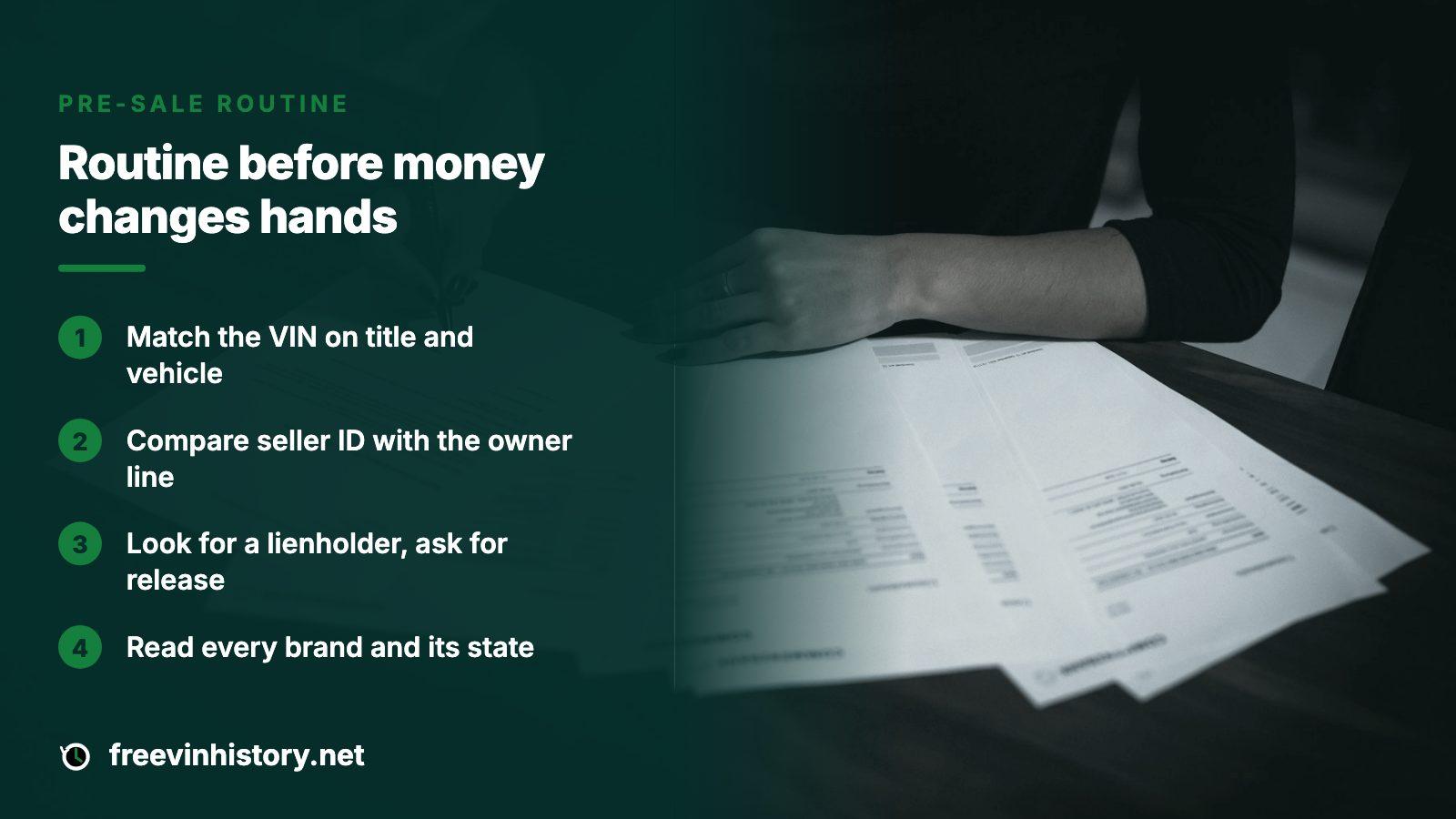
- Set the VIN on the title beside the number printed on the vehicle, and beside the listing.
- Compare the seller's name and ID with the owner line on the paper.
- Look for a lienholder and ask for a written release if one appears.
- Read every brand and note which state printed it.
- Run the VIN through the free official pages, then the preview.
- Book a mechanic's inspection before you put down any deposit.
- In a private sale, do not drive away without the signed title.
Texas advice for private sales is blunt: leave with the title in hand, signed and printed by the seller, with the date and odometer reading filled in on the back.
Where this information comes from
- 28 CFR 25.52: Definitions — Source for the federal definition of a title and of salvage.
- California DMV: Vehicle titles — What a title can show, and the transfer and notice rules.
- California DMV: Branded titles — Brand wording, where it prints, and revived salvage cautions.
- TxDMV: Title check, look before you buy — Texas brand list and private-sale paperwork advice.
- NMVTIS: Consumer information — What the national system holds and where its gaps are.
Sources and photos: Facts checked against the sources above in November 2026. Photos by Tigran Shishmanyan, Dimitri Karastelev and tim on Unsplash; diagrams by FreeVINHistory.
Keep reading
- Title issue reported on a car's history: what it can meanAnother title entry that calls for questions before you buy.
- Car title search by VIN free: what you can see before you payWhich no-cost title lookups exist and what they leave out.
- Title transfer on a vehicle history report: what the entry meansWhat a transfer entry says about the car's owners over time.
- Free salvage title check by VIN: what the free lookups showHow to look for a salvage brand before paying for a report.
Frequently asked questions
Is a certificate of title the same as a car title?
Yes. Car title, vehicle title and certificate of title are different names for one state-issued record. Some states hold it electronically instead of on paper, so ask how it is held and whether a lender is listed before you agree on a price.
Is a certificate of title the same as registration?
No. The title shows ownership and history, while registration is the state's permission to use the car on public roads. A current registration card can sit in a glovebox for a car whose title carries a serious brand, so ask to see the title itself.
Who holds the certificate of title when there is a car loan?
Practice varies by state. Some states list the lender on the title and either the lender or the state keeps it until the loan is paid. Either way the lien should be released in writing before you buy, and the release should match the VIN.
Can I check a title before I buy the car?
You can read the paper and run the VIN through official pages. Texas steers buyers to approved national-system providers that charge a few dollars. Add the state's record and an inspection, since no single source is complete.
The seller says the title is lost. Now what?
Treat it as a stop sign. The legal owner can usually apply to the state for a replacement, so the sale can wait until the seller has it. Paying first and sorting the paperwork later leaves you holding a car you cannot register.
Now check the car itself
The guide explains what to look for. The report shows what this VIN has on record.