THE SHORT ANSWER
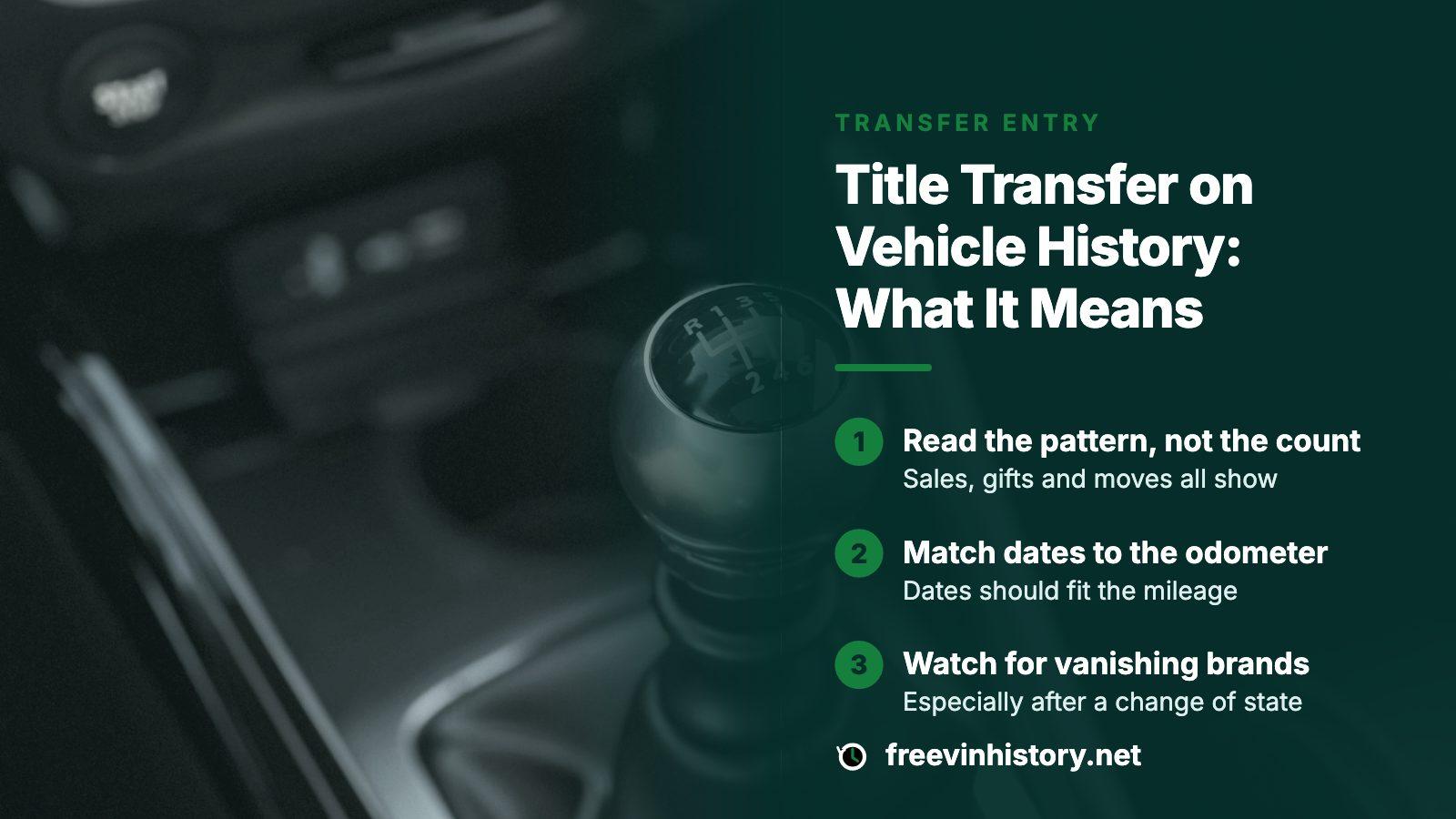
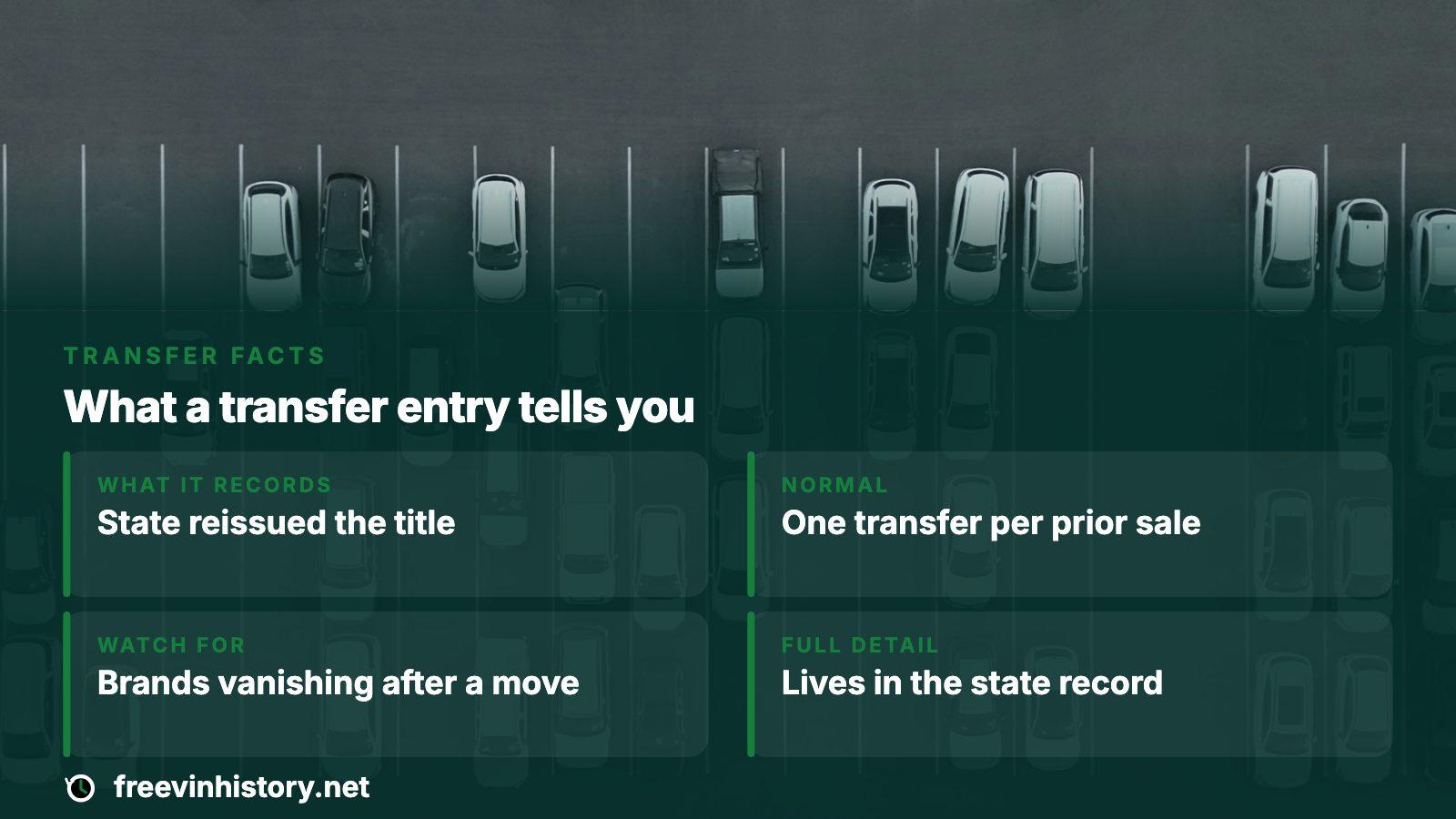
A title transfer entry means a state titling office reissued the title in a new owner's name, usually after a sale, gift, inheritance or move from another state. The entry alone is not a defect. Count the transfers, check the dates against the odometer, and look for any brand that appears or vanishes when the car crosses a state line.
- What it records
- A state reissued the title to a new owner
- Normal for a used car
- At least one transfer per prior sale
- Watch for
- Brands that disappear after a change of state
- Full detail
- Lives in the state's own title record
What a transfer entry actually records
Think of the entry as a receipt from the state, not a verdict on the car. California's DMV says the certificate of title must follow any sale, and any change of registered owner or lienholder.
So the line on your report says that a state processed paperwork on a certain date. It does not say who the buyer was, what they paid, or whether the car was fine when they got it. Those answers sit elsewhere, if they exist at all.
A lender changing is also a transfer event. Pay off a loan, and the title can be reissued without the car ever changing hands. A single odd-looking entry may be nothing more than that.
Why a title gets transferred
California's DMV lists several kinds of transfer, each with its own checklist, and the list shows how many different stories hide behind the same word on a report.
- A standard sale between two parties, the most common reason.
- A gift or an inheritance, where no sale price changes hands.
- An out-of-state transfer, when the car arrives from somewhere else and is titled for the first time locally.
- A change of lienholder, as when a loan is paid off or refinanced.
On a report these can look alike. A car that passed through a family and a car that was flipped by a stranger can both show two transfers in a year, which is why dates and states matter more than the count.
Reading the pattern instead of the count
Ask three questions of every transfer list. Are the gaps between dates plausible for the mileage? Does the state change? Did any event, such as a total-loss call or a stay at a salvage yard, come just before a transfer?
| Pattern on the report | Usual reading | What to do |
|---|---|---|
| One transfer every few years, same state | Ordinary private ownership | Move on to the other checks |
| Several transfers within a short span | Possible flipping or auction churn | Ask the seller why, and check the odometer trail |
| Transfer right after a salvage or total-loss entry | Car was sold on after a claim | Look for a brand and an inspection record |
| Transfer into a new state, then no history before it | Earlier records may sit with the first state | Request the first state's title record |
None of these rows is proof of a problem. Each one tells you where to push harder before you hand over money.
Where state lines change the story
The federal title database exists because brands can be lost in transit. A brand is a condition label such as salvage or flood, assigned by the state. When a car is registered in a second state whose office never queries the first, the fresh paper title can omit the label.
The Justice Department page cites Experian Automotive on this: in the first half of 2008, more than 185,000 titles were branded in one state, moved to a second, and came out looking clean. That figure is old, and the checking process has changed since, but it explains why an out-of-state transfer gets a second look.
Brands are not uniform
Rules differ by state. Identical damage may earn a salvage label in one place and none in another, depending on a cost threshold. Flood brands exist only in some states. A missing brand is a reason to ask, not proof the car was never damaged.
Matching the report to the paper in your hands
In a private sale the title itself is your best cross-check. Texas warns buyers not to drive off from a private sale empty-handed, and wants the seller's printed name, signature, sale date and odometer figure on the back.
Compare those handwritten details with the last transfer on the report. A sale date that disagrees by months, or a mileage figure below an earlier reported reading, is worth a direct question.
Texas allows 30 days after purchase to apply for a new title before penalties begin, so a transfer that shows up long after the claimed sale date can simply mean the previous buyer was slow. Other states set their own deadlines, so confirm with the state in question.
What the free official pages cover, and where they stop
State titling agencies publish rules and forms at no charge, and some route you to a title check. Texas, for one, sends buyers to approved providers of the federal database, which reveals salvage-yard custody and insurer total-loss calls. Those providers set their own fees.
The federal system is built to be short, with five indicators per report. Not every source reports yet, so a clean result may still miss something. Each report also points onward to the state's own file on the car, and that file carries extra detail the national one leaves out.
The preview on this site shows how many entries a VIN has on file, a quick hint at whether this car has a history long enough to study.
When the full report earns its fee
If the preview shows a pile of entries, or the car crossed states, the full report lays the events out in order with dates, so you can set each transfer beside the odometer readings and any title brand. The pricing page has the cost, paid once per report with no subscription behind it.
- Run the VIN through the preview and note how many entries come back.
- Ask the seller to show the physical title and compare its VIN with the car.
- Buy the full report if the car changed states or the dates look tight.
- Request the state's own title record when a brand is missing but the history suggests damage.
A mechanic's inspection still belongs on the list. No paper record replaces someone looking at the frame.

Where this information comes from
- U.S. Department of Justice: NMVTIS for consumers — Brand washing across states, the five-indicator limit and the false-negative warning.
- NMVTIS: approved data providers — Where consumers can buy federal title data, and which firms serve dealers only.
- California DMV: title transfers and changes — The kinds of transfer a state processes and the paperwork behind each.
- California DMV: vehicle titles — When a title has to move to a new owner or lienholder.
- TxDMV: title check, look before you buy — Private-sale paperwork, the application deadline and the title check.
Sources and photos: Facts checked against the sources above in November 2026. Photos by Nils Keesmekers, Michal Biernat and Iain on Unsplash; diagrams by FreeVINHistory.
Keep reading
- Certificate of title meaning: what the document proves and what it hidesWhat the title document proves before any transfer is added.
- Out of state title history: what a title from another state can hideHow a move between states changes what a report can show.
- Gaps in vehicle history: what a thin record really tells youWhat missing stretches in a timeline mean.
- NMVTIS report: what the federal title record shows and missesThe federal title record behind most transfer entries.
Frequently asked questions
Is a title transfer on a vehicle history report bad?
No. Every used car has at least one, since a sale means a new title. Concern starts with a cluster of transfers in a short span, a jump to another state, or a transfer that follows a salvage or total-loss entry. Read the dates and compare them with the mileage.
Does a title transfer mean the car had an accident?
Not by itself. Transfers record a change of ownership or lender, and the cause can be a sale, a gift or a loan payoff. An accident or damage shows as its own entry. If one appears just before a transfer, ask the seller what happened.
How many title transfers is too many?
No official number exists. Judge by time and distance: a few owners over many years is ordinary, while several transfers within months deserves questions. Ask why, and check whether the odometer readings climb in a believable way between each date.
Can a title transfer hide a salvage brand?
It can, if a car is retitled in a state that does not check earlier titling states. The federal system keeps reported brands on the VIN to counter this. If the brand is missing but the history suggests damage, ask for the first state's title record.
Where do I see the full title record behind a transfer?
Federal title reports link to the state's own record, which keeps details the national database leaves out. Your state titling office can also explain how to request it. Run the preview here first to see how many entries a VIN has on file.
Now check the car itself
The guide explains what to look for. The report shows what this VIN has on record.