THE SHORT ANSWER
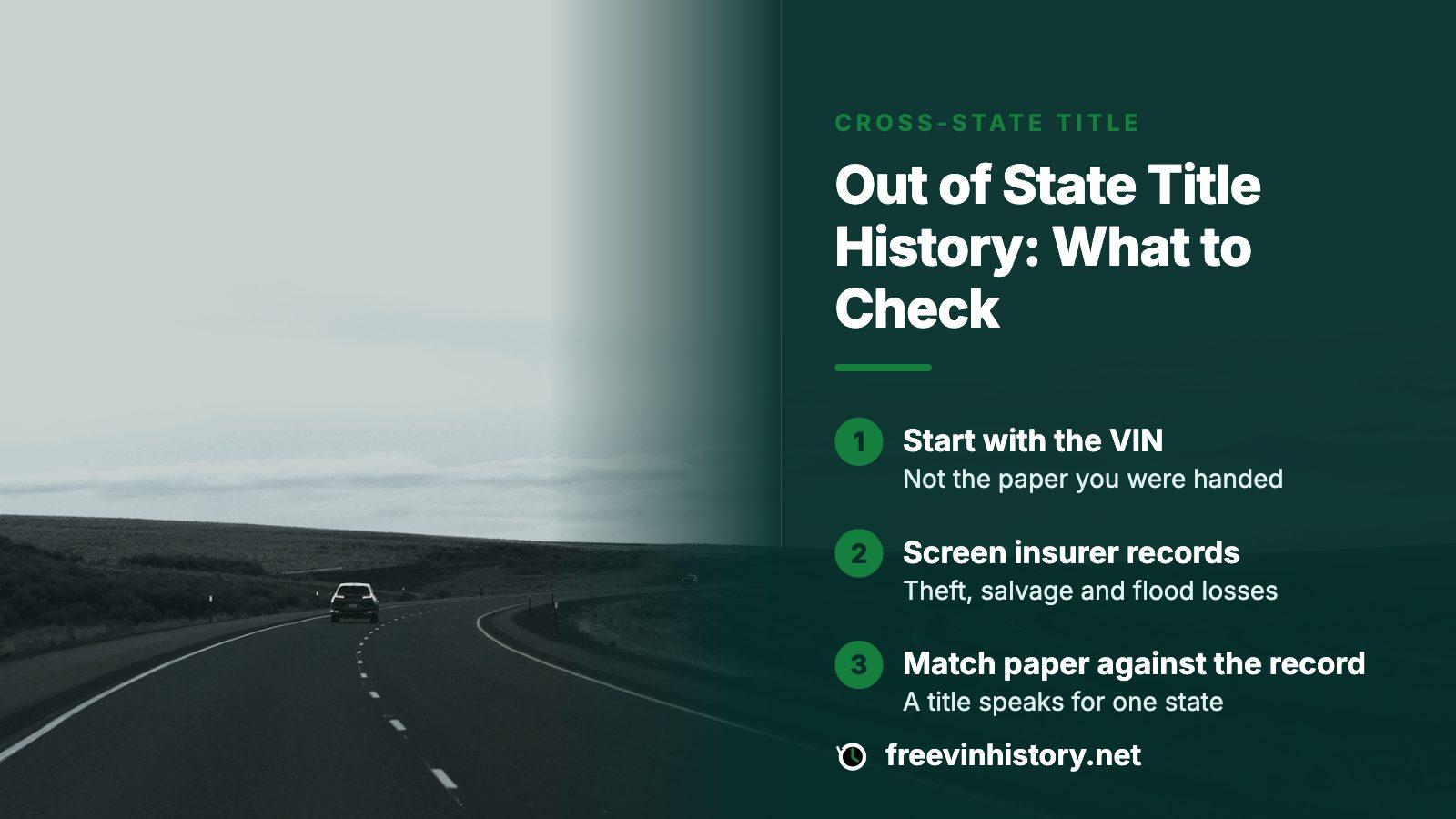
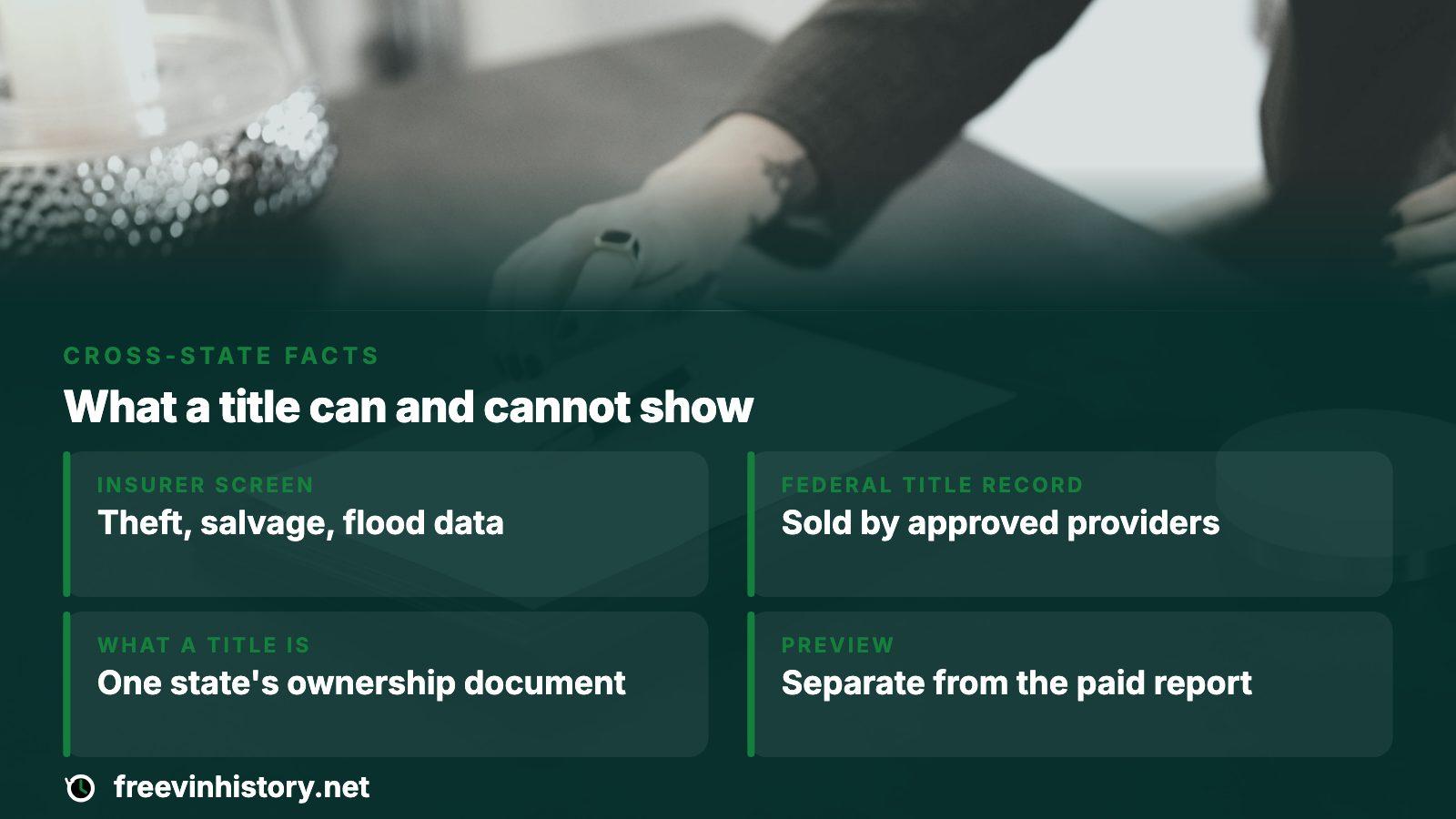
Start with the VIN, not the paper. NICB's free VINCheck screens insurer records for theft, salvage and flood losses. NMVTIS, the federal title database, reports five things, and approved providers sell access to it. The title you are handed shows only what its own state recorded, so compare it against those records before any money moves.
- Free first screen
- NICB VINCheck: insurer theft, salvage, flood data
- Federal title record
- NMVTIS, sold by approved providers, up to $4 per report
- What a title is
- A state document showing who owns the car
- Paid step
- Preview is free; report is a separate payment
A title speaks for one state only
Under the federal definitions, a certificate of title is a paper a state hands out to record ownership of a vehicle, and that is the whole of its job. It names an owner, a VIN and a mileage on the day of issue. It is not a diary of where the car has been, and it says nothing about what a different state, an insurer or a salvage buyer wrote down along the way.
That gap is why a car from out of state deserves one extra step. When the seller lives down the road, you can ask neighbors, visit the shop that did the brakes and look at the local tax office. When the seller is three states away, the paper in your hand is often the only local evidence, and a single document is a thin basis for a large payment.
The questions the federal title system can answer
NMVTIS belongs to the Department of Justice, which built it to stop stolen and dangerous cars from slipping back into sale. Its rule lists what a user must be able to establish quickly. Four items matter most for a car that crossed a border.
- Which state a given VIN is titled in, and whether a car titled in that state was ever a salvage or junk vehicle.
- Whether the VIN was ever reported as salvage or junk to the federal system, independent of the state named on the paper.
- The validity and current standing of a document that presents itself as a title.
- The odometer figure written down at issue, then whatever later readings a state happened to keep.
Notice what is absent: nothing in that list is an owner's name or address. The rule bars the operator from giving individual buyers that kind of personal data.
Where the entries come from
Inputs come from state title offices, insurance carriers and the yards and recyclers that handle wrecks. Every one of those but the state offices must file reports under federal law, and the program says no other public system has that backing. So a total-loss call made by an insurer in one state can reach a buyer in another, even if the car was never retitled in between.
The definitions are worth reading once. The federal test for salvage is arithmetic: if the scrap value of a damaged car plus the repair bill needed to make it road legal comes out higher than its value before the event, it qualifies. A total loss declared by a jurisdiction or an insurer qualifies as well, even when the insurer never takes the car.
The free rungs, and where they stop
Use the no-cost tools first, in this order, and write down each result with the date.
- NICB VINCheck: enter the full 17-digit VIN. Results show whether a member insurer flagged the VIN for an open theft, a salvage declaration or flood damage. The site caps each IP address at five searches a day.
- The state title or registration page, where the seller's state offers one. Coverage varies, so confirm with that state's motor vehicle agency what it shows.
- The FreeVINHistory preview, which tells you what a full report holds for the VIN before you decide to buy one.
What a clean NICB result means
NICB says VINCheck covers only participating insurers' records, does not query law enforcement, and is not a full history report. A clean answer lowers the odds of a problem. It does not remove them.
Matching the paper against the record
Once you have a federal-style report in hand, put it beside the title and look for disagreement. The table lists the common mismatches and what to ask about each.
| Finding | Possible reading | Follow-up |
|---|---|---|
| Report shows a brand, title says nothing | The title in hand may not carry every entry on file | Which state issued the title, and was the car ever retitled? |
| Report lists salvage or total loss, seller says never wrecked | An insurer or yard reported a loss the seller has not mentioned | Request repair invoices and dated photos |
| Title state differs from where the seller lives | The car relocated, or this seller bought it used | Ask for the full chain of owners |
| Report has no entries at all | The program calls a clean result a good thing | Still inspect the car; the report is deliberately short |
The mileage printed on the title
The mileage on a title is a reading taken at one moment, the day the document was issued. Later readings depend on whether the state chose to note them, so a thin mileage trail can say more about the state's habits than about the car.
A practical check: compare the title's reading with the figure on the dashboard and on any service paperwork. A dashboard that shows far fewer miles than an older title is a reason to stop and ask, not a detail to wave through.
A sequence for a car you cannot visit
Distance removes the easy checks, so do the cheap ones early and keep the expensive one for a car you still want.
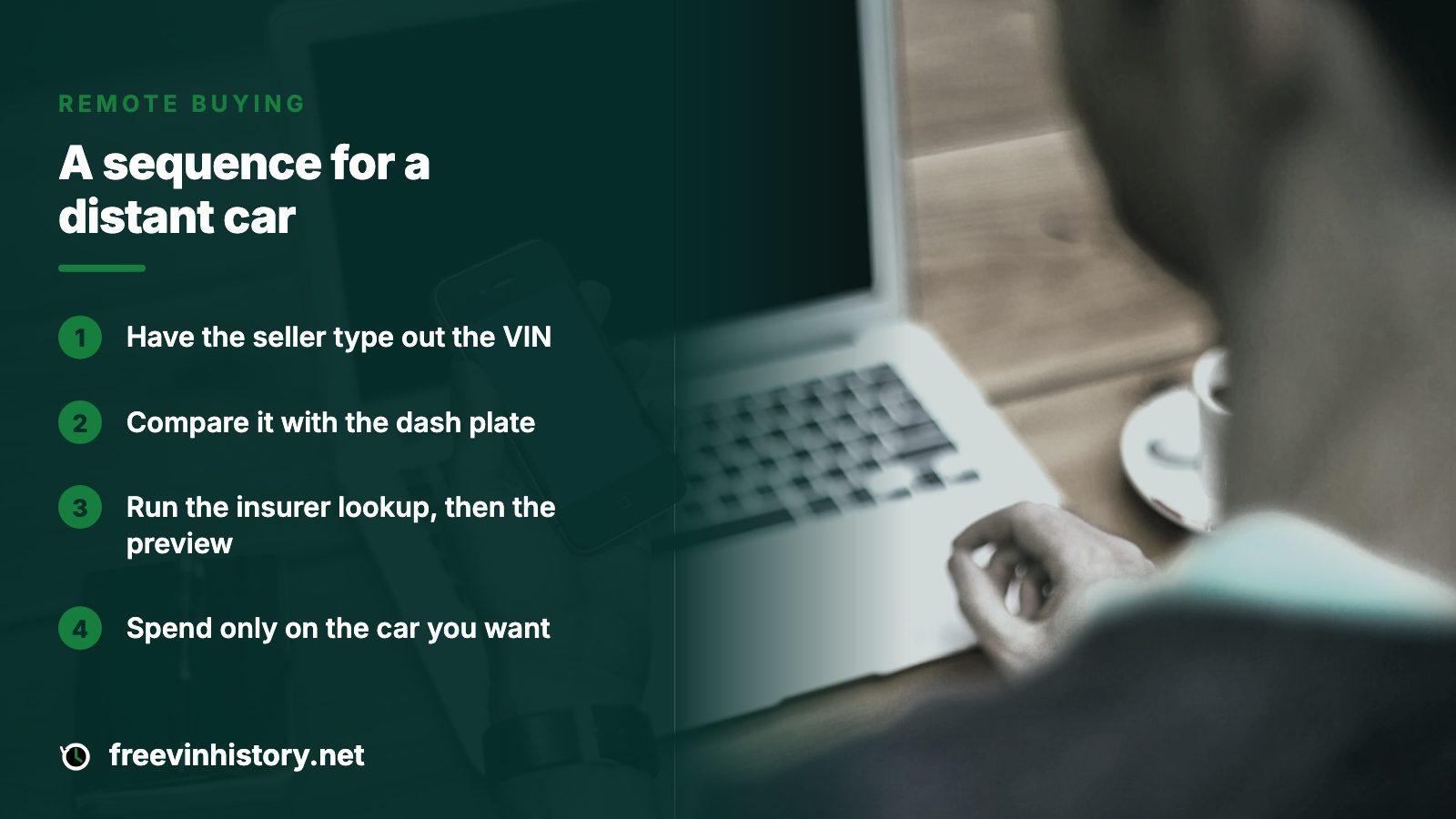
- Ask the seller to type out the VIN, then compare it with the metal plate on the dashboard and the sticker on the driver's door frame.
- Run VINCheck, then the preview, before spending anything.
- Ask for sharp pictures of the title, front and back, and confirm the name printed on it is the person you are dealing with.
- Hire a mechanic near the seller for an independent inspection, which the federal buying tips list as the first step.
- Buy the full report only when the earlier steps leave the car in the running.
Federal buying tips also suggest asking for maintenance records and talking to the previous owner if the current one is unfamiliar with the car.
Where the full report earns its fee
The federal title record is intentionally concise. It leaves out items the program says private providers offer, such as repair history and recall details. A FreeVINHistory report puts the title brands next to accident, damage and odometer records, so you can see whether the story on the paper matches the story in the data.
Only the preview carries no charge, and it never asks for a card. The report is bought once per vehicle, with bundles described on the pricing page. No report stands in for a mechanic's inspection.
After you agree on the car
Titling rules belong to your own state, so ask its motor vehicle agency which documents it wants for a car from elsewhere. As one example, Texas expects the buyer to have the car titled within 30 days of the sale date, with the seller supplying a signed title that shows the sale date and mileage. Other states set their own deadlines, so find out yours before a deposit leaves your account.
Where this information comes from
- NMVTIS: Understanding a vehicle history report — the five indicators and who must report
- NMVTIS: Used car buying tips — inspection advice and the up-to-$4 report cost
- eCFR 28 CFR 25.53: operator responsibilities — what the system must let users establish
- eCFR 28 CFR 25.52: definitions — certificate of title, salvage and junk definitions
- NICB: VINCheck — free theft, salvage and flood screen and its limits
- TxDMV: Buying or selling a vehicle — one state's titling window and seller paperwork
Sources and photos: Facts checked against the sources above in November 2026. Photos by John Kakuk, Alejandro Escamilla and Annika Wischnewsky on Unsplash; diagrams by FreeVINHistory.
Keep reading
- NMVTIS report: what the federal title record shows and missesWhat the federal title record lists and how it is sold.
- Car title search by VIN free: what you can see before you payWhich title questions the no-cost tools can answer.
- Certificate of title meaning: what the document proves and what it hidesWhat the title document itself does and does not prove.
- Free odometer check by VIN: what you can verify before you payWays to test a mileage claim against records.
Frequently asked questions
Can I see a car's title history from another state for free?
Only in pieces. NICB's VINCheck is free and screens insurer theft, salvage and flood records. The federal title database is sold through approved providers, and the government's own tips put the cost at up to $4 a report. A state agency may offer its own lookup for cars it titled.
Does a clean title from another state mean the car was never branded?
No. A title reflects what its issuing state recorded. Salvage and total-loss reports also come from insurers, yards and recyclers, so a VIN check can show entries the paper does not. Compare the title with a report before paying.
What is NMVTIS and does it show owners?
NMVTIS is the Department of Justice's national title database. Its consumer report is limited to five items: the last title's state and date, brands, mileage, total loss and salvage. Federal rules bar the operator from giving individual buyers an owner's name or address.
How do I check a car I cannot see in person?
Get the VIN in writing, run the free screens, ask for clear title photos and hire a local mechanic near the seller. If the car still looks right, order the full report. Send no a deposit until the inspection and the records agree.
Does FreeVINHistory charge for its report?
No. Only the preview comes at no charge, and no card is requested for it. The report itself is a one-off payment per vehicle, as the pricing page explains. Tools like NICB VINCheck are no-cost but cover just a slice of a report.
Now check the car itself
The guide explains what to look for. The report shows what this VIN has on record.