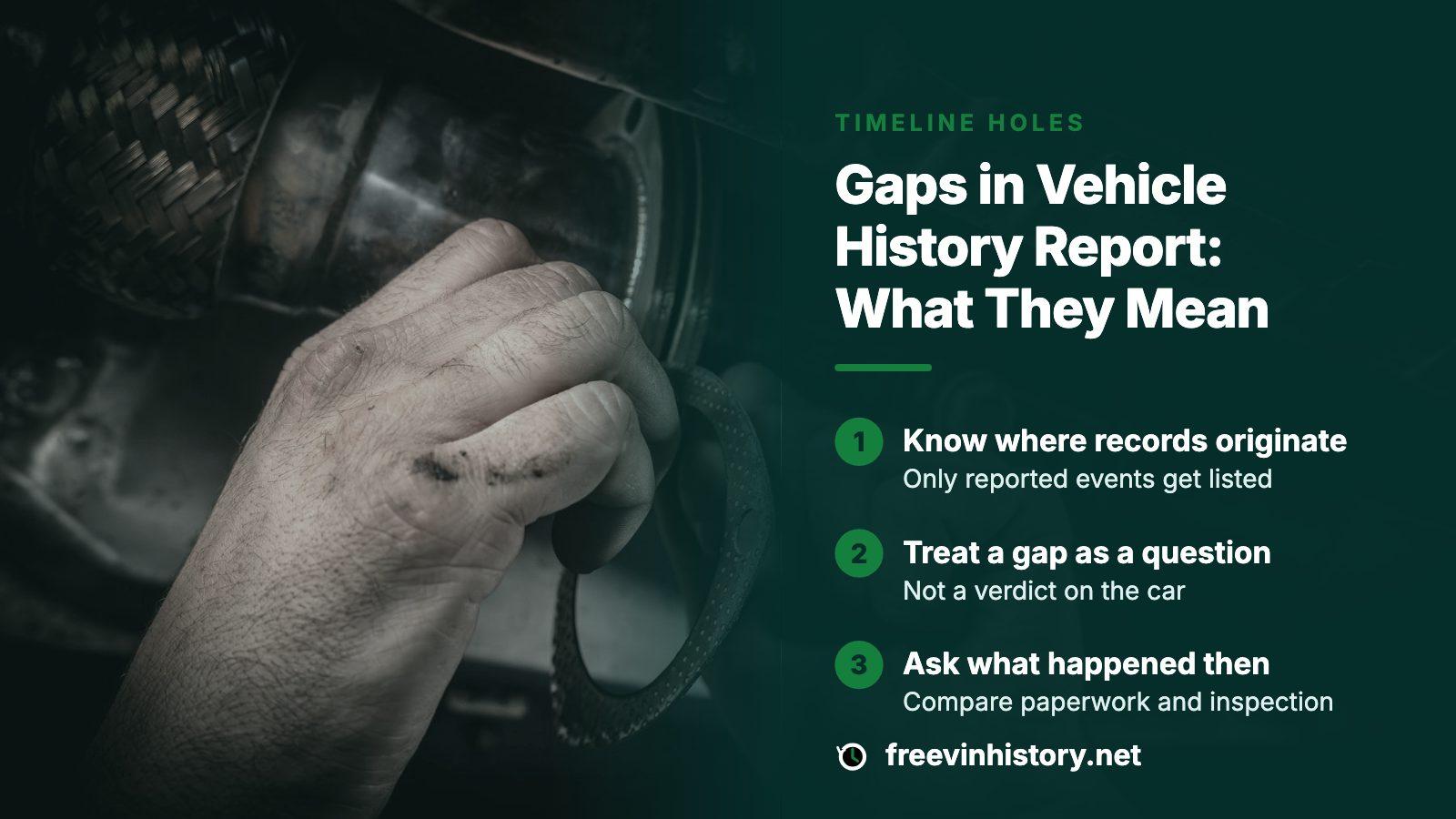
THE SHORT ANSWER
Gaps appear because history reports only list events that someone was required or chose to send in. A car with no accident entries may never have crashed, or the crash may have been fixed privately. Treat a gap as a question, not a verdict: ask the seller what happened in that period, compare the title and odometer records, and pay for a mechanic's inspection before you commit.
- Where records come from
- Title agencies, insurers, salvage yards and recyclers report to the federal title system
- What a short report means
- The federal report is meant to be brief, and silence on brands is the good outcome
- What never reaches it
- Private repairs, routine service and recall work are not its job
- Best test
- Compare the seller's paperwork against the VIN's records and an inspection
What counts as a gap, and what does not
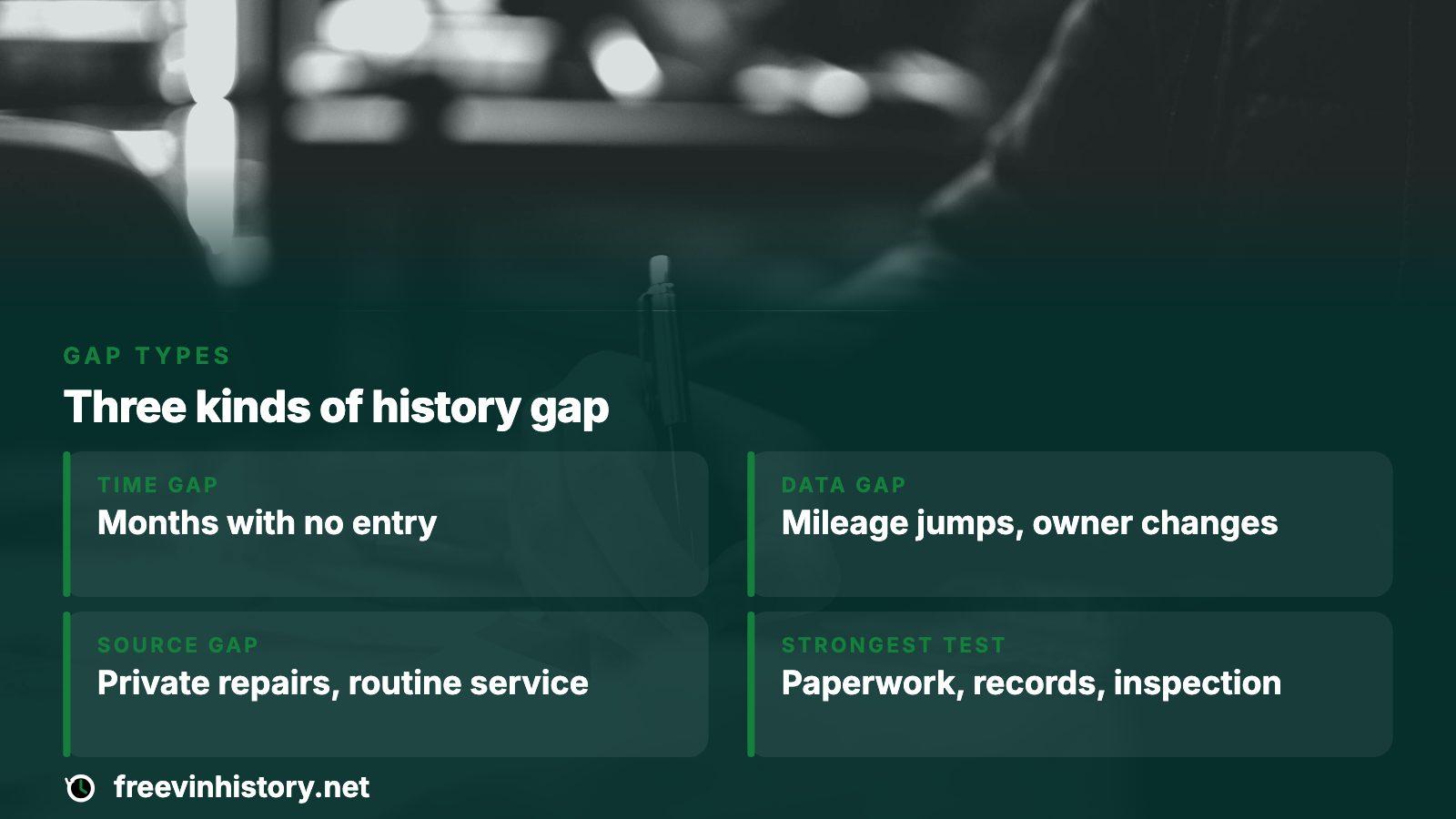
People use the word for three different things, and mixing them up leads to bad decisions. The first is a time gap: a year or two with no entries at all. The second is a data gap: an event that clearly happened, such as a sale, but has no matching record behind it. The third is a source gap: a whole category the report never covers, so its silence says nothing.
Only the first two are worth chasing. A source gap is simply the edge of what that report was built to hold. If you read a clean page and conclude the car was never touched, you have made the source-gap mistake without noticing.
- Time gap: months or years with no title, odometer or damage entry.
- Data gap: the mileage jumps, or an owner change appears with no title step.
- Source gap: private paid repairs, oil changes and cash sales that no agency sees.
Why records go missing
The federal title system draws on five kinds of reporter: state titling agencies, insurance carriers, junk yards, salvage yards and auto recyclers. Federal law requires all of them to send data, and the Department of Justice site says the reports are meant to stay short on purpose. That design is good for consumers, but it also means the system will not see anything outside those channels.
Even inside those channels there are carve-outs. A salvage business that handles fewer than 5 salvage vehicles a year does not have to report, and some recyclers cannot match a part to a VIN at all. Add a crash the owner paid for in cash, with no insurance claim, and you can see how a badly damaged car might leave nothing behind.
Silence has more than one cause
No entry can mean no event, an event nobody had to report, or a report that arrived under a different VIN or never arrived. The page cannot tell you which one you are looking at.
What the no-cost official sources can and cannot fill in
Start with what costs nothing. NICB runs a VIN lookup for theft and total loss flags, and the Department of Justice buying-tips page points shoppers to it for flood and similar information. NHTSA publishes recall campaigns by make, model and model year. Each of these answers one narrow question well.
| Source | Good at | Blind to |
|---|---|---|
| NICB lookup | Theft and insurer total loss flags | Owner changes, mileage, unreported repairs |
| NHTSA recalls | Open safety campaigns for the model year | Crashes, titles, service history |
| State title page | Current title status where offered | Often only the present state of the title |
| Seller's records | Maintenance and repairs, if kept | Whatever the seller chooses not to show |
None of them draws a timeline. That is the real gap: the free tools answer separate questions and leave you to join the answers. A full report exists to put title, damage, odometer and salvage entries in date order, and that ordering is what makes a hole visible in the first place.
How to read a timeline for holes
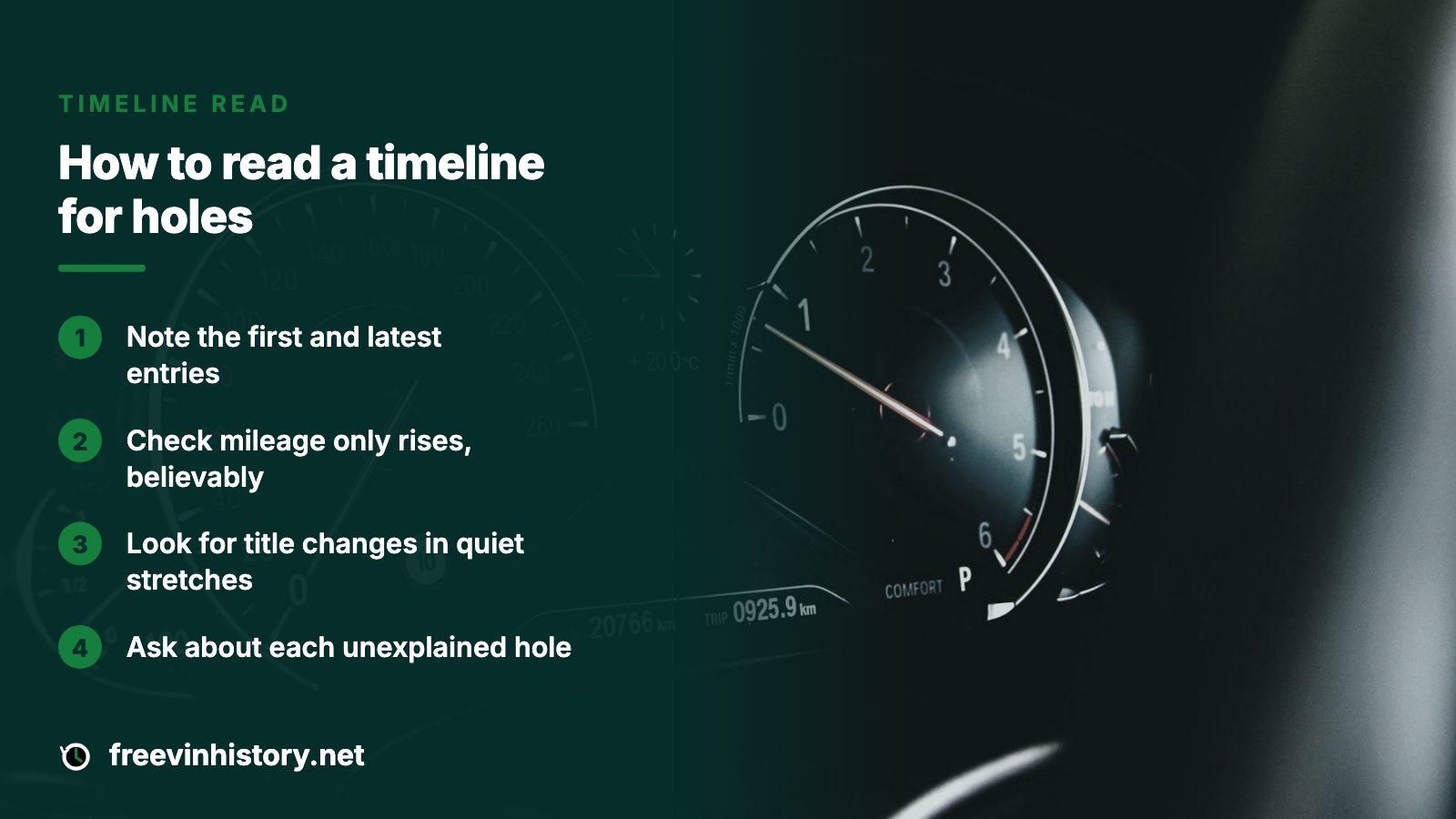
Lay the dated entries out in a row and look at the spacing. Ordinary cars leave a steady trickle: a title event when ownership changes, an odometer reading at each registration or sale, and occasionally something heavier. A long flat stretch is not suspicious by itself. A long flat stretch that sits between a damage event and a clean re-title is a different matter.
- Note the date and mileage of the first entry and the most recent one.
- Check that the mileage only rises, and that it rises at a believable rate across the quiet stretch.
- Look for a title event in a different state, since a move is the most common innocent reason for a pause.
- Match every owner change to the seller's story and to the paper title.
- Flag any stretch where a brand or total loss entry appears just before the silence.
The federal title system tells states to use its data to spot inconsistencies and errors, and each state's own law decides what the title is called. You are doing the same job on a smaller scale, so write down anything that does not line up and ask about it directly.
Gap patterns that deserve a harder look
Not every pause is equal. Some patterns show up again and again in cars that were hurt or tampered with, and they are worth separating from the harmless ones.
- Mileage that stops moving, then resumes lower or barely higher after a long silence.
- A salvage or total loss entry followed by a clean title in another state and no repair record between them.
- An owner change with no title step, which can mean the seller never retitled the car and is passing along someone else's paperwork.
- A VIN whose earlier records point to a car that was destroyed, since thieves reuse VINs from crushed vehicles because the true one never reappears on the road.
The last pattern is rarer, but it explains why reporting rules for salvage businesses exist. Salvage yards must tell the system each month whether a car was crushed, disposed of or offered for sale, which makes a cloned VIN easier to catch. If the paperwork and the VIN records disagree about the car's identity, stop the sale and ask for a mechanic's and the state's help.
Gaps with an ordinary explanation
A careful buyer also needs to know when to relax. A garage-kept car with one owner may go years without anything reportable. A vehicle that spent time overseas with a service member or in a private collection can show a thin record for the same reason. A lightly driven second car has few registration events and few readings.
Newer sources can also lag. Businesses report to the federal system on a monthly cycle, and the Department of Justice site lets you look up when a reporting entity last sent data. If the car changed hands only recently, the missing entry may simply not have arrived yet. Ask the seller for a date and a document, and see whether the story holds up when you check it.
Testing a gap before you pay
Turn the gap into specific questions. Which owner had the car then, and where is the proof? Who serviced it, and can that shop send its files? The federal buying tips note that if the owner has no copies, the dealership or repair shop that did most of the work may share its records. Ask the previous owner too, if the seller is unfamiliar with the car's past.
Then check the car itself. A mechanic who knows what repaired frame work and mismatched panels look like can answer something no record can. Run the VIN through this site's preview first to see how many entries exist, then decide whether the one-time paid report is worth it for the dates and brands behind them. If the gap sits next to a damage entry, it is worth it.
A reasonable rule
If you cannot explain a gap with a document or a phone call, treat the car as unproven and price it, or walk away, accordingly.
Where this information comes from
- NMVTIS: Understanding a vehicle history report — What the federal report holds, why it is short and where its data comes from.
- NMVTIS: Who must report — The reporting entities, the small-yard exemption and the monthly cycle.
- NMVTIS: State requirements — State title checks and the use of data to find inconsistencies.
- NMVTIS: Used car buying tips — Inspection, maintenance records and the free databases buyers are pointed to.
- NMVTIS: Salvage yard reporting — What salvage yards report and why cloned VINs are harder to hide.
Sources and photos: Facts checked against the sources above in November 2026. Photos by Martin Fennema, Viktor Theo and Owen Michael Grech on Unsplash; diagrams by FreeVINHistory.
Keep reading
- VIN check no records found: reading a blank resultWhen the search returns nothing at all, not just a thin stretch.
- Out of state title history: what a title from another state can hideA move between states is the most common innocent cause of a pause.
- NMVTIS report: what the federal title record shows and missesThe federal title record in more detail.
- Free vehicle history report: what the free sources showWhat the no-cost lookups cover before you consider a paid report.
Frequently asked questions
Is a gap in vehicle history always a red flag?
No. Quiet cars exist: one careful owner, a garage, few registrations. A gap matters when it sits beside a damage or total loss entry, when mileage stalls or drops, or when an owner change has no title step. Ask for documents covering that stretch and weigh the answer.
Why does my report show no accidents when the car was repaired?
A repair paid in cash, with no insurance claim and no salvage handling, may never reach any reporting source. The federal title system lists insurer, salvage and title data, not every body shop visit. A clean page means nothing was reported, so have a mechanic look at the panels and frame.
Can a seller hide a gap from me?
A seller can leave out service papers or pick which records to show, but cannot easily edit official title and salvage entries. Ask for the paper title, check its VIN against the car, and compare the dates on it with what the VIN records show.
Do gaps mean the report is wrong?
Usually not. Reports hold what was sent to them, and some entries arrive late or under a typo. If a clear event is missing, ask the seller for proof and ask the report provider to review the VIN. A missing entry is a reason to verify, not to assume an error.
What is the cheapest way to investigate a gap?
Begin with calls: the seller, the previous owner if known, and the shop that serviced the car. Then use the free recall and theft lookups, and a mechanic's inspection. If those leave questions open, the one-time paid report can order the title and damage entries by date.
Now check the car itself
The guide explains what to look for. The report shows what this VIN has on record.