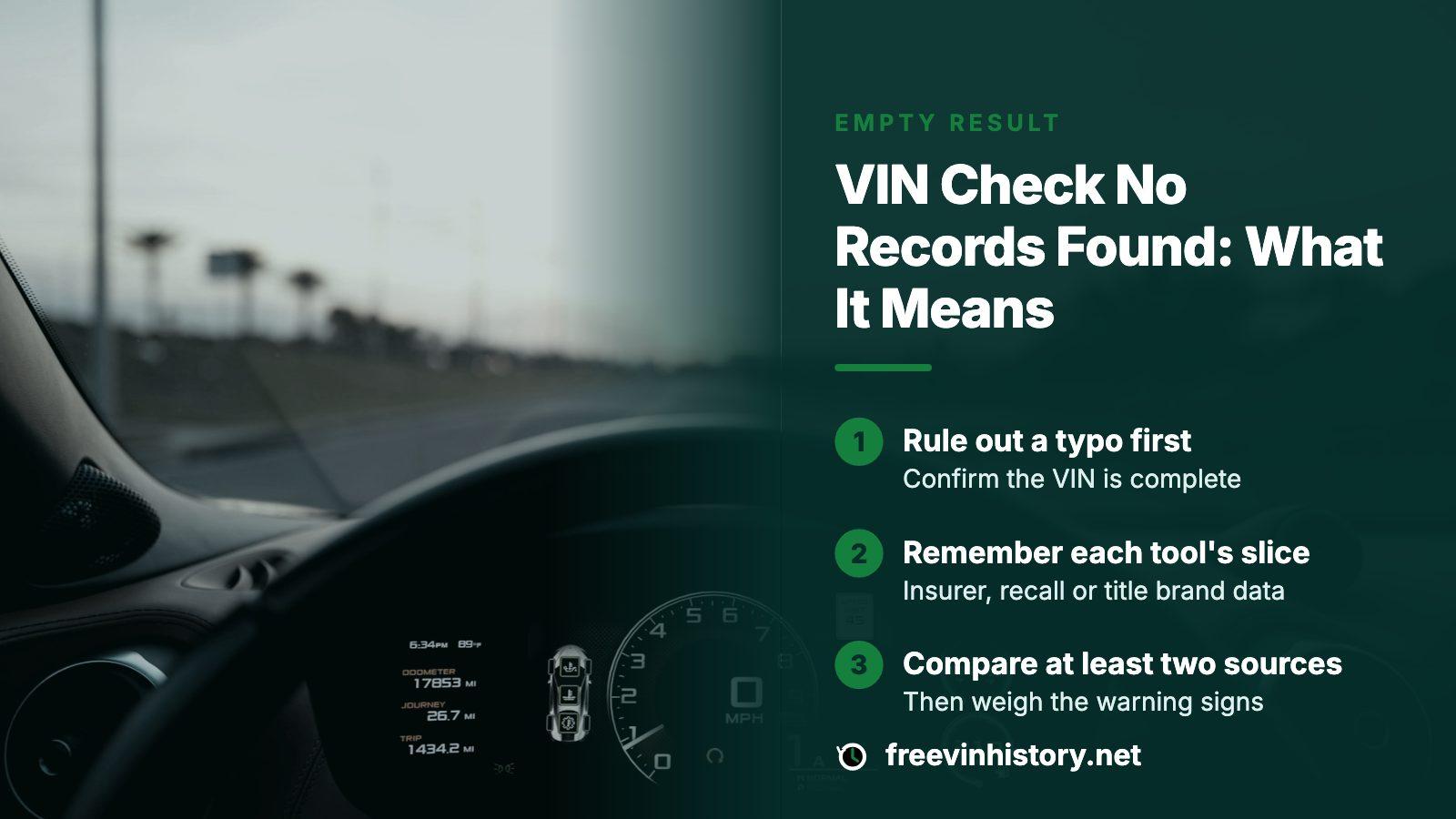
THE SHORT ANSWER
Empty means that one source found nothing it tracks, not that the car has no history. First confirm the VIN is complete and matches the car and its paperwork. Then remember that each free tool covers a narrow slice: insurer theft and salvage flags, open recalls, or federal title brands. Compare at least two sources and inspect the car before paying.
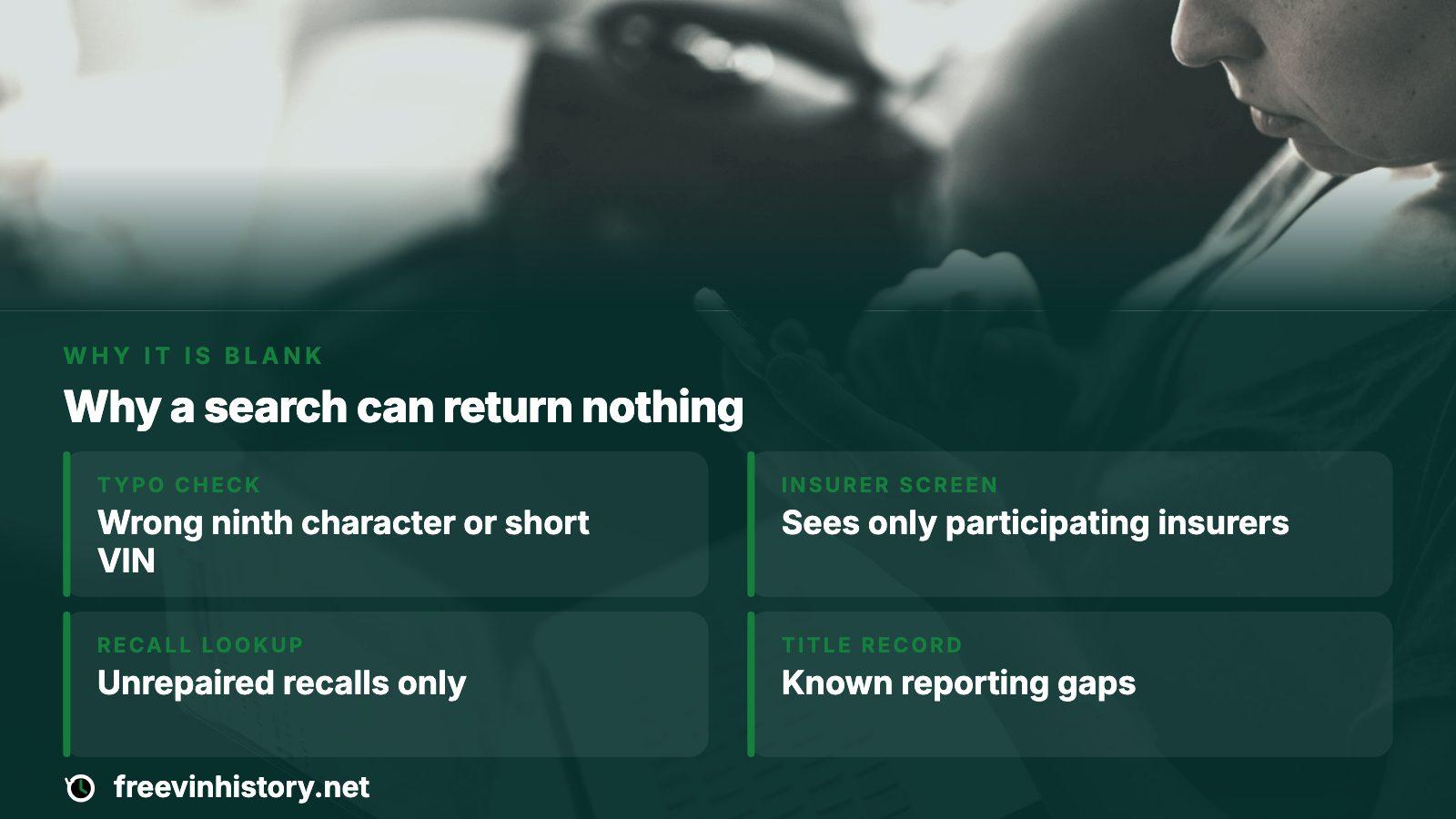
- Typo check
- A decoder flags a wrong ninth character or a short VIN
- Insurer screen
- NICB sees only participating insurers
- Recall lookup
- Shows unrepaired recalls, not repaired ones
- Title record
- Federal brand data has known reporting gaps
One narrow question gets one narrow answer
Our starting point at FreeVINHistory is simple: each official no-cost lookup is built to answer a single question, and a blank result only tells you that question came back negative. The insurer screen asks whether a member company reported a theft or a total loss. The recall lookup asks whether a repair is still owed. The federal title system asks whether a state or a salvage yard recorded a brand.
None of them asks whether the car was in a wreck that the owner paid for in cash, whether the odometer was rolled back before the last sale, or whether it spent three years as a rental. So a car can be spotless in all three and still have a story. The useful move is to work out which of three causes produced your empty page, because each one calls for a different next step.
Rule out the typo before anything else
The most common reason for nothing found is a bad entry. The insurer lookup states that it wants all 17 digits entered correctly, and a wrong one may just fail to match. Letters and numbers that look alike are the usual culprits, so read the number off the car itself rather than a listing photo.
You can test the number for free. NHTSA's decoder reports an error code when something is off. Given a VIN missing its last character, the decoder answered with an incomplete-VIN error and left make and year blank. A full-length VIN with the last character altered came back with a note that the ninth-position check digit fails its calculation, though make and model year still came back.
Quick test
If a decoder cannot name the make and model year, or complains about the ninth character, fix the VIN first. A clean decode with the right make and year means the number is at least well formed, and an empty history result becomes meaningful.
What each free source can and cannot see
| Source | An empty result means | It cannot rule out |
|---|---|---|
| NICB VINCheck | No participating insurer reported it stolen and unrecovered, salvage or flood | Insurers outside the program, police records, unclaimed damage |
| NHTSA recall search | No unrepaired recall tied to that VIN | Repaired recalls, very new recalls, small makers, non-safety campaigns |
| Federal title record | No brand, total loss or salvage reported | Brands a state never applied, entities that never reported |
The insurer screen sees only part of the market
NICB's VINCheck rests on member insurers writing 92.49% of American premiums, per a figure NICB dates August 2026. That is a large share, and it is still a share. Records from companies that opt out, and anything that never became an insurance claim, are invisible to it.
NICB says as much: a clean result is no guarantee, and a stolen, badly wrecked or title-encumbered car may still not show up. It also limits each address to five searches per day, which matters if you are comparing several cars in an afternoon.
A wreck repaired out of pocket at a body shop is the classic blind spot. No insurer ever opened a file, so there is nothing to find. Only a physical inspection, or repair and auction entries gathered by a full report, tends to surface that kind of event.
Why the recall lookup says zero
When a car has nothing outstanding, NHTSA's page displays the line "0 unrepaired recalls associated with this VIN." That is a useful sentence, but note the word unrepaired. A recall fixed by a previous owner will not appear, so a zero says little about earlier recall history.
- A recall someone already had fixed will not display.
- Fresh announcements may not list every affected VIN yet.
- Anything past 15 years old is dropped, unless the maker offers longer coverage.
- Cars from tiny makers, some ultra-luxury and specialty brands among them, are not covered.
- Voluntary service campaigns and imports built for foreign markets are absent.
Look again right before you pay, because the agency keeps adding VINs.
Why a clean title record can still be incomplete
The Justice Department's title system is built to be short. It tracks five things: the title's state and last date, brands, mileage, total losses and salvage. The department's own site treats a clean report as good news, then cautions that a false negative is possible. Roughly 87 percent of U.S. vehicles are covered and some 20 million entries for salvage or total loss sit in the database, yet states do not all contribute, and any entity that skips reporting leaves a hole.
States also disagree on definitions. A damaged car might get a salvage brand in one state but not in the next, where the damage cutoff sits elsewhere. Some states exempt older vehicles from titling altogether. The federal file is a subset of what each state keeps, so the department suggests requesting the state's full title record too.
A sequence to follow when the result is empty
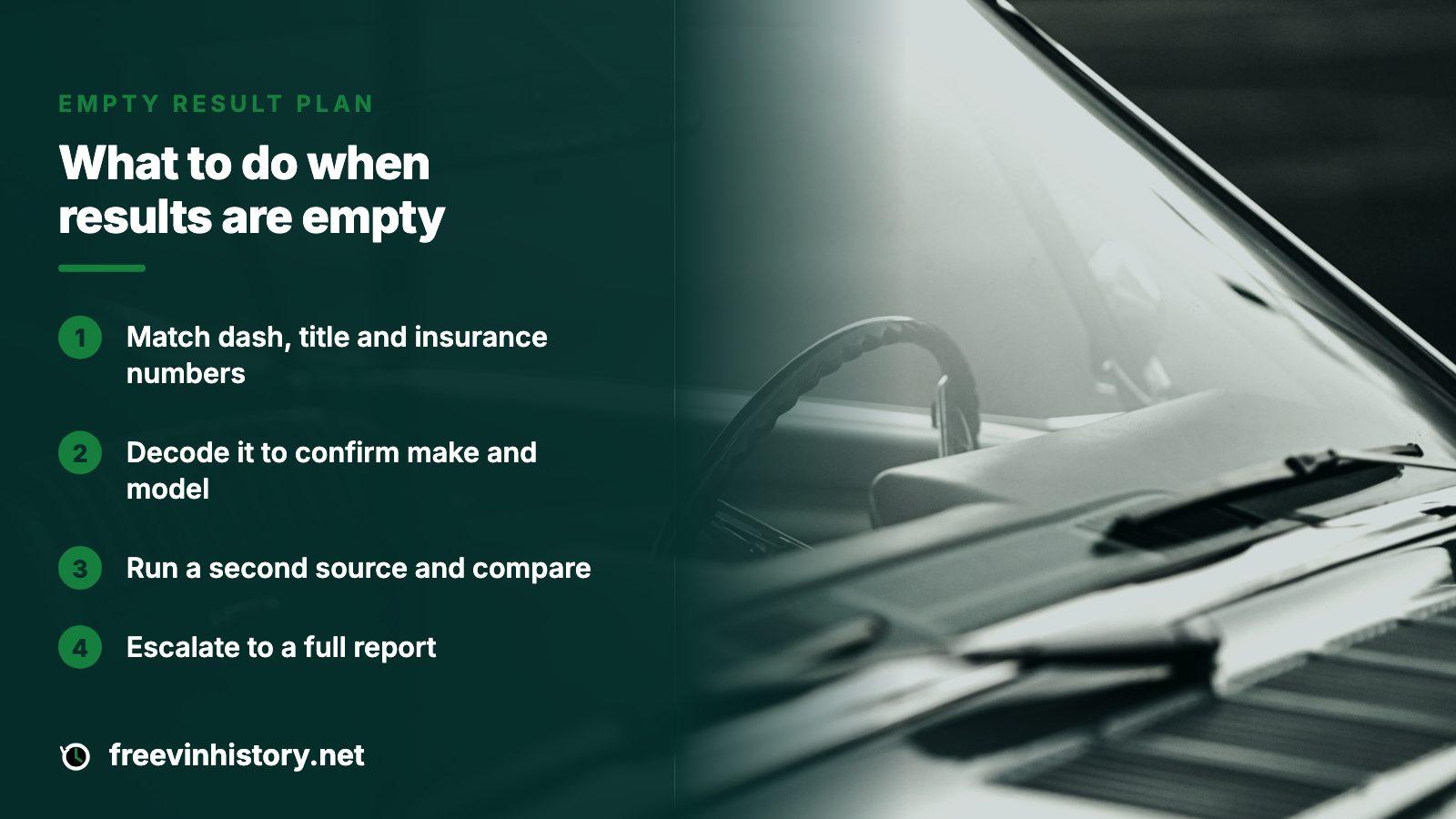
- Match the number on the dashboard against the title, registration and insurance card. A mismatch stops the conversation.
- Decode it and confirm the make and model year match the listing.
- Run the insurer screen and the recall lookup, and write down what each says.
- Pull a title-based history, which is where brand records live, and read the odometer entries.
- Request service receipts from the seller, plus anything they know about earlier owners.
- Book an independent mechanic, and drive the car on varied roads, including hills and highway speeds.
The federal buying tips page lists both the mechanic and the drive for a reason: they catch what no database holds.
When a paid report is worth it
Free tools are good at ruling cars out. They are weak at ruling a car in. If the VIN decodes cleanly, the insurer screen and recall lookup are empty, and you still like the car, the gap you need to fill is everything those tools skip: title records, auction entries with photos, odometer readings over time and lien information.
The preview here carries no charge and counts the entries held for your VIN. Beyond that sits the full report: one payment per report, no subscription, cost listed on the pricing page. Start with the preview. If it also shows little, you will at least know that the thin result is consistent across sources and not a typo.
Read an empty report as a question
Ask whether the car is simply uneventful, very new to the market, or old enough that records are sparse. A late-model car with nothing anywhere deserves another call to the seller.
Signs that an empty result is a warning
Most blank results come from clean cars. A few patterns are worth taking seriously, because blank plus oddity is different from blank alone.
- The seller is reluctant to share the VIN or insists on a deposit before you can run it.
- The dash plate, door label and paperwork do not agree.
- The car is a few years old yet reports nothing at all across every source.
- The seller cannot produce a title, or the title was issued in a state far from where the car is sold.
- The price sits well below comparable listings.
Each of these justifies stopping to request documents and calling an inspector before money moves.
Where this information comes from
- DOJ title system: consumer guidance — Source for the false-negative caution, state differences and fleet coverage.
- DOJ title system: what a report contains — The five items the federal report tracks and why it stays short.
- DOJ title system: used-car buying checklist — Where the mechanic and road-test advice comes from.
- NHTSA: Check for recalls — Which recalls the VIN search lists and which it skips.
- NHTSA: vPIC VIN decoder API — Decoder behavior with partial VINs and its error codes.
- NICB: VINCheck lookup — Source for the insurer screen and its stated limits.
Sources and photos: Facts checked against the sources above in November 2026. Photos by Dennis Eusebio, Dylan Michaud and Michal Biernat on Unsplash; diagrams by FreeVINHistory.
Keep reading
- NMVTIS report: what the federal title record shows and missesDeeper look at the federal title file and its blind spots.
- Free open recall check by VIN: GM, Polaris and every other makeHow to run the recall lookup and read what it says.
- Free salvage title check by VIN: what the free lookups showWhat salvage flags look like in the no-cost lookups.
- Free stolen car check online: what each lookup coversTheft screening and what the insurer data leaves out.
Frequently asked questions
Does no records found mean the car is clean?
Not by itself. It means the source you asked had nothing matching in the categories it tracks. Accidents paid out of pocket, odometer changes and rental use may sit outside it. Treat the result as one clear signal, then confirm with a second source and a hands-on inspection.
Why would a real VIN return nothing?
Typical causes: a mistyped character, a VIN read from a blurry photo, or a car too new or too old for the database. A decoder can tell you whether the number is well formed. If it decodes to the right make and year, the empty result is more likely genuine.
Can a title brand be missing from a clean search?
Yes. Reporting is incomplete in places, which the Justice Department calls a false-negative risk, and states apply brands under different rules. A car can sit in a salvage yard without any state branding it. Ask for the state title record as well.
Is a car with no history a red flag?
Sometimes. A very recent model may just not have accumulated entries. A car several years old with nothing anywhere is worth a call to the seller about where it has been. Pair that with a mismatch between paperwork and VIN, and walk away.
What should I run after an empty free check?
Decode the VIN, run the insurer screen and the recall lookup, then pull a title-based report if you are serious. The preview here is free and lists the entries on file; the full report is one payment, with the amount shown on pricing.
Now check the car itself
The guide explains what to look for. The report shows what this VIN has on record.