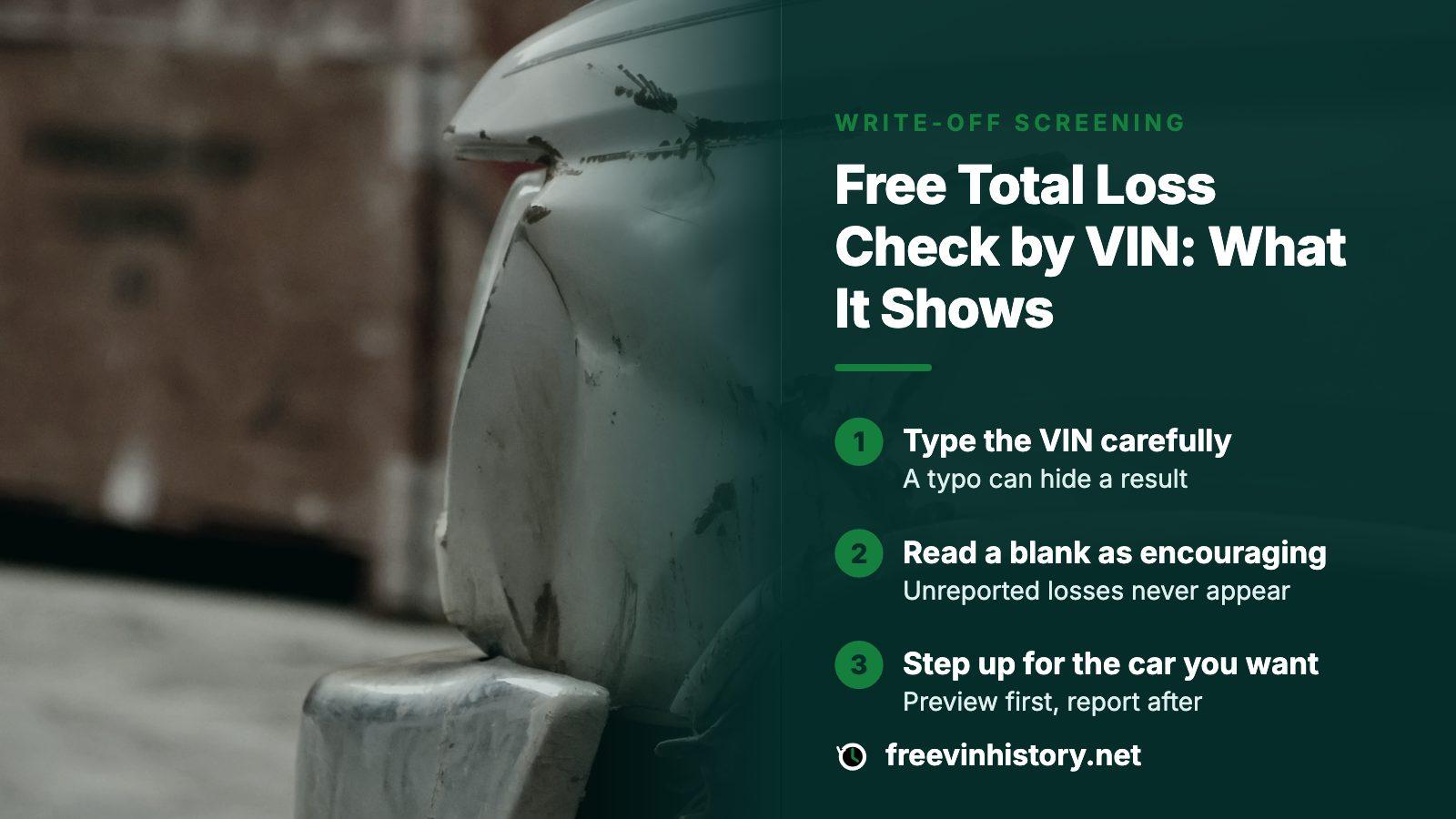
THE SHORT ANSWER
Yes, partly. Type the 17-character VIN into NICB's VINCheck and it returns any salvage, flood or theft record from member insurers. A blank result is encouraging, not final: the tool never sees a write-off that no member insurer reported. Add the free preview's record counts, and spend on the paid report only once a particular car has earned it.
- Free lookup
- NICB VINCheck, with a daily cap per connection
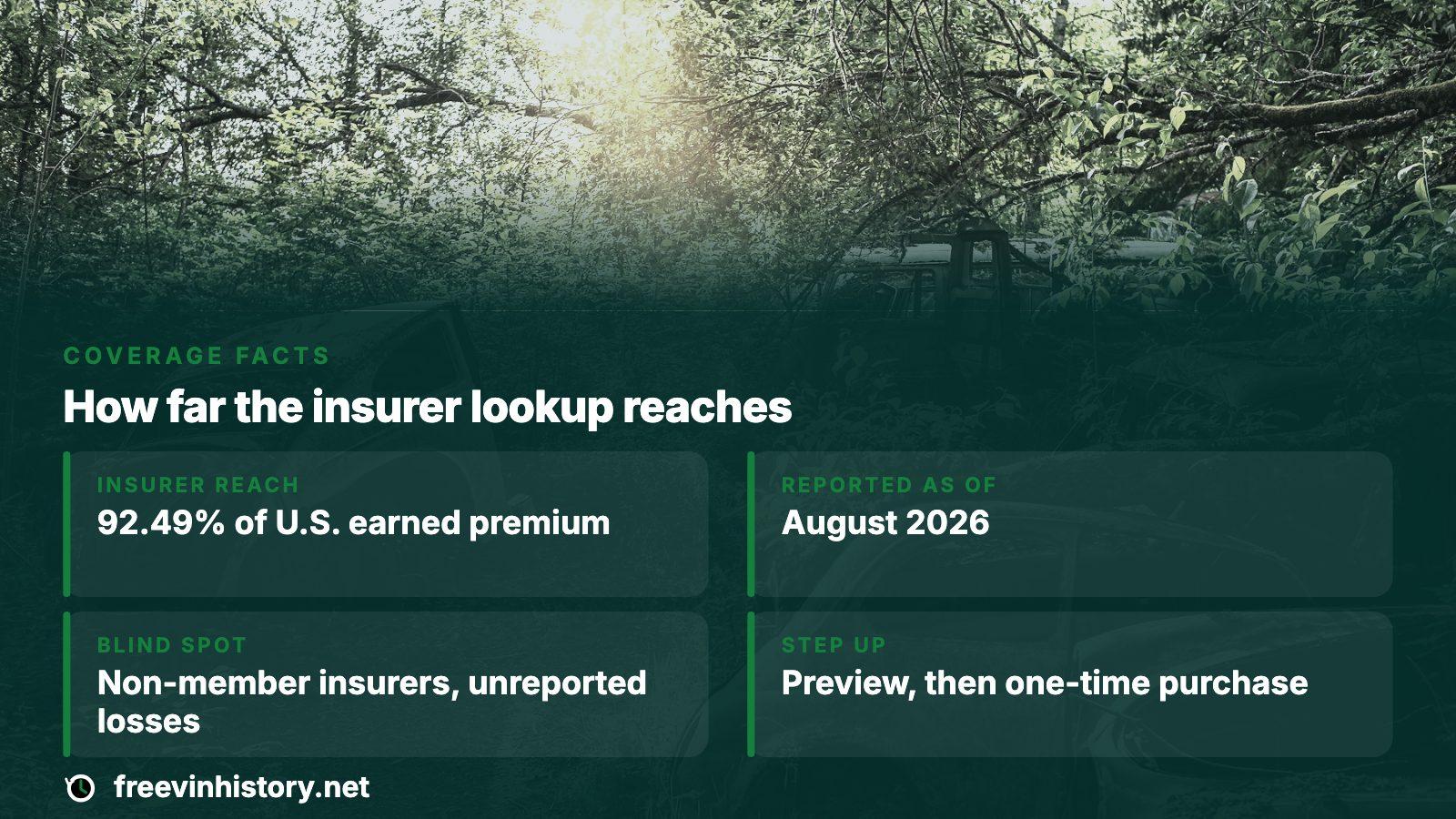
- Insurer reach
- Members representing 92.49% of U.S. earned premium (August 2026)
- Blind spot
- Insurers that do not take part, and any loss never reported
- Step up
- Preview at no charge, then a one-time purchase for the report
What a total loss record actually says
A total loss is a money decision made by an insurer, not a photograph of a wreck. Federal rules for the national title database spell out the sum: repair cost, plus expected supplements, plus lost resale value, plus rental reimbursement, weighed against the car's value just before the damage minus what the wreck would fetch as salvage. When the repair side wins, the car is written off.
Those rules also fold every state or insurer write-off into the salvage category, whoever ends up holding the wreck. So the words total loss and salvage overlap heavily in the records, and the free tools mostly speak the second word.
The free tools worth running first
Two public lookups cost nothing and take about a minute each. Neither is a history report, and each answers a narrow question.
| Free tool | Run by | What it can tell you about a write-off |
|---|---|---|
| VINCheck | NICB, a nonprofit funded by insurers | A salvage, flood or unrecovered-theft entry filed by a member insurer against that VIN |
| Recall search by VIN | NHTSA | Only open safety recalls, which can hint at a repair history problem but never prove a loss |
| Free preview | This site | Vehicle identity, how many recalls are open, and record counts for titles and auctions |
Each connection gets only a handful of lookups a day from NICB, so settle on your short list before typing any VINs.
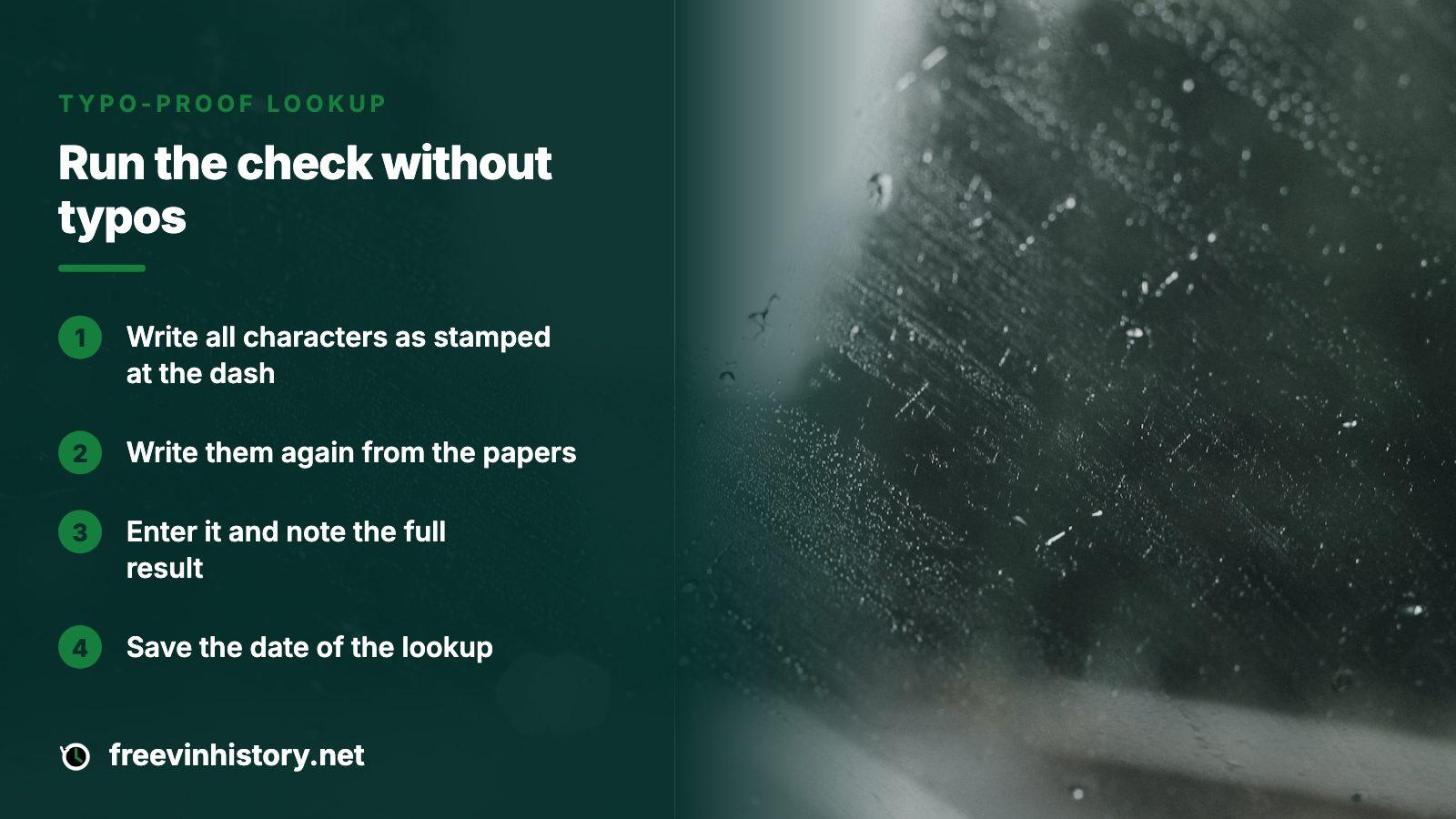
Running the check without a typo costing you a result
NICB warns that a wrong VIN may simply fail to match anything, which looks exactly like a clean car. Take the number off the car, not just the ad. NHTSA says to look at the driver-side base of the windshield, and notes it also appears on the registration and may be on the insurance card.
- Write down all 17 characters as stamped at the dashboard, then again from the seller's papers, and confirm both match.
- Enter it into VINCheck and note the result, including any date and loss type shown.
- Open NHTSA's recall search with the same VIN and screenshot the answer.
- Run the free preview here and write down the title and auction tallies.
- Compare the three, then decide whether this car deserves the paid report.
If the windshield number and the paperwork disagree, stop there. That is a bigger problem than any insurer record.
What a clean free result still leaves open
NICB is direct about its limits. It reads only insurance records, only from participating insurers, and it does not query law enforcement files. It advises against leaning on VINCheck alone when buying, since a seriously damaged or encumbered car may not appear.
- A write-off paid by an insurer outside the program never reaches the lookup.
- A car damaged while uninsured, then sold quietly, leaves no insurer record at all.
- The lookup reports no state title brands, odometer readings or auction photos.
- The recall search leaves out repaired recalls, plus campaigns past the 15-year mark where the maker offers no extension.
Read a clean result as one signal
Coverage of 92.49% of premium sounds close to complete, yet it is a share of insurance dollars, not a share of every vehicle claim. Treat silence as good news that still needs a second source.
Where the federal title record fits
Insurers, salvage yards, junk yards and recyclers must all report to the national title system under federal law, and states feed it their title brands. Carriers must file monthly on cars from the present model year back through four earlier ones, whenever they took the car and classed it junk or salvage, write-offs among them.
That five-year window matters for older cars. The system's own report is deliberately short, covering where the title sits, brands, mileage, and the write-off and salvage tallies, and the Justice Department's page says a clean one is good news. Reasons for a loss, such as flood or fire, are only encouraged from carriers, so expect a record without a story attached.
From the free preview to the full report
The preview needs no card. Type a VIN and you get the car's identity, how many recalls are open, and counts of title and auction records. Any count above zero is a prompt: something was recorded, and the preview alone will not spell out what.
The full report opens those records with accident and damage entries, odometer readings, insurance and salvage history, auction photos where they exist, and title brands with dates. You pay once, for one report or for a bundle if several cars are in play, and nothing renews. The pricing page carries today's amounts, and the preview costs nothing regardless.
Red flags that justify walking away
A write-off is not an automatic no, because NICB notes a salvage car can legally be rebuilt and retitled. It is a reason to slow down and price the risk.
- A salvage or flood result the seller never mentioned.
- A free result that disagrees with the title in the seller's hand.
- A preview showing auction records on a car sold as one-owner.
- A seller who objects to an independent inspection, which the Justice Department urges every buyer to get.
Any one of these deserves the full report and a mechanic's hour before money changes hands.
Where this information comes from
- NICB: VINCheck lookup — the free insurer lookup, its daily limit, coverage share and stated limits
- 28 CFR 25.52 definitions — how federal rules define total loss, salvage and junk automobiles
- 28 CFR 25.55 insurance carriers — what insurers must report and over which model years
- NMVTIS: understanding a vehicle history report — the five indicators of the federal title report and who must report
- NHTSA: check for recalls — where the VIN is found and what the recall search leaves out
Sources and photos: Facts checked against the sources above in November 2026. Photos by Everett Pachmann, Cole Keister and Patrick von der Wehd on Unsplash; diagrams by FreeVINHistory.
Keep reading
- Free salvage title check by VIN: what the free lookups showThe closest neighbor: how salvage flags differ from state title brands.
- Total loss reported: what the line on a vehicle history meansDecode the wording when a report says total loss reported.
- NMVTIS report: what the federal title record shows and missesThe federal title record that holds the state brands and write-off history.
- Free VIN check with pictures: what free sources show and where photos beginSee which free lookups show photos and which only show records.
Frequently asked questions
Can I check if a car was totaled for free?
Yes, up to a point. NICB's VINCheck is free and shows whether a participating insurer reported the VIN as salvage or flood damaged, which usually follows a write-off. It cannot see losses that insurers outside the program handled, so use it as a first filter rather than a verdict.
Does a totaled car always get a salvage title?
Not always in the same way everywhere. Federal definitions treat any total loss as salvage, but states decide what goes on the title and when. A car may carry the brand, or the record may sit only in insurer data. The full report lines the two up.
Is the free VINCheck result enough to buy a car?
NICB itself says no. It calls VINCheck useful yet far short of a history report, and notes a damaged or encumbered car may not appear. Add an independent inspection and a title-based report for any car you are seriously considering.
How many times can I run NICB VINCheck?
NICB allows five searches in a 24-hour period per IP address. Searches are unlimited over time, so if you have a longer list of cars, spread the VINs across days or narrow the list first with the free preview.
What does the FreeVINHistory preview show about total loss?
It shows the car's identity, how many recalls are open and tallies of title and auction records. It does not spell out a write-off in words. If a tally is above zero, the full report, a one-time payment, opens the underlying records.
Now check the car itself
The guide explains what to look for. The report shows what this VIN has on record.