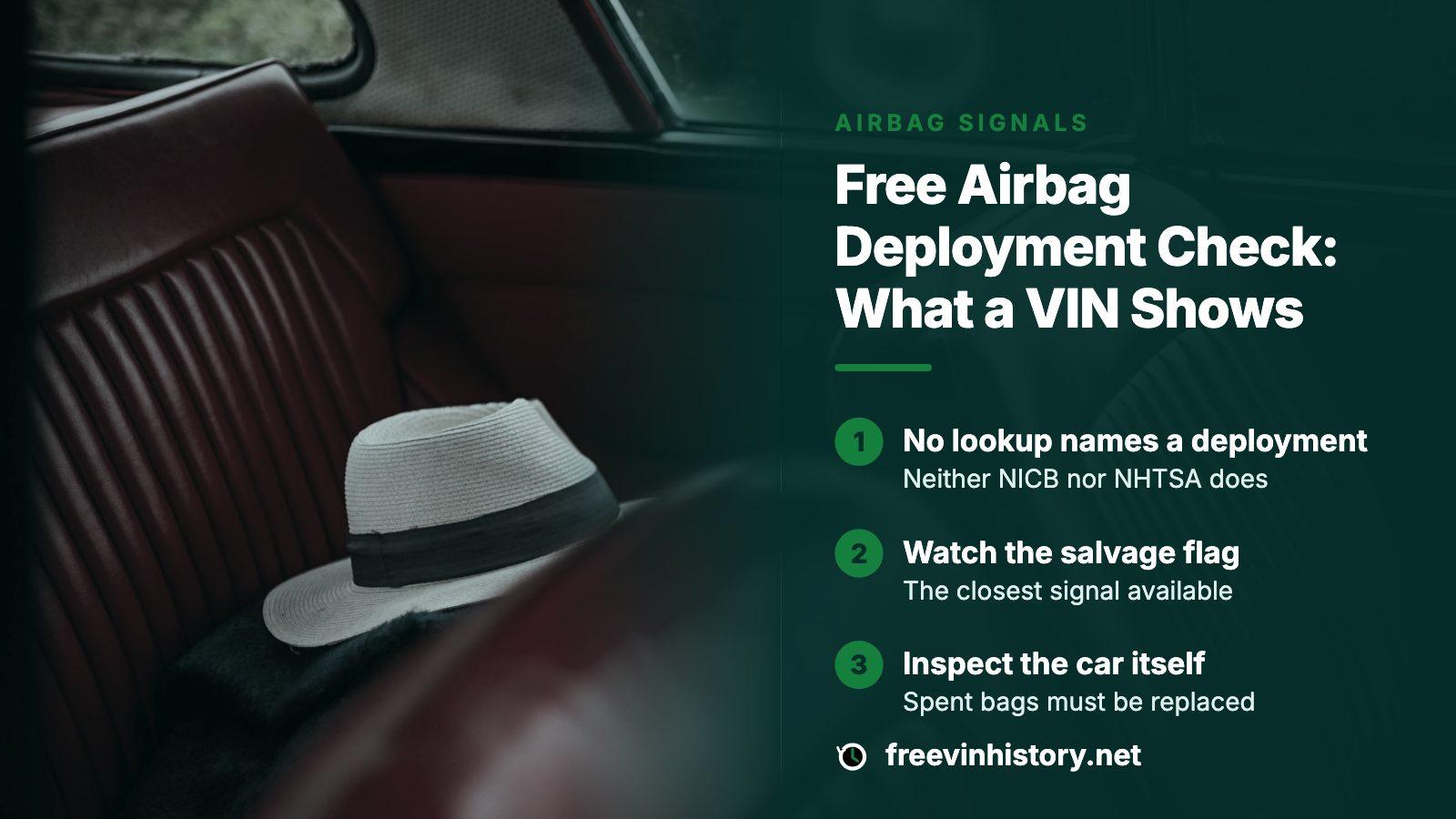
THE SHORT ANSWER
A free airbag deployment check does not exist as a single lookup. NICB VINCheck flags insurer total losses, NHTSA's recall search lists unrepaired airbag recalls, and the FreeVINHistory preview shows whether title and auction records are on file. None of them names a deployment. If records exist, the paid report can show damage entries, and an inspection of the restraint system settles the rest.
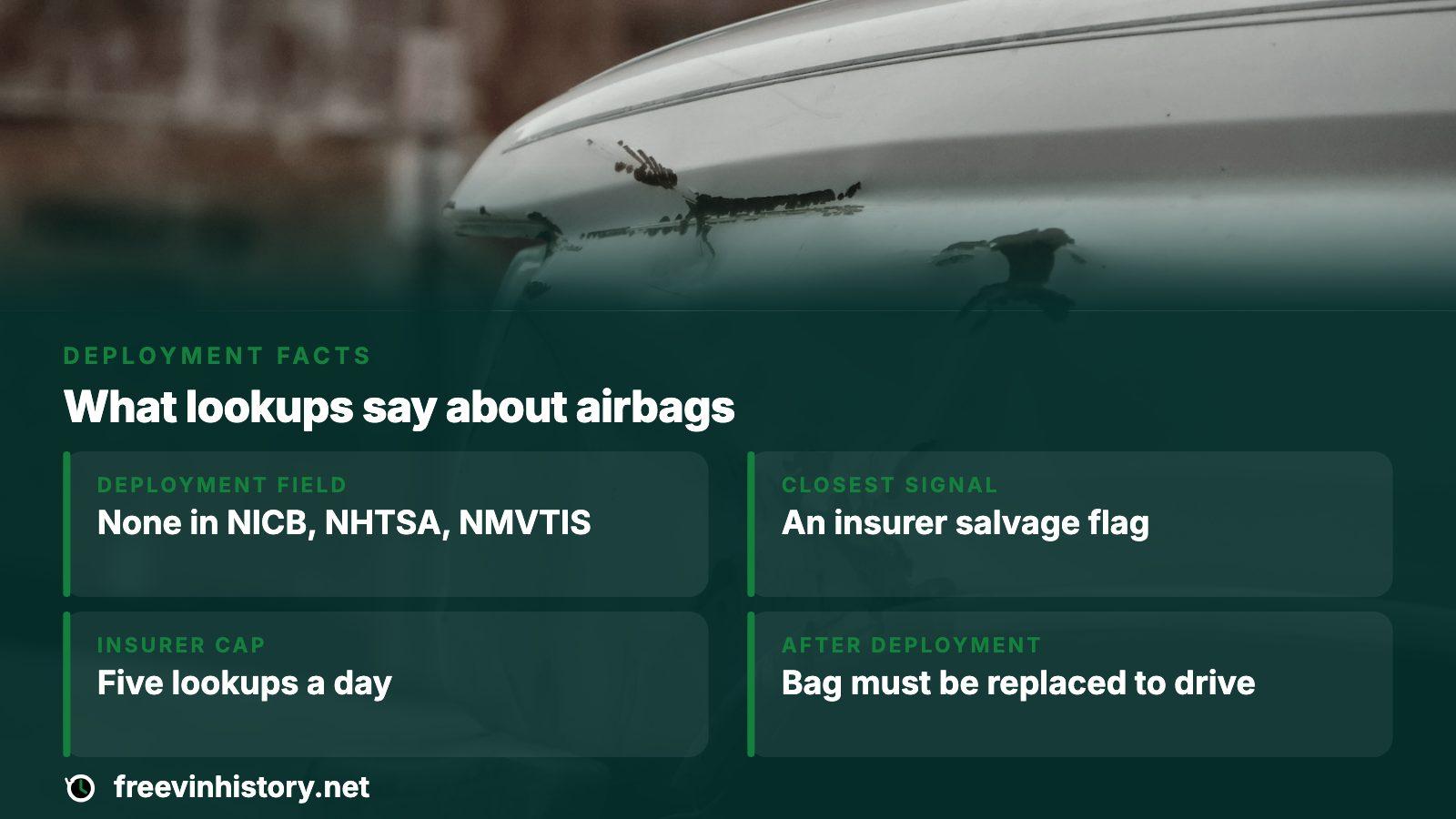
- Free tools that name a deployment
- None. NICB, NHTSA and NMVTIS carry no airbag deployment field
- Closest free signal
- An NICB salvage flag, which means an insurer declared a total loss
- NICB cap
- A limit of five lookups a day per connection
- After a deployment
- The bag cannot be reused and must be replaced before driving
Why no free lookup answers this directly
Search for a free airbag deployment check and you will find pages promising one. The official sources say otherwise. The Justice Department's title database keeps a short ledger: title state and date, brands, mileage, plus total-loss and salvage entries. Nothing in it is labeled deployment. NICB's lookup has three buckets, theft, salvage and flood. NHTSA's recall page is about manufacturer defects.
That does not make the check pointless. An airbag fires in a hard hit, and hard hits often leave other footprints. Your free pass is a way of looking for those footprints, and being honest about which ones the free tools can see.
The free looks, and what each one is worth
| Free source | What it can hint at | What it misses |
|---|---|---|
| NICB VINCheck | A salvage flag, which means an insurer wrote the car off | Crashes paid as ordinary repairs, carriers outside the program, police records |
| NHTSA recall search | An airbag campaign whose repair is still owed | Campaigns already fixed, every kind of crash history, makers it does not cover |
| Federal title report (sold by approved providers) | Title brands plus write-off and salvage entries | Whatever falls outside its short indicator list, and states that skip reporting |
| FreeVINHistory preview | A yes or no on title and auction entries for that VIN | What the entries say, which the report spells out |
Read the table as a funnel. Each free look narrows the question without answering it, which is why none of them should be the last thing you do before paying a seller.
Running the check on one car, step by step
- Find the VIN plate where the dashboard meets the glass, then hold it against the number on the registration or insurance card. Two different numbers are trouble before any lookup starts.
- Type all 17 characters into NICB VINCheck. One mistyped character can send you to an empty page for a car with a long record.
- Put the same VIN through NHTSA's recall search. An open inflator recall is not a deployment, but it tells you the airbag system needs attention.
- Open the free preview here and see whether title and auction entries are present.
- If anything came back, or the price looks too low, move on to the paid report and an inspection of the restraint system.
Screenshot each result with the date. Records change, and a note of what you saw on the day is useful if the seller's story shifts.

What a quiet result does and does not prove
NHTSA's own guidance explains why silence is weak evidence. Bags are built for moderate to severe frontal crashes, can fire in a minor one, and may stay shut when the belt is enough. So a car can have been hit with no deployment, and a car can have deployed with nothing in a free database, because the repair was paid by the owner and no insurer ever recorded a loss.
From an NHTSA owner complaint
Writing to NHTSA, a 2009 Honda Accord driver described a multi-vehicle crash in which no airbags fired. The vehicle-history report they pulled showed an entry that an airbag had been serviced at 123,157 miles, plus a minor front collision. The owner said the work and parts behind that entry were unverified and asked NHTSA to look at prior restraint work.
The lesson for a buyer: a line about airbag service is where questions start, not where they end. Ask the seller for the shop invoice and the parts used.
Signs on the car that records cannot give you
A bag that has fired is spent. NHTSA says an authorized technician must swap it out before anyone drives the car again. That makes the replacement the weak link, and the agency warns that counterfeit bags have surfaced in vehicles repaired after crashes.
- A dashboard airbag lamp that stays lit, or one that never lights at start-up
- A steering wheel hub or passenger-side panel with uneven gaps, mismatched grain or fresh adhesive
- A new windshield or fresh headliner on a car with no repair story
- A seller who cannot name the shop that did any restraint work
Have a technician scan the restraint module, not only the engine computer. A dark warning lamp is not proof that the system is intact.
When the deployment came with a hidden salvage brand
From an NHTSA owner complaint
Another owner, of a 2012 Honda Civic, got the car from a private seller who advertised a clean title and 112,000 miles on the clock. The airbag light and a tire sensor light were on at pickup. Afterward the buyer discovered a salvage history, and the real mileage looked closer to 180,000 or higher.
A glowing airbag lamp during a test drive should stop the sale, run the VIN, and read what the title and salvage records actually say. A salvage brand and an airbag fault together describe a car worth much less than the asking price.
When to step up to the full report
Go beyond the free tools when the car passes your first screen and you are still thinking of buying it. The paid report opens up the records the preview only counts. It lists damage and accident entries, salvage and auction history with photos, brands and mileage readings, so you can look for signs of a serious impact in the record rather than guessing from its absence.
Be clear about the limit. The federal title system has no airbag field, and I could not confirm which data source feeds an airbag line in any commercial report. Treat an entry as a lead and confirm it on the car.
Cost, and the order to work in
Previewing a VIN costs nothing. After that, each full report is bought once, with larger sets of 3, 5 or 10 for shoppers weighing several cars, and no subscription behind any of it. Amounts are shown on the pricing page only.
- Start with NICB and NHTSA, then the preview using the same VIN
- Spend on a report for the one car still on your list
- Pay for a restraint-system scan from an independent shop before you hand over money
Where this information comes from
- NHTSA: Air Bags — How bags are meant to work with belts, one-time use, and the counterfeit warning.
- NHTSA: Check for Recalls — The no-cost recall lookup by VIN, with its blind spots.
- NMVTIS: Understanding a report — The federal title report's short list of indicators, none of which is a deployment.
- NICB: VINCheck — Insurer-supplied theft, salvage and flood answers, plus the search limit.
- NHTSA owner complaint 11772026 — owner experience, paraphrased
- NHTSA owner complaint 11726572 — owner experience, paraphrased
Sources and photos: Facts checked against the sources above in November 2026. Photos by Nik, Anastasiia Nelen and Everett Pachmann on Unsplash; diagrams by FreeVINHistory.
Keep reading
- Airbag deployment reported: what the entry means on a history reportWhat an airbag entry on a report means and what to ask once you see one.
- Free accident history check by VIN: what shows up before you payThe wider free screen for crash history, with what each source can see.
- Free salvage title check by VIN: what the free lookups showThe total-loss flag in detail, the nearest free signal to a hard impact.
- PricingSingle report and multi-report sets, and confirmation that nothing renews.
Frequently asked questions
Can I see if airbags deployed for free with a VIN?
Not directly. Neither NICB nor NHTSA keeps a deployment field, and the federal title report has none either. Free tools can show a salvage flag or an open airbag recall, which are clues. Confirming a deployment takes the paid report's damage records and a scan of the restraint module by a technician.
Does a clean NICB result mean the airbags never went off?
No. NICB only reports records from participating insurers, and it says a clean result is not a guarantee. A crash repaid out of pocket, or one reported to a carrier that is not part of the program, leaves nothing there. Use it as one screen among several.
Is an open airbag recall proof of a past collision?
No. A recall is a manufacturer defect campaign tied to the VIN, and NHTSA's search says nothing about collisions. It still matters, since an unrepaired inflator is a safety problem, and dealers perform recall repairs without charge.
Is it safe to buy a car whose airbags deployed?
It can be, if the full restraint system was replaced properly and the car scans clean afterward. NHTSA says a bag cannot be reused and warns about counterfeit replacements. Ask for the repair invoice, insist on an independent inspection, and price the car as a repaired wreck.
How is the full report priced?
The preview step costs nothing and shows if any title or auction entries are on file. Opening the whole report is a single payment for each one, with no renewals, and the pricing page lists amounts.
Now check the car itself
The guide explains what to look for. The report shows what this VIN has on record.