THE SHORT ANSWER
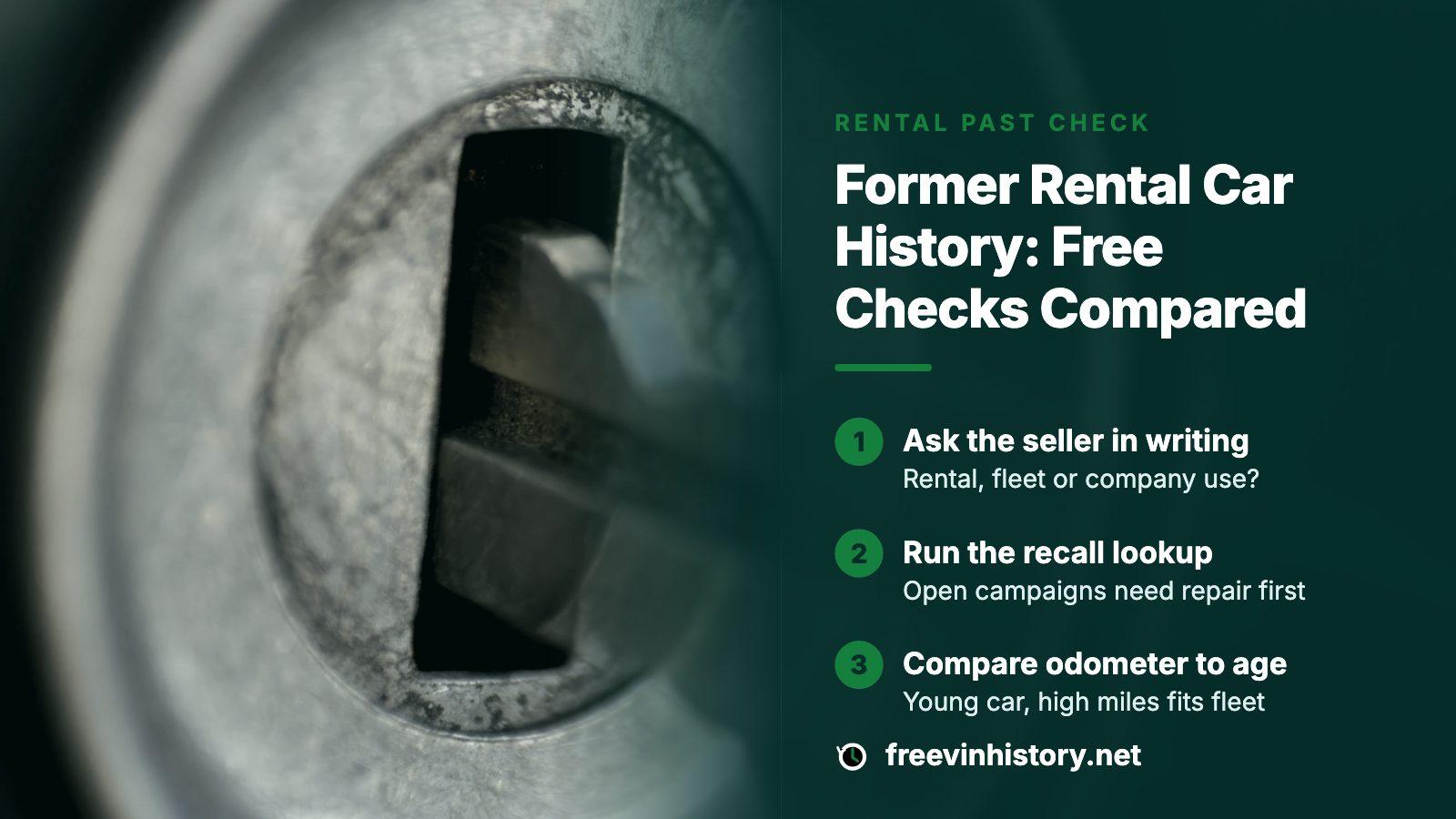
Run NHTSA's recall page and NICB VINCheck first; both cost nothing. Neither says whether a car was rented out, and the federal title database records only a handful of title and loss facts. To learn about a rental past, ask the seller in writing, read the title paperwork, run the preview here, and then weigh a one-time purchase.
- Free recall lookup
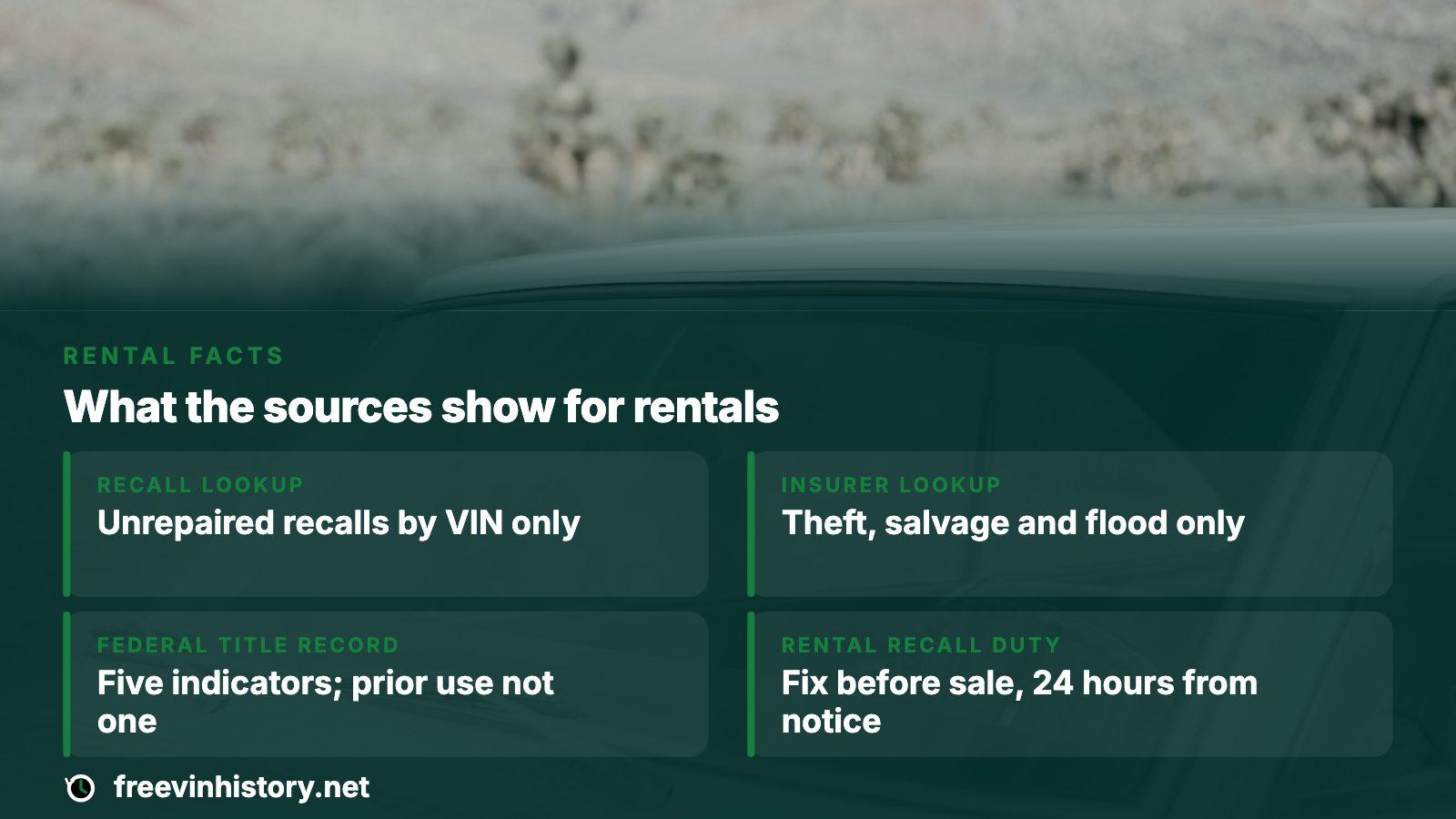
- NHTSA shows unrepaired recalls by VIN, not repaired ones
- Free insurance lookup
- NICB VINCheck: theft, salvage and flood from participating insurers
- Federal title record
- Five indicators, and prior use is not one of them
- Rental company recall duty
- Fix before sale, within 24 hours of notice (48 for 5,000+ vehicles)
A rental past is a use type, not a brand
Buyers often assume a former rental would show up the way a salvage title does. It does not work that way. A brand is a label a state puts on a title after something happened to the car, such as a total loss. Having been rented to travelers is not an event of that kind, so no state title carries a stamp for it.
That is why this page starts with the free sources instead of a report. They are worth running every time, and they are honest about their limits. Once you see where they stop, the question of a rental past becomes a question for the seller and for any record that tracks how a car was used.
What each free source covers for a car with a fleet past
Three official sources are free to use. Here is what each one adds when the car you are looking at might have spent its first years at a rental counter.
| Free source | What it adds | What stays hidden |
|---|---|---|
| NHTSA recall search | Whether the VIN has an unrepaired safety recall | Repaired recalls, very old campaigns, maker-only service bulletins, any use history |
| NICB VINCheck | Theft not recovered, salvage or flood, per participating insurers | Law enforcement records, insurers that opt out, any use history |
| Federal title system (DOJ) | Where it was titled, brand labels, mileage readings, loss and salvage entries | Rental, lease, taxi or police use |
| Your own eyes and a mechanic | Wear, repairs, mismatched panels, worn interior | Anything about the paper trail |
Notice that the right-hand column repeats the same gap. For use history, the free tools stay silent, and a silent result is not the same as a no.
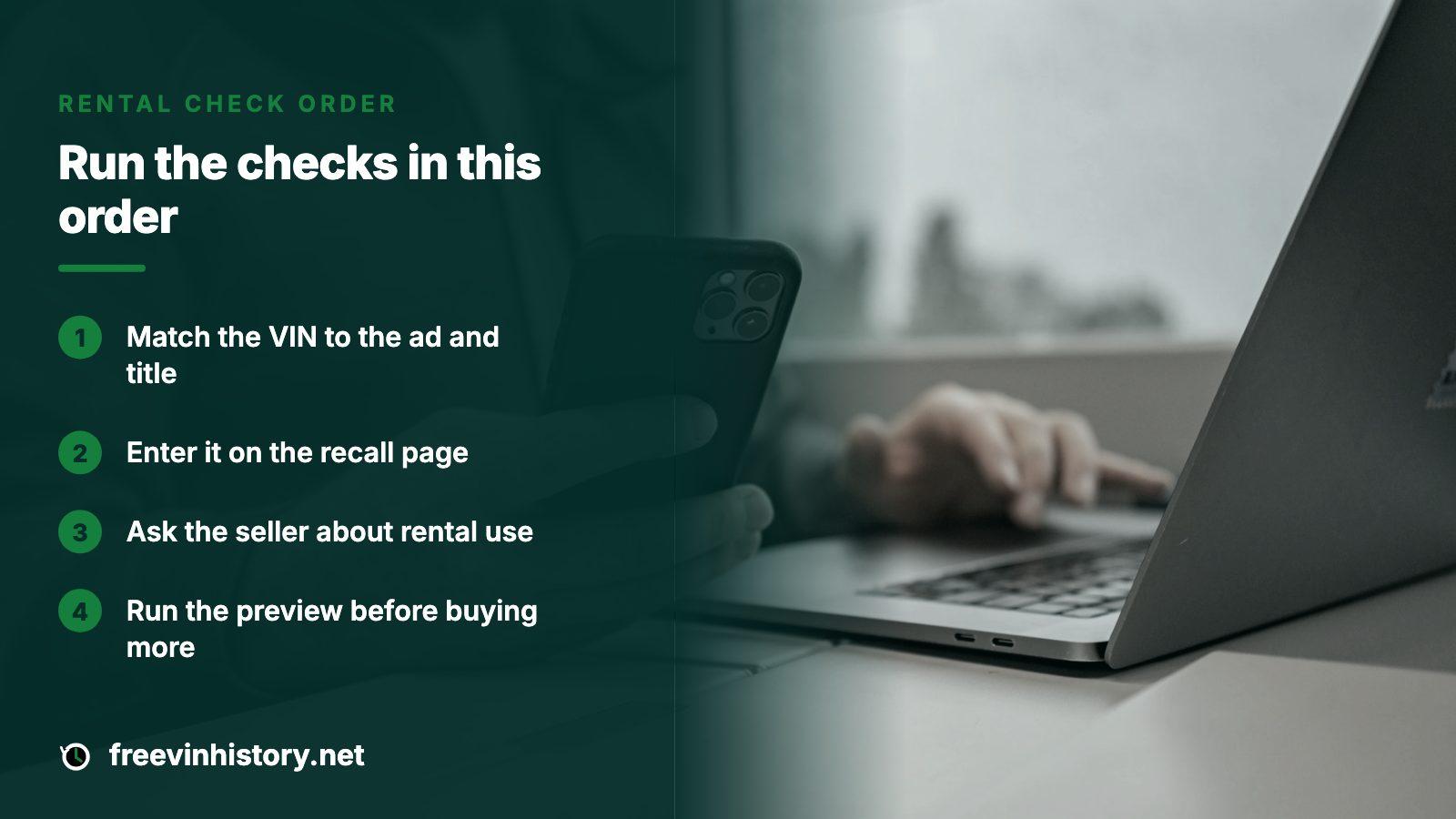
Run the free steps in this order
- Read the 17-character VIN off the vehicle and check it against the ad and the title. One wrong character points every lookup at a different car.
- Enter it on NHTSA's recall page. A clean answer reads 0 unrepaired recalls, and anything open should be fixed before you pay.
- Enter it on NICB VINCheck. The tool allows five searches per address in a day, so keep a short list of cars instead of testing every listing you see.
- Ask the seller directly, in writing, whether the car was ever a rental, fleet or company vehicle, and keep the reply.
- Put the same VIN into the preview here, and only then think about buying the full report.
The one legal rule that applies to rental fleets
Federal law does single out rental companies, and the rule is about recalls. Under 49 U.S.C. 30120, once a maker has notified a rental company about a safety defect in a covered vehicle, the company can sell, lease or rent that car only after the fix is done. The company has until 24 hours after it first receives the notice with the VIN. A notice that reaches over 5,000 of the company's cars stretches that to 48 hours.
Two details matter to a buyer. If the repair part is not available yet and the maker gives temporary steps, the company may keep renting the car after those steps but may not sell it. And the law lets a rental company offer a car for sale at any time; the limit applies to completing the deal before the repair.
What this does not tell you
The rule only reaches notices already sent. It is silent on driving habits and service intervals, and on recalls announced once the car has left the fleet. A fresh NHTSA lookup on the VIN is still the check that matters.
Recalls that arrive after the car changes hands
The practical risk with any ex-fleet car is a recall that lands after the sale, when the notice goes to a company that no longer owns the vehicle. Titling the car in your name does not guarantee the maker has your address.
From an NHTSA owner complaint
The owner of a 2019 Hyundai Elantra told NHTSA the car stalled without warning, sometimes failing to restart, and that no recall notice ever reached them. They said they were the first owner and had bought it from a dealer that had used it as a rental.
The lesson is narrow and useful. Run the VIN through NHTSA before you buy and again after you register the car, and add the car to NHTSA's SaferCar app so a later campaign reaches you.
Questions that bring out a fleet past
Sellers are not required to volunteer where a car spent its first years, so ask plainly and compare the answers with the documents.
- Who was the first owner, and can I see the original bill of sale or the title history?
- Did you buy it at a dealer, at auction or straight from a company?
- Is there a service record, and who did the oil changes?
- Has any recall repair been done, and can I see the paperwork?
A seller who hedges on the first owner is telling you something. A mechanic's inspection before payment is the other half of this, since the federal buying tips urge one for every used car.
Where the full report picks up
NICB says its free tool is narrow next to a paid history report, which can pull in DMV title files, auction listings and service entries. The Justice Department's title system adds that private providers hold repair and recall details outside its own scope.
This site's report is that next step. You get a free preview first, then pay once if you want the detail, with no recurring charge. A fleet or rental entry would sit in the ownership and use part when the underlying records contain one. If they do not, nothing can be shown, which is why the seller questions above still matter.
How to weigh a rental past once you know
Learning that a car was rented out should sharpen your inspection rather than end the deal. No public record covers how renters drove, so you judge by the car itself and its paperwork. Weigh these points together.
- Odometer: a young car with high mileage is typical of fleet use, and the title record keeps odometer readings you can compare.
- Title and damage: any brand, total loss or salvage entry outweighs the rental question.
- Recalls: every open campaign should be repaired, with paperwork, before you hand over money.
- Condition: an independent inspection beats any record for wear on brakes, tires and interior.
Where this information comes from
- U.S. Code: 49 U.S.C. 30120, remedies for defects — Rental company recall deadlines, the remedy-before-sale rule and the junk automobile exception.
- NHTSA: check for recalls — What the VIN search shows and leaves out, and where the VIN is printed.
- NICB: VINCheck — Free theft, salvage and flood lookup, its search limit and its stated limits.
- NMVTIS: understanding a vehicle history report — The five indicators in a federal title report and where the data comes from.
- NMVTIS: used car buying tips — Inspection and maintenance-record advice for used buyers.
- NHTSA owner complaint 11517155 — owner experience, paraphrased
Sources and photos: Facts checked against the sources above in November 2026. Photos by Derek Nelson, Anastasiia Nelen and Wesley Tingey on Unsplash; diagrams by FreeVINHistory.
Keep reading
- Fleet vehicle meaning: what it says about a used car's pastWhat a fleet entry on a report means and how fleets differ from rentals.
- Free open recall check by VIN: GM, Polaris and every other makeA step-by-step open recall lookup for any maker.
- Free vehicle history report: what the free sources showWhat the free sources show about a car beyond its use history.
- PricingWhat one report or a pack costs, with nothing recurring.
Frequently asked questions
Can I find out for free if a car was a rental?
Not from the official free lookups. NHTSA covers recalls and NICB covers insurance theft, salvage and flood reports. Neither lists past use. Your best free routes are a written question to the seller and a read of the title paperwork for a leasing or rental firm listed before the current seller.
Does the federal title record show rental use?
No. Its report is limited to five items: where and when the car was titled, brands, mileage, total loss and salvage. A clean result speaks to those items only. A car can come back clean there and still have spent years in a rental fleet.
Are former rental cars safe to buy?
Safety depends on the individual car. The recall rule is real: a rental company must get a covered recall fixed before sale. Beyond that, nothing public records driving habits, so rely on recall lookups, a title check and a mechanic's inspection before paying.
Why would a former rental have an open recall?
A recall announced after the car left the fleet reaches a company that no longer owns it, and the maker may not have the new owner's address. Run the VIN through NHTSA yourself and use the free SaferCar alerts.
What does the preview here add for a possible rental?
The preview costs nothing and shows which sections hold records for the VIN. If a use or ownership entry exists, the full report, bought once with no subscription, spells it out. If none exists, ask the seller and keep the reply.
Now check the car itself
The guide explains what to look for. The report shows what this VIN has on record.