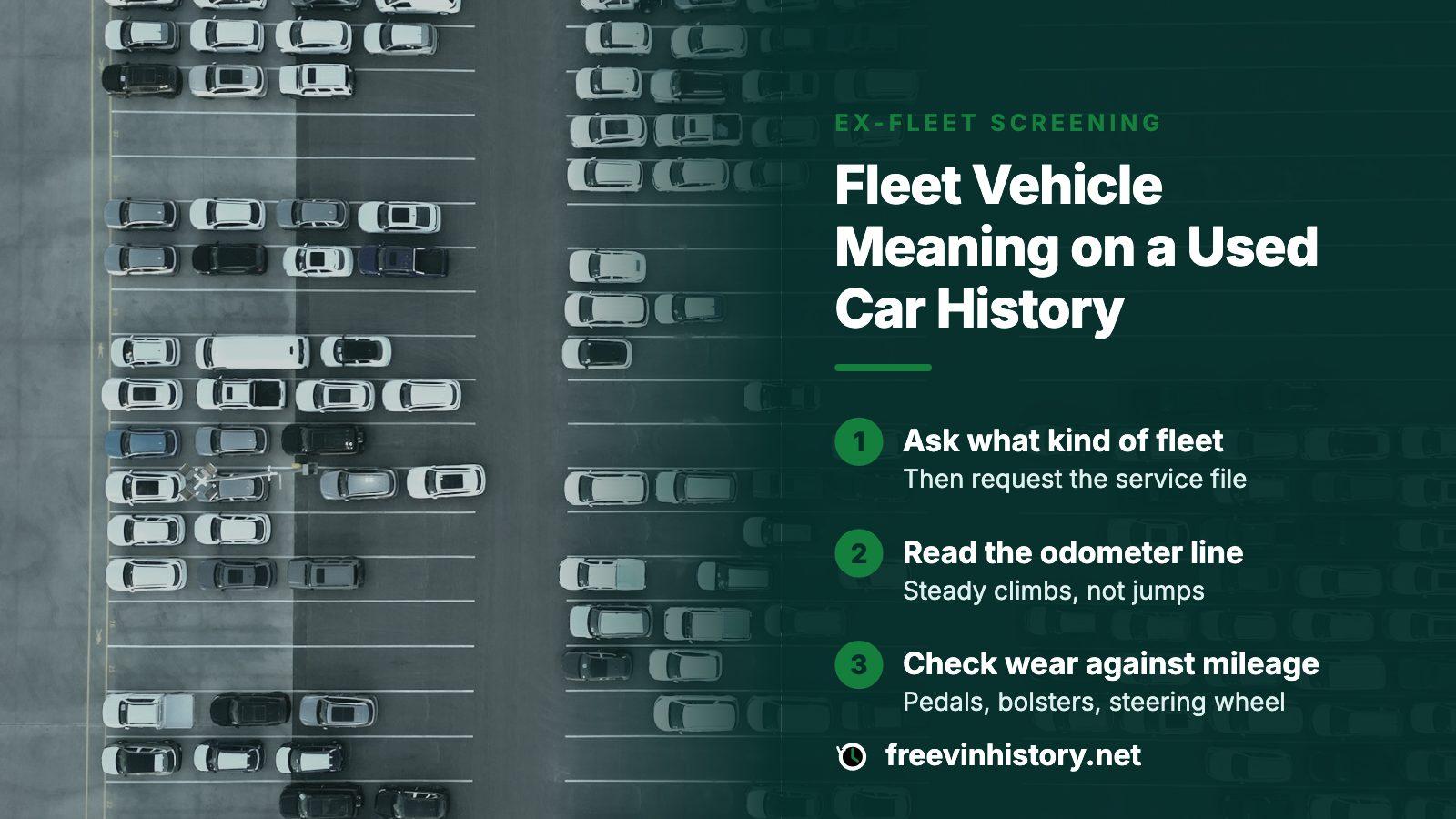
THE SHORT ANSWER
Fleet means the car belonged to an organization that ran many vehicles: a delivery company, a utility, a city, a sales force or a rental lot. Fleet cars often pile up miles quickly and usually follow a set service plan, but neither is guaranteed. Judge the individual car by its title brands, odometer record, open recalls and service paperwork.
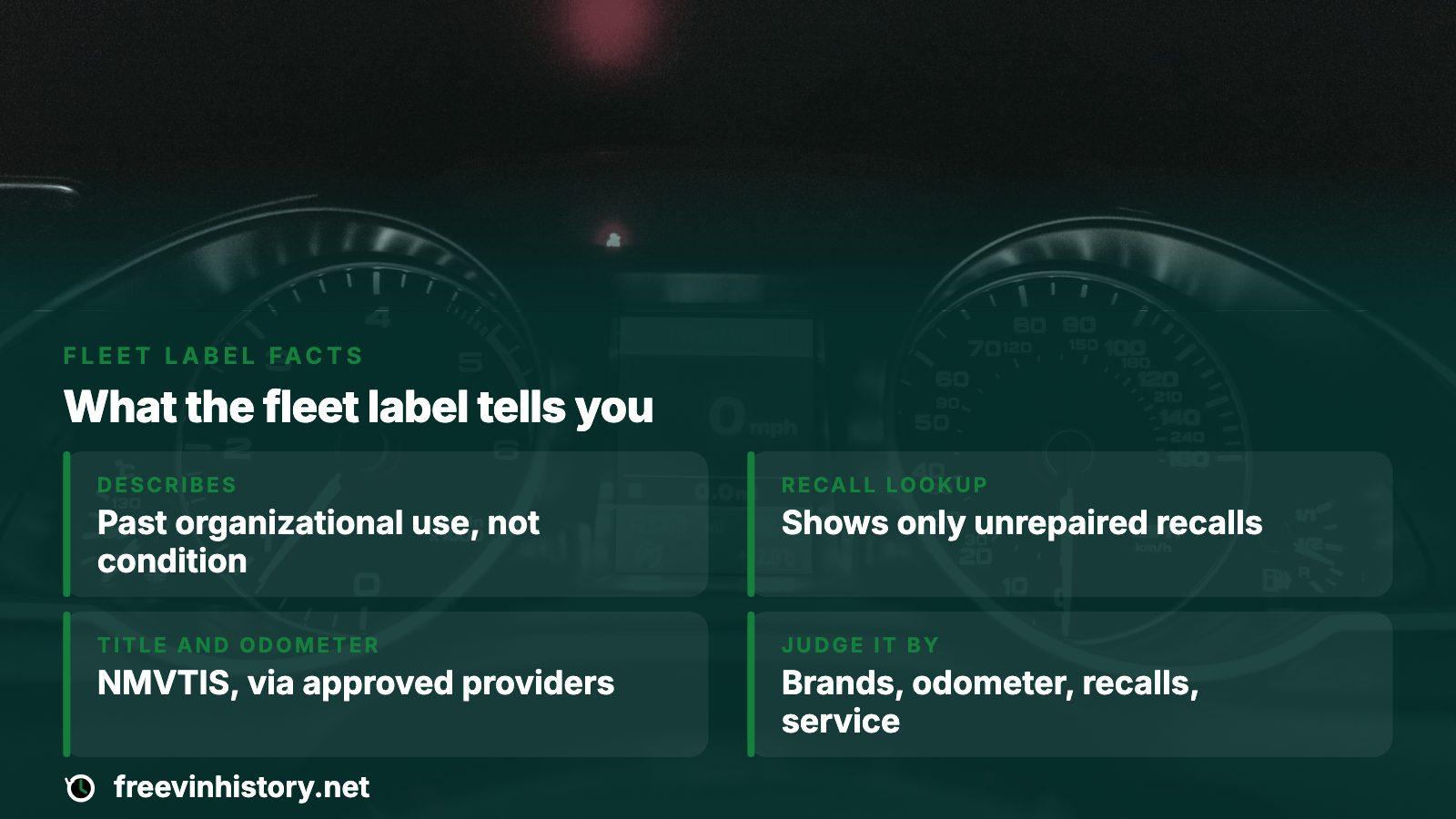
- What it describes
- Past use by an organization, not condition
- Free official recall check
- NHTSA, by VIN, shows only unrepaired recalls
- Free theft and salvage check
- NICB VINCheck, five searches per day per IP address
- Title and odometer data
- NMVTIS, through approved report providers
What a seller means by fleet
In everyday car-lot talk, a fleet vehicle is any car that was bought for a company or public body to be used by employees or customers. Plumbers' vans, sales reps' sedans, county pickups and airport rental cars all qualify. The business usually holds the title, pays the insurance and decides when to sell, often on a schedule tied to age or mileage instead of to trouble.
No federal page we opened sets a single legal definition for the word as a used-car buyer meets it, so treat it as a description of ownership. Different report providers draw the line differently: one may tag a rental or taxi separately from a corporate fleet, another may fold them together. Read the exact wording on the report you have, and ask the seller which kind of fleet it was.
Why the label shows up on a history report
Use type is a piece of ownership history. It comes from registration and titling records, from companies that remarketed the vehicle, and from other providers that choose to report it. That is also why two reports on the same car can disagree: the label depends on which source reported and when.
The Justice Department's title system, NMVTIS, gathers a car's title, its newest mileage entry, any condition brands and, now and then, theft history. Nothing on its consumer pages names fleet or rental use as one of those fields. So a fleet tag, where one appears, usually sits on top of the government data and comes from a report provider's own sources.
What fleet leaves unanswered
- Crash history. Many hands drive a fleet car, yet a tidy fleet record is silent about collisions that nobody reported or repaired on paper.
- Mileage honesty. Big numbers are normal on a work car; what matters is whether successive readings rise in a believable line.
- Title status. A salvage or flood brand can land on a fleet car just as easily as on a family sedan.
- Upkeep. A company may keep neat service logs or none; the paperwork settles it, not the label.
Put simply, fleet describes who used the car. Condition is a separate question, and it is answered by records and an inspection.
A fleet owner and the recall that was not fixed
Fleet cars change hands often, and each handoff is a chance for an open recall to slip through. A real complaint filed with the federal safety agency shows how it happens on the service side.
From an NHTSA owner complaint
An owner running a 2013 Ford Fusion Hybrid as a fleet car took it in for service and asked the shop to look at the seat belt pretensioner recall. A service rep replied that the repair would wait until the part actually failed, and that parts were scarce. The invoice had no recall check on it, even though one was requested when booking.
The lesson for a buyer: a car that lived on a fleet schedule may still carry an unrepaired recall, so run the VIN yourself instead of trusting a service stamp.
Rental use is a different kind of fleet
A rental car is fleet use with a twist: many short-term drivers, each one unfamiliar with the car. Those drivers sometimes notice quirks an owner would have learned to live with.
From an NHTSA owner complaint
Someone driving a rental 2012 Chevrolet Malibu reported to NHTSA that a shoe could get caught between the gas pedal and the plastic beside it, so the car would not ease off. The fix was to stomp the pedal flat and rotate the foot. No crash came of it.
Nothing here proves a rental car is worse than another used car. It shows why a test drive, with your own shoes and your own driving position, belongs on the checklist for any ex-fleet vehicle.
The free checks worth running first
Before paying anyone, spend ten minutes on the free official tools. Each answers a narrow question, and each says plainly what it leaves out.
| Free tool | What it answers | What it leaves out |
|---|---|---|
| NHTSA recall lookup | Any open, unrepaired recall tied to this exact VIN | Repaired recalls, brand-new recalls not yet loaded for every VIN, and recalls past 15 years |
| NICB VINCheck | Whether insurers reported the VIN stolen and unrecovered, salvage or flood damaged | Insurers that do not take part, police records and anything about how the car was used |
| NMVTIS consumer information | Where to find title, odometer and brand history | Fleet or rental use, since it is not a listed field |
NHTSA also lets you search up to 100 VINs at once, handy if a dealer is selling several ex-fleet cars from one lot.
Where a full report earns its place
NICB itself warns that its lookup is no substitute for a full history report. Here the free preview on this site is the next step: enter the VIN, see what turns up, and decide whether the car merits the one-time paid report. That report is where title brands, odometer readings, accident and damage records, and ownership and use type sit side by side.
For a car described as fleet, the sections to read first are ownership and use type, then odometer readings, then brands and damage. Prices are on the pricing page; the preview costs nothing.
A short checklist for an ex-fleet car
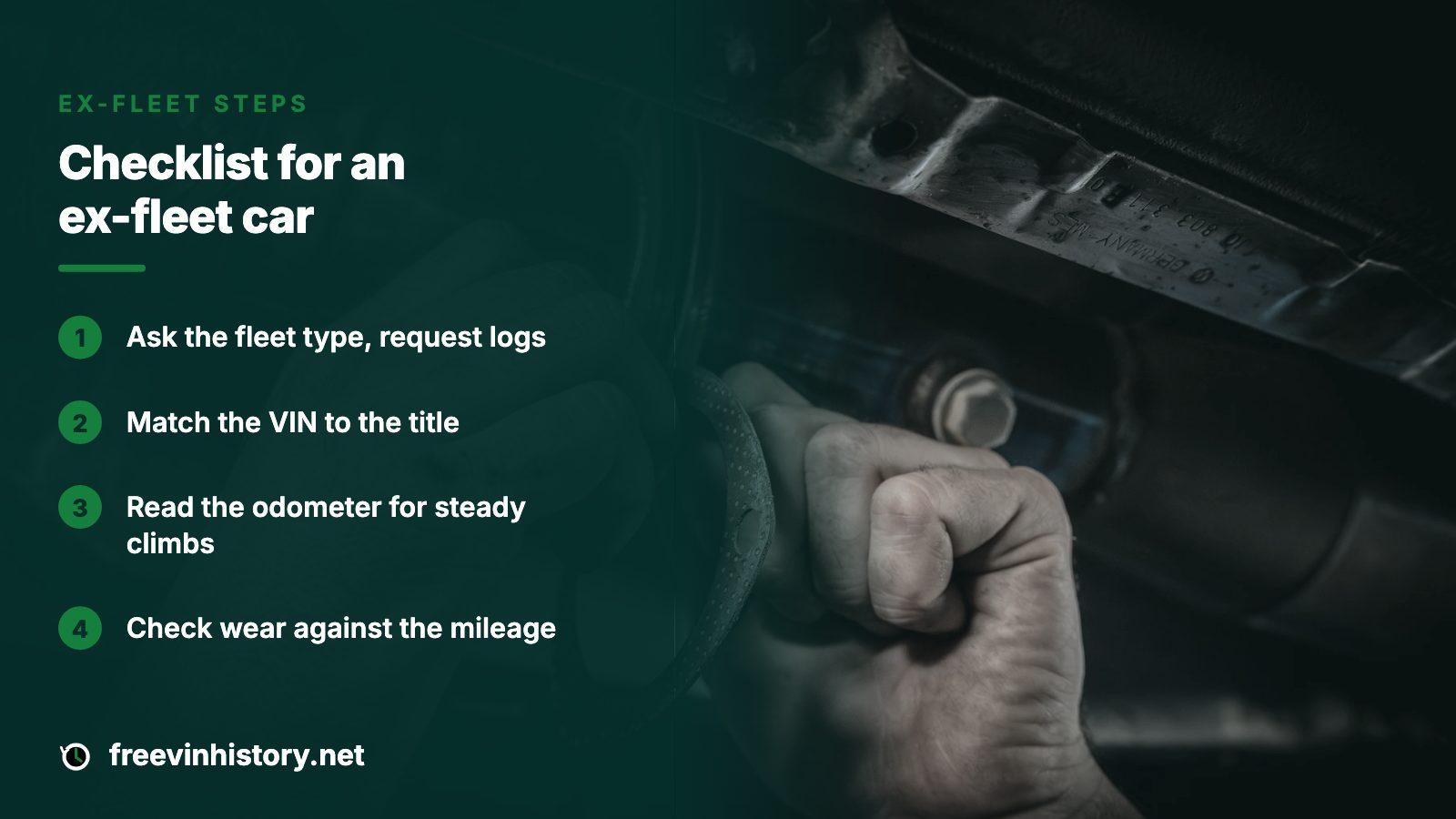
- Ask the seller what kind of fleet it was, and request the service file.
- Find the 17-character VIN on the windshield base or registration and confirm it matches the title.
- Run the NHTSA recall lookup and the NICB lookup.
- Run the VIN preview and read the odometer line for steady climbs, not jumps.
- Look for wear that matches the mileage: pedals, seat bolsters, steering wheel, door panels.
- Have an independent mechanic look at brakes, tires and suspension before you sign.
If the price is only slightly below the same car with private-owner history, ask why you would take on the unknowns. A fair discount for hard use is reasonable; a large one with no records is a warning.
Where this information comes from
- NHTSA: Check for Recalls — What the VIN recall search shows and omits, the 100-VIN option and alerts.
- NICB: VINCheck — Theft, salvage and flood scope, the daily search limit and its own caveats.
- U.S. Department of Justice: NMVTIS for consumers — What the system holds on a car and which businesses feed it.
- NHTSA owner complaint 11001788 — owner experience, paraphrased
- NHTSA owner complaint 10487305 — owner experience, paraphrased
Sources and photos: Facts checked against the sources above in November 2026. Photos by Iain, Martin Fennema and Ambitious Studio* | Rick Barrett on Unsplash; diagrams by FreeVINHistory.
Keep reading
- Former rental car history: what free sources show and what they missRental use in detail, the most common kind of fleet history.
- Lease vehicle history meaning: buying a car that was leasedHow lease returns differ from company fleet cars.
- Free open recall check by VIN: GM, Polaris and every other makeStep-by-step recall lookups for any make.
- Free vehicle history report: what the free sources showWhat free sources cover before you move to a full report.
Frequently asked questions
Is a fleet vehicle a bad buy?
Not by itself. Fleet use can mean regular servicing or it can mean hard, anonymous driving, and the label cannot tell you which. Price the car against its mileage and records, compare its history to similar cars, and have a mechanic inspect it. A clean title and steady odometer matter more than the word fleet.
Does a fleet vehicle have a different title?
No. Fleet is a use description, not a title brand. Brands such as junk, salvage or flood describe condition and are tracked by states and NMVTIS. A fleet car can carry a clean title or a branded one, so check the title record separately instead of assuming either.
Can I see if a car was fleet-owned for free?
Not reliably. The free official tools covered here look at recalls, theft, salvage and flood records, and none of them reports how a car was used. The free preview here is a quick first look at the VIN, and ownership and use type appear in the paid report.
Are rental cars and fleet cars the same thing?
Rental cars are one kind of fleet. Others include taxis, delivery vans, police cars and company-assigned sedans. Some reports separate these categories and some group them, so read the exact label and ask the seller who the previous operator was.
What should I ask a dealer about an ex-fleet car?
Ask who owned it, how long, and why it was sold. Request maintenance logs, the recall repair status for the VIN, and the original purchase paperwork if they have it. A dealer who bought it at auction may know little, and that gap is worth weighing in the price.
Now check the car itself
The guide explains what to look for. The report shows what this VIN has on record.