THE SHORT ANSWER
A leased car belonged to a leasing company the whole time, while one driver paid to use it for a set term and mileage allowance, then handed it back. Off-lease cars are often newer, with moderate mileage and maker-scheduled service, yet the label guarantees none of that. Check recalls, theft and salvage records, title brands and the odometer, then ask for the service file.
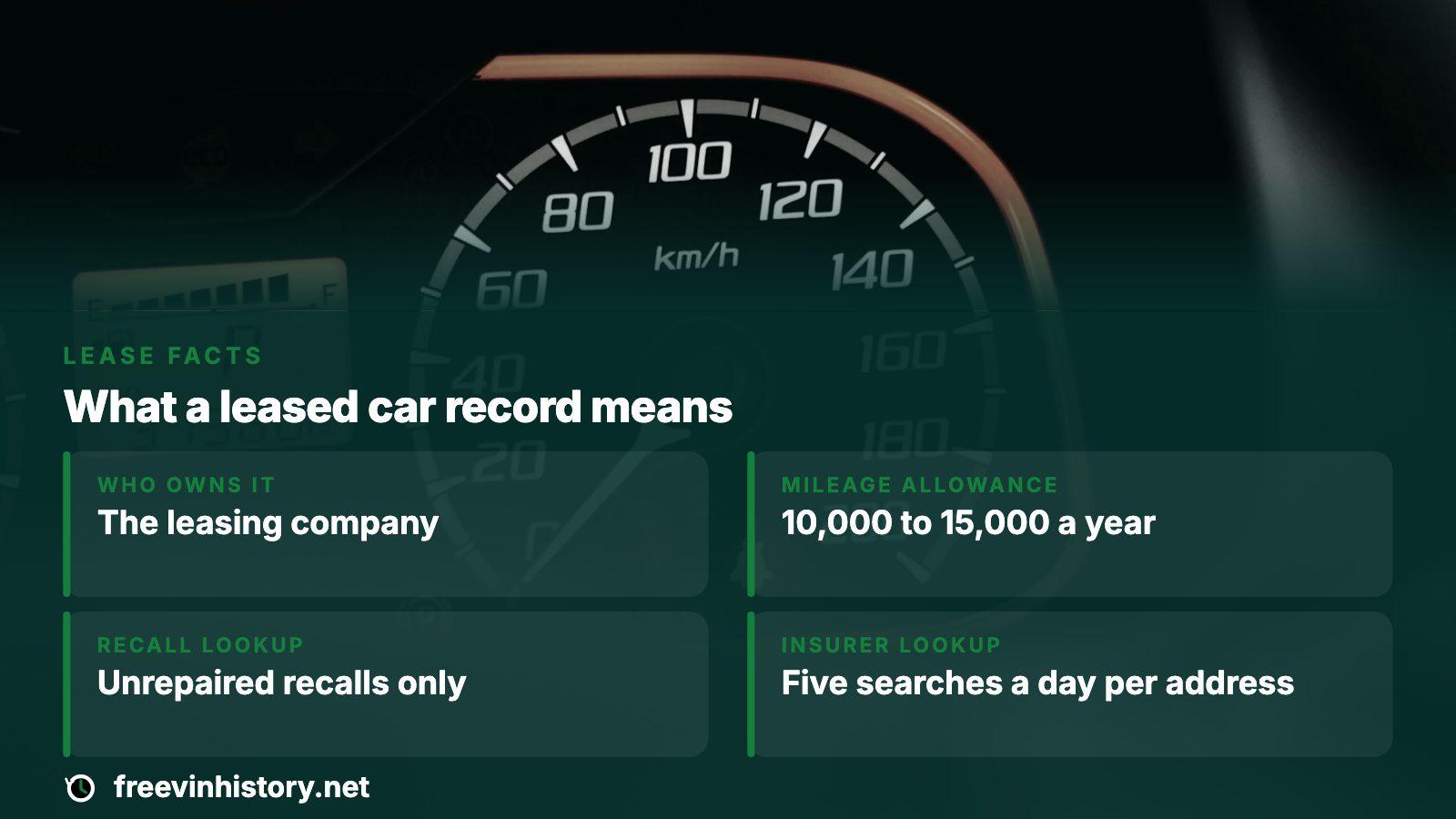
- Who owns a leased car
- The leasing company, not the driver
- Typical mileage allowance
- 10,000 to 15,000 miles a year
- Free recall check
- NHTSA, by VIN, unrepaired recalls only
- Free insurer-record check
- NICB VINCheck, five lookups a day per IP address
What the phrase actually describes
When a listing or report points to lease history, it is describing a ownership arrangement, not a condition. The leasing company held the title. The driver covered the value the car was expected to lose while in use, added to a finance charge, taxes and fees, in exchange for an agreed number of months and miles behind the wheel. The FTC frames it as buying use of the car, not the car.
When the term ends the car goes back, unless the agreement gave the driver a purchase option. That return is how most off-lease cars reach dealer lots, and it is also why a lease car can show up with one earlier driver, a short ownership chain and a title that changed hands only once or twice.
Why mileage and wear are the two things to watch
A lease carries a yearly mileage cap. The CFPB says most fall between 10,000 and 15,000 miles a year, and the Federal Reserve's leasing guide describes limits of 12,000 or 15,000 as common. Drivers who go over pay by the mile when they return the car, so many people watch the odometer closely. That counts for a little, since a leased car is more likely to show restrained use than a car with no allowance at all.
The wear side works differently. The lessee answers for excess wear, damage and missing equipment, and the standard for excessive wear is generally set by the company that owns the car. A driver who expects a bill may fix dents and tires before returning it, or may not bother and pay the charge. Either way, what you see at the dealer reflects that choice, so a clean-looking body is not proof of anything.
What to take from the cap
A low-mileage lease car is not automatically gentle. A cap limits distance, not how hard the miles were. Read the odometer history for steady climbs, then judge the car by how it drives and what the service papers show.
What the free official sources say about a leased car
Three public tools are worth running before you spend money. None is built around leasing and none tags a car as a former lease, so use each for its own job.
| Source | Good for | Blind spots |
|---|---|---|
| Recall lookup (NHTSA) | Open safety recalls attached to the VIN you type in | Repairs already done, very fresh notices, campaigns past the 15-year mark |
| NICB VINCheck | A theft, salvage or flood flag from member insurers | Carriers outside the program, police files, and how the car was driven |
| NMVTIS consumer data | Title details, brand history and the latest reported odometer reading | Lease use, which the consumer page never mentions |
Expect a daily cap of five lookups from one connection on VINCheck, and a caution from NICB that it is only a starting point. If a dealer lines up a row of off-lease cars, NHTSA's bulk option handles a hundred VINs per search.
Buying your own leased car at the end
A driver who wants to keep the car uses the purchase option, if the lease has one. The price is the residual value written into the lease, and the Federal Reserve notes that when the car's market value is above that figure, the difference is equity the driver can capture only through the option or by selling or transferring it. Lessors also often let a driver extend month to month for up to 6 months while deciding.
Buying a car you already drove is the one case where you know the history, but it still pays to run the VIN. A buyout does not erase a recall, and your own memory will not show a record filed by someone else, such as an insurer.
Two owners who bought cars that came off a lease
From an NHTSA owner complaint
One 2016 Honda Civic owner bought the car after a three-year lease ended. Within months the air conditioning blew hot air. The maker confirmed it would cover the condenser if a fault was found, but the dealer also condemned the compressor and a seal, and the owner was told the bill would run close to two thousand dollars.
From an NHTSA owner complaint
A second owner bought a certified used 2015 Hyundai Sonata that had been a lease car, with 36,000 miles on it. While driving at roughly 35 mph the engine started clunking and then failed. The car was towed to the dealer for a replacement engine, and the owner asked the maker for a recall.
Both are owner accounts, not findings, and neither proves anything about lease cars in general. The lesson is narrower: low miles and a former lease say little about coming repairs, and warranty coverage that sounds broad can stop short of the parts that fail. Open recalls and the exact scope of any coverage are the questions to settle before you pay.
A short routine for an off-lease car
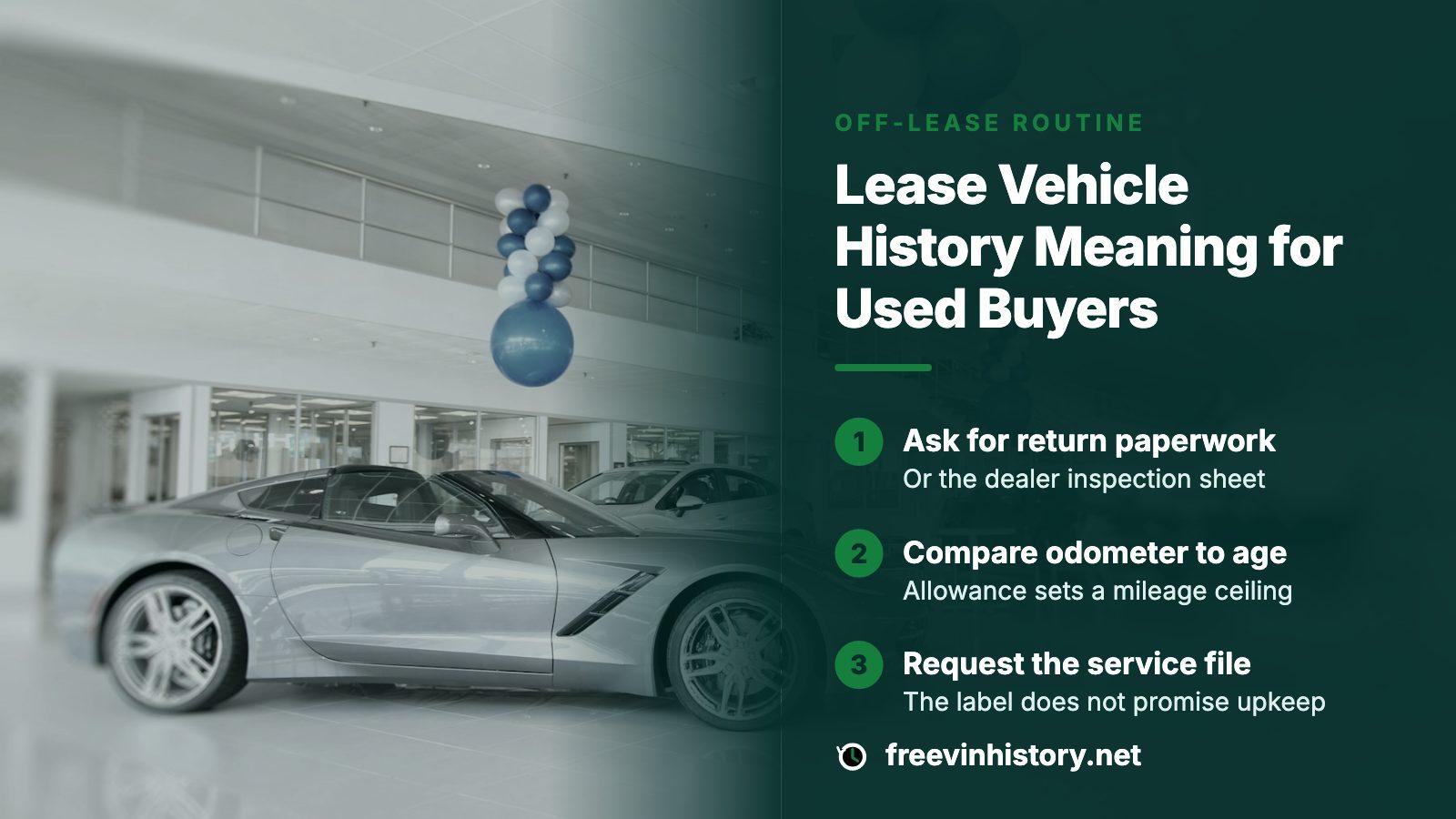
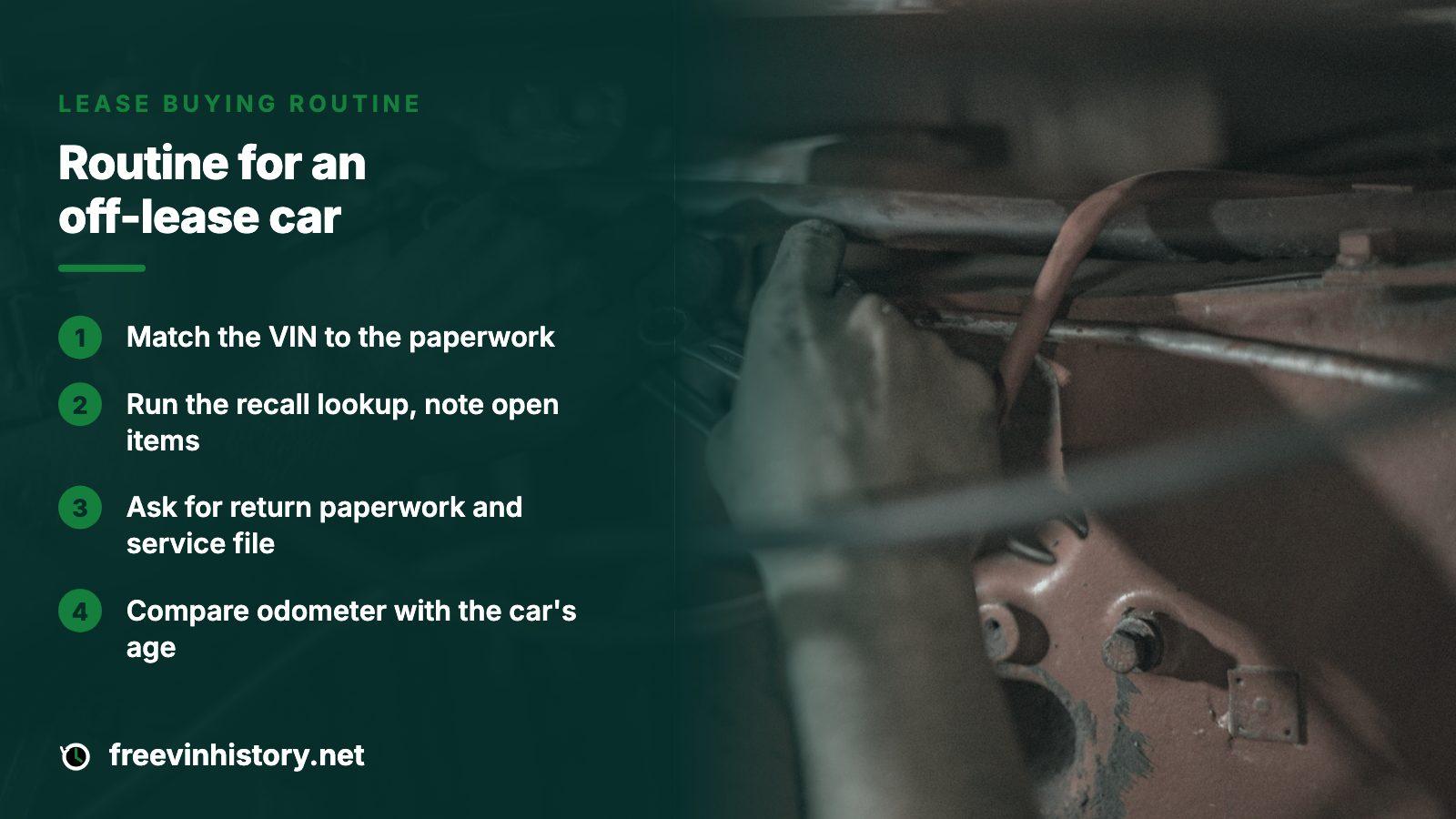
- Read the VIN off the windshield corner nearest the driver or off the registration, and confirm it matches the paperwork.
- Run the NHTSA recall lookup and note anything unrepaired.
- Run NICB VINCheck for theft, salvage and flood flags.
- Ask the seller for the original lease return paperwork or the dealer's inspection sheet, and for the service file.
- Compare the odometer to the age of the car. A lease with a 12,000 mile allowance and a three-year term implies a ceiling far below what many used cars show.
- Have an independent mechanic inspect it before any deposit.
The mileage arithmetic in step five is only a rough guide, since a driver may have bought extra miles up front. Treat a number far above the allowance as a question for the seller.
When the paid report is worth it
The free sources stop at recalls, insurer theft and salvage flags, and thin title data. They leave out accident and damage records, auction history, liens, and the ownership and use-type picture that tells you how many hands held the car. If you are within a few days of buying, run the VIN through the free preview here first, then decide whether the full report is worth one payment for this particular car.
See the pricing page for the cost. Only the preview costs nothing; the report is one purchase, with no subscription.
What we could not confirm
We could not find an official federal page that says history reports mark a car as a former lease, so we make no promise that any given report will. Federal pages on the odometer disclosure rules did not open for us, so this guide says nothing about lease odometer statements. Ask the seller what paperwork exists, and rely on records you can verify.
Where this information comes from
- FTC: Financing or Leasing a Car — What a lease is, mileage caps, wear responsibility and early termination.
- CFPB: Leasing versus buying a car — Who owns the car, typical mileage caps, and the buyout option.
- Federal Reserve: Vehicle Leasing, returning the vehicle — Return charges, purchase option equity and month-to-month extensions.
- U.S. Department of Justice: NMVTIS for consumers — What title data the system holds and where it comes from.
- NICB: VINCheck — Free theft and salvage scope, the daily limit and its caveats.
- NHTSA: Check for Recalls — What the VIN recall search shows and omits.
- NHTSA owner complaint 11309093 — owner experience, paraphrased
Sources and photos: Facts checked against the sources above in November 2026. Photos by Richard R, Nina Mercado and muhammad dennisa on Unsplash; diagrams by FreeVINHistory.
Keep reading
- Fleet vehicle meaning: what it says about a used car's pastHow company fleet use differs from a single lease.
- Former rental car history: what free sources show and what they missRental use, the other common short-term arrangement.
- Free vehicle history report: what the free sources showWhat free sources cover before you consider a full report.
- Free odometer check by VIN: what you can verify before you payReading the odometer record on an off-lease car.
Frequently asked questions
Is a lease return a good used car to buy?
It can be. Off-lease cars tend to be fairly new and are often serviced to a maker schedule, but a lease history guarantees neither. Judge the individual car by its recalls, title and odometer record, service paperwork and a mechanic's inspection, and price it against similar cars.
Does a lease show up on a free VIN check?
Not on the free official tools we opened. NHTSA covers recalls, NICB VINCheck covers insurer theft and salvage flags, and NMVTIS consumer pages never bring up leasing. Use-type labels, where they appear, come from report providers' own sources.
Who owned a car while it was leased?
The leasing company held ownership throughout, and the driver paid to use it. That is why the title often shows few changes. If a driver bought the car at the end, the title then moves to that person.
What happens if a lease driver ends the lease early?
The driver may owe a substantial early termination charge, and a stolen or totaled car is generally treated the same way. The car then goes back to the lessor, which may sell it at auction or to a dealer. That path can leave damage or insurer records worth checking.
Can I check a leased car's history before I buy it?
Yes, with the VIN. Run the free recall lookup and VINCheck first, ask the seller for lease return and service papers, then run the preview here. Move to the full report if the car passes and you are close to paying.
Now check the car itself
The guide explains what to look for. The report shows what this VIN has on record.