THE SHORT ANSWER
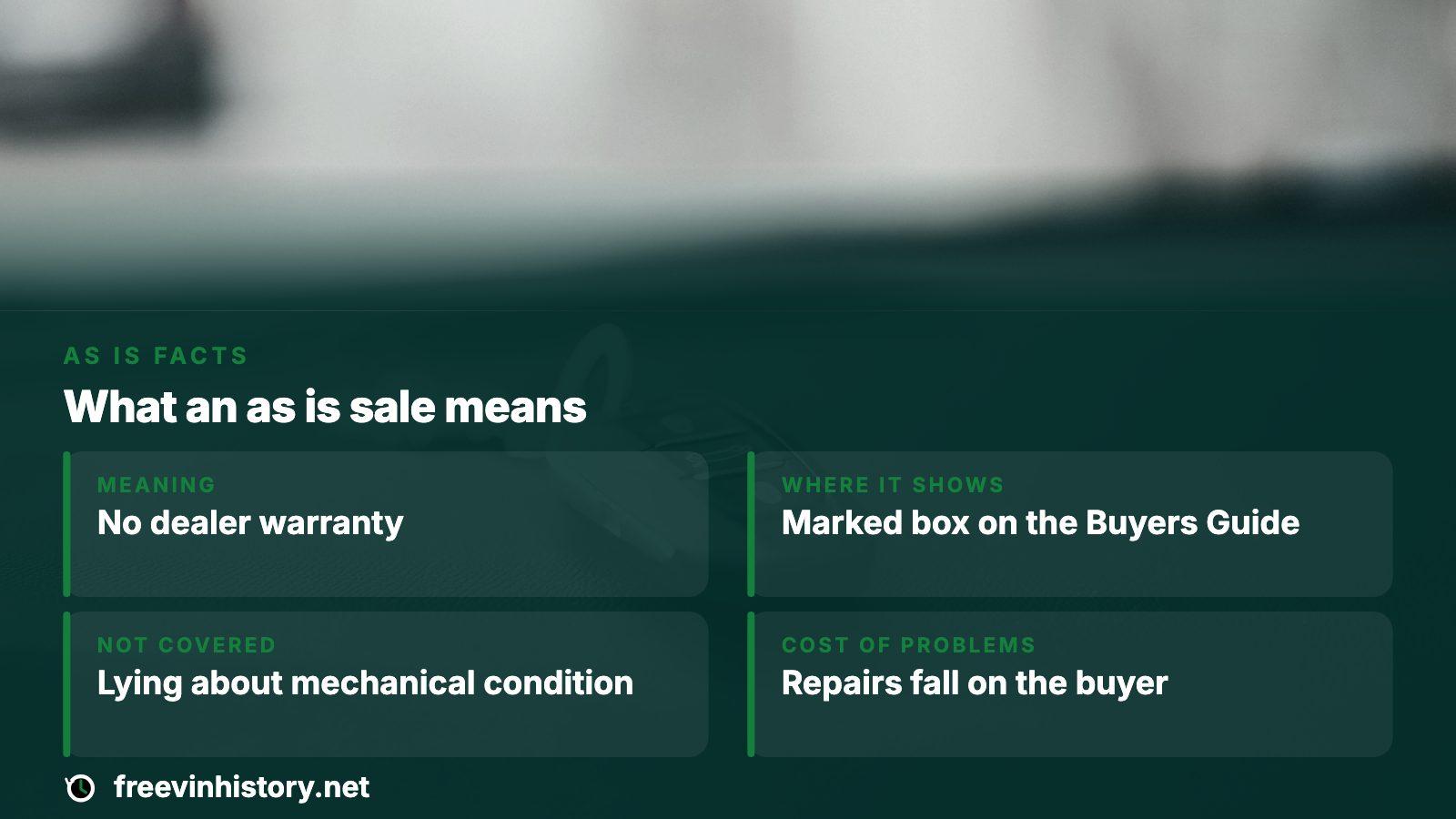
An as is sale means the seller offers no warranty, written or implied, on the car. If it breaks the day after you buy it, the repair bill is yours. Dealers must mark this on the Buyers Guide, and the box does not excuse lying about the car's condition. Since you carry the risk, check the VIN against free official records and get a mechanic to look before you pay.
- What it means
- No dealer warranty, so later repair costs fall on the buyer
- Where it shows
- A marked box on the dealer's Buyers Guide window form
- Not covered by the box
- Lying about mechanical condition is still a violation
- Free first step
- Run the VIN through official recall and insurer records
The plain meaning of an as is sale
Think of a handshake with no safety net. The car changes hands in whatever shape it is in, and a transmission that fails on the first commute is your problem.
The FTC's consumer page says the same thing plainly: the dealer declines to cover repairs, and whatever goes wrong afterward is on you.
The phrase says nothing about whether the car is good. Plenty of sound, older cars sell this way. What it removes is your fallback if you guessed wrong.
Where a dealer has to say it: the Buyers Guide
Dealers must post a Buyers Guide in each used car's window. The FTC says that includes small vans and pickups, dealer demo cars and off-lease program cars, and online buyers get a copy too. Motorcycles and most recreational vehicles are exempt.
With no written warranty, the dealer marks one of two boxes. One reads As Is, No Dealer Warranty. The other, Implied Warranties Only, is for places where state rules restrict as is deals. The form also carries the car's VIN and a contact for complaints.
- Look for the marked box before you talk price.
- Compare the VIN on the form with the one on the car.
- Ask for a copy of the final form at signing.
- Wisconsin and Maine dealers use their own version, so read the wording on those.
The final form becomes part of your sales contract and beats conflicting contract language. A dealer may not say anything that contradicts it.
What the as is box waives, and what it leaves alone
The box concerns warranties. Under the federal rule, a warranty is a written undertaking to refund, repair, replace or maintain the car without charging extra. Marking as is means the dealer makes no such promise, and the unwritten ones state law would add are off too.
It gives the dealer no license to misdescribe the car. The rule treats a false account of mechanical condition as deceptive, with no exception for as is. A salesperson who says the engine never gave trouble, when it did, made a statement the box does not cover.
| Question | As is sale from a dealer |
|---|---|
| Dealer pays for repairs after the sale? | No |
| Dealer may misstate the car's condition? | No, the rule forbids it |
| Federal rule overrides a state ban on as is? | No, state law wins |
| Does a spoken promise protect you? | Weakly, so get it on the form |
The unwritten promises that as is erases
Without a written warranty, a car is still covered by implied ones, unless the sale is as is. The main one is a promise that the car does what cars do, meaning it runs. It reaches basic functions only, and you must show the fault existed at purchase.
Another applies if you buy on the dealer's advice for a particular job, such as towing a trailer. Lengths vary by state, and the FTC notes coverage can run as long as four years in places. An as is sale gives all of this up.
A service contract can change the picture
Per the FTC, a service contract bought from the dealer within 90 days of the sale stops the dealer from removing implied warranties on the systems that contract covers. An extended warranty is not a true warranty, but it can bring implied coverage back for the parts it names. Read what it covers before you count on it.
Private sales and what the rule does not reach
The federal rule targets dealers, and it defines them by volume: someone who has moved five or more used cars within the past year, counting cars merely offered. Banks and certain lessors are carved out. Anyone else is a consumer.
A neighbor selling from the driveway usually has no Buyers Guide, so the paper trail is thinner. In practice such sales run as is, with only the bill of sale and state law behind you.
With no form to read, put the effort into your own checks: see the title, compare its VIN with the car, and write down any promise.
Free checks to run while the risk is still yours
As is leaves the questions to you, so start with what costs nothing. Two official tools fit well and both take the VIN.
- NHTSA's recall search shows whether that exact car has an unrepaired safety recall. It will not show recalls already fixed, some very new ones, or non-safety campaigns.
- NICB VINCheck looks for theft, salvage and flood records reported by participating insurers. It allows five searches per address in a day.
- Compare the VIN across the windshield, the registration card and the paperwork before you rely on either result.
Neither is a full report. NICB says a clean result guarantees nothing, and police records and non-participating insurers are not searched. A clean answer means one kind of bad news is absent.
Where free results run out
An as is buyer fears a rebuilt wreck, a rolled-back odometer, a lender's claim still on the car. Free recall and insurer lookups touch only part of that. State title brands, odometer readings and auction history sit mostly elsewhere.
NICB notes that complete reports pull from more places, DMV title files and auctions among them, and mostly cost money. The federal title system's own site sells consumer reports as well. Read what any report lists before paying.
Here our full report is the natural step up. We offer a free preview first, then a one-time purchase, with details on the pricing page. Reach for it when the free tools come back clean on a car you still intend to buy as is.
Why a mechanic still matters
The FTC warns that no report stands in for a mechanic. Reports tend to show crashes and flooding, rarely worn-out parts, and on an as is car worn-out parts are the risk you buy.
Pick your own mechanic, even if the dealer calls the car certified. Ask for written findings with a repair estimate and the VIN on the page, then use the total to bargain.
If a dealer refuses to allow an independent inspection, the FTC suggests simply shopping at another dealer. For an as is car, that refusal tells you something about the car or about the seller.
A short routine before you sign
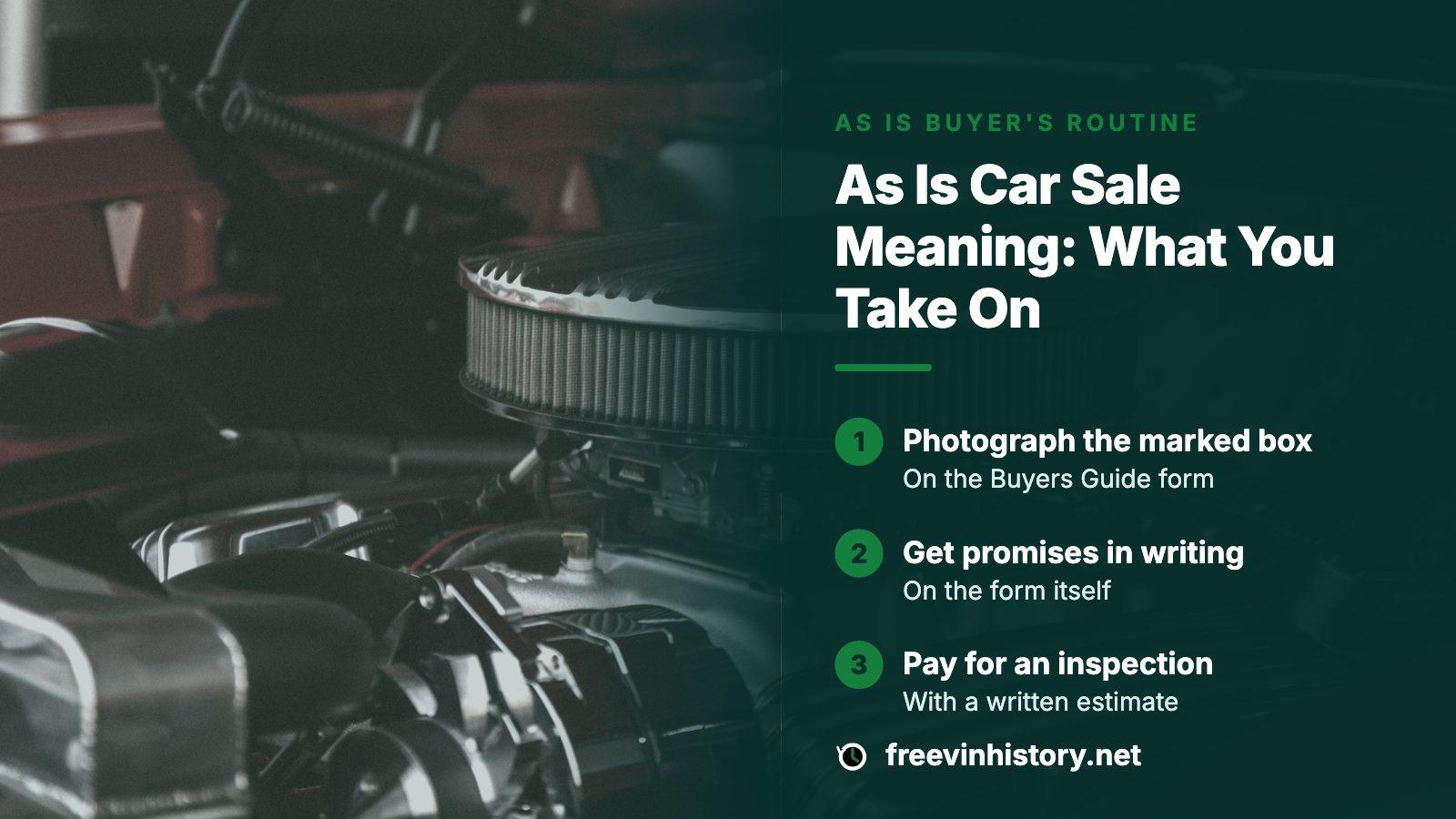
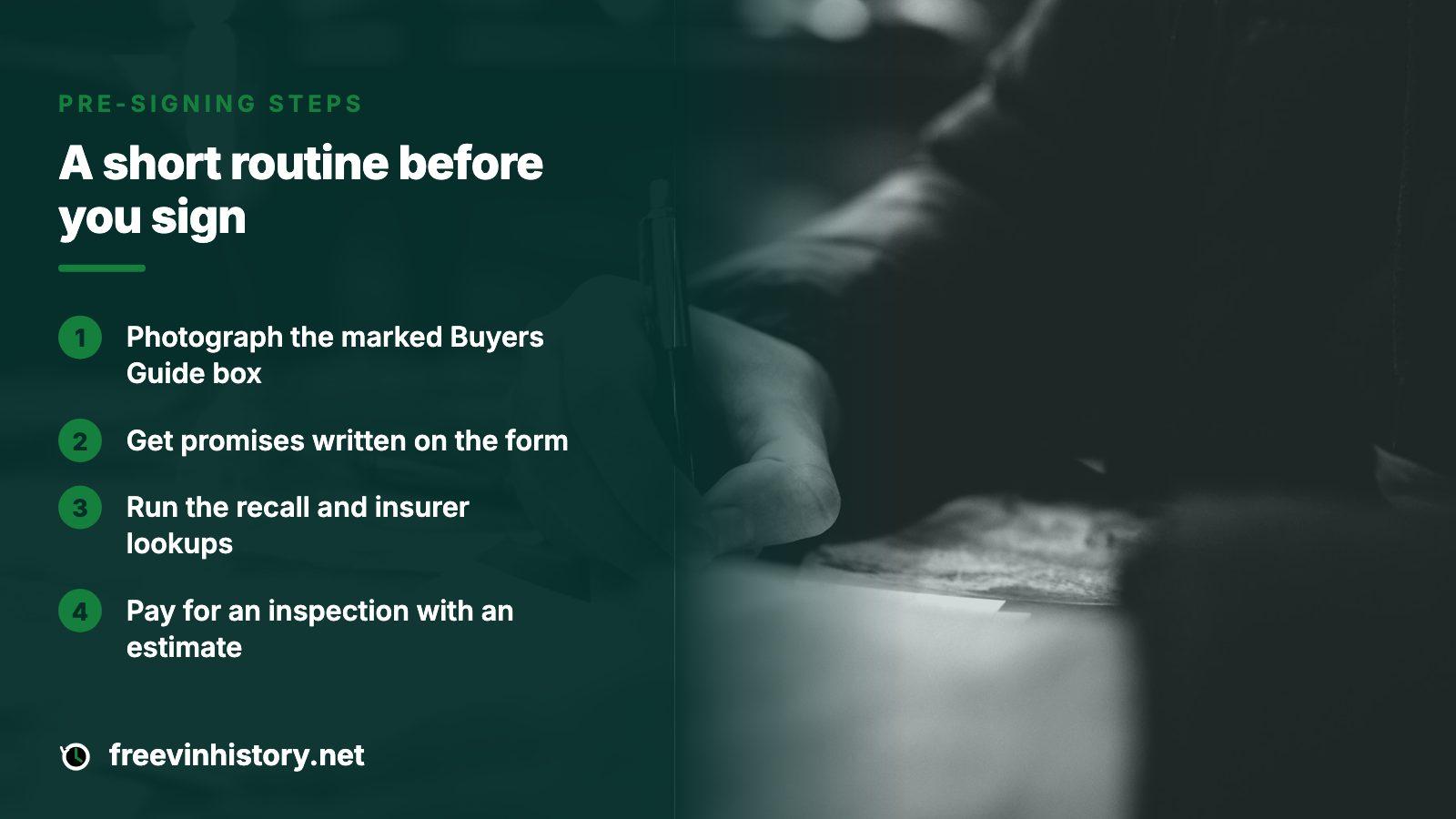
- Read the box that is marked on the Buyers Guide and photograph it.
- Get any promise, such as a repair or a chance to cancel, written on the form itself.
- Run the free recall and insurer lookups, then add the VIN report if the car is worth it.
- Pay for an inspection with a written estimate.
- Ask about any return policy in writing, since no federal cancellation window exists for dealer sales.
- Contact your state attorney general's office to learn the as is disclosure rules where you live.
Done in that order, an as is sale becomes a decision you made with your eyes open, rather than a gamble you discovered afterward.
Where this information comes from
- FTC: Buying a Used Car From a Dealer — Backs the as is meaning, implied warranties and the inspection advice.
- eCFR: 16 CFR Part 455, Used Car Rule — The dealer definition, window form duties and the state law override.
- FTC: Dealer's Guide to the Used Car Rule — Confirms the two Buyers Guide versions and the buyer tips printed on it.
- NICB: VINCheck — What the free insurer lookup covers, its daily limit and its gaps.
- NHTSA: Check for Recalls — What a VIN recall search shows and leaves out.
- NMVTIS: Vehicle History — The federal title system site where consumers can buy a history report.
Sources and photos: Facts checked against the sources above in November 2026. Photos by Victor Hughes, Owen Michael Grech and Bence Balla-Schottner on Unsplash; diagrams by FreeVINHistory.
Keep reading
- Certified pre owned meaning: what the label does and does not proveCertified is not the same as warranted; see what that label promises.
- Car title search by VIN free: what you can see before you payWhich no-cost title lookups exist before you buy as is.
- Free open recall check by VIN: GM, Polaris and every other makeHow to read an open recall result for the car you are eyeing.
- Free vehicle history report: what the free sources showWhat free history tools show and where they stop.
Frequently asked questions
Can I return a car I bought as is?
Not by right: federal law sets no cancellation period for dealer sales. Some states grant one, and some dealers offer their own return window. Ask for the policy in writing before you sign, and check with your state attorney general about local rules.
Is a private sale always as is?
Usually in practice. The Buyers Guide rule is aimed at dealers, so a private seller has no form to mark. What protects you is the bill of sale, anything written down, and state law. Get promises on paper and inspect the car yourself.
Does as is mean the seller can lie about the car?
No. For dealers, the federal rule calls a false account of mechanical condition deceptive, as is or not. The box removes the repair promise only. If you were told something false, keep notes and contact your state attorney general.
What if the Buyers Guide says warranty but the contract says as is?
The FTC says the Guide overrides the contract in that case, and the dealer has to give the warranty described on the Guide. Keep your copy of the final form with your paperwork, since the written terms are what you would point to.
Should I still run a VIN check on an as is car?
Yes, more than on any other. With no repair backstop, find out what you can first. Start with the free recall and insurer lookups, then use the full report for title, odometer and auction records, and add a mechanic's inspection on top.
Now check the car itself
The guide explains what to look for. The report shows what this VIN has on record.