THE SHORT ANSWER
A certified pre owned car is a used vehicle that a manufacturer's program (or, less often, a dealer's own) has inspected and backed with a limited warranty. Each brand sets its own age cap, mileage cap, inspection list and coverage. Because the rules differ and a program inspection is not an independent one, verify the VIN against free official records and still hire a mechanic.
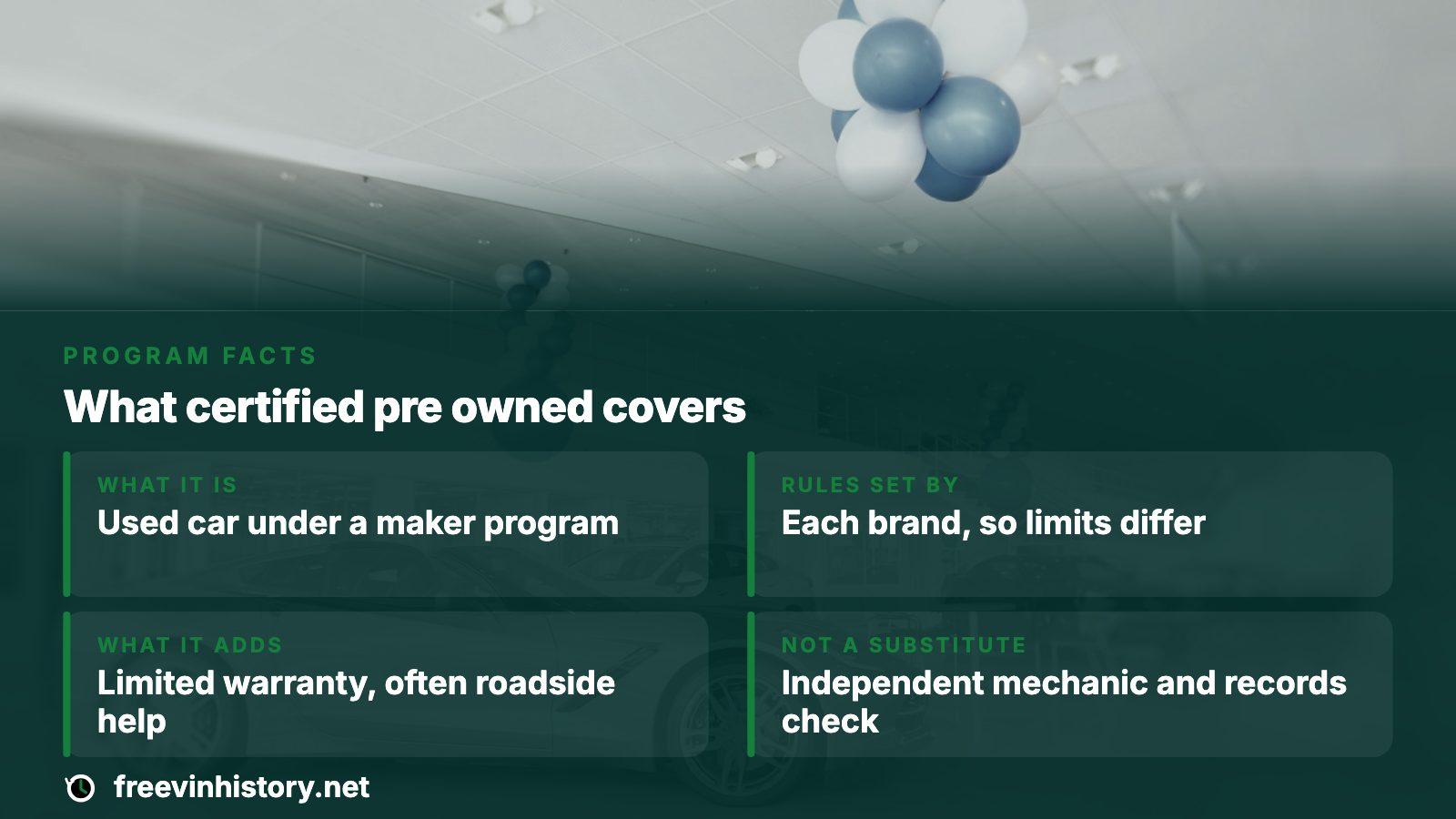
- What it is
- A used car sold under a maker's inspection and warranty program
- Who sets the rules
- Each brand, so limits and coverage differ
- What it adds
- A limited warranty, often plus roadside help and an inspection report
- What it does not replace
- An independent mechanic and a check of the car's own records
A label from a program, not a rule of law
Walk onto a lot and the word certified can sound like an official stamp. It is closer to a brand's loyalty program for its own used cars. A maker decides which trade-ins and off-lease cars qualify, tests them against its own list, and attaches coverage it stands behind.
That is why the FTC's used car buying page never defines the term. The agency writes rules about warranties and the dealer's Buyers Guide, but the word certified itself belongs to whoever runs the program. Two cars wearing the same label from different brands can come with very different promises.
Our approach is to begin with what official no-cost sources show about a car, so a label like this is one more claim to test against the VIN rather than take on faith.
Typical terms, using two makers as examples
Toyota's program, which began in 1996, runs two tiers. Gold Certified cars must be no older than 6 years and show 85,000 miles or fewer. They get a one-year, 12,000-mile broad limited warranty, and engine-and-drivetrain cover that lasts seven years or 100,000 miles. Silver Certified reaches back 10 model years and allows up to 125,000 miles, but its drivetrain cover is only one year or 12,000 miles.
Honda's HondaTrue Certified tier accepts 2021 through 2026 models with fewer than 80,000 miles, and its drivetrain coverage is listed at 7 years or 100,000 miles. The HondaTrue Used tier takes 2016 through 2026 cars at any mileage, with just 6 months or 10,000 miles of cover.
| Program tier | Age and mileage limits | Coverage headline |
|---|---|---|
| Toyota Gold Certified | Up to 6 years, 85,000 miles or less | 7 years or 100,000 miles on drivetrain |
| Toyota Silver Certified | Up to 10 model years, 125,000 miles or less | One year or 12,000 miles on drivetrain |
| HondaTrue Certified | 2021-2026, under 80,000 miles | 7 years or 100,000 miles powertrain |
| HondaTrue Used | 2016-2026, no mileage cap | 6 months or 10,000 miles |
These come from each maker's own pages and can change, so read the current terms for the exact car.
What the inspection claim really tells you
Programs advertise a point count. Honda lists 182 points for its Certified tier and publishes a downloadable inspection report; its comparison chart shows rival programs at 160, 167 and 172. A bigger number is not automatically a better inspection, since each maker decides what counts as a point.
The useful part is the written report. Ask to see it for the actual car, not a sample, and read which items were repaired or replaced to get the car certified.
The FTC adds a caution that fits here. Even a certified car that the dealer already looked over deserves a mechanic's visit. The seller has a stake in the sale. A mechanic you hire does not.
Reading the warranty like a contract
Certified coverage is almost always limited. The FTC notes that a limited warranty can cover only certain systems, and that a full warranty needs no time limit, no charge and transfer to any owner during its term. Drivetrain coverage, for example, speaks to the engine and transmission, not the air conditioning or the screen.
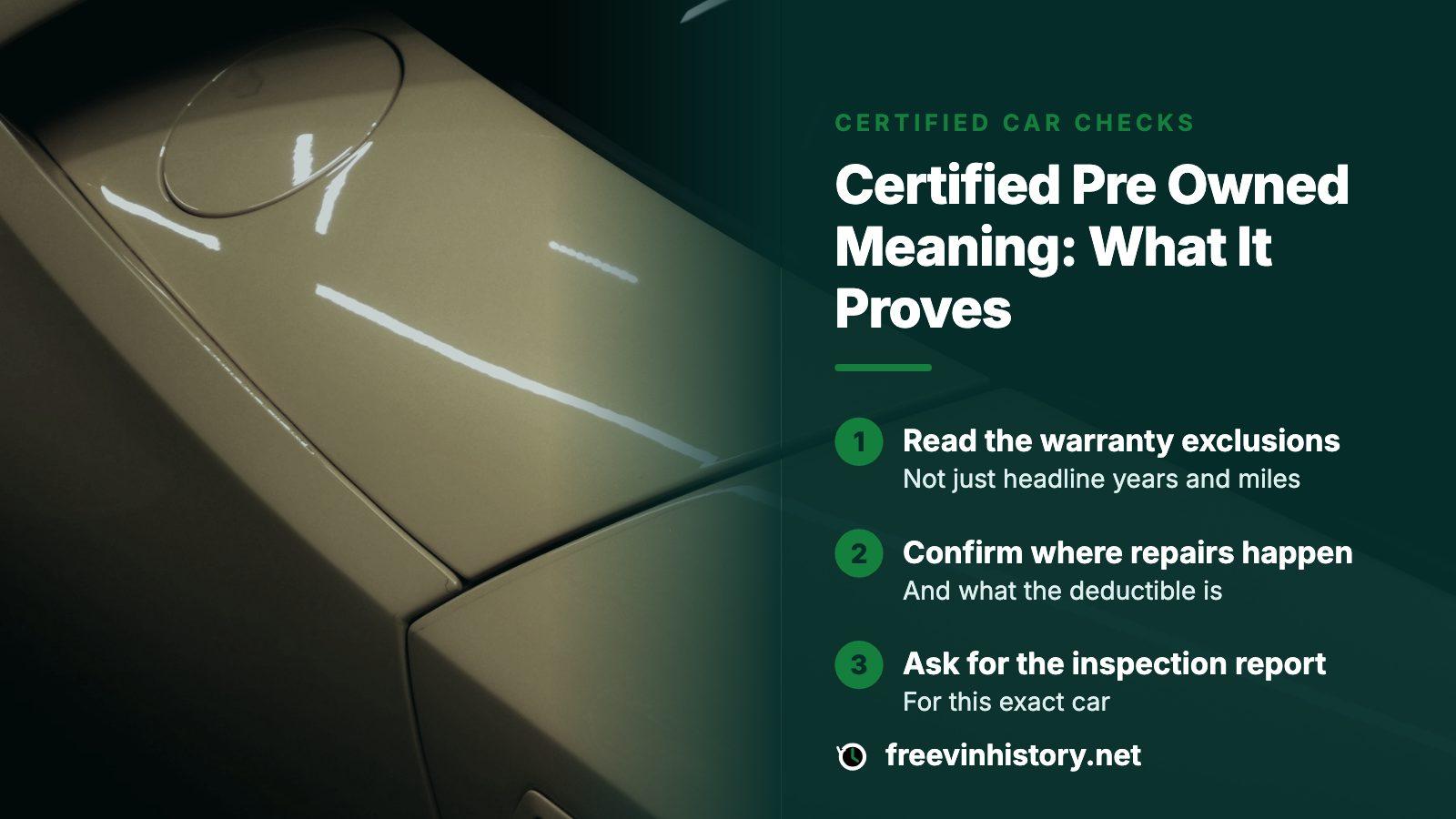
- Ask for the warranty booklet and read what is excluded, not just the headline years and miles.
- Find out whether the clock runs from the original sale date or from your purchase.
- Confirm the deductible, and whether repairs must happen at a brand dealer.
- Call the dealership with the VIN to verify coverage and paperwork, as the FTC suggests.
- Put every verbal promise in writing.
Remember that the dealer's Buyers Guide sits above conflicting terms in the sales contract, so check the box on it matches the deal you were told about.
What the free official checks add
A certified car should have no open safety recalls, and you can test that yourself. You can enter a VIN into the federal recall search and see whether any repair is still outstanding. It will not list recalls already fixed, some very new campaigns, very old campaigns past the 15-year mark, a maker's non-safety campaigns, and cars from small builders.
If the search shows 0 unrepaired recalls, that is a good sign, not a full history. Match it with the insurer theft and total loss lookups covered on the vehicle history guide, and keep a note of what each tool covers.
Compare, do not assume
Certification says the program accepted the car on one day. A VIN check shows what was recorded about it before and after that day.
Where free results run out
Free lookups stop short of title brand history, odometer readings across years, and auction or damage records. Those gaps matter on a certified car because the premium you pay assumes a clean past.
Programs usually name a history report from a particular vendor, and Honda's chart lists AutoCheck while Toyota lists Carfax. You still get one vendor's view, chosen by the seller. Running your own VIN lets you see the record without relying on what the dealer hands over.
Our full report is the natural step up here. The preview is yours to read first, and a CPO report is a single purchase only if you decide you want one; amounts are on the pricing page. Use it when the free checks come back clean and you are about to pay the certified premium.
When certified is worth asking for
Certification earns its keep on newer, low-mileage cars from a brand you expect to keep servicing at its dealers, where the extra coverage is longest. On an older car near the age cap, the warranty may be brief and the premium harder to justify.
Weigh the price gap against what the coverage is likely to cost you. A short drivetrain term on a high-mileage car protects against less than a long term on one with few miles.
Also check the seller. Some stores use the word certified for their own in-house checks with no maker behind it. Ask who stands behind the warranty and who pays if a covered repair is denied.
A sequence for a certified car you like
- Get the VIN and compare it across windshield, registration and the paperwork.
- Run the NHTSA recall search and the free insurer lookups.
- Ask for the inspection report and the warranty booklet for this exact car.
- Review the VIN report for title, odometer and damage records.
- Hire an independent mechanic for the CPO car and request any repair costs in writing.
- Compare the Buyers Guide with the paperwork before you sign.
Leave if the seller refuses to let anyone else inspect it. In that case the FTC suggests considering another dealer.

Where this information comes from
- FTC: Buying a Used Car From a Dealer — Backs the warranty definitions, Buyers Guide and the advice to still inspect a certified car.
- FTC: Dealer's Guide to the Used Car Rule — Shows the Buyers Guide is not itself a warranty.
- NHTSA: Check for Recalls — Covers what a VIN recall search shows and leaves out.
- Toyota Certified Used Vehicles: Certification — Source for the Gold and Silver age, mileage and warranty terms.
- Honda Certified: Certified Pre-Owned Benefits — Source for HondaTrue tiers, inspection points and history report named.
Sources and photos: Facts checked against the sources above in November 2026. Photos by Franck V., Mustafa Sheikhmouss and Richard R on Unsplash; diagrams by FreeVINHistory.
Keep reading
- As is car sale meaning: what you take on when you signThe opposite end of the warranty spectrum, with no dealer promise.
- Free open recall check by VIN: GM, Polaris and every other makeHow to run the recall lookup on a certified car.
- Free vehicle history report: what the free sources showWhat free history tools show and where they stop.
- Car title search by VIN free: what you can see before you payCheck the title brand behind the certified label.
Frequently asked questions
Is a certified pre owned car guaranteed free of past accidents?
No. Programs set an inspection and eligibility list, and some allow repaired damage. A VIN report is where accident, flood or salvage records show up, so read it yourself rather than assuming a certified car has a spotless past.
Is a manufacturer certified car better than a dealer certified one?
Often the maker's version has clearer written terms and a warranty honored across its dealer network. A dealer program can be fine, but ask who backs the coverage and get the terms in writing before you rely on it.
Can I skip the mechanic on a certified car?
The FTC still recommends hiring an independent mechanic for a certified car. The seller or maker did the inspection behind the label, and you cannot know how deep it went without your own inspector.
Does certified pre owned mean the warranty transfers to the next owner?
That depends on the program. Toyota lists extended warranty coverage as transferable at no cost, but terms vary by brand and tier. Read the booklet for transfer rules and any fee before you count on it at resale.
Is certified pre owned a legal term?
No federal rule defines it. The FTC's used car page does not discuss certified programs, so the label means whatever the program that issued it says. Compare the actual warranty and inspection documents rather than the word.
Now check the car itself
The guide explains what to look for. The report shows what this VIN has on record.