THE SHORT ANSWER
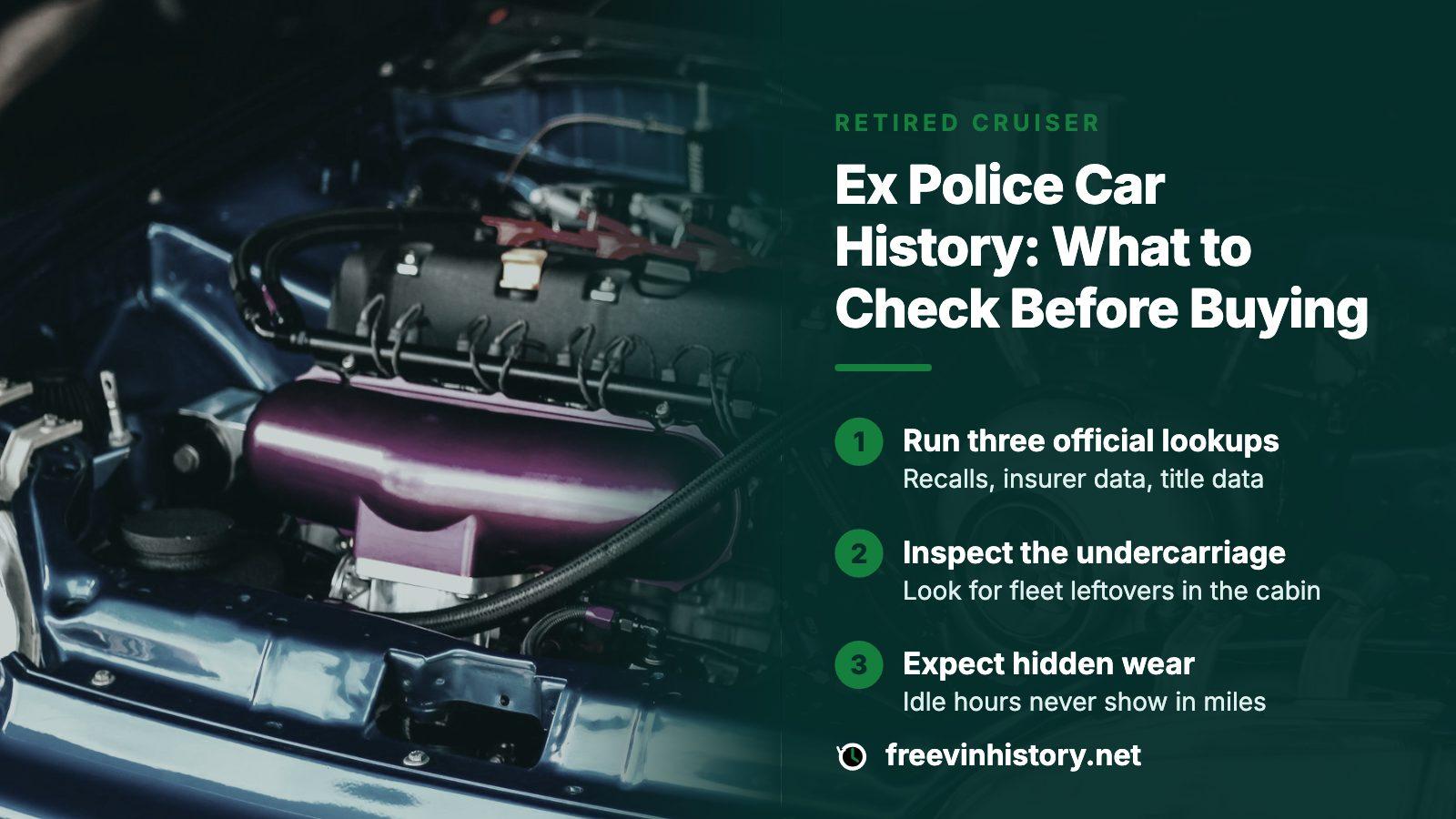
No free government database tells you a car served a police department. NHTSA lists open recalls by VIN, NICB VINCheck flags insurer theft, salvage and flood entries, and NMVTIS reports title, brand, odometer and total loss data. Use all three, inspect the undercarriage and the cabin for fleet leftovers, ask the seller for the agency's disposal paperwork, then run the free preview before paying for a full report.
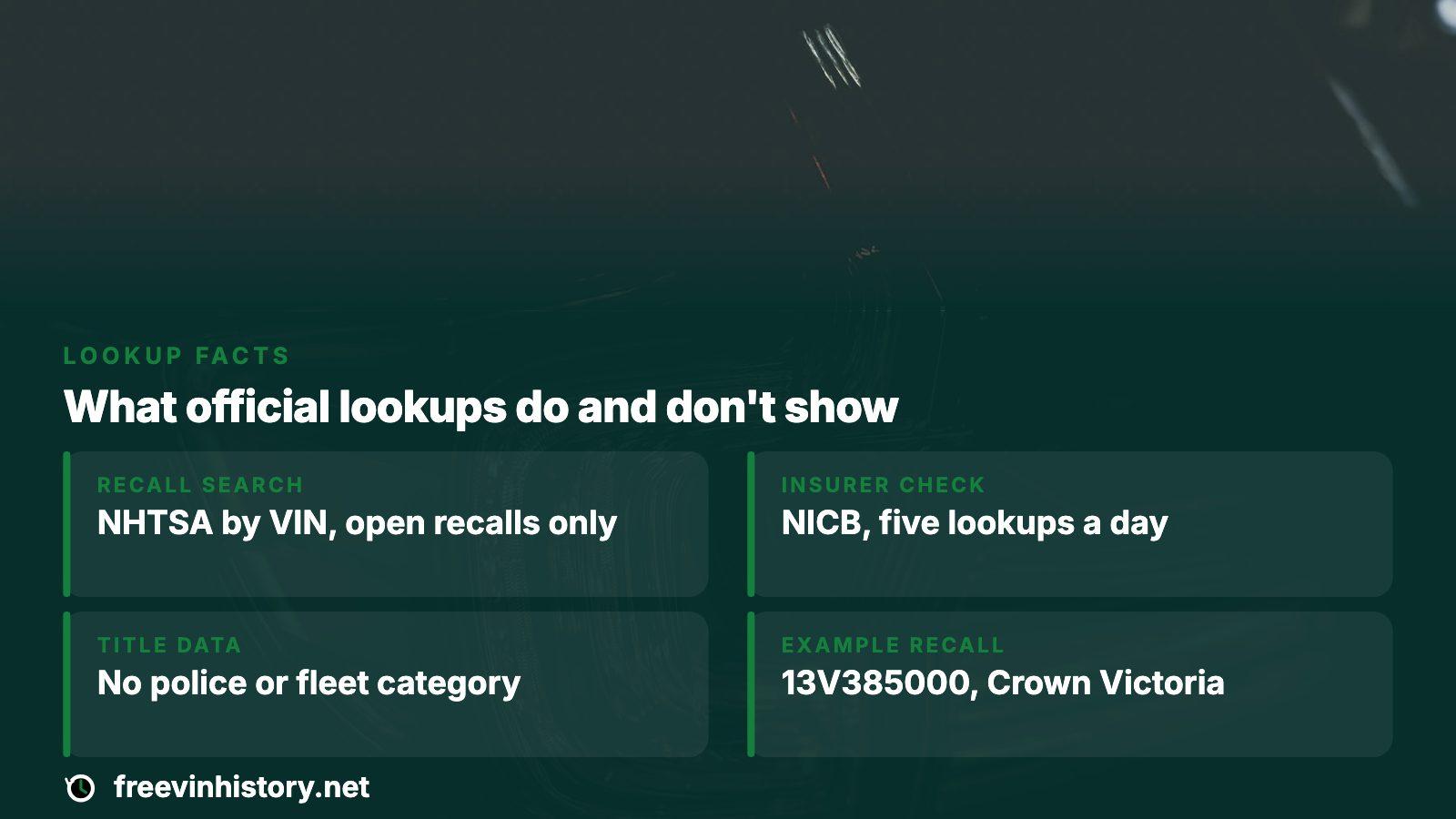
- Free recall check
- NHTSA search by VIN, open recalls only
- Free insurer check
- NICB VINCheck, capped at five lookups a day per connection
- Not in NMVTIS
- No police-use or fleet-use category on its consumer pages
- Example recall
- 13V385000 covered 2005-2011 Crown Victoria Police Interceptors
Why a retired cruiser's record looks so thin
A department sells a car at auction or through a dealer, a new owner registers it, and the history that follows reads like any other used sedan. State titling agencies label problems such as junk, salvage or flood, but the Justice Department's NMVTIS pages describe five indicators: title state and date, brand history, odometer, total loss and salvage. Police service is not one of them.
That gap is the reason a seller can say nothing and still be telling the literal truth. Your job is to fill it with evidence that the free tools were never designed to give.
What three free official lookups do return
| Lookup | What it returns | What it leaves out |
|---|---|---|
| NHTSA recall search | Open recalls for that exact VIN | Repaired recalls and any record of past use |
| NICB VINCheck | Insurer-reported theft not recovered, salvage and flood | Law enforcement files and insurers that opted out |
| NMVTIS report | Title state, brands, odometer, total loss, salvage | Repair history and police or fleet use |
Read each result as a narrow answer to a narrow question. NICB is blunt about the limits: an empty result proves little, and it describes VINCheck as a handy free step, not a full report.
Signs a car was once a patrol car
Work through the car slowly, and keep notes and photographs for later.
- Plugged holes in the roof, trunk lid or dash where lights, antennas or a radio mount once sat.
- A paint seam, sticker ghosting or mismatched panels where decals were stripped.
- A spotlight post hole beside the driver's door.
- Worn vinyl or cloth on the front seats, scuffed rear seat plastic and a rear cabin that looks washed out.
- Wiring tucked under the dash that stops at nothing, and extra fuses or relays.
- Window tint or a steel-bar footprint in the rear cargo area.
A single sign is a reason to ask, not a ruling. Several together mean you should assume fleet use and price the car on that basis.
Mileage can understate the wear
Patrol cars spend long shifts parked with the engine running, so the odometer reading may be lower than the work the drivetrain has done. A useful way to think about it: the odometer counts distance, and idling adds hours it never records. Ask the seller for the maintenance records the agency kept, including oil change intervals, brake work and any transmission service.
Compare the odometer line on the history report with the number on the dash, and treat a rollback or a gap in readings as a stop sign. The NMVTIS page gives the latest odometer reading it holds, which is a floor for your comparison, not a full log.
What one buyer found under a retired cruiser
From an NHTSA owner complaint
A Florida buyer filed a complaint about a former Wisconsin police Crown Victoria bought in May 2013 from a Milwaukee dealer. About four weeks on, rust flakes beneath the car sent him crawling under it, where the steering shaft, mufflers and brake lines were coated in rust. His emailed photos got no reply, so he spent five days cleaning and repainting the underside at about $250 in supplies, then asked how he could be reimbursed.
Look underneath before any money changes hands. A car that worked winter streets in the northern states can look fine from above and be corroded where you cannot see it. Have a mechanic hoist it and photograph the underside first.
Check recalls, because patrol models share them
Police packages often share parts with the civilian version, so recalls can name both. NHTSA's campaign 13V385000, received in August 2013, covered 2005 through 2011 Ford Crown Victoria cars, including the Police Interceptors, for a corroded lower intermediate steering shaft. The remedy was a free replacement at a dealer, with the upper shaft and column bearing inspected. The recall began October 23, 2013.
A second campaign, 14V704000, followed for cars whose upper shaft had been serviced during the first recall. Type the VIN into the NHTSA recall box to learn whether either campaign is still open. The search shows only unrepaired items, so a missing result means no open recall, not that none ever existed.
Paperwork that proves more than a report can
- Ask who sold it, and get the name of the agency or the auction house that handled the disposal.
- Request the title and read its VIN against the plate visible through the glass on the driver's side, low by the dash corner, which is where NHTSA points. The registration card repeats the same string of 17.
- Find out if it was ever in a pursuit, a wreck or a body shop, and whether the agency kept repair orders.
- Collect any maintenance printouts and staple them to your purchase receipt.
A department that sold the car properly should have no trouble answering. Vague replies, a missing title or a number that will not match are reasons to walk away.

Where this site's preview and report fit
After the free lookups, feed the VIN to the free preview on this site. It tells you if title, auction or damage entries exist at all. If the preview turns up anything, or the car is one you intend to buy, the one-time report lays out title brands, mileage readings and salvage or auction photos in one place. Cost is listed on the pricing page; nothing renews.
The report will not say a car served a police agency, and nothing on this page claims it will. It earns its place by showing a branded title or a hidden total loss before you put a deposit down.
Pricing and the final decision
Ex-police cars tend to be sold as fleet disposals, and a lower asking price makes sense only if the underside, the drivetrain and the paperwork back it up. Take the quote from the dealer and subtract the cost of what an inspection finds: tires, brakes, steering parts, rust treatment. If you cannot do that arithmetic honestly, the car is not a bargain.
Keep a short list of dealbreakers: a branded title, a mismatched VIN, an odometer gap, an open recall the seller will not fix and any refusal to allow a pre-purchase inspection.
Where this information comes from
- NHTSA: Recalls by vehicle API, 2011 Ford Crown Victoria — Campaign numbers, dates and the free steering shaft remedy.
- NHTSA owner complaint 10538335 — owner experience, paraphrased
- NHTSA: Recalls search — How the VIN recall search works, where the VIN sits and what it omits.
- NMVTIS: Understanding a vehicle history report — The title indicators a federal report holds and the data it leaves out.
- NICB: VINCheck lookup — What the free insurer lookup covers and the caveats NICB states.
Sources and photos: Facts checked against the sources above in November 2026. Photos by Willian Cittadin, Scott Graham and A n v e s h on Unsplash; diagrams by FreeVINHistory.
Keep reading
- Police report by VIN number: what the free lookups can showWhy police files do not come attached to a VIN check, and where else to ask.
- Fleet vehicle meaning: what it says about a used car's pastWhat a fleet label on a record tells you about how the car was used.
- Former rental car history: what free sources show and what they missAnother high-use history to compare with a retired cruiser.
- Free open recall check by VIN: GM, Polaris and every other makeA step-by-step walk through the NHTSA recall search for any VIN.
Frequently asked questions
Can I find out if a car was a police car from its VIN?
Not from a free government lookup. NHTSA, NICB and NMVTIS return recalls, insurer flags and title data; none has a police-use category. A history report may hint at fleet or government ownership, so pair it with a physical inspection and a request to the seller for the agency's disposal paperwork.
Are ex-police cars a bad buy?
Not automatically. Some were maintained on a strict schedule. The risks are hard idle hours the odometer never counts, rust in northern states, and unrecorded repairs. Maintenance records plus an inspection on a lift settle it better than guesswork.
Does a clean VIN check prove it was well kept?
No. A clean result means nothing negative reached those databases. NICB warns that an empty result proves little, and the NMVTIS page tells buyers to add an independent inspection to even a tidy report.
Do police cars have recalls?
Yes, often the same as the civilian model. NHTSA campaign 13V385000, for example, named Crown Victoria Police Interceptors from model years 2005 to 2011. Run the VIN in NHTSA's recall search to see whether a repair is still open on the exact car.
What do I ask when buying a former patrol car?
Ask which agency sold it, whether it was wrecked, and for maintenance and repair records. Ask to see the title, match the VIN to the windshield, and have the car inspected on a lift. If a seller balks at any of them, you have learned what you needed.
Now check the car itself
The guide explains what to look for. The report shows what this VIN has on record.