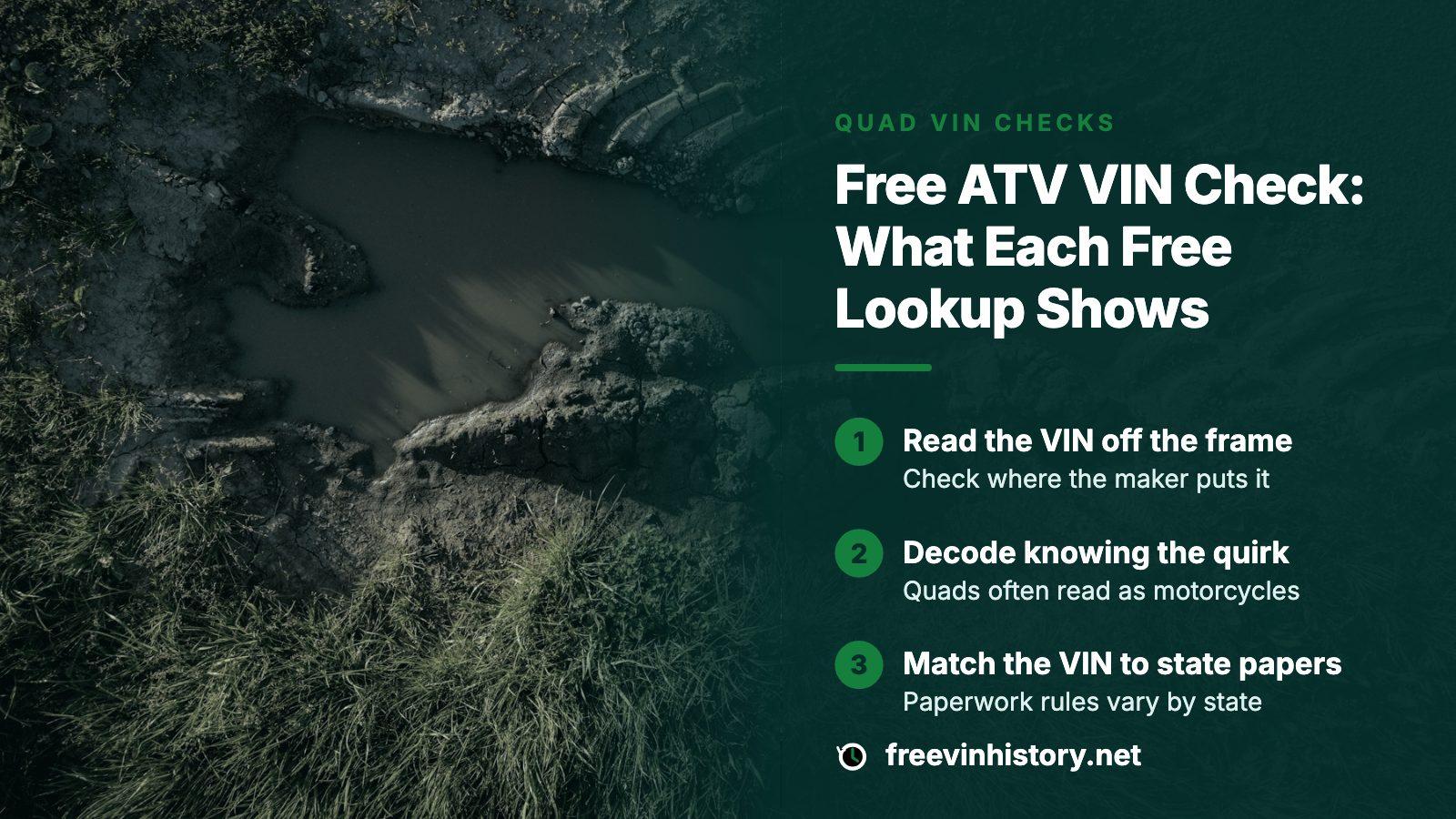
THE SHORT ANSWER
Yes, up to a point. Read the VIN off the frame, run all 17 characters through NICB's VINCheck for insurer-reported theft and salvage, then look up recalls on the maker's site and in CPSC's ATV notices. None of that shows title brands, liens or past owners. Before paying anything, run the free preview to see what is on file, and keep the paid report for a quad you are close to buying.
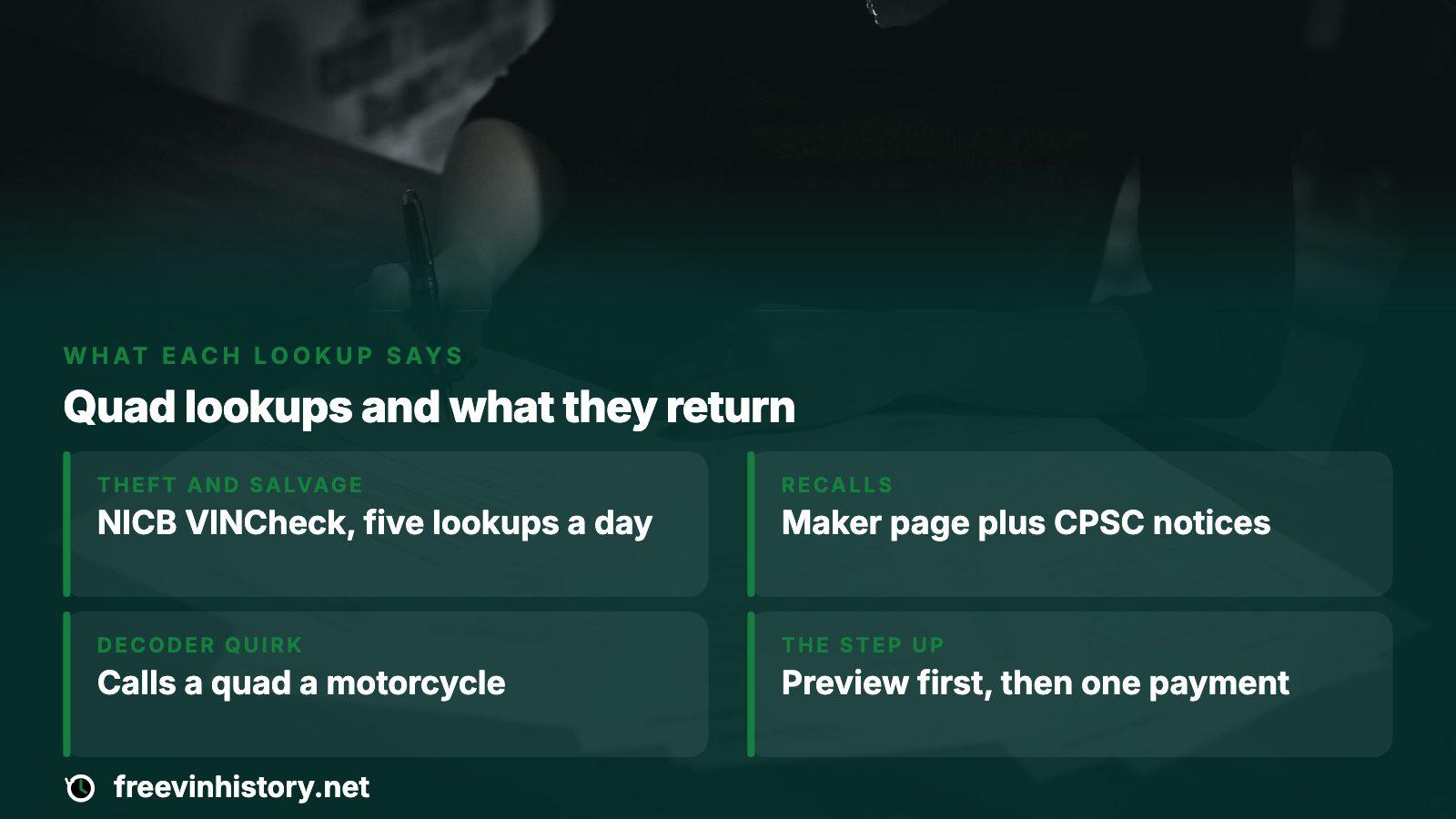
- Theft and salvage
- NICB VINCheck, which stops you at five lookups in 24 hours from one IP address
- Recalls
- The maker's own page and CPSC notices, matched by model year and VIN
- Theft odds
- 11,050 ATVs reported stolen in 2025, with 23% recovered
- The step up
- Free preview first, then one payment for the report
Four free lookups, and what each can say about a quad
None of these costs a cent, and each answers one narrow question. Run all four, and read a blank result as a blank, not as clearance.
| Free lookup | What it can tell you | Where it goes quiet |
|---|---|---|
| NICB VINCheck | Whether a member insurer holds the VIN as a theft not recovered, a salvage loss or a flood loss | Police files, insurers that opt out, quads with no claim. Its page names insured vehicles plus some motorcycles and watercraft, never ATVs |
| Maker's recall page | Whether the VIN falls inside an open recall; Polaris's page accepts a VIN | Other brands, and anything the maker never recalled |
| CPSC recall notices | Campaigns for quads, with the years and VIN details each one names | You match the VIN and the years against each notice yourself |
| NHTSA VIN decoder | The maker and model year a builder registered | Anything about this machine's own history |
Where makers say the VIN sits on a quad
A quad has no windshield and no standard spot, so placement depends on the brand. These come from CPSC recall notices; models change, so confirm on the machine.
| Maker | Placement named in its notices |
|---|---|
| Polaris Sportsman | Left rear of the frame |
| Can-Am | On the frame under the seat, and behind the right front wheel |
| Honda | Stamped on the front of the frame |
| Kawasaki | On the steel frame, at the lower front A-arm mounts on the right side |
| Arctic Cat | Front right-hand frame tube, beside the shock |
| Yamaha Grizzly | Left front of the frame |
| CFMOTO | Frame behind the right rear wheel on a 2024 model |
The tenth character is the model year, as on a car. Can-Am's notice gives P as 2023, R as 2024, S as 2025 and T as 2026. Compare that letter with the year in the advert, and copy all 17 characters from the metal, never from the listing.
Why the federal decoder calls a quad a motorcycle
NHTSA's decoder works from builder registrations, and the labels in that register can surprise a quad buyer. The builder codes it lists for Polaris (4XA and 3NS), Honda (1HF), Yamaha (5Y4) and Can-Am (3JB) all return the vehicle type motorcycle, while Arctic Cat's 4UF returns off-road vehicle.
That label is a quirk of the register, not a warning about the machine. Use the decoder to confirm the maker and the year against the advert, and treat any other detail as unconfirmed until the labels on the quad agree.
Recalls: ask the maker and CPSC, then read the model years
Quad recalls run through the Consumer Product Safety Commission, which enforces a mandatory ATV standard, and through each brand's own site. A recent Polaris Sportsman notice names only certain VINs within two model years, so a matching year alone proves nothing.
Youth models draw many of the recent notices, and the newest one concerns a speed-adjusting module that lets a child's quad run past the top speed set for its age group. On a youth quad, look for the frame plate naming the maker's CPSC-approved action plan, and ask whether the speed module is original.
From an owner's CPSC report
An owner who bought a CFMOTO quad new in 2015 told CPSC that flames appeared near the shifter in February 2024 after a short ride, with about 300 miles on it. He found a recall on newer models that sounded like his problem, but his year was not listed. The maker said the machine was not part of any recall, and the owner wrote later that it sat at the dealer for nearly two months with no cause found.
For a buyer: a recall notice covers named models, years and VIN ranges. Match the full VIN against the maker's own lookup, and keep a record of the answer.
Theft: the free screen, and why a clean result counts for less
NICB counted 11,050 ATVs reported stolen to police in 2025 and says only 23% came back, the lowest recovery rate of the recreational categories it tracks. NICB describes recreational vehicles as valuable, portable and often kept where thieves can reach them, so the screen earns its two minutes.
VINCheck wants all 17 characters, and a typo can hide a real match. It sees only insurance records, and NICB itself says a full report should follow any flag. A hit means stop. A miss means only that participating insurers hold nothing under that number. If a quad is flagged:
- Pause the sale and leave the machine where it stands.
- Report a suspected fraudulent sale to NICB online or at 800-835-6422.
- Keep the advert, the messages and a dated screenshot of the result.
Paperwork changes by state, so match the VIN to it
States disagree on whether a quad has a title at all. Texas's DMV titles off-highway vehicles, ATVs included, but says they cannot be registered. Colorado registers them through its parks and wildlife agency and accepts a signed bill of sale as proof of ownership, alongside a title, a maker's certificate or an earlier registration.
So a seller saying there is no title can be normal in one state and a problem in another. Ask your own agency what a transfer needs before agreeing a price, then check three things:
- The VIN on any title or bill of sale matches the frame, character for character.
- A bill of sale carries both parties' names plus the quad's year, make, model and VIN.
- The seller's name matches the earlier title or registration.
Where the full report fits after the free checks
Each free source is narrow: insurers, one maker, a register of builder codes. A full FreeVINHistory report gathers whatever is filed under the VIN: title brands, salvage-yard and auction records with photos, theft flags, insurer entries, liens and odometer readings.
A quad is regulated as a consumer product, not a road vehicle, so its record trail can be thin, and nobody can promise entries for a given machine. Open the preview first: no charge, and it shows what the files hold for that number. The pricing page lists what the full report costs, and you pay for it only once.
A sensible order for checking a quad before you pay
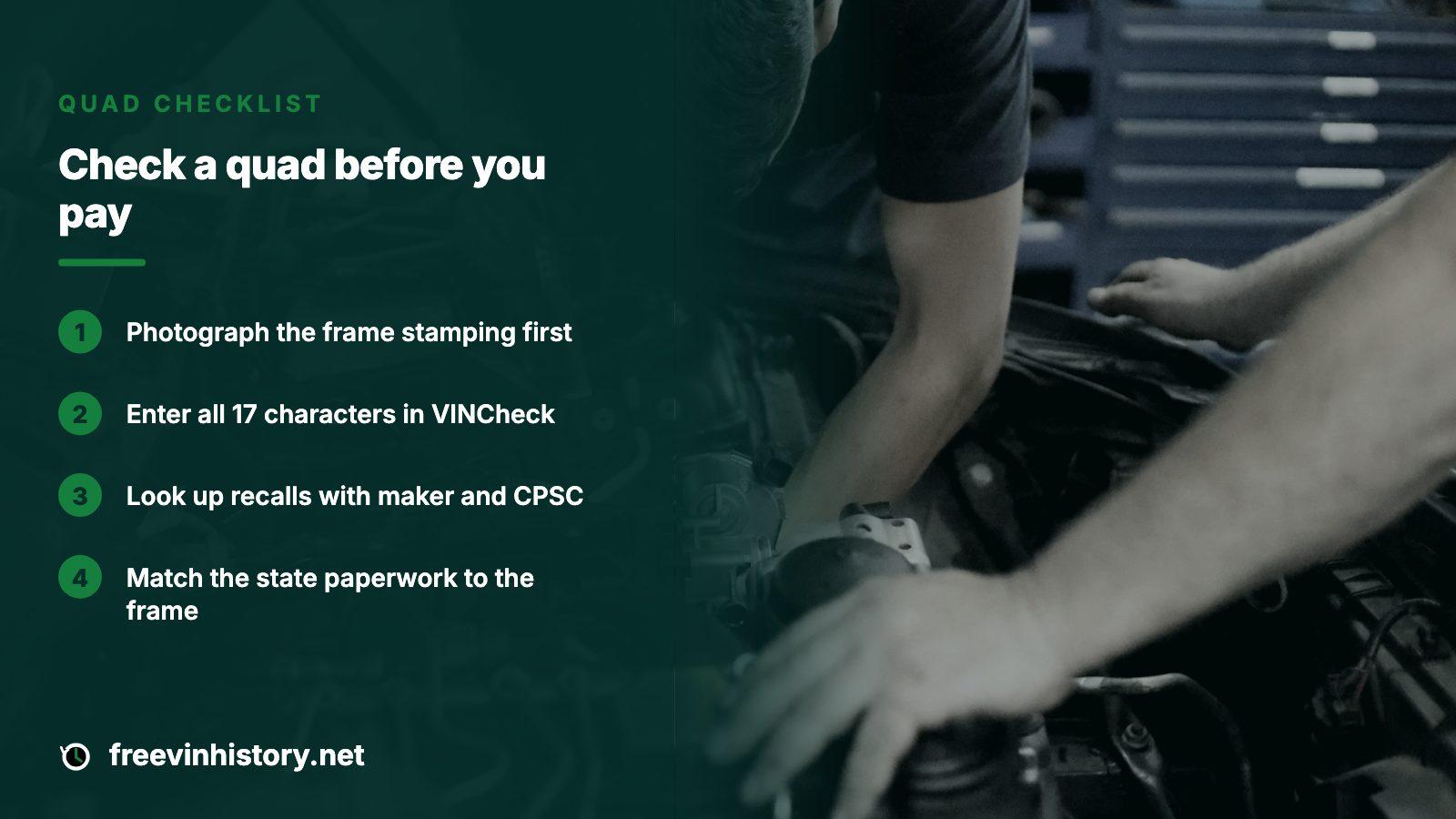
- Photograph the frame stamping and any plate on the frame before talking price.
- Type all 17 characters into VINCheck and note the date and result.
- Compare the tenth character with the year in the advert, then decode the VIN for maker and year.
- Look up recalls on the maker's page, then read any CPSC notice naming that model and year.
- Ask your state agency what a transfer needs, and match the papers to the frame.
- Run the preview next, and order the full report only when you mean to buy.
- Have the quad looked over in person, ideally by a mechanic who works on quads, because a lookup cannot see a bent axle or a cracked weld.
Where this information comes from
- NICB: VINCheck lookup — what the free theft, salvage and flood screen covers, its search cap and its scope line
- NICB: Recreational vehicle thefts declined in 2025 — 2025 ATV theft and recovery counts
- CPSC: ATV recall notices via the recall API — where each maker says the VIN sits, model-year codes and youth ATV notices
- NHTSA: vPIC builder code lookup — how the decoder's register labels ATV makers
- Texas DMV: unique vehicles — Texas titles off-highway vehicles but does not register them
- Colorado Parks and Wildlife: register an off-highway vehicle — accepted proof of ownership, including a bill of sale
- CPSC SaferProducts.gov report 20240301-CB9D6-4635564 — owner experience, paraphrased
Sources and photos: Facts checked against the sources above in November 2026. Photos by Bernd 📷 Dittrich, Mustafa Sheikhmouss and Dimitri Karastelev on Unsplash; diagrams by FreeVINHistory.
Keep reading
- Motorcycle VIN check free: what the free lookups show and missThe two-wheel cousin, with its own VIN spots and free lookups
- Free open recall check by VIN: GM, Polaris and every other makeHow open recalls are found by VIN and what the lookups skip
- Free stolen car check online: what each lookup coversTheft screens in more detail, and what to do after a hit
- Car title search by VIN free: what you can see before you payWhat a title record shows and where to get your state's
Frequently asked questions
Is there a free way to check an ATV VIN?
Yes, in pieces. NICB's VINCheck covers insurer-reported theft and salvage, the maker's recall page covers open campaigns, and the NHTSA decoder confirms maker and year. Each leaves gaps, and none shows liens or title brands, so treat the set as a screen before spending money, not a full history.
Where do I look up ATV recalls by VIN?
Start on the maker's own site, since Polaris, for example, lets you enter a VIN there. Then read CPSC's notices for that brand, model and year, because the agency publishes quad recalls, and match your VIN against any ranges a notice lists. A recall can cover only some VINs within a model year.
Why does a decoder show my quad as a motorcycle?
NHTSA's register files the builder codes it lists for several makers of quads, Polaris and Honda among them, under the type motorcycle. The label reflects how each code was registered. It says nothing about your machine, so confirm the maker and year, and rely on the frame labels.
Does a used ATV have to come with a title?
It depends on the state. Texas titles off-highway vehicles but does not register them, while Colorado registers them and accepts a bill of sale as proof of ownership. Ask your own agency before paying, and make sure any bill of sale carries the VIN stamped on the frame.
What does the preview cost, and what does the report add?
Opening the preview costs nothing. You pay once for a full report, with no monthly charge afterward, and the amount is listed on the pricing page. It adds records the free tools skip, such as title brands, salvage-yard and auction entries, liens and odometer readings, where any exist for that quad.
Now check the car itself
The guide explains what to look for. The report shows what this VIN has on record.