THE SHORT ANSWER
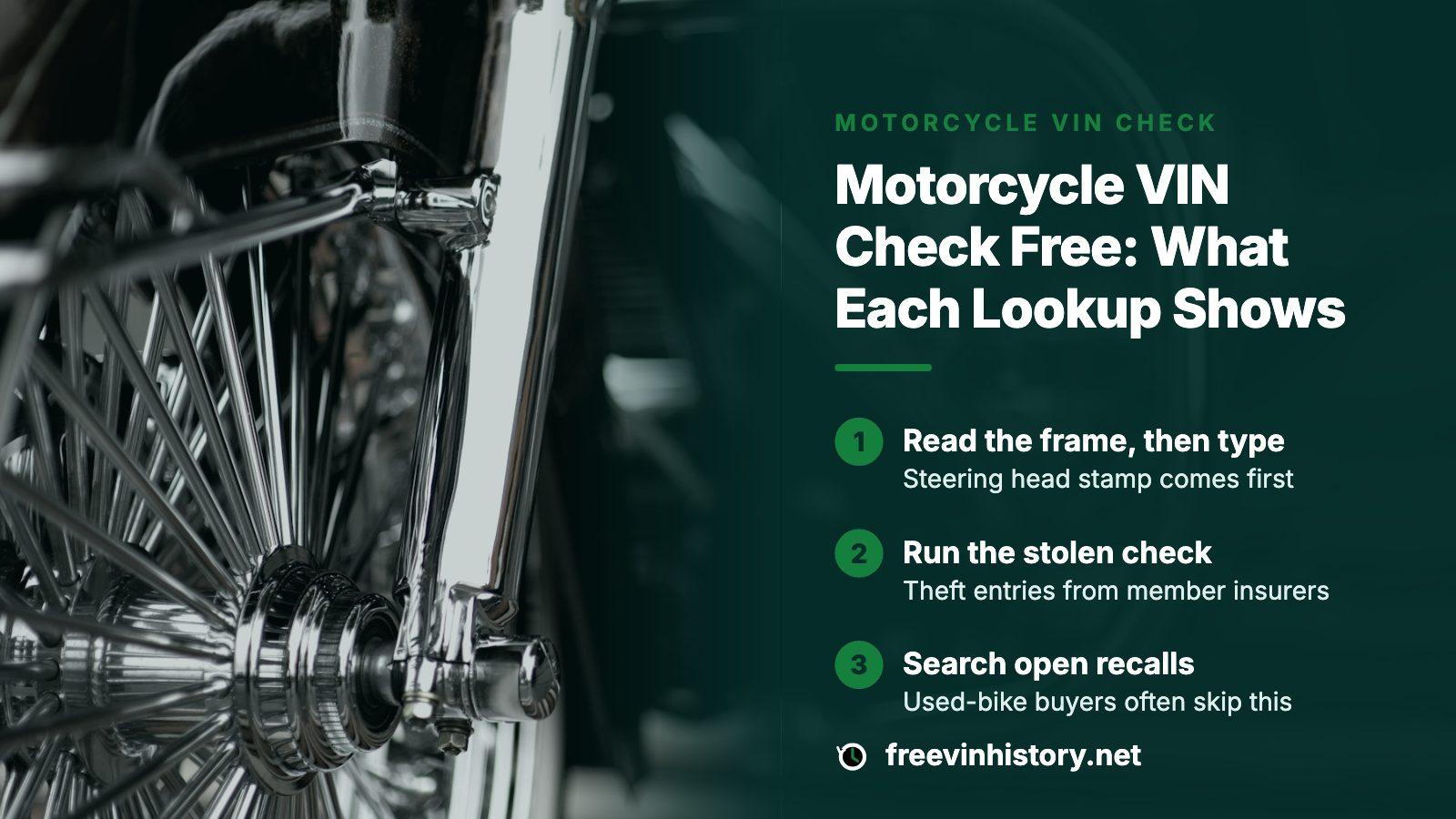
Yes. Read the VIN off the frame, then run it through NICB's VINCheck for theft, salvage and flood entries from member insurers, and through NHTSA's recall search for repairs still owed. Both cost nothing. Neither shows title brands, mileage history or liens, and NICB says it covers only some motorcycles. Run the preview next to see what records exist for that VIN, and buy the full report once a bike becomes a real contender.
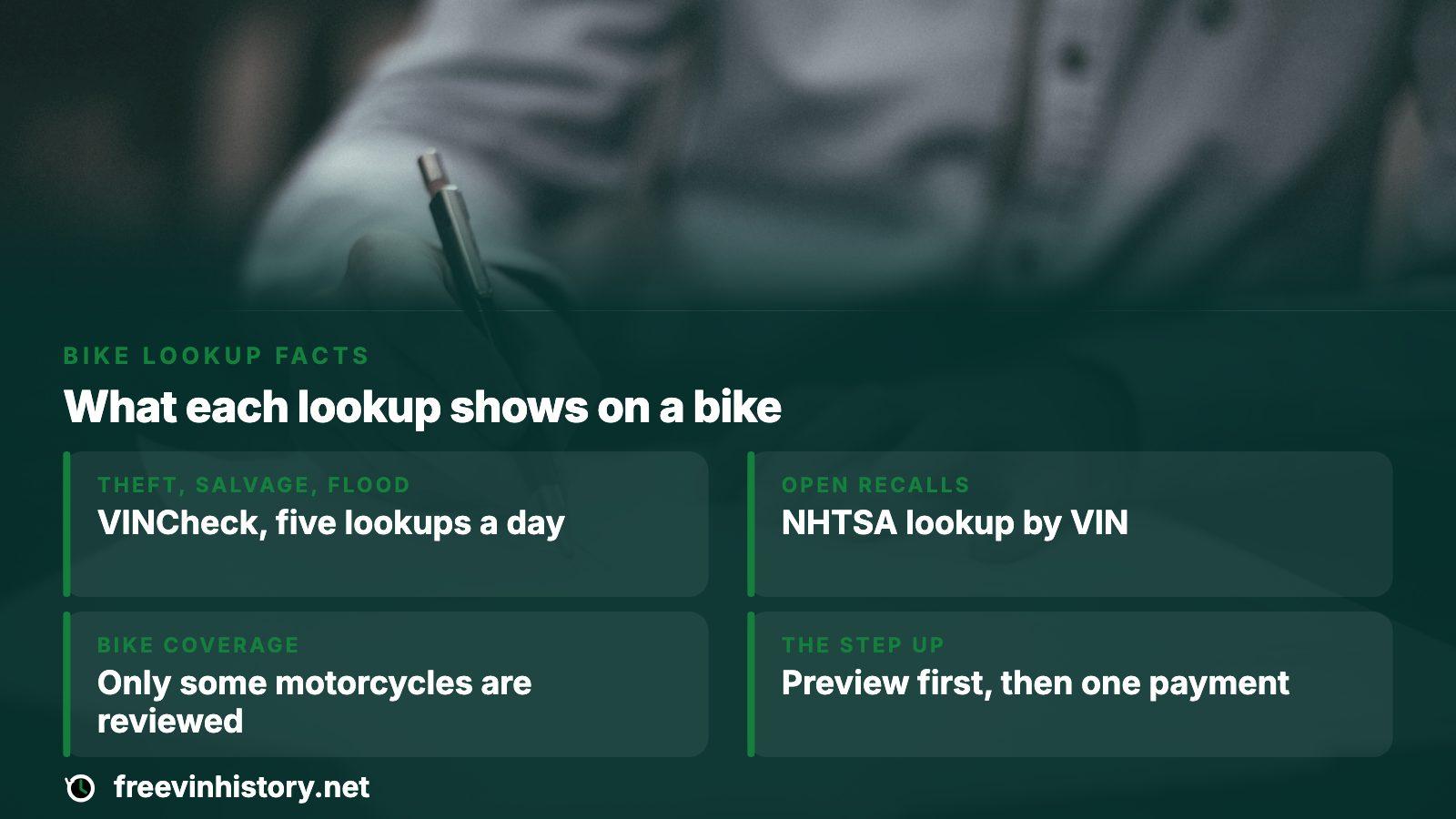
- Theft, salvage, flood
- NICB VINCheck, with a daily limit of five lookups per connection
- Open recalls
- NHTSA lookup by VIN; repaired recalls and ones past 15 years do not show
- Bike coverage
- NICB reviews only some motorcycles, so a quiet result proves little
- The step up
- Preview first, then one payment for the report
Four free lookups and what each one answers
Each of these costs nothing and answers one narrow question. Run all four, and note the blank results as carefully as the hits.
| Free lookup | What it answers for a bike | What it cannot see |
|---|---|---|
| NICB VINCheck | Whether a member insurer holds the VIN as an unrecovered theft, a salvage loss or a flood loss | Police files, insurers that opted out, and any bike that was never insured |
| NHTSA recall search | Whether the VIN has a safety recall still waiting for its repair | Repaired recalls, small makers, and recalls past 15 years old unless the maker extends them |
| Arizona's TheftAZ | Whether Arizona's police stolen-vehicle data lists the bike; motorcycles are named as covered | Thefts reported outside Arizona |
| NHTSA VIN decoder | The details the VIN encodes, including the build plant, as the maker reported them | Anything about this particular bike's past |
Read the VIN off the frame before typing anything
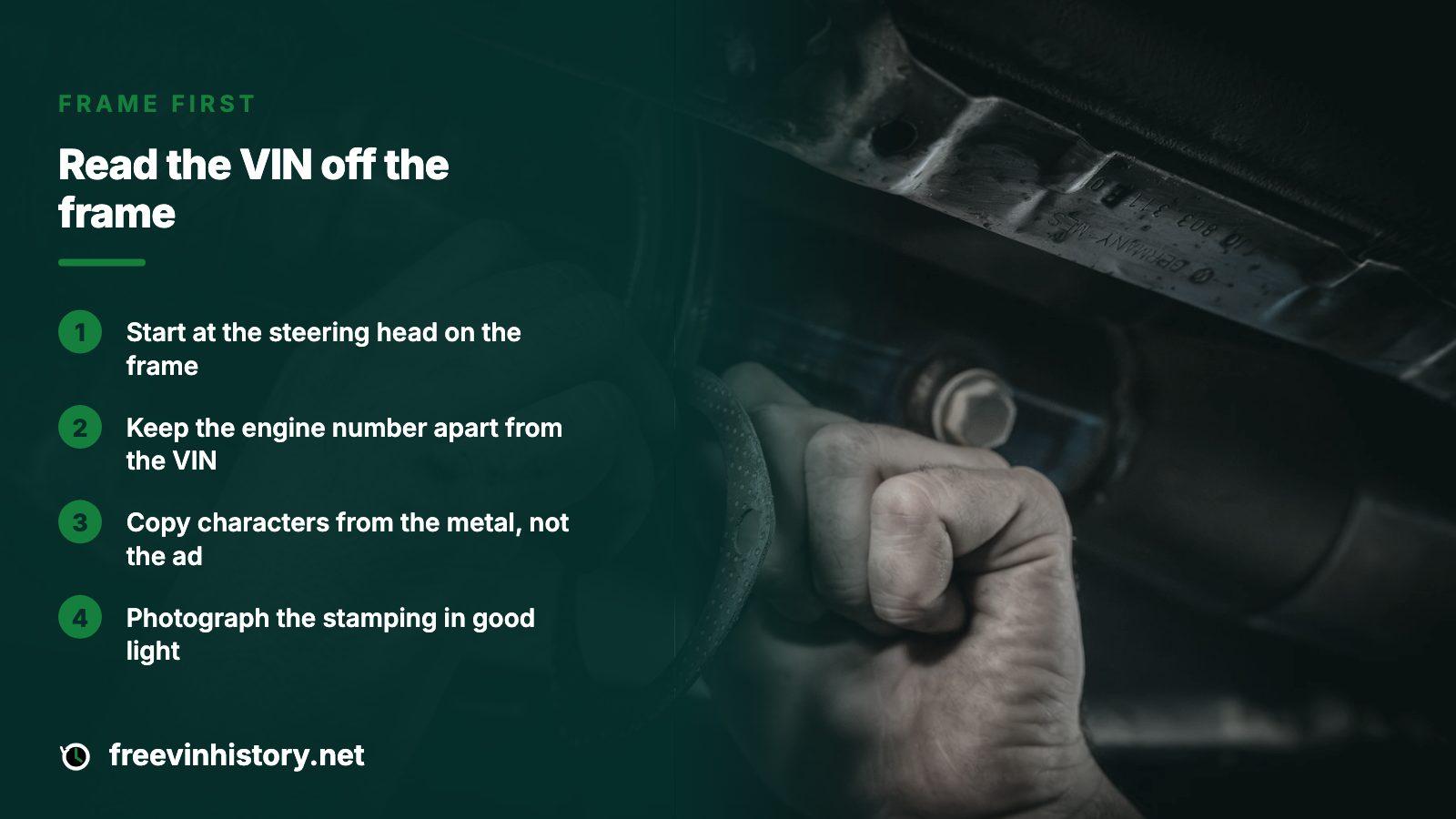
- Start at the steering head, where the front forks pivot on the frame. Indian Motorcycle's help page puts the VIN there on most models it lists: the left side on a Scout, and stamped on the right with a sticker repeating it on the left for the FTR.
- Keep the engine number apart from the VIN. It is a separate stamping on a crankcase, so it does not belong in a VIN field.
- Copy the characters from the metal, never from the listing, and compare them one by one with the title. A single wrong digit can hide a genuine match, and a frame that disagrees with its paperwork is a reason to leave.
- Photograph the stamping in good light, so you hold your own record of what was on the bike that day.
NHTSA's recall page tells people to look low on a windshield, which a motorcycle lacks. Indian adds that labels and locations differ by model and market, so check the owner's manual for your model.
Running the stolen check on a motorcycle
Bikes are a favorite target. NICB notes that many now carry sticker prices of $20,000 or $30,000 and up, and that thieves either sell them whole or strip them for parts. Frames and components are easier to alter and disguise than car parts, which is why stolen bikes come back less often than stolen cars and trucks.
VINCheck flags a bike only when a member insurer logged it as stolen and unrecovered, so a theft that never reached a participating insurer would not appear. Arizona's state lookup is the other free route and takes motorcycles. If either one flags the bike:
- Stop negotiating and leave the bike where it is.
- Call the police agency named in a state result. Arizona's own FAQ says to phone the police and not act alone.
- Report a suspected fraudulent sale to NICB online or at 800-835-6422.
- Keep the advert, the messages and a dated screenshot of the result.
Where free results run thin on motorcycles
NICB says VINCheck reviews insured U.S. vehicles plus some motorcycles, and its page sends bike shoppers to a separate partner for more. A bike that never carried insurance leaves an insurer's file with nothing to report.
The federal title system has a similar gap. NMVTIS reporting is required for common automobiles only, and the Department of Justice says several states also send in motorcycles. More than half of states report to it, not all, so a search can return a false "no salvage history." Its consumer reports also come through approved providers for a fee, which makes that step paid, not free.
A quiet result is not a clean one
On a motorcycle, a blank answer means these particular files hold nothing under that VIN. It does not mean nothing happened. NICB itself warns that a stolen or badly wrecked machine can slip past its search.
Open recalls: the lookup used-bike buyers skip
NHTSA's recall search takes a VIN and says whether a repair is still outstanding. Makers write to the registered owner, so a notice can land in a previous owner's mailbox instead of the new rider's.
From an NHTSA owner complaint
An owner of a 2014 Harley-Davidson Road King filed a complaint after buying the bike in July 2025 with no idea a saddlebag-hardware recall applied. A hard bag came off on the highway and was ruined. When the owner asked the maker to cover the damage, the answer pointed back at the earlier owner for never passing the recall along.
NHTSA's records include a saddlebag-mount recall for that model year, the kind of item a VIN lookup before payment is meant to surface. Run it yourself and do not count on the seller having done so.
Paperwork and seller red flags on a used bike
- A title or registration reading "assembled vehicle," or a seller calling the machine all custom.
- A paper trail with many separate origin certificates for big components, which suggests the bike was put together from parts.
- A story that the bike or a major part came from a swap meet.
- A frame whose stamped number reads even slightly differently from the one on the title.
NICB warns about clone cycles: machines assembled from replica aftermarket parts, passed off as an original factory bike, and carrying a false VIN that is easy to obtain and apply. A database lookup cannot see that. NICB's advice is an insurer pre-inspection or an expert appraisal before any money moves.
How the preview and the paid report slot in
NICB's own FAQ draws the line: a full history report pulls from a wider spread of sources, such as title files from state motor vehicle agencies, auction sales and service records, and most of those cost money.
FreeVINHistory's free preview needs no card. It shows the year, make, model and trim, photos where records exist, the open recall count, and counts of title and auction records. Those counts show whether anything sits behind the VIN before you spend anything.
If the counts show activity, the paid report is one purchase, either a single report or one of the larger sets of three, five or ten for people weighing several bikes. Rates are kept on the pricing page, and nothing auto-renews. The report opens the entries behind the counts: title brands, odometer readings, theft and impound entries, liens and auction photos. How much a given motorcycle VIN has on file varies, which is why the preview comes first.
What to do with each result
| What came back | Your next move |
|---|---|
| NICB: stolen, not recovered | Stop, keep your records, and contact the police agency or NICB. Do not try to collect the bike yourself. |
| NICB: salvage or flood entry | Ask for the repair paperwork and the state title record. A salvage bike may be legally rebuilt and given a new title, so the real question is workmanship. |
| NHTSA: open recall | Get the repair completed first, or negotiate the cost down. A dealer performs the recall fix without billing the owner. |
| Everything blank | Ask the state motor vehicle agency to check the VIN and run a title search, then book an insurer inspection or a mechanic's look. Blank is not proof. |
Where this information comes from
- NICB: VINCheck lookup — What the free lookup searches, its daily cap, its partial motorcycle coverage and how it differs from a full report.
- NICB: Motorcycle and boat theft — Why bikes are stolen, how clone cycles are built, and the checks NICB suggests before buying.
- NHTSA: Check for recalls — What the VIN recall search shows, what it leaves out and how makers notify owners.
- U.S. Department of Justice: NMVTIS for consumers — What the federal title system holds and how patchy its motorcycle reporting is.
- Arizona Attorney General: TheftAZ FAQ — A state stolen-vehicle lookup that names motorcycles as covered, with its limits.
- Indian Motorcycle: VIN and information label locations — Where one maker stamps the VIN and the engine number on its bikes.
- NHTSA owner complaint 11679641 — owner experience, paraphrased
Sources and photos: Facts checked against the sources above in November 2026. Photos by Steve Smith, Martin Fennema and Scott Graham on Unsplash; diagrams by FreeVINHistory.
Keep reading
- Free stolen car check online: what each lookup coversThe theft side in more depth, including cloned VINs and what a clean result hides.
- Free salvage title check by VIN: what the free lookups showWhat a salvage entry means and how to read a rebuilt bike's paperwork.
- Car title search by VIN free: what you can see before you payThe title record behind the VIN, which the insurer lookups never show.
- PricingWhat one report costs, and the sets of 3, 5 or 10, with nothing recurring.
Frequently asked questions
Is there really a free way to check a motorcycle VIN?
In pieces, yes. NICB's lookup, NHTSA's recall search and Arizona's stolen-vehicle lookup cost nothing. None of them builds a full history, and NICB says its reach includes only some motorcycles. Use them as a first screen, then the preview and report for title and auction records.
How many motorcycle VINs can I check for free?
NICB limits each IP address to five lookups a day, with no cap over time, so a long shortlist can be spread across several days. NHTSA's page lets you search up to 100 VINs at once for open recalls.
Does a clean NICB result mean the motorcycle is not stolen?
No. NICB calls a clean result no absolute guarantee, since it holds only participating insurers' records and nothing from police files. A clone wearing a copied VIN can also look clean. Add a state lookup where one exists, a title search through your motor vehicle agency, and an in-person inspection.
Will a free check show a motorcycle's accident or mileage history?
Not on the official free tools. NICB shows salvage entries when an insurer wrote the bike off, but not smaller damage, odometer readings or the state's title brands. Title-based and auction-based records hold those, which the full report covers once the preview shows something on file.
Does the preview cost anything?
No card is requested for the preview, and it carries no charge. The paid report is a single purchase, with larger sets of three, five or ten for people comparing bikes, and no subscription. Check the pricing page for current rates.
Now check the car itself
The guide explains what to look for. The report shows what this VIN has on record.