THE SHORT ANSWER
A listing shows a free Carfax report when the dealer or seller has already paid for it. Kelley Blue Book does not give Carfax reports away, and its own history page runs on AutoCheck: the VIN search is free and counts records, while the full report is an order. With no link on the listing, ask the seller for the report tied to that VIN, run NHTSA's recall lookup and NICB's VINCheck yourself, then decide whether a second, independent report is worth buying.
- Who pays for a listing's report
- The dealer or seller, not you
- KBB and Carfax
- KBB says Carfax is not affiliated with it
- Federal rule on reports
- Dealers are not required to supply a history report
- Official checks at no charge
- NHTSA recall lookup, NICB VINCheck, NHTSA VIN decoder
Why a listing can hand you a report at no cost
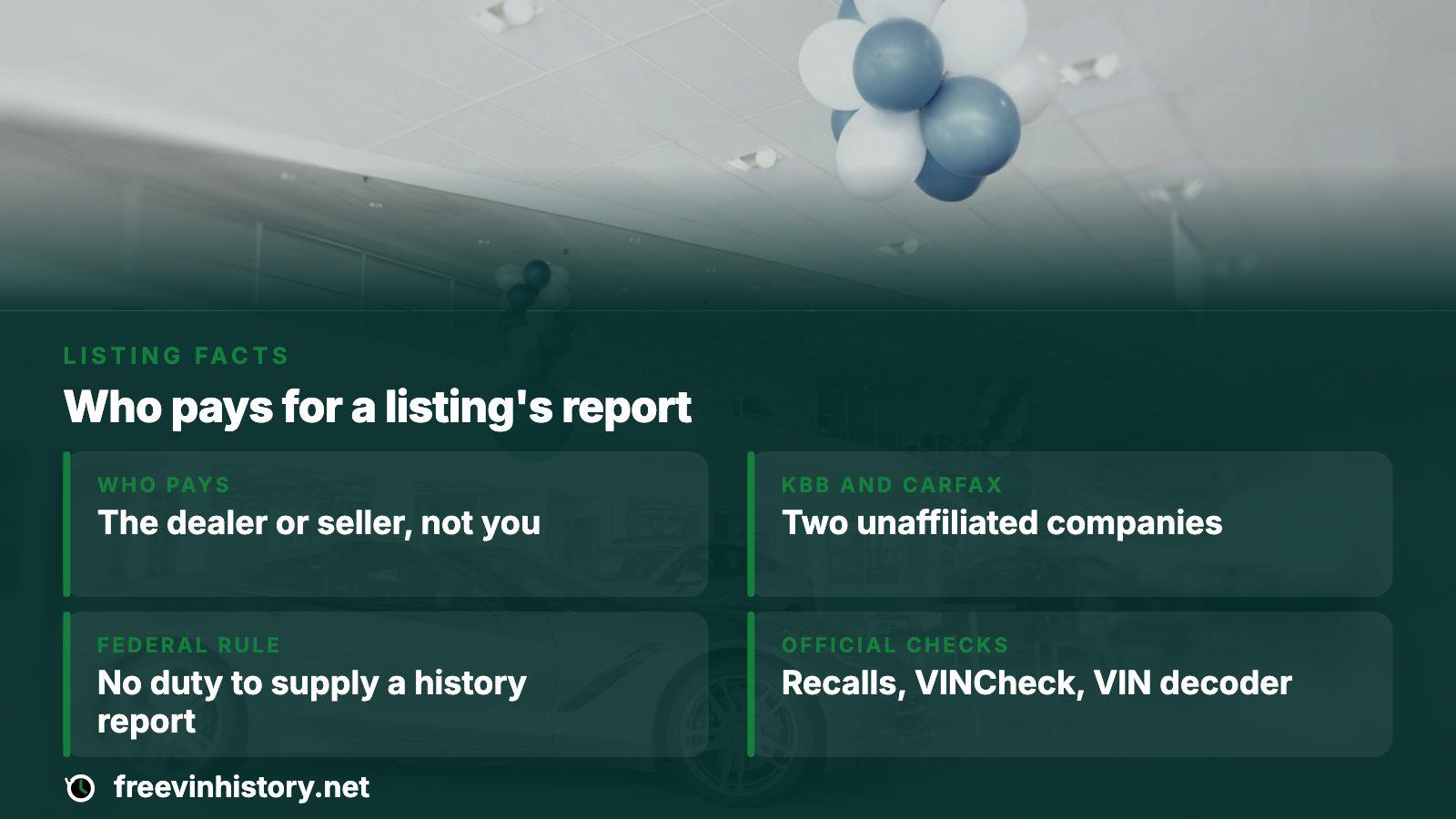
A history report is a priced product, so one you can open without paying has been covered upstream. The cost may sit with a dealer on a subscription, with an owner who bought a report before advertising, or with a temporary promotion. Kelley Blue Book's own buying article puts it plainly: outside a promotion, a complete report costs money, yet sellers often give shoppers access to show what they have.
The same article says many dealerships place the report straight into their listings on the online marketplaces. An older KBB comparison article, dated 2020, went further and said many listings point to a Carfax report that costs the shopper nothing. Both point the same way: the link is there because the seller wants it there.
Kelley Blue Book and Carfax are two different companies
Searches for a free Carfax through Kelley Blue Book assume a tie that KBB itself denies. Its Carfax comparison page says the two are unaffiliated, naming both Kelley Blue Book and Cox Automotive. What KBB does run is a history page built on AutoCheck, the Experian product. Searching by VIN or plate costs nothing and reports how many records exist. The records themselves sit in the full report, which is an order, with no price shown on the page.
A separate KBB page, written for dealers, explains what shoppers meet on listings. Once a dealer subscribes, it says, AutoCheck reports show up on Autotrader and KBB listings without further setup, and dealers can hand their AutoCheck ID to other partners, their own websites among them. So the link on a KBB listing may well lead to AutoCheck rather than Carfax, depending on which service that dealer pays for.
Reading the report behind the link
Treat the report as the seller's exhibit: useful, but chosen and dated by them. Four things to check before leaning on it.
- Which company issued it. The link may lead to either brand, and each one shows only what its own sources received.
- The pull date. Anything filed after that day is missing from the page in front of you.
- The VIN printed on the report, set beside the number on the car itself and the one on the dealer's Buyers Guide.
- What it cannot cover. KBB's article notes that a report holds the latest reported event, only damage that was reported, and nothing about overall condition or wear.
The FTC states the limit that matters most: no history report replaces an independent inspection, which can find damage that no record mentions.
When the listing has no link
A missing link breaks no rule. The FTC's guide to the Used Car Rule says dealers do not have to provide a history report. The Buyers Guide posted on the car covers warranty terms and tells shoppers to get a report on their own. The request therefore falls to you.
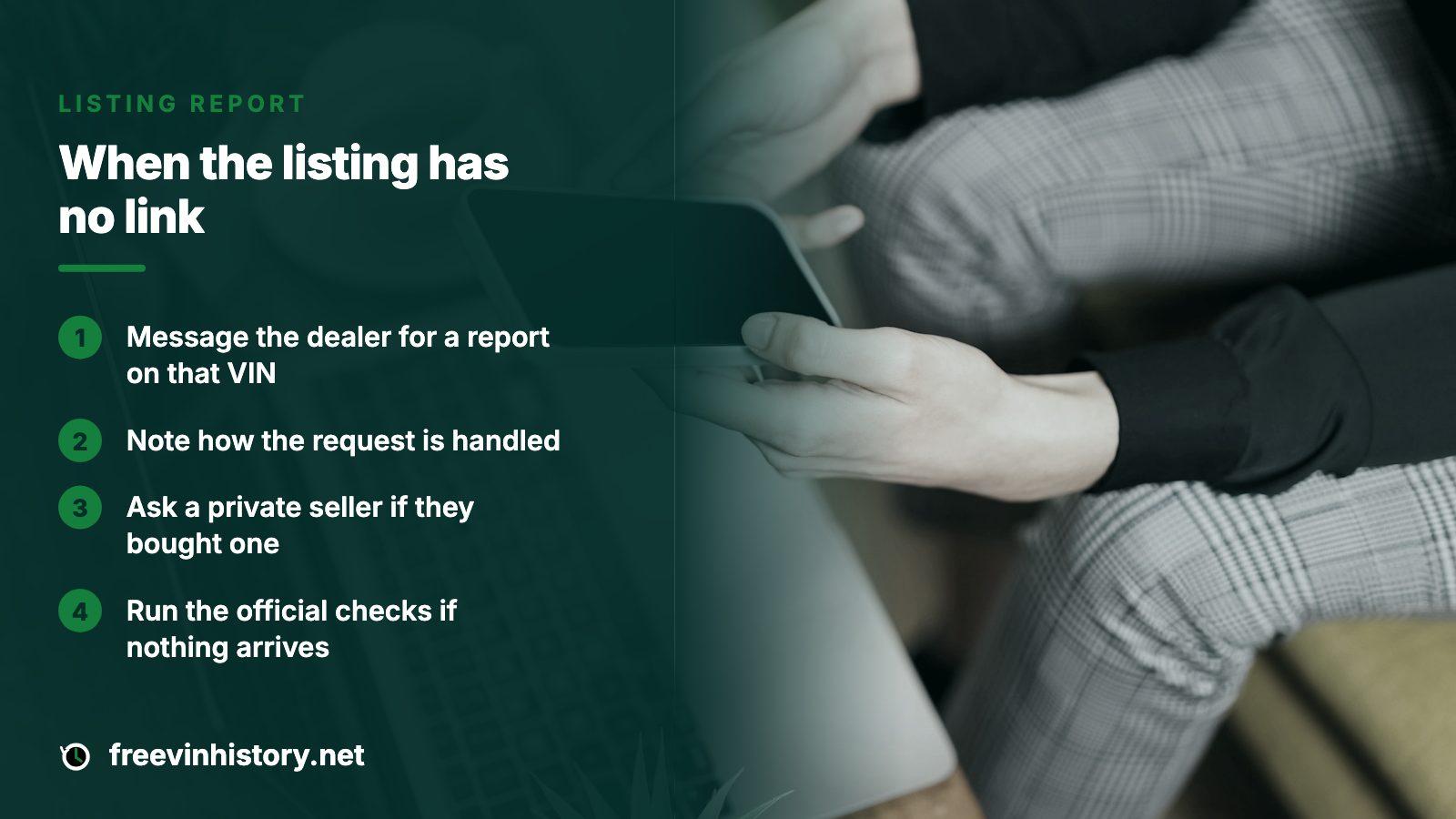
- Message the dealer before the visit and ask for a report on that exact VIN.
- Note how the request is handled. A dealer who shares reports on other cars but stalls on this one has told you something.
- On a private sale, ask whether the owner bought a report. KBB observes that private sellers sometimes share one.
- If nothing arrives, run the official checks below, then decide whether to buy a report yourself.
Checks anyone can run on the VIN
| Check | Cost | What it returns | What it leaves out |
|---|---|---|---|
| NHTSA recall lookup | Free | Open safety recalls on the VIN: a recall exists and the repair is not done | Title, accident and mileage history |
| NICB VINCheck | Free | Flood damage, a theft never recovered, or a salvage declaration on the VIN | Repairs, ownership and mileage |
| NHTSA vPIC decoder | Free | Basic factory specifications, model year 1981 and later | Anything about the car's life since it was built |
| NMVTIS report through an approved provider | Provider's fee | Where the car is titled, brands, odometer, total loss and salvage entries | Repairs, recalls and maintenance |
Run the recall lookup and the decoder first. If the decoded engine or body style disagrees with the ad, either the VIN or the listing is wrong, and that gets settled before anything else.
What a clean result means, and what it does not
The federal title system shows how narrow a clean result can be. The Justice Department says an NMVTIS report rests on five indicators: the state of title with its latest date, any brand, the odometer reading, and the car's total loss and salvage past. A clean one means none of those turned up, and the department still urges an independent inspection. Repair, recall and maintenance records are left to private providers.
Clean means nothing was reported
A repair settled in cash, with no claim filed and no title action, can leave no trace in these records. KBB's article says as much: reports hold only damage that was reported. Keep the inspection even when every check comes back clear.
When a second report is worth buying
The listing's report belongs to the seller. An independent one from a company with no stake in the sale makes sense when the listing carries none, when the pull date is old, when the car costs enough that a gap in its record would hurt, or when a private seller has nothing to show.
On FreeVINHistory, start with the free preview. Enter the VIN and it reads back the car's year, make, model and trim, a count of open recalls, and whether title or auction records are on file. The report itself is a separate step: buy one, or take three, five or ten together, and nothing recurs. Rates are listed on the pricing page. FreeVINHistory is independent of Carfax and does not supply Carfax reports.
Where this information comes from
- FTC: Used cars — Supports the points on free recall listings, NICB's flood, theft and salvage check, approved title-record providers, and the inspection limit.
- FTC: Dealer's guide to the Used Car Rule — Supports the statement that dealers need not provide a history report and what the Buyers Guide covers.
- Justice Department NMVTIS: Understanding a report — Supports the five indicators, the meaning of a clean result and what private providers cover instead.
- Kelley Blue Book: Vehicle history report guide — Supports dealers placing reports in listings, sellers sharing access, and the limits of what a report holds.
- Kelley Blue Book: Vehicle History Report and VIN Check — Supports the AutoCheck basis of KBB's page and the split between a free record count and a paid full report.
- Kelley Blue Book: Carfax compared with KBB — Supports the line that Carfax is not affiliated with Kelley Blue Book or Cox Automotive.
- Kelley Blue Book: Dealer vehicle history page — Supports AutoCheck reports appearing on marketplace listings when a dealer subscribes.
Sources and photos: Facts checked against the sources above in November 2026. Photos by Iain, Jakub Żerdzicki and Richard R on Unsplash; diagrams by FreeVINHistory.
Keep reading
- Free Carfax report: what the free checks show and when to step upThe wider question of what a free Carfax means and which free sources cover which records.
- Free VIN value lookup: what a VIN can and cannot tell you about priceThe price side of the Kelley Blue Book question: what a VIN can and cannot say about value.
- NMVTIS report: what the federal title record shows and missesMore on the federal title record and how a buyer reaches it.
- Sample reportSee what a full report looks like before you decide to pay for one.
Frequently asked questions
Is there a free Carfax report on Kelley Blue Book listings?
Not as a Kelley Blue Book product. KBB says Carfax is not affiliated with it, and its own history page runs on AutoCheck. A listing may still link to a report the dealer paid for, so open the listing first, then ask the dealer for the report on that VIN.
Can I get a Carfax report for free without going through a dealer?
A private seller may have bought one and be willing to share it. Without that, the route that costs nothing is partial: NHTSA's recall lookup, NICB's VINCheck and NHTSA's decoder. None of them is a title or accident history, and a complete report from a third party normally costs money.
Does a dealer have to give me a vehicle history report?
No. The FTC's dealer guide says the Used Car Rule does not require one. The Buyers Guide on the car covers warranty terms and tells shoppers to get a report themselves. Ask anyway, by VIN, and pay attention to how the dealer answers.
Is the VIN search on Kelley Blue Book the full report?
No. KBB's page says the search by VIN or plate returns the number of records found. The records themselves are in the full report, which you order. Use the count to judge whether a full read is warranted, and check the report's date and brand before relying on it.
Should I trust a report the seller sends me?
Use it, but as the seller's exhibit. Check the pull date, the VIN on the page and which company issued it. Then run the official checks yourself and book an inspection, since, per the FTC, an inspection finds things a history report never will.
Now check the car itself
The guide explains what to look for. The report shows what this VIN has on record.