THE SHORT ANSWER
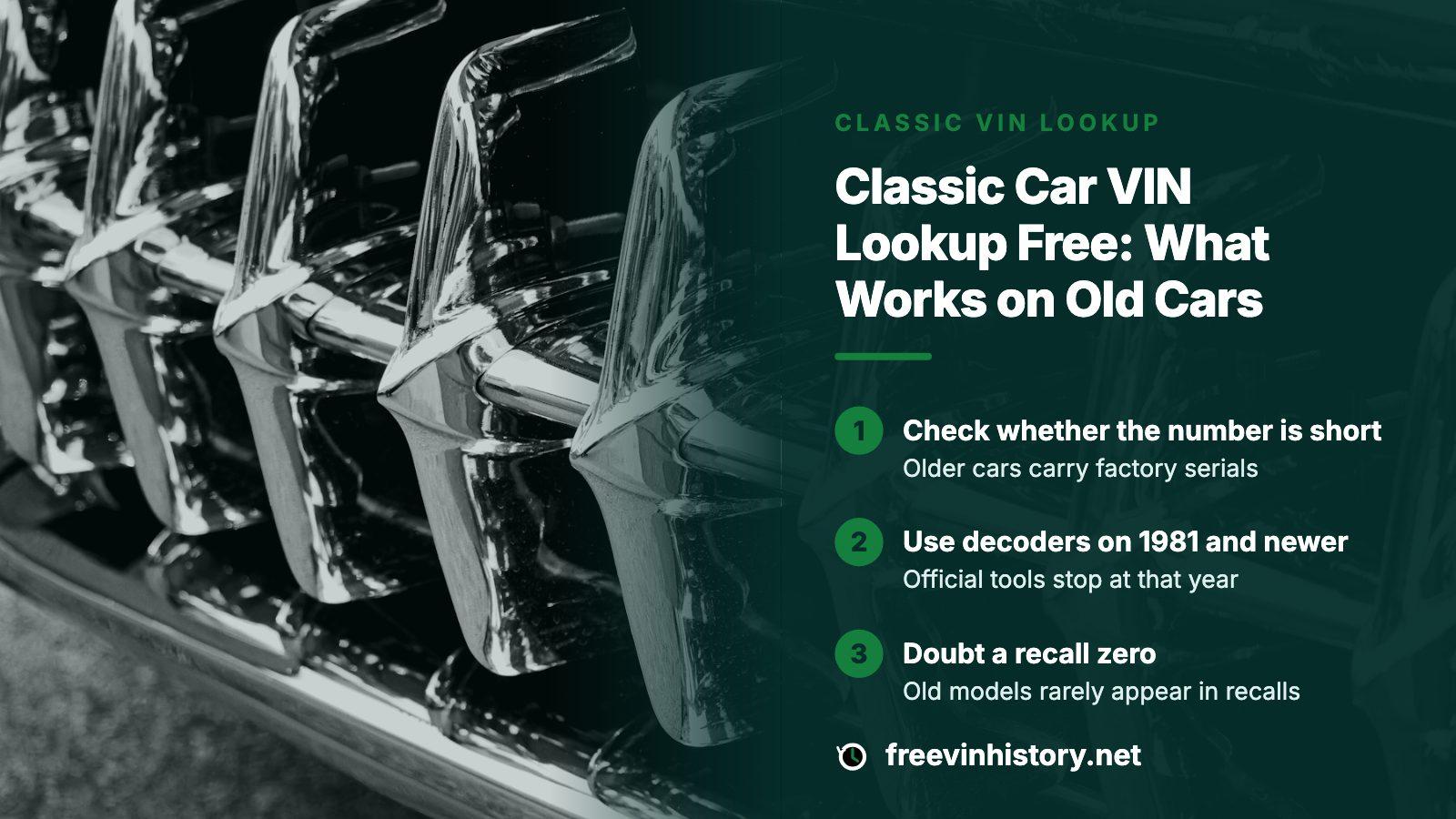
Only partly. Three tools cost nothing and help on a car from 1981 on: NHTSA's decoder, its recall search and NICB's VINCheck. A pre-1981 car carries a short factory number that none of them can use, and the decoder answers it with an error. Identify that car from its plate, a marque reference and the title. The preview here takes a 17-character VIN, and the paid report opens the title and damage detail behind it.
- Decoder cut-off
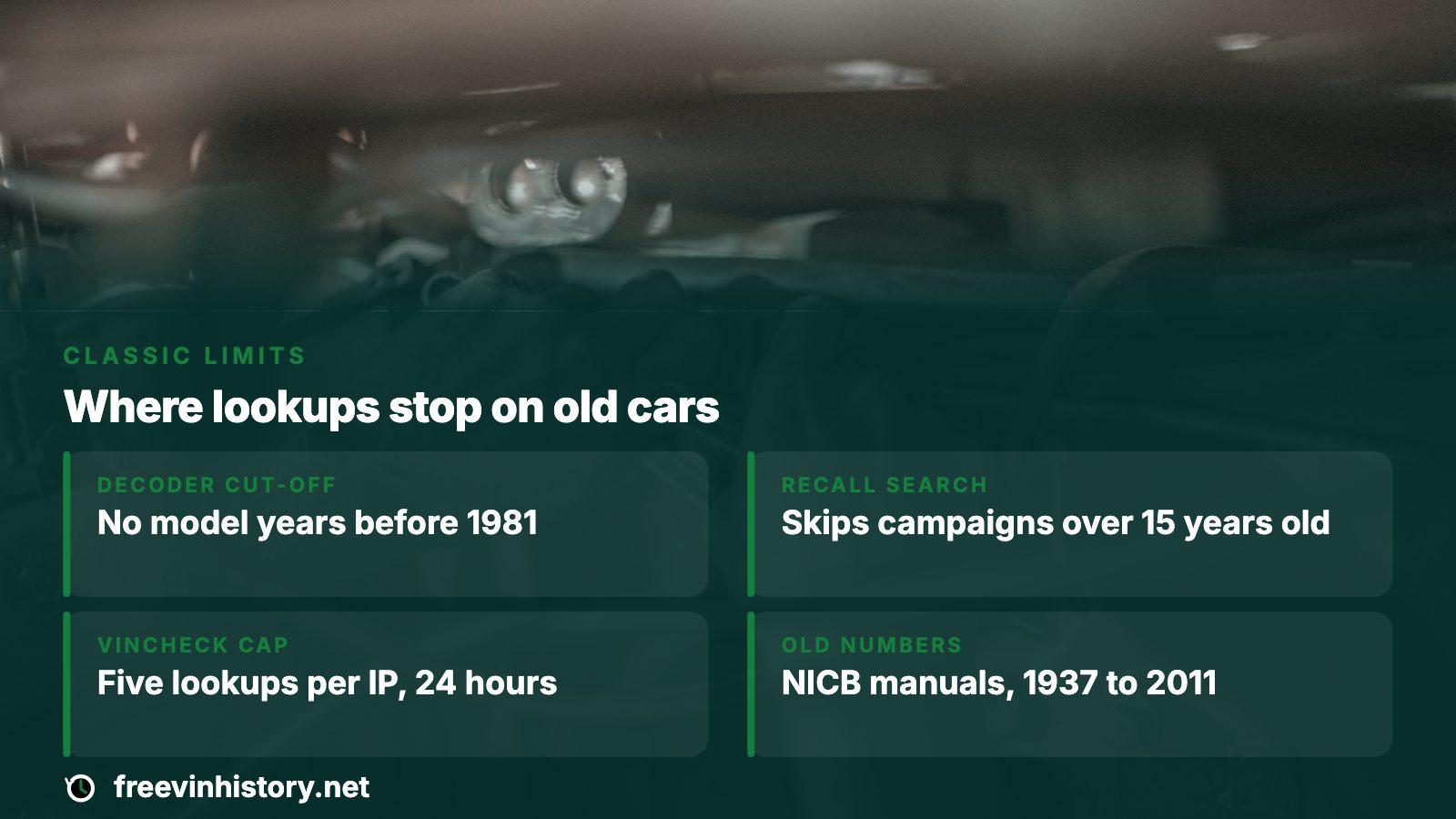
- NHTSA's decoder returned an error for a 1967 number: no model years before 1981
- VIN recall search
- Skips campaigns older than 15 years, except where the maker extends coverage
- NICB VINCheck
- Capped at five lookups per IP address in a 24-hour span, and needs a correct 17-digit VIN
- Reference for old numbers
- NICB passenger manuals from 1937 to 2011 are sold on a disc
Where the free lookups stop on an old car
The dividing line is the 1981 model year. When this page was researched, NHTSA's free decoder was handed a 1967-style number together with model year 1967. It returned no results and an error naming a pre-1981 decode attempt. Nothing was broken: the service refuses model years before 1981.
California's vehicle verification form draws a similar line from the other side. For 1980 and newer cars, the inspector reads the model year off the tenth character of the VIN. For anything older, the inspector records which NICB manual and page supplied the year.
The free sources side by side, tested against a classic
Each free source answers one narrow question, and each behaves differently on an old car.
| Source | Cost and limit | On a classic | What it leaves out |
|---|---|---|---|
| NHTSA VIN decoder | No charge; include a model year | Reads from 1981 only; older numbers return an error | Damage, owners and title history |
| NHTSA recall search by VIN | No charge; up to 100 VINs per search | Asks for the 17-character VIN and skips campaigns past 15 years | Repaired recalls and non-safety campaigns |
| NHTSA recall search by year, make and model | No charge | Casts wider: recalls, investigations, complaints | Whether your own car was fixed |
| NICB VINCheck | No charge; capped at five lookups per IP address in a 24-hour span | Needs a correct 17-digit VIN | Police records and any insurer that opts out |
| NMVTIS title report | Paid, through an approved provider | May run thin; a number of states waive titling past a certain age | Repairs, recalls and maintenance |
Reading a short factory number on the car itself
Before 1981 the work is physical. California's DMV publishes the checklist its trained verifiers fill in while physically inspecting a vehicle, and it doubles as a buyer's list: where the number sits, how it is fixed on, and whether it reads cleanly, looks altered or is missing.
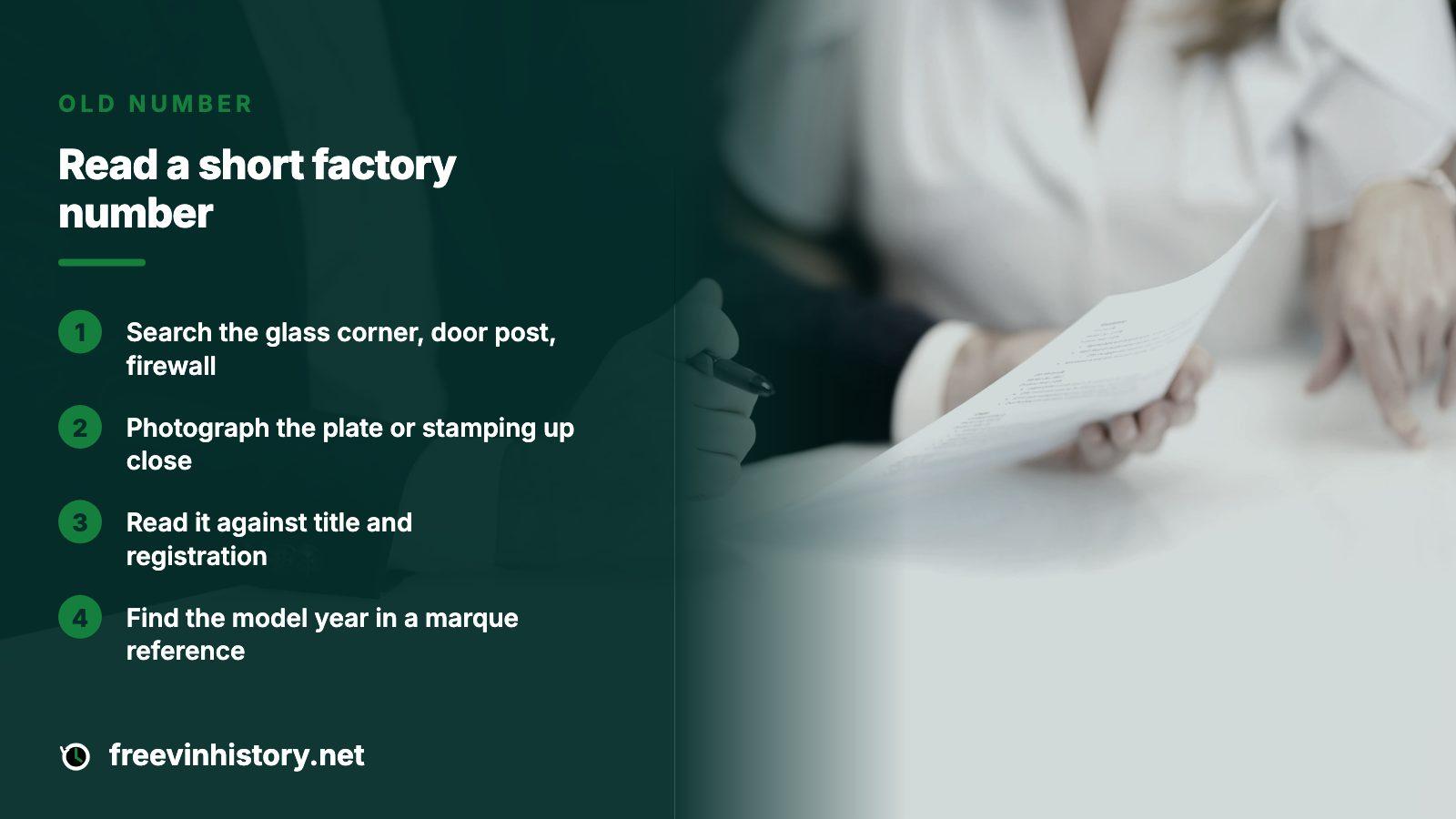
- Start at the lower left corner of the glass, then search the door post, firewall, steering column and engine bay.
- Photograph the plate or stamping up close, including whatever holds it in place.
- Read the number against the title and registration, one character at a time.
- Find the model year in a marque reference, because the tenth character gives it only for 1980 and newer cars.
- If the car and the paper disagree, hold the money until the difference is explained.
One reference California's form names is the NICB manual. NICB sells a disc holding every passenger edition from 1937 through 2011, searchable by year or make, while the current edition has no public digital copy. For a 1960s car, the answer is references and an inspection, not a search box.
Recalls on older cars: a zero that means little
NHTSA's VIN search reports only unrepaired recalls, and it omits campaigns older than 15 years, except where the maker extends coverage. On a 1987 car, a result of zero unrepaired recalls therefore says almost nothing. A search by year, make and model casts wider, though it gives no verdict on one particular car.
From an NHTSA owner complaint
A 1987 Chevrolet Corvette owner filed a complaint in 2019 after the driver's seat belt stopped pulling out of its retractor. The dealer the owner contacted was unable to run a recall check, since its system would not find the VIN, and the maker gave the owner the same answer. The owner cited NHTSA campaign 91V143000 for seat belts, and the belt was still undiagnosed and unrepaired.
The takeaway: work by campaign number. Note each number the year, make and model search turns up, ask a dealer or the maker about it by that number, and keep the reply in writing.
Running a VIN you can read, and what the preview returns
From the 1981 model year on, the 17 characters sit in the bottom left corner of the windshield, and NHTSA notes that the registration card carries them too. Read them off the car, then off the paper, and make sure the two agree. NICB warns that an incorrect VIN can hide a match, so check each character twice.
Type the number into the FreeVINHistory preview. It costs nothing and gives a first look: the car's identity, whether any recalls are open, plus a tally of title and auction entries. A tally above zero is the reason to read further, since the preview does not display the records themselves. A shorter pre-1981 number belongs with the physical checks above.
What a clean free result can hide on a classic
- A plate that is missing, unreadable or altered. California's form lists each as its own finding, and several mean the car is referred to the state highway patrol instead of being processed.
- A federal certification label that disagrees with the number. The form requires that comparison from the 1970 model year on.
- A title or registration number that differs from the car. California has the owner sign a statement under penalty of perjury that the gap was unknown. A buyer has no reason to inherit it.
- A clean NICB answer. It reads only participating insurers' files, so a car that never went through a claim leaves nothing to find, and NICB says a clean result is no guarantee.
- A thin title record. Gaps in state reporting can produce a false negative.
None of these should end a deal alone. Each calls for a seller's answer you can verify, and for someone who knows the marque to look the car over.
Where the paid report takes over, and what it costs
For a later classic, the preview shows whether records exist and the full report opens them. Expect branded titles, theft entries, liens, photographed auction lots, odometer entries and a market value to set against the asking price. A salvage or total-loss flag from the free tools is a natural trigger, because the report shows the detail behind it.
Buying is a one-time payment per report. Bundles come in sizes of 3, 5 and 10 reports for anyone with a short list of cars, and there is no subscription. Current amounts live on the pricing page.
A sensible order of checks for a classic you want to buy
- Match the plate on the car to the title and registration before anything else.
- If the number has 17 characters, run NHTSA's decoder and then its recall search.
- Search recalls again by year, make and model, and write down every campaign number.
- Run NICB's lookup, mindful of its five-search cap, then put the VIN through the preview and read the counts.
- Buy the report for the car you are close to buying, and pay a mechanic who knows the marque to look at it.
For a number shorter than 17 characters, skip steps 2 to 4. Lean on the references, the inspection and the paperwork, and price in what you cannot verify.
Where this information comes from
- NHTSA: Check for recalls — What the VIN recall search shows and omits, the 15-year limit, the year-make-model alternative and where the VIN is printed.
- NHTSA vPIC: decode VIN API documentation — How the free decoder takes a model year, and the error it returned for a 1967-style number.
- NICB: VINCheck lookup — The daily search limit, the 17-digit requirement and the insurer-only scope of the free theft and salvage check.
- NICB: VIN manuals — The yearly passenger manual, the 1937 to 2011 disc and who gets digital copies.
- U.S. Department of Justice: NMVTIS for consumers — Why a federal title report can return false negatives and how states differ on titling.
- California DMV: REG 31 verification of vehicle — What a trained verifier checks on an older car: number location, attachment, condition and match to the title.
- NHTSA owner complaint 11266987 — owner experience, paraphrased
Sources and photos: Facts checked against the sources above in November 2026. Photos by Jacob McGowin, Carrie Allen www.carrieallen.com and Nina Mercado on Unsplash; diagrams by FreeVINHistory.
Keep reading
- Free stolen car check online: what each lookup coversNICB's theft lookup in detail, and what an insurer-only search cannot see.
- NMVTIS report: what the federal title record shows and missesThe federal title record behind brand and salvage flags.
- Free odometer check by VIN: what you can verify before you payHow to test a mileage claim on an older car.
- PricingWhat one report costs, plus packs of 3, 5 or 10, with nothing recurring.
Frequently asked questions
Is there a free VIN lookup for a car built before 1981?
Not one that decodes the number. NHTSA's decoder returns an error for those model years, and NICB's VINCheck asks for a correct 17-digit VIN. What works is a physical check of the plate, a match against the title, and NICB's passenger manuals, sold in print or on a disc covering 1937 through 2011.
How often can I run NICB's VINCheck on a classic?
Five lookups from one IP address within 24 hours, though the total over time has no limit. It reads theft, salvage and flood records from participating NICB insurers only, so a car with an uninsured past can come back clean. NICB itself says a clean answer is not an absolute guarantee.
Why does the recall search show nothing for my old car?
NHTSA's VIN search never lists repaired recalls, and it skips campaigns older than 15 years where the maker has not extended coverage. Try the year, make and model search, then ask a dealer or the maker about any campaign number directly. Keep the reply in writing in case a repair is refused.
Can I type a 1960s or 1970s VIN into the preview?
The preview is built for 17-character VINs, the format NICB's lookup asks for and the one NHTSA's recall page tells owners to find. A shorter factory number from those decades does not belong in the box. Read the plate, compare it with the paperwork and use a marque reference instead. Cars from 1981 forward can go straight in.
What does the paid report cost for a classic?
Amounts are on the pricing page. The preview costs nothing, and each report is paid once, with bundles of 3, 5 or 10 for people weighing several cars. Nothing renews, and the preview comes first, so the money goes toward a car already narrowed down.
Now check the car itself
The guide explains what to look for. The report shows what this VIN has on record.