THE SHORT ANSWER
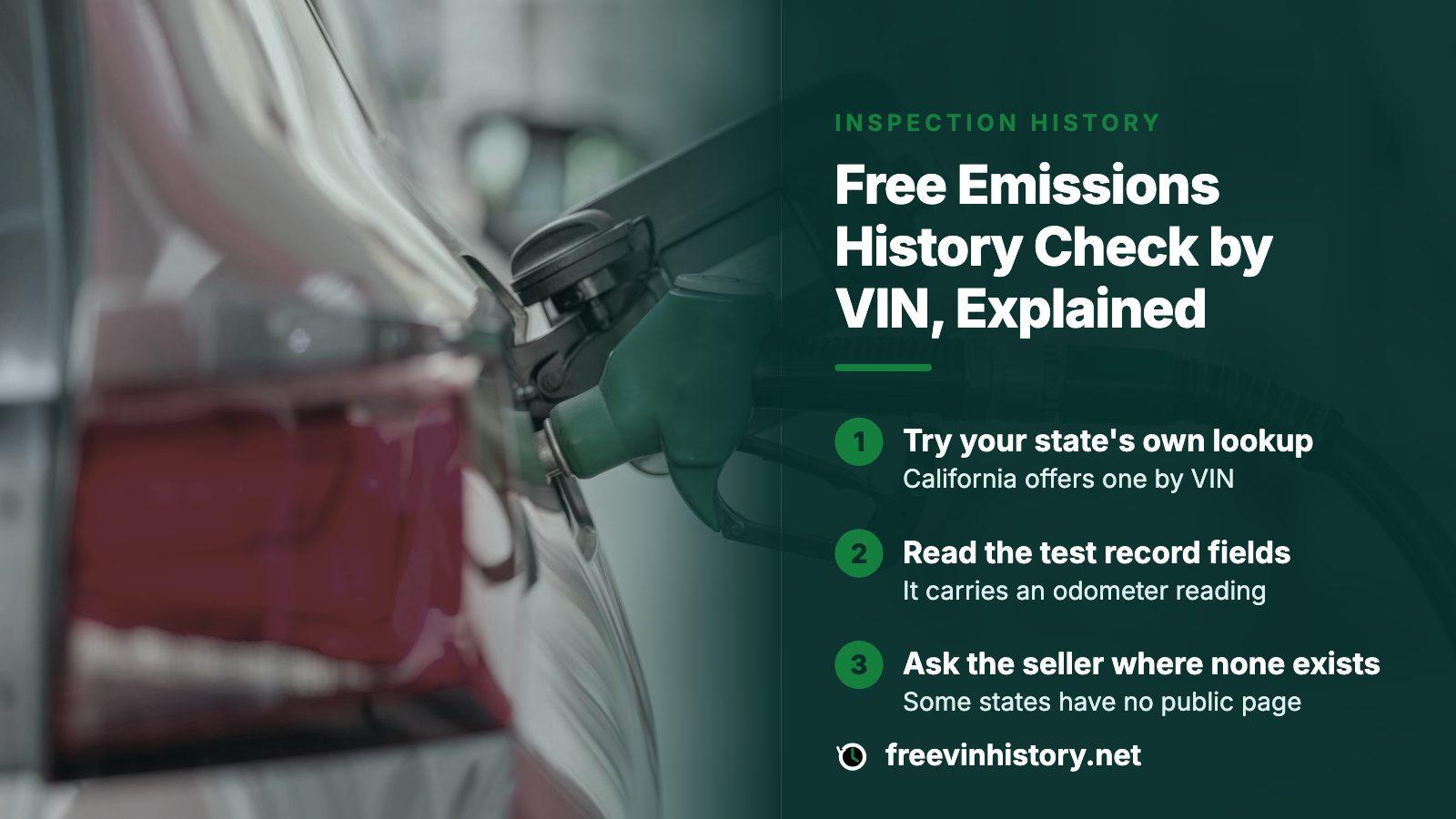
Run the VIN through your state's own inspection lookup if it has one. California's Bureau of Automotive Repair offers one at no charge, updated daily. States without a public page leave you asking the seller for the inspection paperwork. A test record cannot tell you about title brands or past crashes, so pair it with a title check and the free preview before paying for anything.
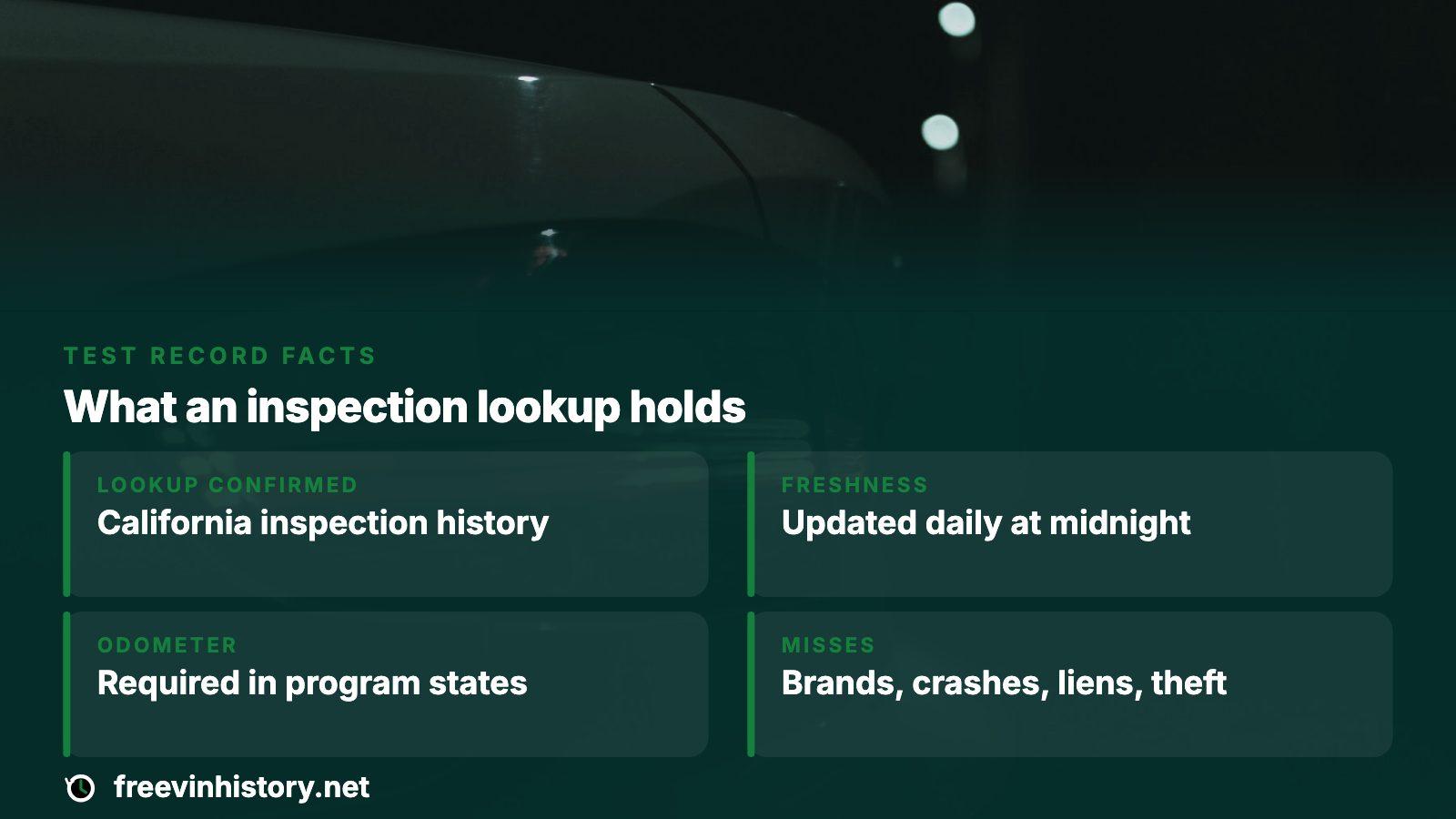
- Free lookup we confirmed
- California BAR inspection history, by VIN or plate
- Record freshness
- California updates its records daily at midnight
- Odometer on a test record
- Required by the federal rule for program states
- What this check misses
- Title brands, crashes, liens and theft
What free actually covers in emissions history
Emissions testing is run by states and regions, not by one national office, so there is no single free database to search. What you can reach for nothing is whatever the testing state decides to publish. I opened the California lookup and the federal pages behind it; for other states I could not confirm a public page, so this guide does not promise one.
That makes the order of work simple. First find out whether the car was ever registered where tests are required. If it was, try the state lookup. If the state has none, ask for the paperwork. Then add the checks that cover what a smog test never will, and hold the paid report back until one car is left on your list.
The California lookup, in order
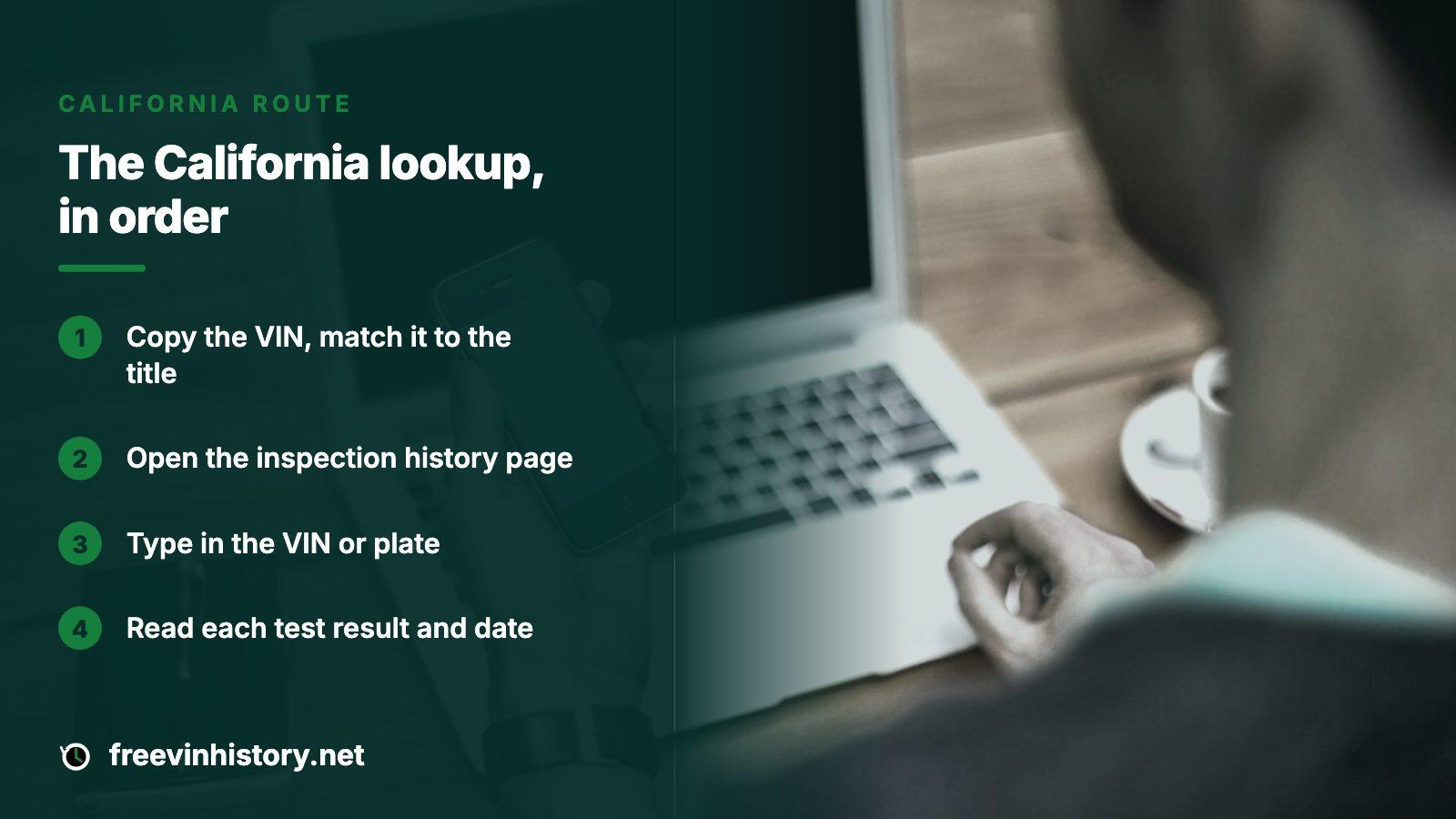
- Copy the 17 characters from the dash or door label, then match them to the title and bill of sale.
- Open the Bureau of Automotive Repair page titled Check a vehicle's inspection history.
- Type the VIN rather than the plate. The bureau itself cautions that plates get swapped, and a VIN avoids a wrong or empty match.
- Submit the form, then go through each result line one at a time.
- If the page reports zero results, treat that as a question, not an answer: the car may be exempt, new, or from elsewhere.
Records refresh daily at midnight, so a test done this morning may not show until the next day. A car that just passed at a station should be visible by the following day.
What sits inside a test record
A state page may show only a summary, but the federal rule for inspection programs, 40 CFR 51.365, sets out what the program must collect on every test. Its stated purpose is a clean chain from each result back to the car, the registrant, the station and the person who ran it. The list runs to 25 items.
| Item collected | Why a buyer should care |
|---|---|
| VIN and certificate number | Proves the result belongs to this car, not a lookalike |
| Odometer reading | A dated mileage figure from someone with no stake in the sale |
| Test category: initial, first retest, later retest | Shows whether a pass came after failures |
| Exhaust gas scores and visual checks | Shows how close the car was to the line, and what was inspected |
| On-board diagnostic result with trouble codes | Names the faults stored on the day |
Whether a public lookup shows every field is a separate matter. The California page I read does not spell out its fields, so do not assume mileage is displayed there.
Reading what you find
- A fail followed by a pass: a repair happened. Ask what was replaced and ask for the receipt.
- Several failed attempts: the previous owner struggled to fix something. Budget for exhaust or sensor work.
- A long gap with no test in a place that requires them: the car may have been registered elsewhere, or the tests were skipped.
- A sale right after a failure: the seller may have passed the repair bill to you.
- Mileage that drops between two dates: pause the deal until the seller explains it on paper.
From an NHTSA owner complaint
One 2012 Ford Focus owner wrote to NHTSA that the warning lamp lit up within days of buying the car, with a clogged catalytic converter named as the cause. By the owner's account the car never cleared the emissions test while in their hands, and the dealer finished just one open recall.
Read it as a buyer: a lit engine warning on a test drive matters, since California says a car cannot pass its Smog Check while that light is on. Ask for the inspection history before you sign.
When a California seller must give you the paperwork
On a change of ownership, the bureau puts the testing on the seller, who must also hand over a copy of the station's report. A private-sale car needs a pass dated inside 90 days. You can ask for that paper and also search the history online, which shows quickly whether the two agree.
Exceptions exist. Gasoline, hybrid and alternative-fuel cars four model years and newer skip the test at transfer and pay a fee instead, and a transfer between immediate family members needs no test. So a missing report does not always mean a problem, but it should prompt a question.
Cars from states with no public lookup
The federal environmental agency keeps a home page for inspection and maintenance programs, with a section for motorists, so it is a fair place to learn whether your area runs one. After that, the program's own site or your motor vehicle office is the place to ask what a motorist can look up.
If nothing is published, ask the seller for past inspection reports and compare the dates and mileage with the odometer on the dash. A seller who has owned the car for years should have a small stack of them. Missing paper is not proof of a problem, only a gap you will have to fill another way.
What an emissions record cannot tell you
A clean pass says the car met a tailpipe and diagnostic standard on one day. It says nothing about whether the title is branded, whether it sat in a flood, or whether money is still owed on it. The national title system run by the Justice Department covers that ground, including title records, the most recent mileage, brands, and sometimes theft entries, pulled together from titling agencies, salvage yards and insurers.
Do not skip this
The consumer page for that system does not name emissions tests among its items. Treat emissions history and title history as two separate questions that need two separate checks.
Moving from the preview to a report
Here the order is preview first, payment later. Put the VIN into the box on this site and the free preview lists which kinds of records exist, with nothing charged. Once a car is a real contender, the report is a single purchase for that vehicle, and packs suit anyone comparing several. There is no subscription, and the pricing page has the details.
The report is built around title brands, crashes, mileage and similar records. I could not find an official page saying that emissions tests are part of any commercial report, so check the preview for them rather than assuming. Use the state lookup for the emissions side, and the report for everything it cannot see.
Where this information comes from
- California BAR: Check a vehicle's inspection history — The free lookup by VIN or plate, the plate warning and the daily refresh.
- California BAR: Smog Check requirements — Seller duties, the private-sale window, exemptions and the check engine light rule.
- 40 CFR 51.365: I/M test data collection — The minimum items a program records on every test, odometer included.
- EPA: Vehicle emissions inspection and maintenance — The federal home page for inspection programs, with a section for motorists.
- NMVTIS for consumers — What the national title system covers: title, odometer, brands and some theft data.
- NHTSA owner complaint 11408409 — owner experience, paraphrased
Sources and photos: Facts checked against the sources above in November 2026. Photos by engin akyurt, Alejandro Escamilla and Johnathan Kaufman on Unsplash; diagrams by FreeVINHistory.
Keep reading
- Emissions inspection on a vehicle history: what the entry meansWhat an emissions entry on a history means once you find one.
- Free VIN check in California: seven steps, free stops firstThe California rules that shape what a buyer can check.
- Free odometer check by VIN: what you can verify before you payOther ways to test a mileage figure against the car.
- PricingOne report or a pack, paid once.
Frequently asked questions
Can I check a car's emissions history for free?
In California, yes: the Bureau of Automotive Repair has a free page that takes a VIN or plate and returns inspection results. For other states, I could not confirm a public lookup. Check whether your state's program has one, or ask the seller for the past inspection reports.
Should I enter the VIN or the license plate?
Use the VIN. The California bureau warns that a plate number may change, which can send the search to the wrong record or none at all. The VIN stays with the car, so it gives the most accurate match across years and owners.
Does a failed test hurt a used car's value?
A single failure followed by a repair and a pass is common and mostly tells you work was done. Repeated failures, or a sale soon after a fail, deserve a discount and a mechanic's look at the exhaust and sensors before you agree to a price.
Does a vehicle history report include emissions tests?
No official page I opened says so. The national title system names title data, odometer, brands and some theft data. If emissions matter to you, look at what the free preview lists for that VIN and use the state lookup alongside it.
Is a car exempt from emissions testing if I find no records?
Not necessarily. New cars within the exempt window, older cars below the program's cutoff and cars from areas with no program all show nothing. Compare the model year and where the car was registered against the state's rules before reading a blank as a warning.
Now check the car itself
The guide explains what to look for. The report shows what this VIN has on record.