THE SHORT ANSWER
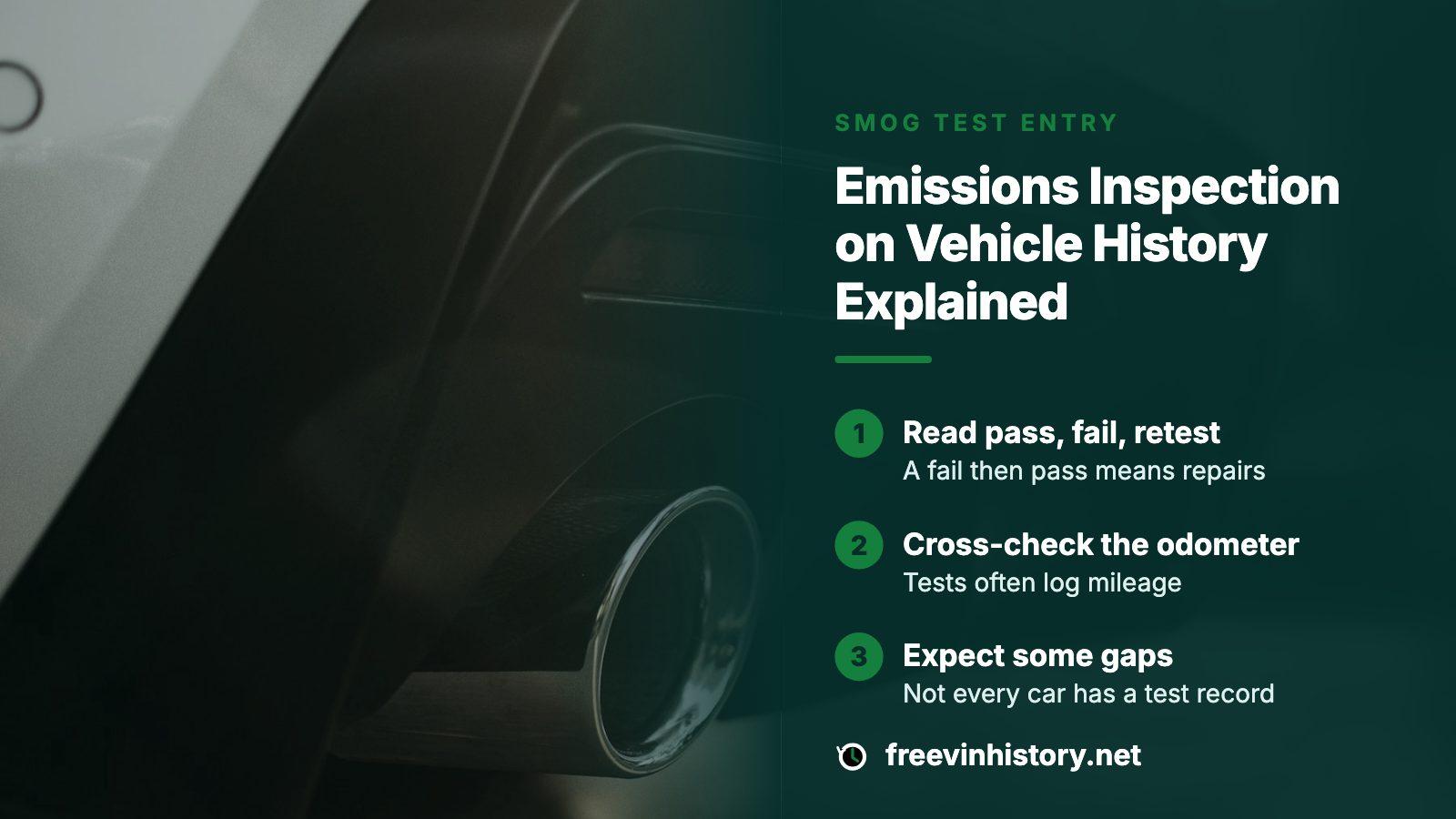
An emissions entry means a state inspection and maintenance program tested the vehicle on a given date and recorded a result, usually pass or fail, often with the mileage at the time. A pass is neutral. A fail followed by a later pass means repairs were made. Use the entry to cross-check mileage and registration history, not to judge accident or title status.
- What it is
- A dated test result from a state emissions program
- Federal minimum
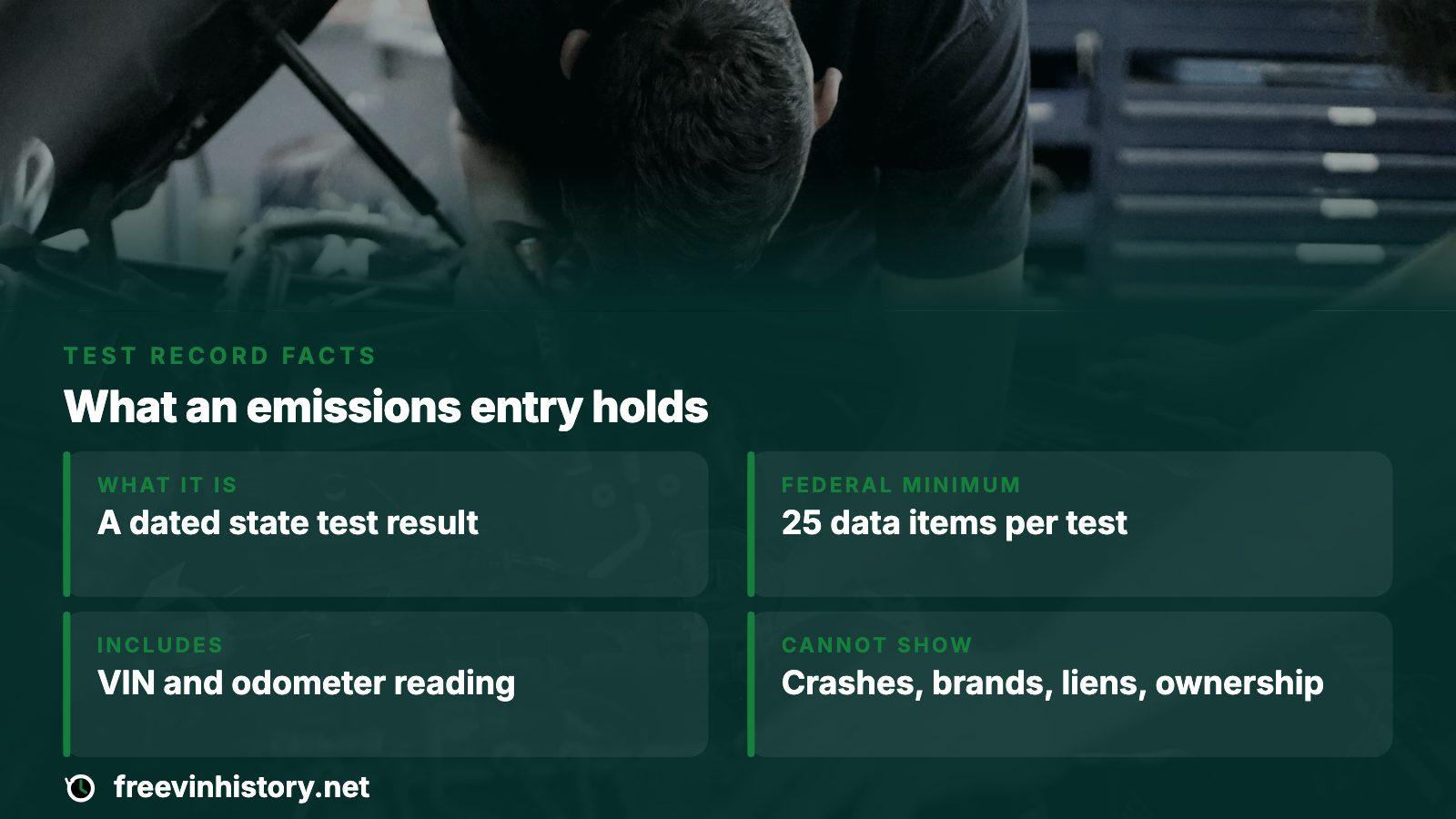
- 25 data items per test, including VIN and odometer reading
- Free lookup
- Some states, such as California, publish inspection history by VIN
- What it cannot show
- Crashes, title brands, liens or ownership
What a single emissions line actually records
Emissions testing is run by states under federal rules for inspection and maintenance programs. Those rules require the program to log each test in a way that ties the result to one vehicle, one registrant, one test site and one inspector. So an entry on a history is not a vague note. It is a row from a government-run testing database.
The row exists because someone brought the car to a licensed station, usually for registration renewal, a sale, or a first registration after moving. If the entry is there, the car was driven in a testing area and put through the procedure on that date.
Plain reading
Think of it as a receipt from the testing program. It proves a test happened. Whether the car is sound in any other way is a different question that the entry does not answer.
The fields behind the entry
The federal data rule sets a floor of 25 items per test. Not every state shows all of them to the public, and no source I opened lists which fields a given public lookup displays. Still, the underlying record is rich, and a history report may surface only a slice of it.
| Record item | Why a buyer cares |
|---|---|
| Test date | Shows when the car was last seen by a testing station |
| VIN and plate | Confirms the test belonged to this exact car, not a lookalike |
| Odometer reading | Gives an independent mileage point to compare with other records |
| Test category | Initial test, first retest or later retest: a retest means an earlier attempt did not pass |
| Diagnostic result | Pass or fail from the on-board computer, with trouble codes where they apply |
| Visual and pressure checks | Gas cap, converter, evaporative system and similar parts |
The category item is the quiet one. A history line that reads as a pass may sit beside an earlier fail that took repairs to clear.
Reading a pass, a fail and a retest
- A single pass: neutral. The car met the standard that day.
- A fail, then a pass shortly after: the owner paid for emissions repairs or fixed a warning light. Ask what was done and ask for the shop invoice.
- Repeated fails with no later pass: the car may have been registered another way, moved to a state with different rules, or left unregistered. Find out which.
- No entry at all: not alarming by itself. Many vehicles are exempt by age, fuel type or location.
California's repair agency explains one common trap: a car will not pass while the check engine light is on, and a recently disconnected battery needs a week or two of driving before the monitors are ready. A fail from those causes is a repair story, not a mystery.
Why some cars have no emissions record at all
Testing is tied to places and rules, not to every vehicle in the country. Federal rules require programs in certain polluted areas, so a car that lived its whole life elsewhere may never have been tested.
Even where testing exists, exemptions are common. Take California as the example, since its agency publishes the rules. Gasoline cars from model year 1976 on and diesels from 1998 on are covered, while electric vehicles and motorcycles are not. Recent gasoline models get a pass on renewal tests for their first eight model years, and on sale tests for their first four.
So an empty emissions section on a three-year-old car, or on an electric one, is expected. The same blank on a car that has lived in a heavily regulated area for a decade deserves a question.
Using the entry to cross-check mileage
Because the odometer is one of the logged items, an emissions test can act as a witness. Line up the mileage at each test against the mileage on the title, the service records and the dash today. The numbers should climb steadily, roughly in step with how the car is used.
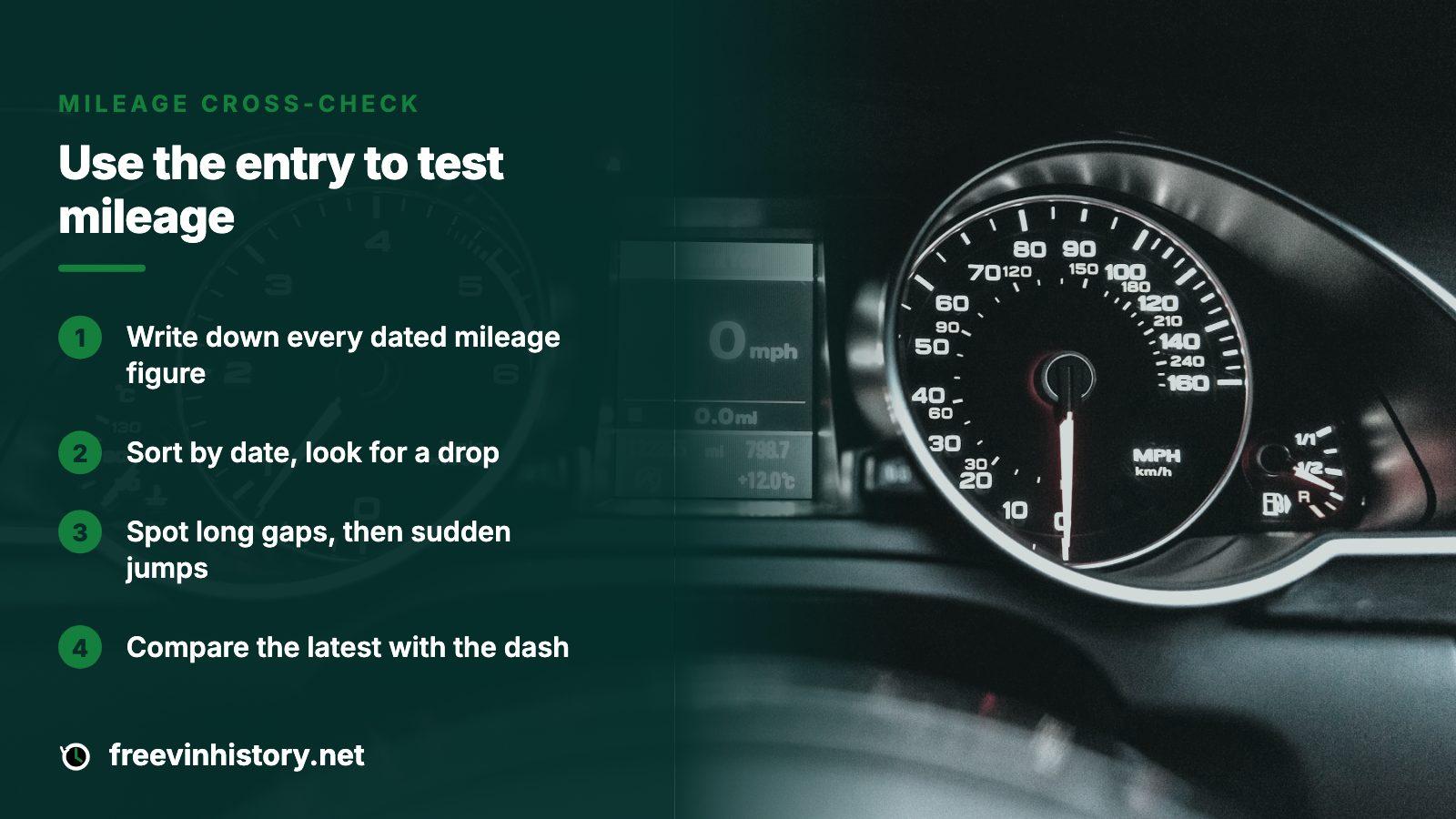
- Write down every mileage figure you can find, with its date.
- Sort by date and look for a figure that is lower than one before it.
- Look for long gaps where the car seems to have barely moved, then jumped.
- If the dash reads far lower than a past test, pause and get the seller's explanation on paper.
A rolled-back or replaced instrument cluster is exactly the kind of problem an old, independent reading can expose. Our odometer check page covers what else to compare.
Free places to look before paying for anything
Start with the state. California's Bureau of Automotive Repair has an inspection history page that takes a VIN or a plate. It warns that plates can change, so the VIN is the safer entry, and it says records refresh daily at midnight. The same agency tells buyers to ask a private seller for the vehicle inspection report, which must show a pass within the last 90 days at a private sale.
Other states run their own programs with their own lookups, and some have none. Check the state agency that runs testing. EPA's inspection and maintenance page is the federal starting point for finding how a program is organized.
What the free state lookup leaves out
It covers one state's tests. It will not show accident damage, title brands from other states, liens, theft or salvage auction history. Treat it as one piece, not a verdict.
When the full report is the sensible next step
If the emissions entry raised a question about mileage, or if the car has lived in more than one state, run the VIN through the free preview here first. It tells you whether a report has records behind it. The report itself is a separate one-time purchase, and the current options sit on the pricing page.
What you are after is the combined picture: odometer readings from several sources, title brands, accident and salvage records and open recalls. An emissions test plus those records lets you see whether the story the seller told holds together.
Where this information comes from
- eCFR via GovInfo: 40 CFR 51.365 data collection — the federal list of items an inspection program must log for each test
- California BAR: Check a vehicle's inspection history — an example of a state lookup by VIN or plate
- California BAR: Smog Check requirements — who must test, who is exempt and what causes a fail
- EPA: Vehicle emissions inspection and maintenance — federal home for the testing programs
Sources and photos: Facts checked against the sources above in November 2026. Photos by Farhan Abid, Ambitious Studio* | Rick Barrett and Mustafa Sheikhmouss on Unsplash; diagrams by FreeVINHistory.
Keep reading
- Free emissions history check by VIN: where it exists and what it showshow to look up a car's emissions history without paying
- Free odometer check by VIN: what you can verify before you paymore ways to test whether the mileage is believable
- Not actual mileage meaning: what the title brand tells a buyerwhat a not actual mileage notation says about a title
- Registration event on a Carfax report: what it meanshow registration entries line up with testing records
Frequently asked questions
Does an emissions inspection show up on a vehicle history report?
Sometimes. It depends on whether the state shares testing data and whether the report provider receives it. Many states publish their own lookup instead. If a report lacks an entry, check the state agency directly before concluding the car was never tested.
Does a failed emissions test mean the car is damaged?
No. A fail points to the emissions system or a warning light, not to a crash. It can be as small as a loose gas cap or as costly as a failing converter. Ask whether repairs were done and whether a later test passed.
Why would an emissions record show a different mileage than the dash?
Honest causes include a typing slip at the station or a replaced cluster with a documented swap. A lower dash figure than a past test is the pattern that deserves a written explanation from the seller, and a check of other mileage records.
Do electric cars have emissions inspection records?
Under California's rules, electric vehicles do not need a Smog Check, so no record is expected. Other states set their own exemptions, so an empty section on an electric car is normal and says nothing against it.
Is an emissions record the same as a safety inspection record?
No. Emissions programs test pollution controls and the on-board diagnostic result. A safety inspection looks at brakes, lights and similar parts and is run under different state rules. A pass on one tells you nothing about the other.
Now check the car itself
The guide explains what to look for. The report shows what this VIN has on record.