THE SHORT ANSWER
A registration event records that a state registration was issued, renewed or changed for the vehicle. No federal rule I found defines the label, and the national title feed does not include registration, so the line cannot show brands, salvage or total loss. Use it to cross-check dates, locations and owner counts against title and odometer records.
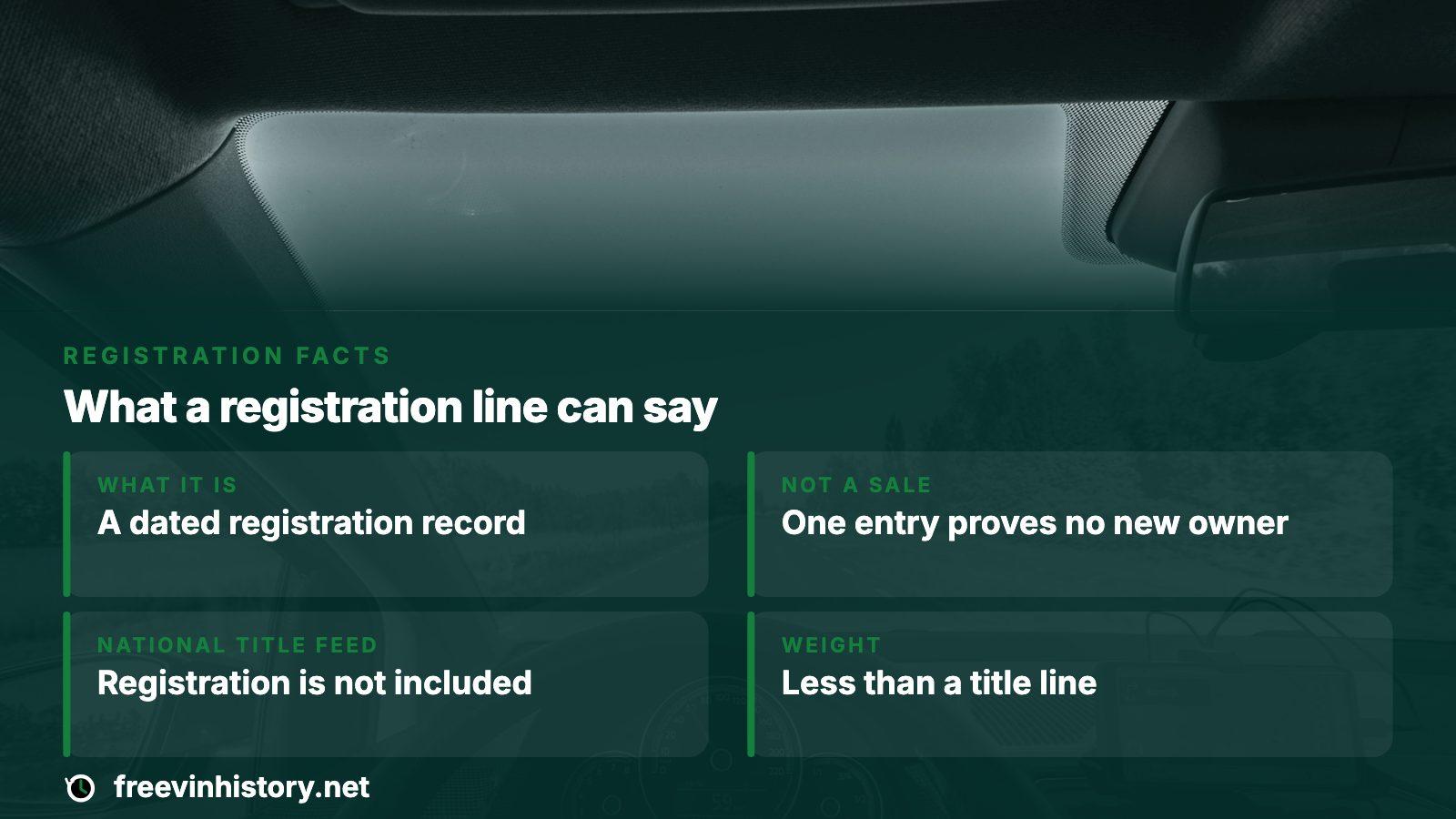
- What it is
- A dated registration record reported to a history provider
- Not a sale
- One entry does not prove a change of owner
- National title feed
- Registration is not among its five items
- Free step
- Official NMVTIS and recall pages cost nothing to read about
What the line is telling you
Think of a registration event as a receipt for being allowed on the road. Somewhere, a motor vehicle office or a registration agent processed paperwork for this VIN, and a data provider picked up a record of it. The report prints it with a date and usually a state.
The wording differs from one provider to the next, and the big commercial services do not publish a single federal definition for it. I could not open Carfax's own pages to confirm its exact label wording, because they refused automated access, so treat any claim about one brand's phrasing with caution. What holds across providers is the basic idea: registration activity was logged.
The short reading
Registration event means paperwork happened. It does not mean ownership changed, and it does not mean anything went wrong.
Why it carries less weight than a title line
Every day, each state forwards its titling data to the federal title database. The rule spells out the fields, and a registration record is not one of them.
- Vehicle identification number
- Title description, with any brand attached
- Who the title was issued to
- Salvage and junk intake data from yards and insurers, if the state gathers it
- Mileage disclosed when the title was issued, and later readings the state notes
So the warnings that matter most, such as a salvage or flood brand, ride on the title side. A registration line is useful context, but it is not where a brand lives. A seller can show you a current registration card for a car with a damaged past.
Common reasons one shows up
Several ordinary things can create an entry. None of them is a red flag on its own.
| Situation | What the entry usually reflects |
|---|---|
| Yearly or periodic renewal | The same owner kept the car legal to drive |
| New owner registers the car | A change of hands, often paired with a title transfer line |
| Move to another state | A fresh registration under the new state's rules |
| Address or plate change | Paperwork updated, same car and same owner |
| Fleet or lease re-registration | A business moving the vehicle between drivers or locations |
Because one change can leave several lines, a long list of registration entries often means a long ownership period or several renewals, not a long list of buyers.
Do not count owners from registration lines
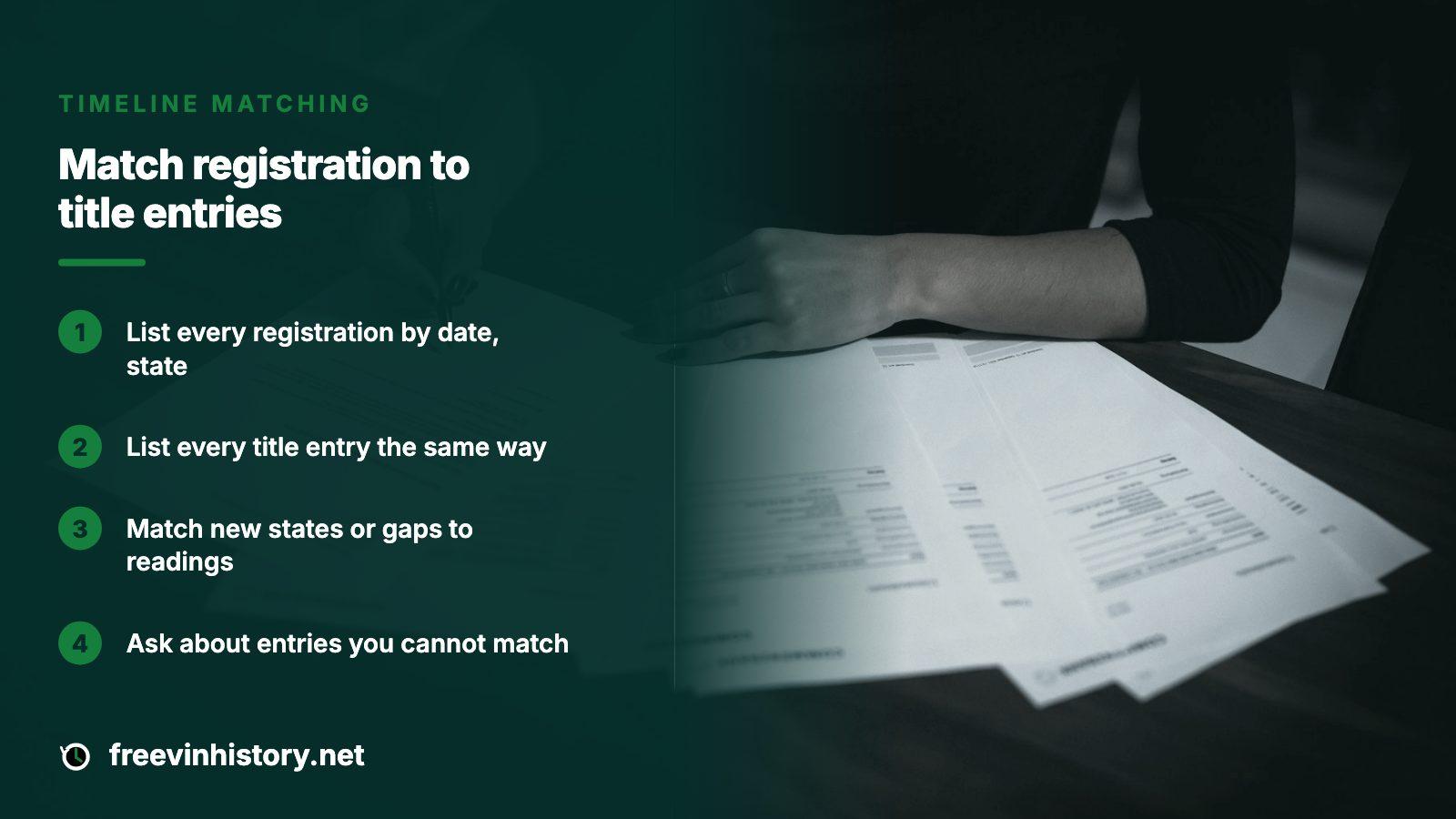
It is tempting to tally entries and announce that a car had five owners. That math fails because renewals add lines without adding people. A better method is to line up the registration dates beside the title transfer entries and the odometer readings, then see whether the story agrees.
- List every registration entry by date and state.
- List every title entry by date and state.
- Match each new state or long gap to a title or odometer reading.
- Ask the seller about any entry you cannot match.
Our own page on gaps in vehicle history covers what a silent stretch can and cannot mean.
When a registration entry deserves a question
Most lines are dull. A few patterns justify asking the seller for an explanation before money moves.
- A registration in a new state shortly after a damage or total loss entry, with no matching title line
- Registrations in two states close together, which can point to a paperwork problem
- Fleet or rental style use that the seller never mentioned
- A registration date that does not fit the odometer trend you see elsewhere
Every one of these is a question, not a verdict. The answer may be a boring move for a job. If the seller cannot explain it, treat that as information too.
What the free official sources show
NMVTIS, the federal system behind vehiclehistory.gov, was built against title fraud and the resale of stolen cars. Its report is deliberately short: the title's current state and latest date, any brands, an odometer figure, plus total loss and salvage records. Repair histories and recall data are left out.
Data arrives from state title offices, scrapyards, recyclers and insurers. No registration timeline is offered. Open recalls are searchable by VIN on the federal safety site. The FTC also points to NICB VINCheck, which covers water damage, cars stolen and never found, and salvage declarations.
What a blank means
An empty NMVTIS report is not proof that nothing exists. It only tells you that no brand, total loss or salvage record turned up.
Where a fuller report helps
Registration lines come from commercial history data, the layer the official pages leave out. When one puzzles you, use the preview here first, at no cost. If that car is still on your list, the single-purchase report puts title, mileage and other records side by side so dates can be compared together. Pack options are described on the pricing page.
The FTC points out that private services may carry accident and repair information that NMVTIS reports lack, and that it does not endorse any one service. Compare what you need before paying.
Do this before you hand over money
A history report, of any kind, only knows what was reported to it. The FTC says no report replaces an independent inspection, and the NMVTIS page strongly encourages one too. A mechanic can spot repaired structure or flood residue that no registration line will mention.
- Run the VIN through the free preview and the official pages
- Match registration, title and odometer dates
- Ask about each unexplained state change
- Pay a mechanic to inspect the car
- Walk away if the seller dodges plain questions
Where this information comes from
- eCFR: 28 CFR 25.54 state responsibilities — what states must send to the national title system
- NMVTIS: Understanding a vehicle history report — what the federal report shows and omits
- NMVTIS: vehicle history home — purpose of the system
- FTC: Used cars — inspection advice and where to check a VIN
Sources and photos: Facts checked against the sources above in November 2026. Photos by Maurice Sahl, Dimitri Karastelev and Sander Jeurissen on Unsplash; diagrams by FreeVINHistory.
Keep reading
- Title transfer on a vehicle history report: what the entry meansThe entry that actually shows a change of owner.
- Gaps in vehicle history: what a thin record really tells youWhat silent stretches between records can mean.
- One owner car meaning: what the label does and does not tell youHow owner counts are built and why they mislead.
- Out of state title history: what a title from another state can hideCars that crossed state lines and what follows.
Frequently asked questions
Does a registration event mean the car was sold?
Not by itself. Renewals, address changes and plate changes can all create entries with the same owner. A sale usually shows up beside a title transfer line, so compare dates before assuming the car changed hands.
Is a registration event bad?
No. It is a neutral paperwork record. It becomes interesting only when it sits next to a damage or total loss entry, a state change nobody explained, or dates that clash with the odometer readings.
Can a registration event hide a salvage title?
The entry itself does not show brands. Brands sit on the certificate of title and travel through the national title system. Check title and salvage records separately rather than reading them from a registration line.
Can I see registration events for free?
The official NMVTIS report centers on title, brand, odometer, total loss and salvage data, not registration timelines. A full commercial report is where registration entries usually appear. Only our preview costs nothing; the report is a one-time purchase.
How many registration events are normal?
There is no official number. A car kept for years in one place can have many renewals, while a car that moved often may have few. Judge the pattern against titles and mileage, not the count.
Now check the car itself
The guide explains what to look for. The report shows what this VIN has on record.